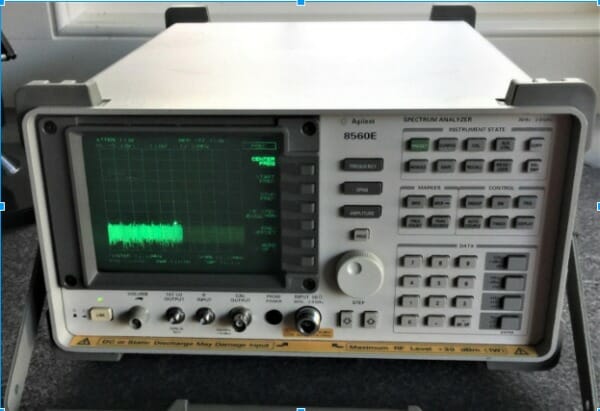
I recently returned to amateur radio after a 50+ year absence, and have been assembling a collection of vintage radio gear, and vintage and more modern test instruments to maintain this gear. While I have a long, strong background in electronics and am familiar with and have used a wide range of test instruments over the years, prior to a few months ago I had never seen a spectrum analyzer and was only vaguely aware of their purpose and functioning. While cruising the classifieds at eHam, QRZ, and QTH a few months ago, I happened to notice an Agilent 8560E spectrum analyzer in working condition for sale at a very low price. After doing a little research online, I emailed the seller with an offer at an even lower price, and he accepted my offer. A few days later, this beast arrived, all 40+ pounds of it. It did not come with a user manual, but I was able to purchase one on eBay and did enough reading to figure out how to fire the SA up and do a preliminary checkout. Sure enough, it worked just like the manual said it should, and was in very good cosmetic condition, with just a few minor battle scars on the case. This instrument listed for about $50,000 in the mid-eighties when it was in production. So, with this acquisition, I thought I was set for life as far as SAs go. Wrong!

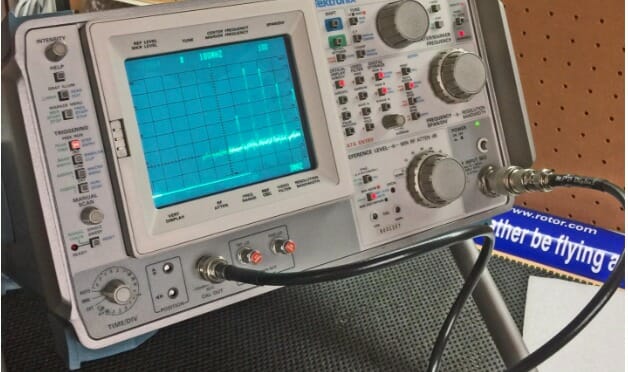
A few months later, I was cruising the classifieds again, looking for some Collins S-line gear and happened across a listing for a Tektronix 495P spectrum analyzer which was described as “works and looks like new,” and, again, at a tiny fraction of the $30,000+ original selling price around 1990. I was skeptical of the “looks new” description, but “new” is good, so I asked the seller to confirm this. He emailed some details of the history of the instrument and more photos, all of which convinced me that he was accurately representing this instrument. The “want” side of my brain quickly overcame the “need” side and I emailed an offer which he accepted. As before, a few days later, this beast arrived in the original Tektronix shipping carton, weighing 70 lbs; this weight included the SA, hard copy user and service manuals, and a few accessories. And it did, indeed, look like new. Turns out some branch of the U.S. government had purchased a bunch of these, sealed them in new, unopened cartons in humidity resistant packaging, and stashed them in a warehouse for years, finally offering them for sale as surplus much later, when the seller I purchased from bought one. And after reviewing the manual and stepping through the initial checkout chapter, I found it did work to spec. Now I was really set for spectrum analyzers! Wrong!
A few weeks later, the guy I bought this one from emailed and told me he had another Tek 495P that “almost works,” and which he had acquired for parts, as the 495P has not been supported by Tek for many years. Then he made me an offer I couldn’t refuse: he would give it to me if I would pay the shipping cost from CA, about $70. How could I possibly say “no”? Here we go again! It took him three months to get around to shipping it, but eventually a 50 lb package arrived. Having seen quite a few “parts” 495s for sale on eBay, I wasn’t expecting much. But, I was pleasantly surprised. While it could not be accurately described as “looks new,” it was quite decent for an instrument manufactured in 1991 (according to the Tek inspection tags inside), and, it worked! Well, … sort of. In stepping through the initial checkout section of the user manual, it displays traces that resemble the illustrations in the manual, however, according to the messages displayed at boot up (this is a microcomputer controlled instrument), it thinks it is a 492AP model SA rather than a 495P. The 49x series of SAs share a common base of microcomputer code, with the specific model type selected by DIP switches on a memory board. There is enough functionality that I decided to try to fix it rather than use it for parts, and I am now launched on that path.
This is an amazingly complex instrument. The two-volume service manual runs some 700+ pages. Fortunately, the problem I am seeing is in the microcomputer controller subsystem, where I am somewhat competent, and not in the analog/RF subsystems, where I am not. This repair effort has travelled an interesting path, along which I have met (online) some helpful and accomplished people and found a number of resources I was not previously aware of. One of these is the [email protected] forum which is mainly focused on keeping vintage Tektronix gear running. This has been a great learning experience and I am confident the fix is close at hand. We’ll see! Still much to learn, however.
My cup runneth over with spectrum analyzers. I’m not sure if there is a 12 step program for SA addiction, but I may need one. I find myself still eagerly looking at for sale listings. I am thinking that I should at least have one of the modern Rigol SAs to balance out my vintage collection. Sure seems rational to me!
Rick, K8EZB