We received some very sad news recently. A long-time member and supporter of the Nashua Area Radio Society and Amateur Radio, Hamilton Stewart, K1HMS, has become a silent key.
I first met Hamilton at a NARS exam session where he earned his Extra Class license, by passing the Technician, General, and Extra exams all in one session. He became active with NARS and began contributing almost immediately. Hamilton made many contributions to NARS.
Hamilton served as an instructor for our license classes and presented some of the most difficult topics in a way students could understand. He was famous for his Yagi antenna demos, which will be missed at our license classes.
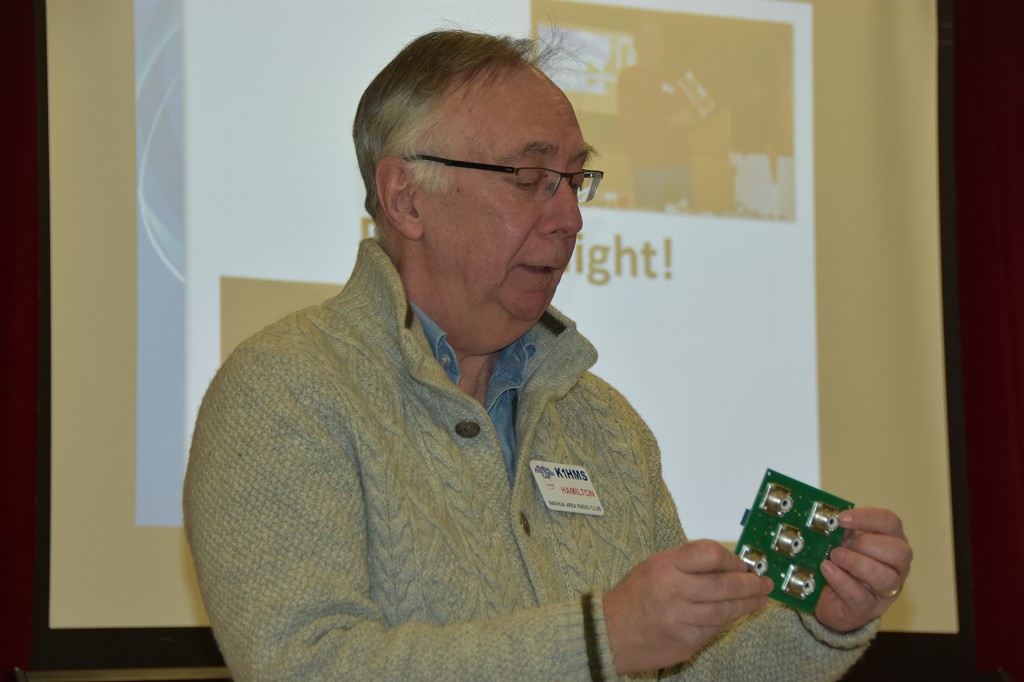
Hamilton explaining a design of his at Project Night
Hamilton was an engineer’s engineer – one of the best that I have had the pleasure to know. He would always take the time to patiently explain the most difficult ideas in simple terms, helping them master technical concepts. When members need help repairing a radio or another piece of gear, Hamilton helps them get back on the air. His workshop was impressive, and he really knew how to use his gear.
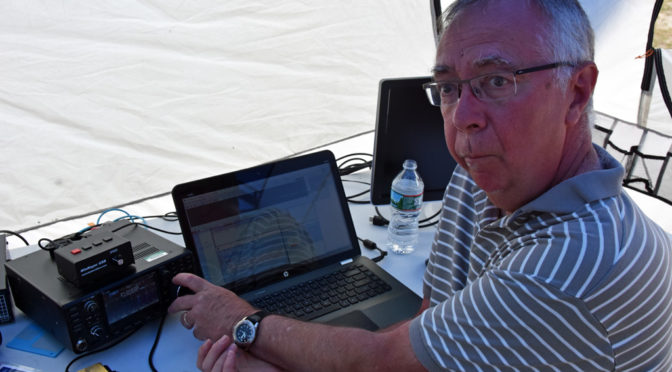
Hamilton, K1HMS Testing CW Stations
Hamilton loved Field Day and served as co-chairman. He was always there to help us build our stations and to operate them. We would find a way to pitch in and help with whatever the team needed to succeed at Field Day. He was always team-focused.
Hamilton was also a past Treasurer of NARS, and served on our non-profit incorporation/501(c)(3) committee
Hamilton loved to mentor and wrote many articles on our website to help newer folks learn about Amateur Radio station building, operating, and electronics. You can find his contributions in this area here.
It was a privilege to have known Hamilton. I have the highest respect for him as a person. Even when he was very sick and fighting to regain his health, he found time to continue contributing to NARS’ educational work and to share his knowledge and mentor others. I will miss him very much.
The Nashua Area Radio Society (N1FD) successfully completed Winter Field Day 2026, operating on January 24–25 under some of the harshest winter conditions we’ve experienced in recent years. Bitter cold persisted throughout the weekend, followed by a snowstorm on Sunday afternoon, yet the club achieved all planned multipliers and delivered a strong overall result.
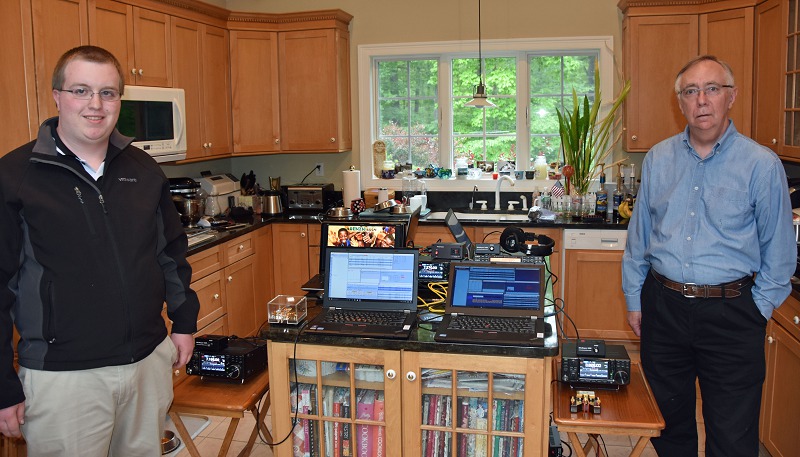
N1FD operated as Class 2H, with all stations located indoors at the QTH of Fred Kemmerer, AB1OC, and Anita Kemmerer, AB1QB. Antennas were deployed outdoors, allowing operators to remain warm, safe, and focused while fully meeting the operating and technical challenges of Winter Field Day.
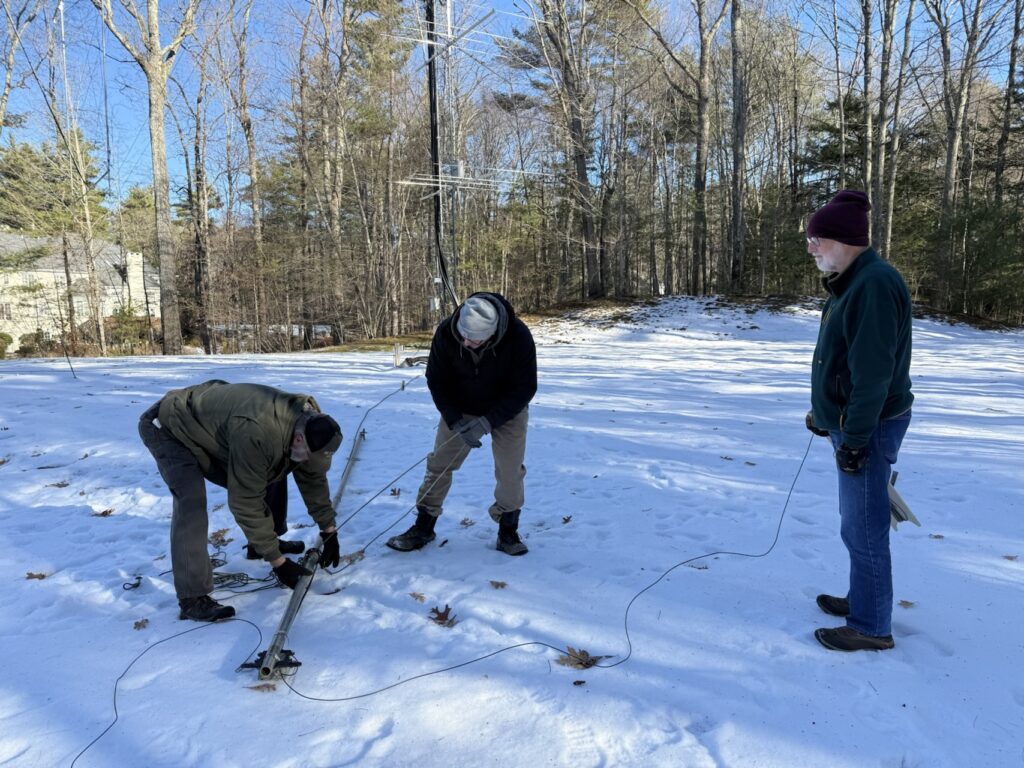
N1FD Team Putting Up the Wire Antennas in the Prep Session on 12/20
Preparation Made the Difference
Winter Field Day success was the result of careful planning and coordination in the weeks leading up to the event. The club focused on targeting specific band and mode multipliers, ensuring coverage across HF, VHF, and UHF, coordinating operator schedules and operating strategies, and verifying station readiness and antenna performance.
That preparation paid off, allowing N1FD to methodically work bands and modes and complete every planned multiplier without last-minute pressure.
QSO and Band Results
During the weekend, N1FD logged:
Band
Mode
QSOs
Pts
160 m
CW
55
110
80 m
LSB
20
20
40 m
LSB
81
81
20 m
PSK31
1
2
20 m
USB
445
445
15 m
USB
337
337
10 m
USB
81
81
6 m
USB
3
3
2 m
FM
3
3
1.2 m
FM
3
3
70 cm
FM
3
3
33 cm
FM
3
3
23 cm
FM
3
3
Total
All
1038
1094
1,038 total QSOs
1,094 total QSO points
28 total multipliers
Based on these results, N1FD’s estimated final score was:
1,094 QSO points × 28 multipliers = 31,726 points
The strongest activity came from 20 meters (USB) and 15 meters (USB), with solid participation across 40 meters, 80 meters (CW), digital modes, and successful contacts on VHF and UHF, all of which were critical to completing the multiplier plan.
Multipliers Achieved
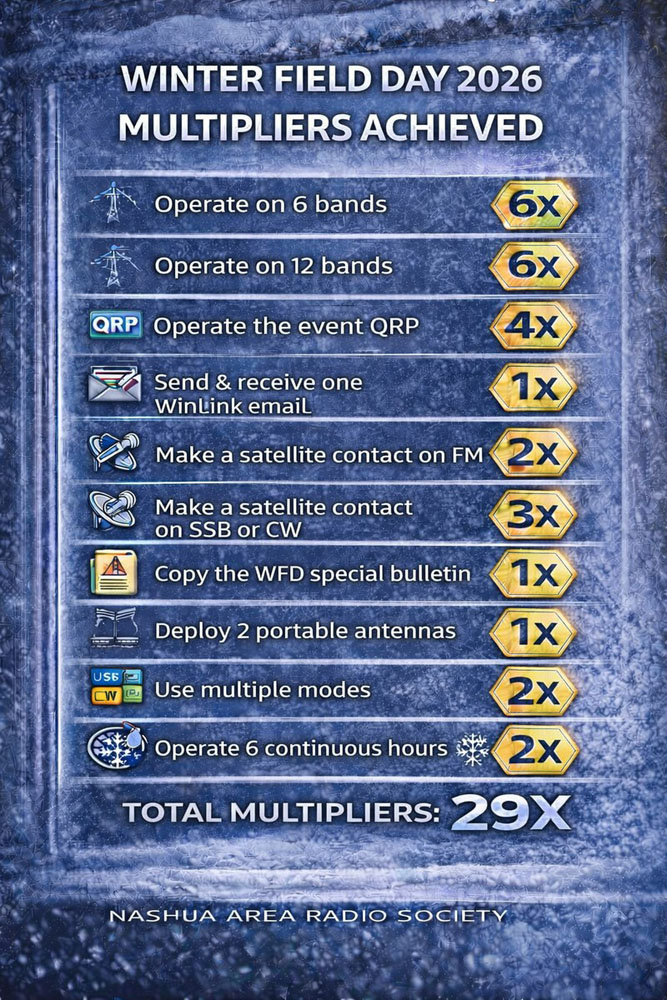
A major objective for Winter Field Day 2026 was to intentionally pursue as many multipliers as possible through planning and disciplined operating. N1FD successfully completed every multiplier we set out to achieve, resulting in a total multiplier of 29X, including the 1X multiplier added for participation.
The following multipliers were earned during the event.
N1FD Multipliers Achieved
Completing the full multiplier set was a direct result of advance planning, operator coordination, and flexibility throughout the weekend.
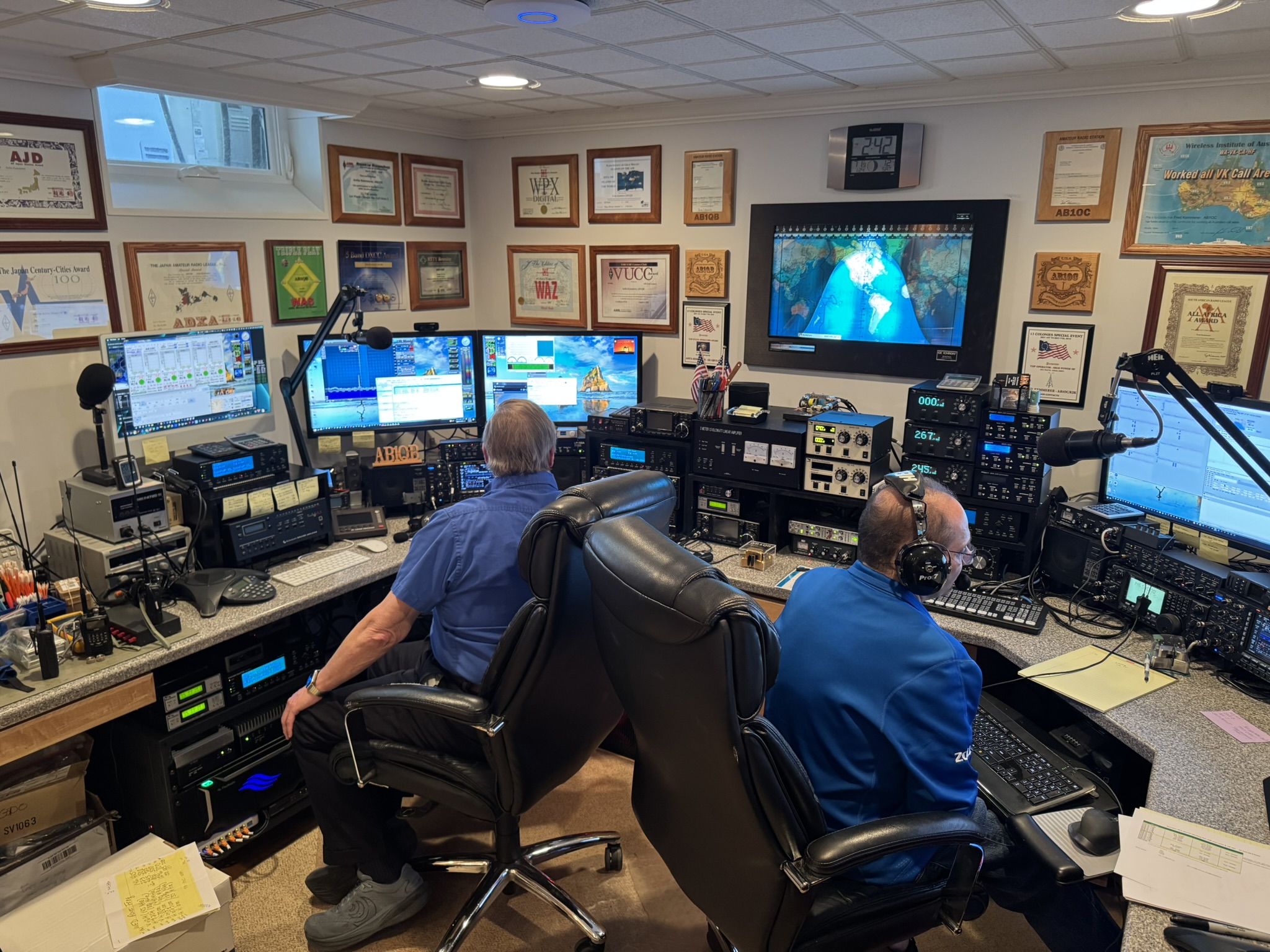
Fred AB1OC Working on Multipliers while Anthony KC1DXL Operates SSB
Operators on the Air
The following members operated under the N1FD callsign during Winter Field Day:
Their rover operations added an important mobile element to N1FD’s Winter Field Day effort.
Special Thanks
Special thanks go to Joe Luszcz, AC1LN, and Brian Quick, W1XMM, who installed the wire antennas on Friday, January 23rd, working outdoors in very cold weather to ensure the stations were fully operational before the event began.
Additional recognition goes to Fred Kemmerer, AB1OC, who spent many long hours preparing the station, testing equipment, and resolving technical details ahead of Winter Field Day. His dedication was critical to the smooth operation and success of the weekend.
We would also like to thank Brian Quick, W1XMM, for his leadership in planning and coordinating Winter Field Day 2026 in his role as Field Day Chairman. His organization and preparation were instrumental in helping the club meet its operating and multiplier goals.
Special thanks to Dave Cherkus, N1AI, for operating 160-meter CW, helping N1FD make effective use of the low bands during challenging winter conditions.
Thank you to Dave Berardinelli, K1BER, for leading and coordinating the VHF Rover effort, which played an important role in expanding our band coverage and multiplier success.
Finally, thank you to all of the operators who participated throughout the weekend. Your time, flexibility, and teamwork made this Winter Field Day a success.
A Successful Winter Operation
Winter Field Day 2026 once again demonstrated what N1FD does best: strong planning, teamwork, and adaptability, even under challenging winter conditions. Operating indoors allowed the club to stay safe and effective while still delivering excellent on-air results.
Thank you to everyone who planned, set up, operated, and supported this effort. We look forward to building on this success for future Field Days and operating events.
It’s that time again, and Winter Field Day will be here before you know it. Planning is well underway. Once again, Fred and Anita have opened their home and shack for Winter Field Day operation, and we will be operating QRP (10 Watts or less), which is a score multiplier. This year a new multiplier category was added to operate on an additional six (6) bands to make it a total of twelve (12) bands.
This past weekend, Fred, AB1OC, and I tested six additional bands with overwhelming success from his QTH to a mobile location I operated, acting as the roving team. They say sharing is caring, so I thought I would write a blog about how we got here and the tools that helped along the way.
Winter Field Day Rules
All the rules are available here; the three specific ones to note are as follows.
Bands: All Amateur bands may be used except 12, 17, 30, and 60 meters. To qualify as a band worked, at least one valid, two-way QSO must have taken place on the said band during the event.
Make three contacts on at least six (6) different bands: Conditions may change throughout an event. Log operations on at least six different bands by making a minimum of three contacts per band. You should be able to accomplish this objective by utilizing HF, VHF, and UHF frequencies. Don’t forget about 1.25 meters (220)! It’s an excellent band for local emergencies. OM x6
Make three contacts on at least twelve (12) different bands: Was six too easy? You may have to pull out your microwave equipment to achieve this one. Log operations on at least twelve different bands by making a minimum of three contacts per band. The six bands from the previous objective count toward this one. OM x6
The first 6 bands are the typical contesting bands: 10m, 15m, 20m, 40m, 80m, 160m. No problem for the AB1OC shack. The other 6 bands will be 6M, 2M, 1.25M, 70CM, 33cm, and 23cm. Here are the challenges.
1) We can’t use a repeater. Simplex only.
2) Since it is VHF and UHF, we need a decent Line of Sight (LOS) with little or no trees to cause interference.
3) We are running QRP, so distance is a factor.
4) We need equipment for the 33cm and 23cm bands.
5) We need at least three contacts.
VHF/UHF Roving
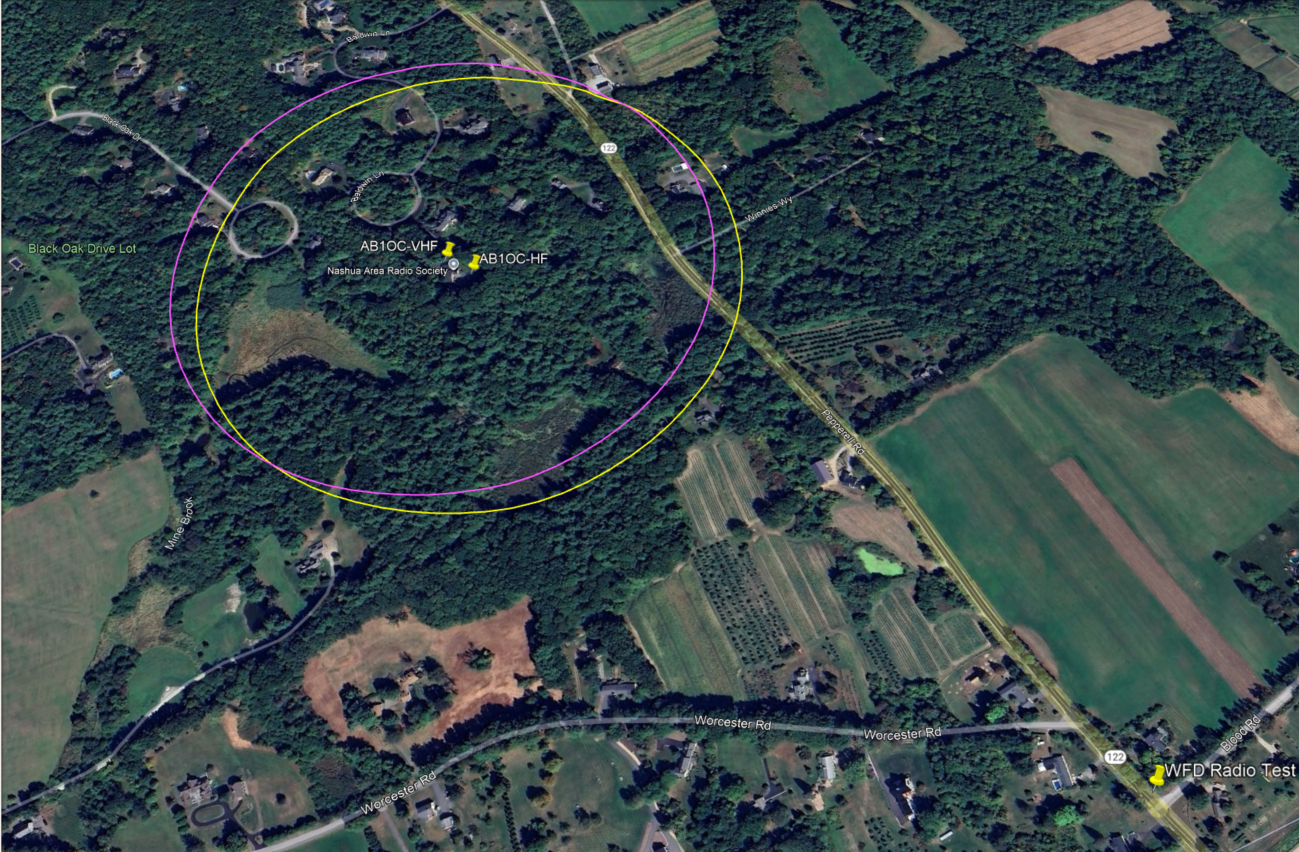
As part of the planning and to address these problems, we decided to send a Roving team to serve as the club’s three contacts. Rules dictate that contacts must be outside a 1000 ft circle from the Field Day base of operation. I started by using Google Earth Pro, setting the coordinates for AB1OC QTH and using the circle ruler to determine our 1000-foot perimeter. The two circles represent the VFH and HF Towers’ location.
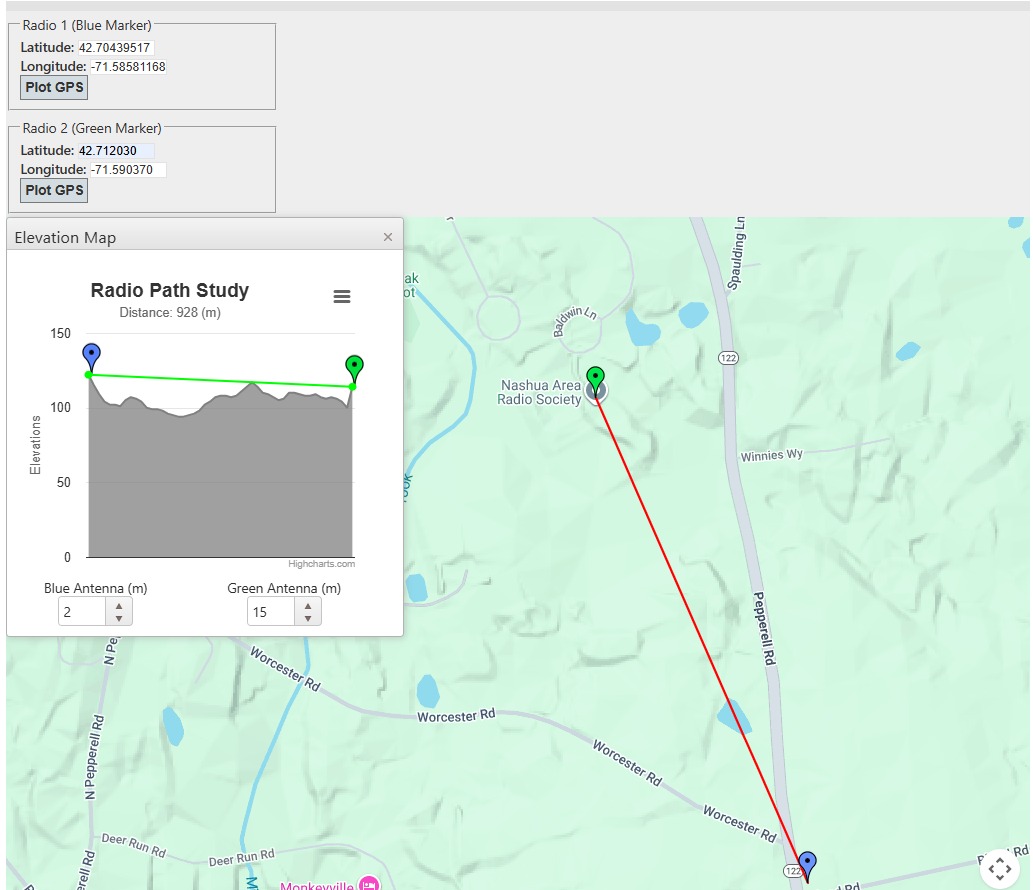
Based on the knowledge of the surrounding area, we chose the location southeast of the intersection of RT 122 and Blood Road.
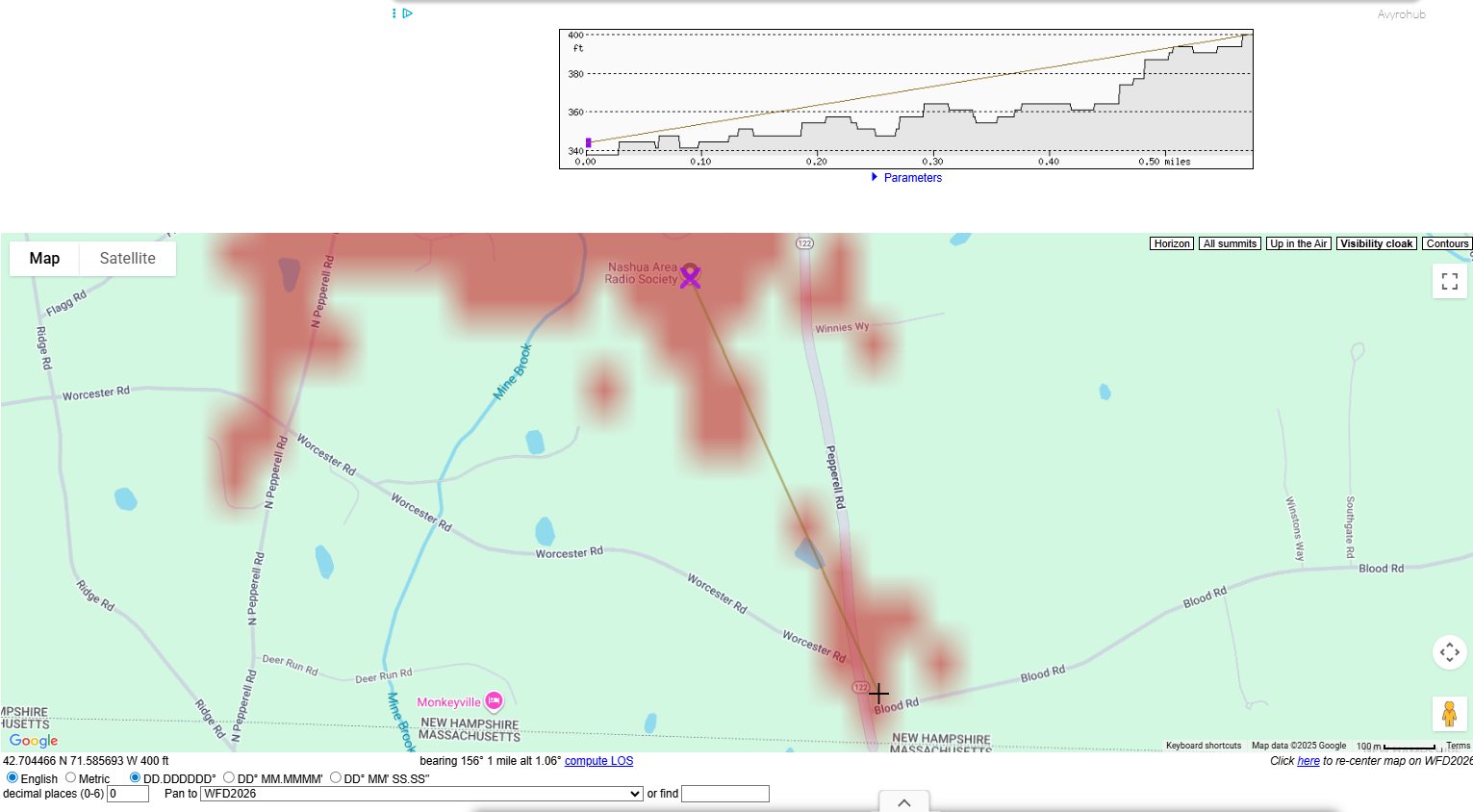
Then we used the HeyWhatsThat website to generate ideas for where we could get a signal based on the topology.
And the Scadacore LOS website to confirm the topology.
Both are very simple to use.
We looked at a few other locations, but tested this site first and had great success, so we called it a win for Winter Field Day.
Another interesting tool is Radio Mobile. This software is a popular, free radio propagation simulation software for planning wireless networks (especially for amateur radio).
They offer both web and download versions. The download version has more features and is worth a peek. This YouTube video is a great tutorial that walks you through installing your first propagation map. Could be a Tech Night session!
I started loading all the variables, but since our field test was successful, I didn’t complete the simulation.
Rover Radios and Antennas
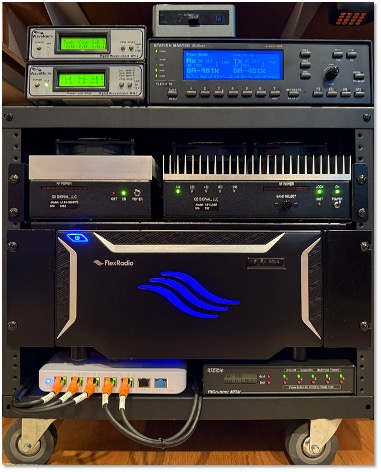
For equipment, Fred’s SDR can handle all the required bands, and his antennas are up to the task.
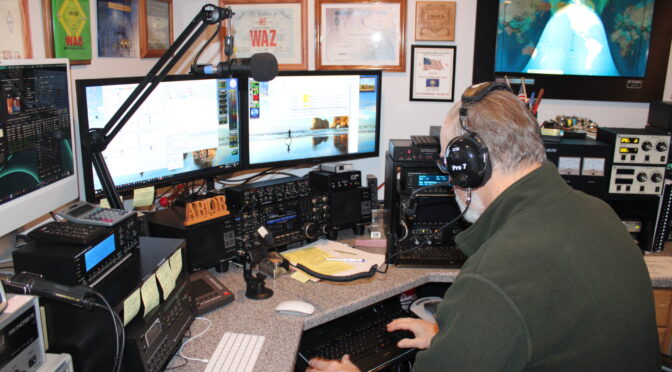
15 Band SDR Remote Gateway at AB1OC
Here is what we are working with for antennas at the base station:
6m Loop Yagi (14.1 dBi)
1.25m Yagi (11.9 dBi)
2m Circularly Polarized Yagi (14.4 dBic)
70cm Circularly Polarized Yagi (18.9 dBic)
33cm Yagi (15.2 dBi)
23cm Yagi (17 dBi)
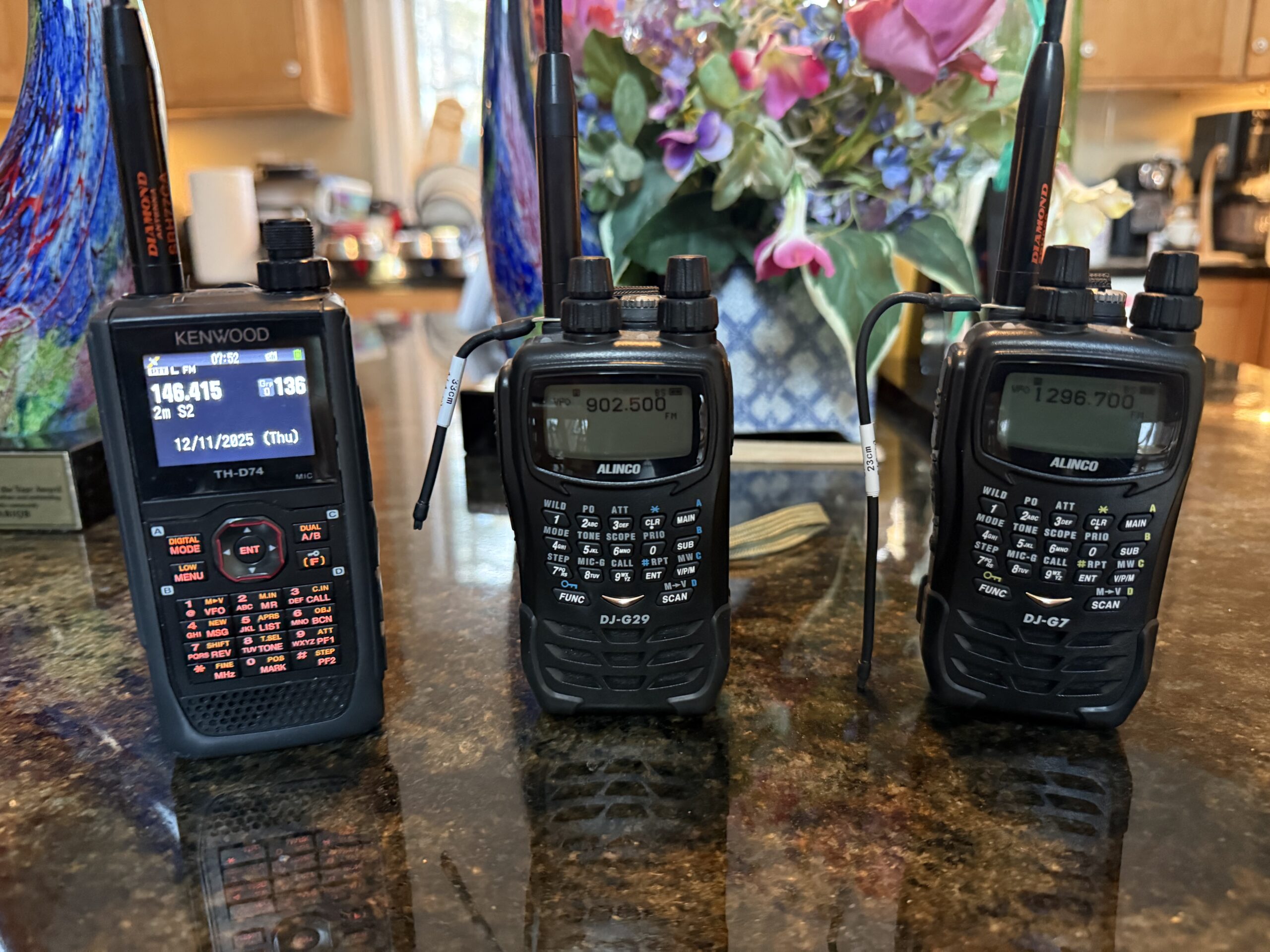
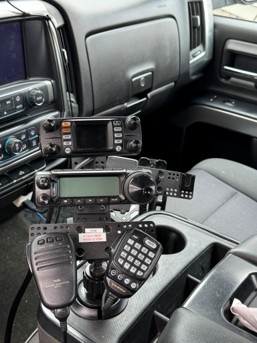
Even at the QRP level, the gain and ability to point the antennas helped overcome distance issues. For the roving team location, I used a 33 cm Alinco HT with a short radial, a 23 cm Alinco HT also with a short radial, a Kenwood HT for 2M, 70cm, and 1.25m from Fred’s stash—finally, a Yaesu 891 with ATAS 120 Antenna for 6M as part of my mobile rig.
K1BER Mobile StationHTs Covering 2m – 23cm
Specifically, we tested the following:
2M 146.415 MHz Vertically Polarized
1.25M 223.500 MHz Horizontally Polarized
70CM 445.925 MHz Vertically Polarized
33cm 902.500 MHz Horizontally Polarized
23cm 1296.700 MHz Horizontally Polarized.
6M 50.150 MHz SSB Horizontally Polarized
As we cycled through the bands and our QSO, the signal reports were between 57 and 59 at both ends. Our 5 challenges were easily overcome.
With a month to go before Winter Field Day, we are ready and excited to have fun, learn, and earn points. We are still looking for volunteer rovers, which is an excellent opportunity for Techs. Don’t worry if you’re new; you will have help. If you are interested in participating in any part of Winter Field Day or in planning, please contact usor join the planning meeting.