Category Archives: General

Articles about Amateur Radio and the Nashua Area Radio Society. This is a general category which includes most articles on our website.

Configuring Emails from Our Forums

We have recently added some new features related to our Forums and some members may be getting more emails from the website.  Here is some information on how you can control the emails that you receive that result from Forum Posts.

There are two types of emails associated with forum posts – Individual Emails are sent with each post or reply.  Digests, are sent periodically and contain all forum posts and replies since the last Digest that was sent.

By default, new Members and Internet Subscribers are setup to be subscribed to all forums.  If you are subscribed to a forum, you will receive an email for each new post or reply.

Limiting Individual Forum Emails

You can change which individual emails that you have signed up for by logging into the website and following the steps below.  You can also change the frequency that you receive digests.
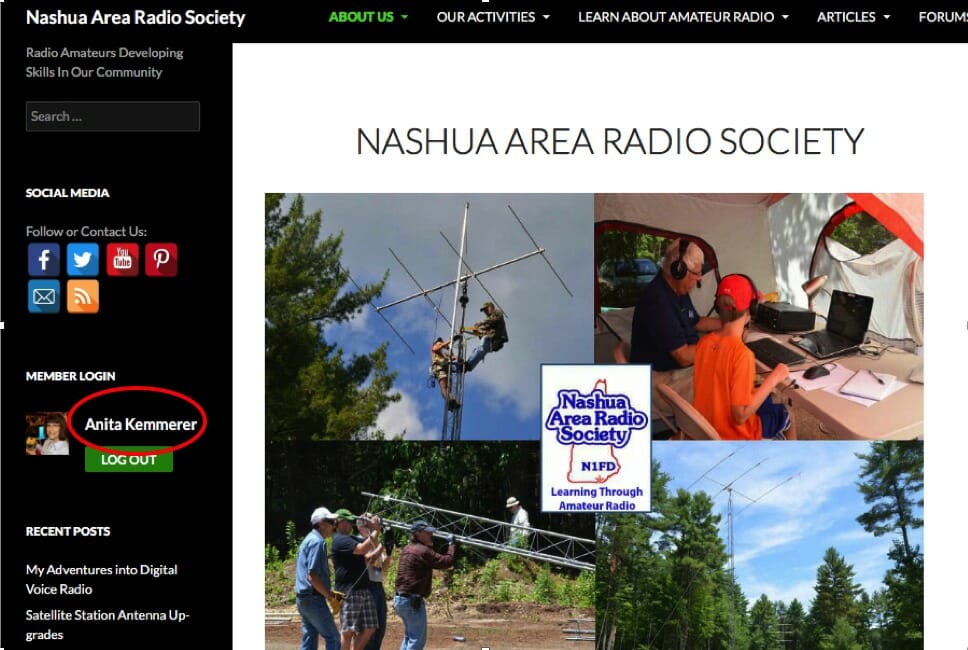
Click on your name where you login
Click on your name where you log in to bring up your Profile
  1. Click on your name on the left-hand side of the page under MEMBER LOGIN.  That will bring up your Profile Page.

    Click on Subscriptions on the left side of your profile page
    Click on Subscriptions on the left side of your profile page
  2. On the left side of your profile page, just below the Avatar or Picture, click on “Subscriptions”

    Unsubscribe from individual forum emails
    Unsubscribe from individual forum emails
  3. If you do not want to receive emails for every new post in a forum, you can click on the pink box with the X in it next to the Forum name to unsubscribe from that forum. We recommend you do not unsubscribe from the General Information Forum as that is where we send information about our meetings and events and those may be time-critical.  We also recommend that members do not unsubscribe from the Members Forum for the same reason.

    Edit your digest settings
    Edit your digest settings
  4. Digests are enabled by default to go out Daily and will include a summary with links to the day’s posts for our Forums.  To change the digest frequency, click on “Edit” just below where you clicked on “Subscriptions”.  Under Forum Digest Preferences, you can change the Digest Frequency from Daily to Weekly or Monthly.  When you are done, you should scroll to the bottom and click on the green rectangle that says “Update Profile”.

    Re-subscribe to individual forum post emails
    Re-subscribe to individual forum post emails
  5. If you want to re-subscribe to a forum that you deleted, start by going to the Forums Menu (On the black bar where you see About Us, Our Activities, etc.). Select Forums and then select the forum that you want to re-subscribe to from the drop-down that appears.   This will bring up the Forum page for that forum.  Just below the Green Rectangle that says “Mark All Topics” you will see a link that says “Subscribe”.  You can click on the word Subscribe to re-subscribe to the forum.  You will see the word “Subscribe” change to “Unsubscribe”.

Help and Suggestions Forum

If you are a new member and have questions about how to use the website, we recommend looking at the articles in the Help and Suggestions Forum to get answers to your questions.

73,

Anita, AB1QB
 

My Adventures into Digital Voice Radio

This article on Digital Voice Radio is intended for those new to ham radio but I hope that all who read these passages will enjoy and learn.

At a recent Nashua Area Radio Society club meeting on Zoom, there was a fascinating talk about Digital Voice Radio – including the mediums known as DMR, D-Star, and Fusion (C4FM) radio, given by Brian Gudzevich, WO1VES.

During that hour, I heard more buzz words, terms, and phrases that I could count. It took me the following week just to look-up everything. But what I heard was quite something, a  way to contact people all over the world with the clarity of digital audio.

What intrigued me even more, is that a new ham –  someone just getting their Technician License – can get involved with this kind of technology rather easily and for not much money.

I remember what it was like for me, just two years ago, getting my first license and having only a Baofeng HT and making some of my first QSOs to the remote corners of New Hampshire and Vermont. Boy, did I feel hot stuff back then! I also tried EchoLink in the beginning and made some other interesting QSOs to the West Coast and parts of the UK. That was great, too!

But, from what I heard, the digital voice radio formats are like EchoLink on steroids. I wanted to give it a try.

Asking around, I heard that DMR – even with its various downfalls – might be a place to start. I found a Baofeng DM-5R Plus being sold for $ 55. This was an awkward radio to play with, but after time, it finally got it to work.

I was able to reach the local repeater in Hudson – K1MOT – and was able to hear a few voices while tuned in to the system with some success.

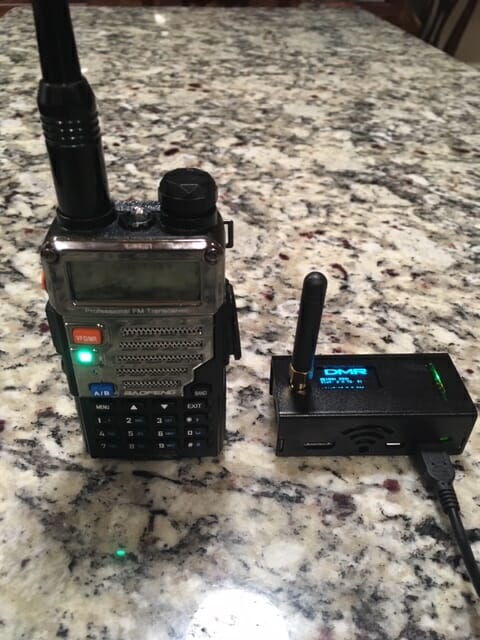
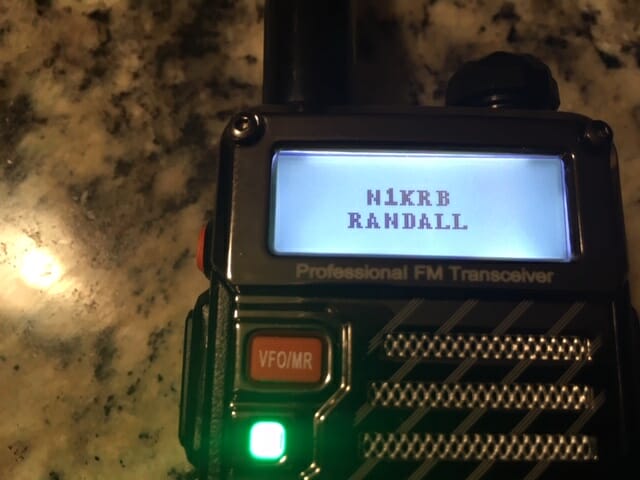
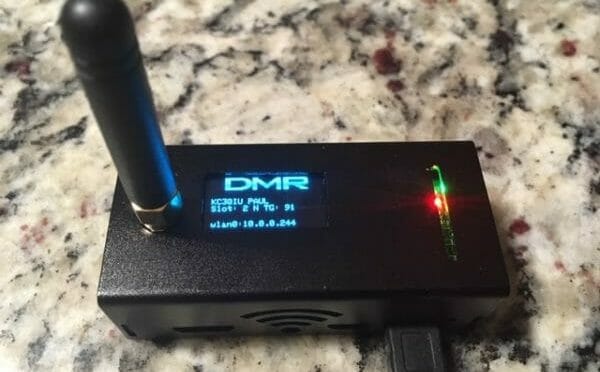
However, the best way to connect to digital radio and to the outside world is with something called a hotspot – a device that talks to the radio at one end and connects to the internet at the other. The hotspot I choose is what is known as a Jumbo, running Pi-Star.

Digital Voice Radio
DMR Hotspot

The basics of a DMR radio is that it is centered around the commercial radio technology, first developed by Motorola, which digitizes the audio and then divides that audio into packets. Those packets are sent and received over VHF and UHF bands.

To help make things work, each radio is required to have a ‘radio ID’, now issued by RadioID.Net. And for one radio to talk to another, the most common way to do this is to connect through something called a “talk group” which is like a virtual telephone party line. Anyone on the talk group can talk to another when they’re on the radio at the same time. Each talk group also needs its own ID number.

What also is required is that each radio needs to be programmed with something called a “code plug”. This is similar to the Chirp program used on HTs.  However, the code plugs on DMR are more like a matrix of data, setting up channels, contacts, talk groups, frequencies and so much more. It can be quite involved with trying to make sure all the information is imported into the right space. It is quite possible to screw things up … which I know first hand.

Using the repeaters, as mentioned, are rather limited as they only handle a small number of talk groups. The common complaint with the repeater is that it is hardly worthwhile because too few people are using them. However, a hotspot, with internet access at home,  in a car, or from a cell phone, can give you unlimited possibilities for chatting with others all over the world.

The first morning I got on the air, I overheard a fellow in Florida talking with someone in England. And then, I got on the air to talk with someone in Ohio and then Illinois, all with the clarity of digital signals. No QRN could be heard. It was quite something.

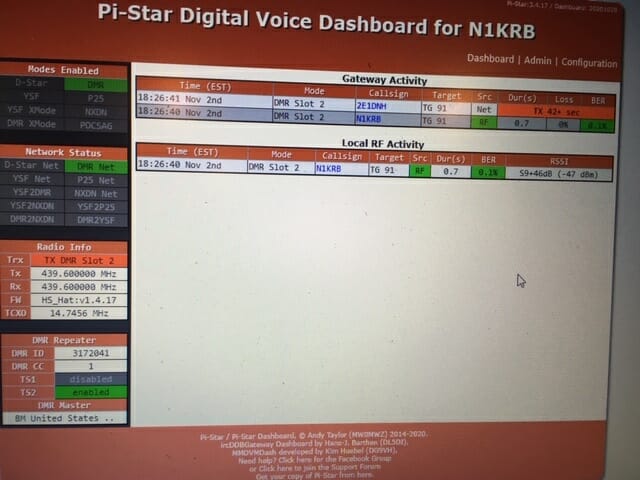
The one other thing I found interesting with DMR – with the Pi-Star hotspot –  I could log onto its ‘Dashboard’ and get an instant read-out of who else is on the talk group. Can you do that on HF? Maybe someday – maybe!

Digital Voice Radio
Hotspot Configuration Screen

And like I said, the whole experiment of trial and error cost less than $125 for the radio and the hotspot. Not great quality stuff but it worked and I was able to get a taste of this technology.

It is dizzying with the number of things available to anyone in ham radio – even for the new ham – and digital voice is just another exciting aspect of this ‘hobby’.

I would be interested in your experience with DMR. And who knows, I may try one of the other digital voice radio formats soon. Stay tuned!

73 Randall, N1KRB

EME Station 2.0 Part 13 – H-Frame Enhancements

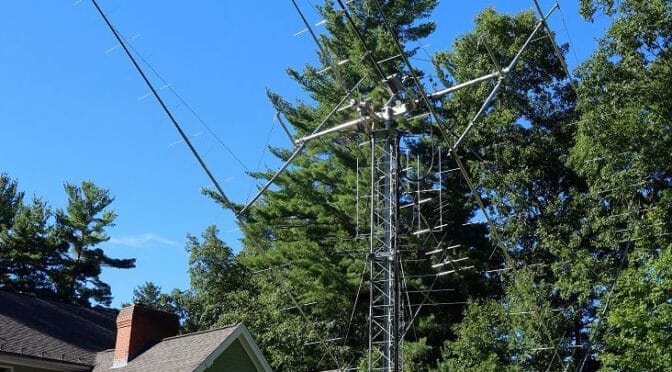
Our new 2m EME Antenna System has been performing very well. One area that we noticed that could use improvement was the alignment of our antennas as we move them in the Elevation plane. We’ve added some custom enhancements to our EME H-Frame to address this problem…

Source: EME Station 2.0 Part 13 – H-Frame Enhancements

EME H-Frame – The Problem

Any antenna system that involves large, multiple yagi antennas is bound to need some tweaking to work at its peak potential and to be mechanically reliable. Our recently constructed EME antenna system is no exception. We added some elements to properly balance our EME H-Frame assembly when we put it up.

We found that the antenna tended to change their alignment when we rotated them in the elevation plane. A solution to reduce some of the stress on the fiberglass components in our H-frame was also needed.

The Solution

Custom EME H-Frame Truss Enhancements
Custom H-Frame Truss Enhancements

The solution to these problems was a Custom Truss System that we worked with Matt at XX-Towers and Robert at M2 Antenna Systems to create. We built the new Trusses using non-conductive Phillystran cable and Turnbuckles. The parts were carefully arranged to keep all of the metal components that were added at the center of our antenna array to prevent any impact on the system’s antenna patterns.

We had a 50-foot Boom lift at our QTH recently to enable some upgrades to our Satellite Antennas. We made good use of it to install our EME H-Frame enhancements as well.

This part of our EME Project is a good example solution for some of the typical mechanical problems one encounters when building a large antenna system.

You can see and read more about what we did via the link above.

Fred, AB1OC

Radio Amateurs Developing Skills Worldwide