Category Archives: Antennas

Articles about Antennas, Feedlines, Towers and related equipment. Fixed, Portable and Mobile Antenna Articles are included.

Winter Field Day 2026 6 Band Multiplier Prep

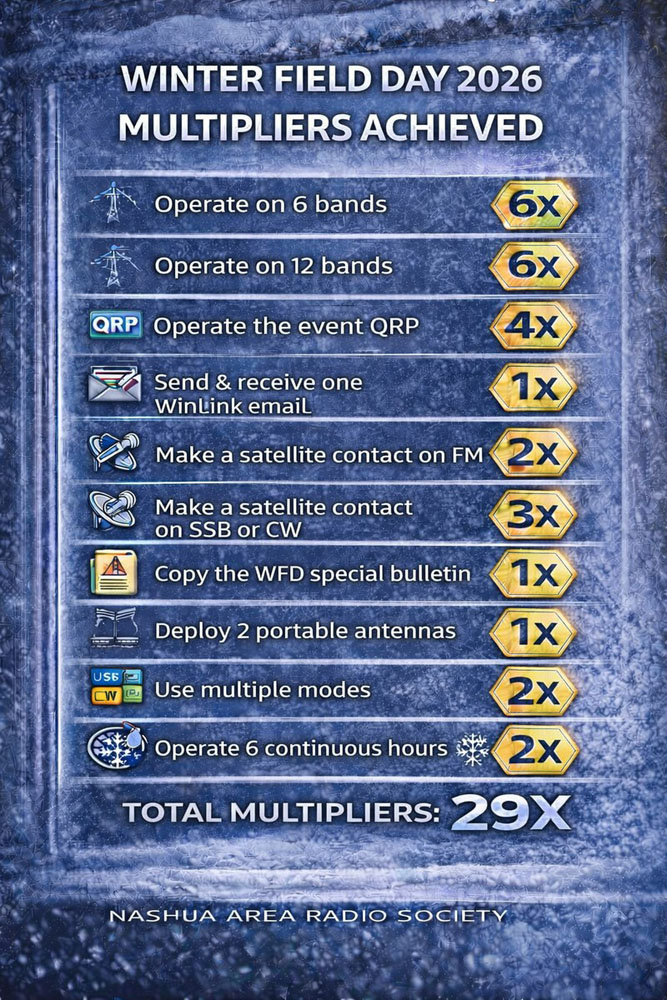
It’s that time again, and Winter Field Day will be here before you know it.   Planning is well underway.  Once again, Fred and Anita have opened their home and shack for Winter Field Day operation, and we will be operating QRP (10 Watts or less), which is a score multiplier.   This year a new multiplier category was added to operate on an additional six (6) bands to make it a total of twelve (12) bands.

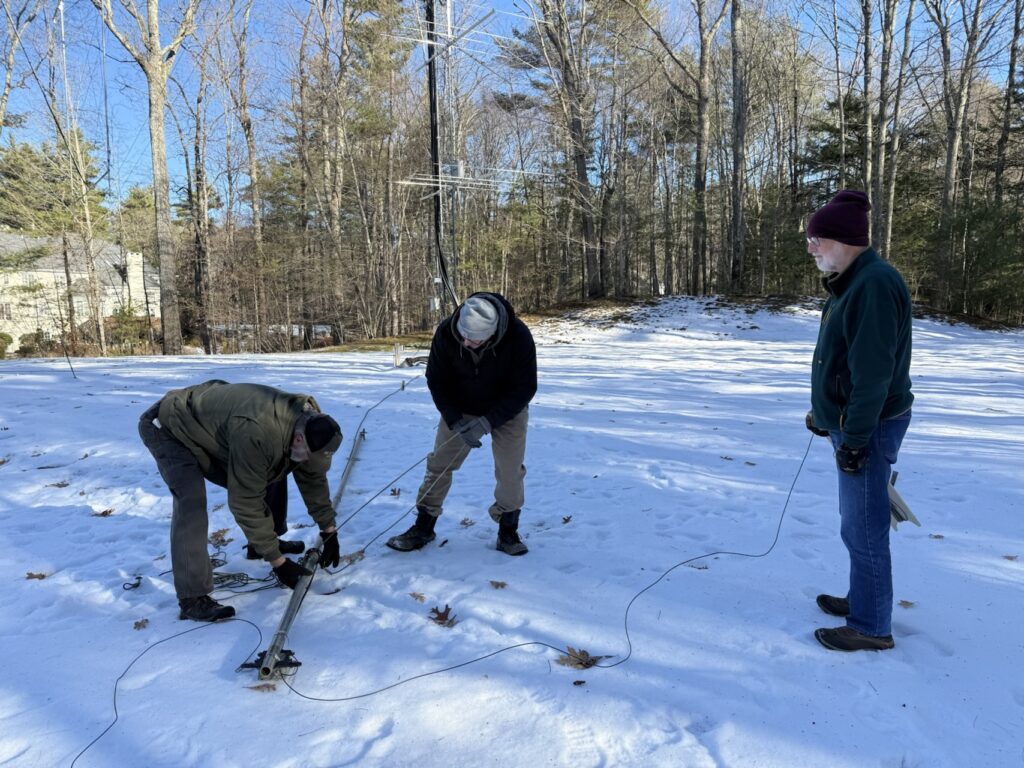
This past weekend, Fred, AB1OC, and I tested six additional bands with overwhelming success from his QTH to a mobile location I operated, acting as the roving team.   They say sharing is caring, so I thought I would write a blog about how we got here and the tools that helped along the way.

Winter Field Day Rules

All the rules are available here; the three specific ones to note are as follows.

Bands: All Amateur bands may be used except 12, 17, 30, and 60 meters. To qualify as a band worked, at least one valid, two-way QSO must have taken place on the said band during the event.

Make three contacts on at least six (6) different bands: Conditions may change throughout an event. Log operations on at least six different bands by making a minimum of three contacts per band. You should be able to accomplish this objective by utilizing HF, VHF, and UHF frequencies. Don’t forget about 1.25 meters (220)!  It’s an excellent band for local emergencies. OM x6

Make three contacts on at least twelve (12) different bands: Was six too easy?  You may have to pull out your microwave equipment to achieve this one. Log operations on at least twelve different bands by making a minimum of three contacts per band. The six bands from the previous objective count toward this one. OM x6

The first 6 bands are the typical contesting bands: 10m, 15m, 20m, 40m, 80m, 160m.   No problem for the AB1OC shack.   The other 6 bands will be 6M, 2M, 1.25M, 70CM, 33cm, and 23cm. Here are the challenges.

1) We can’t use a repeater.  Simplex only.
2) Since it is VHF and UHF, we need a decent Line of Sight (LOS) with little or no trees to cause interference.
3) We are running QRP, so distance is a factor.
4) We need equipment for the 33cm and 23cm bands.
5) We need at least three contacts.

VHF/UHF Roving

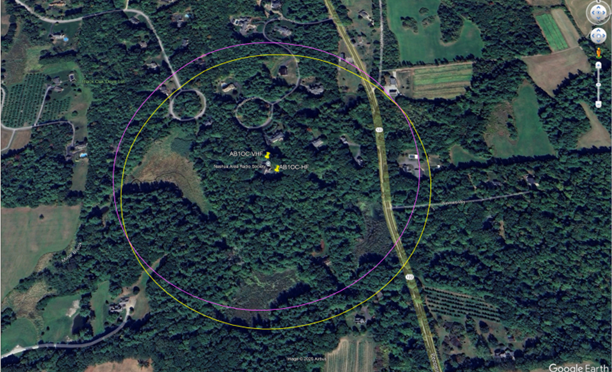
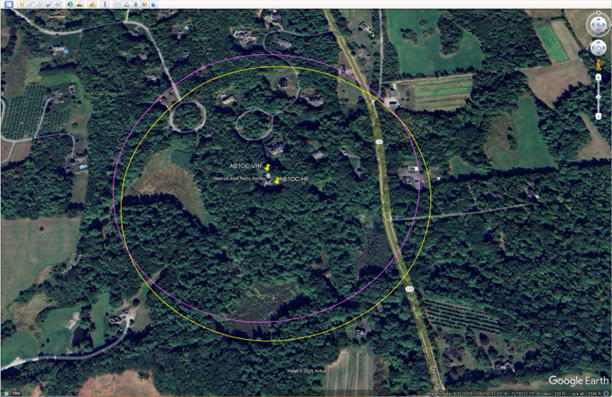
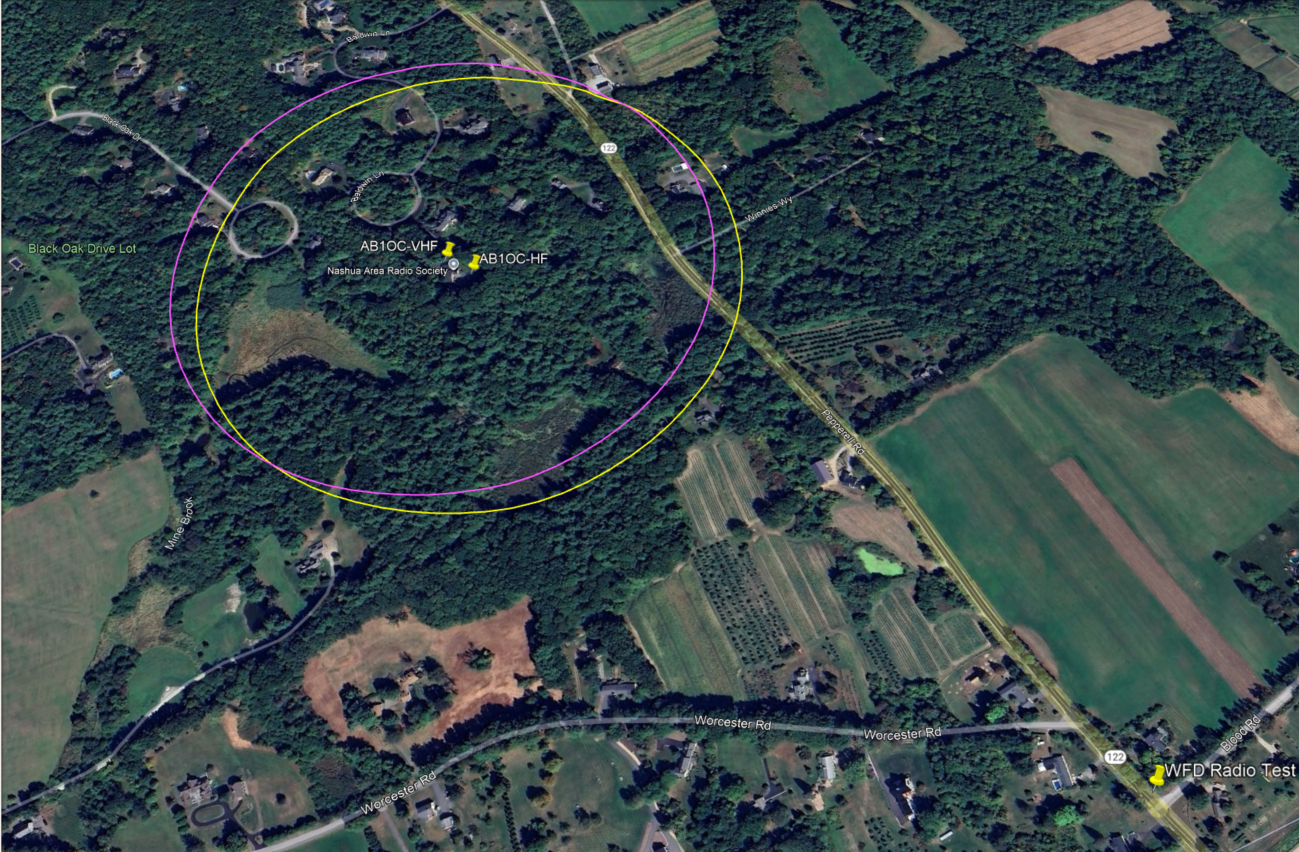
As part of the planning and to address these problems, we decided to send a Roving team to serve as the club’s three contacts.  Rules dictate that contacts must be outside a 1000 ft circle from the Field Day base of operation.    I started by using Google Earth Pro, setting the coordinates for AB1OC QTH and using the circle ruler to determine our 1000-foot perimeter.  The two circles represent the VFH and HF Towers’ location.

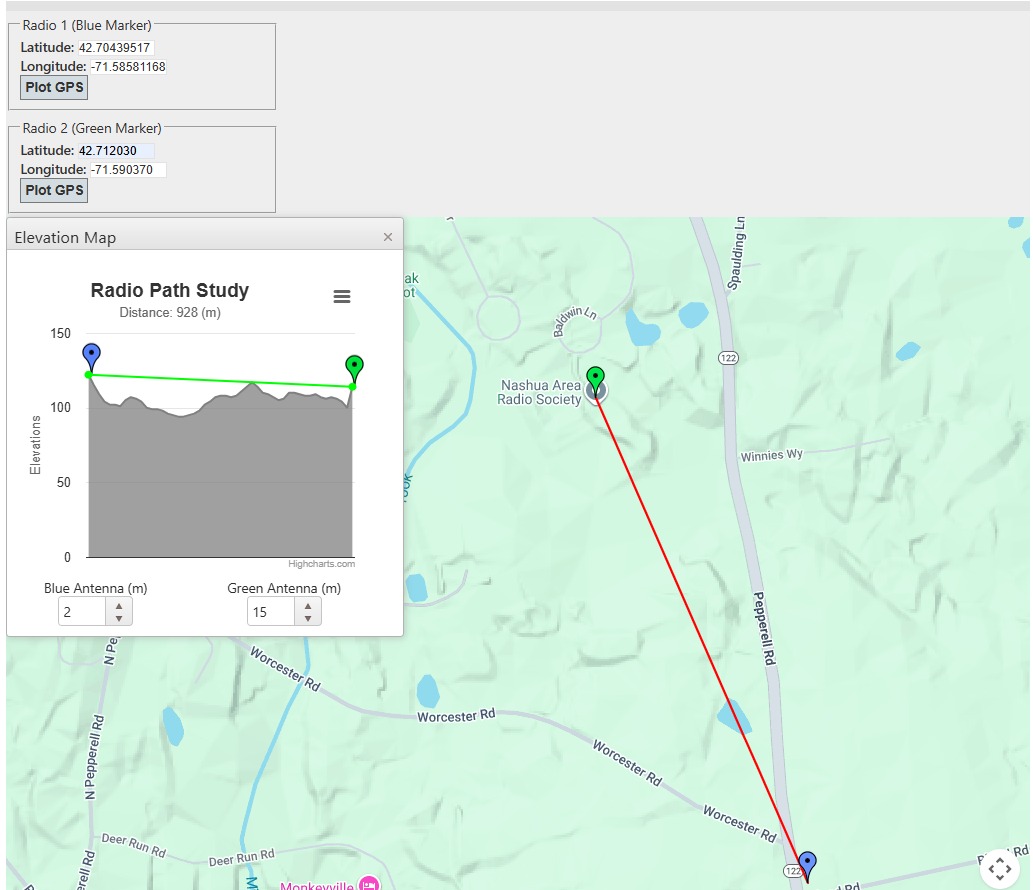
Based on the knowledge of the surrounding area, we chose the location southeast of the intersection of RT 122 and Blood Road.

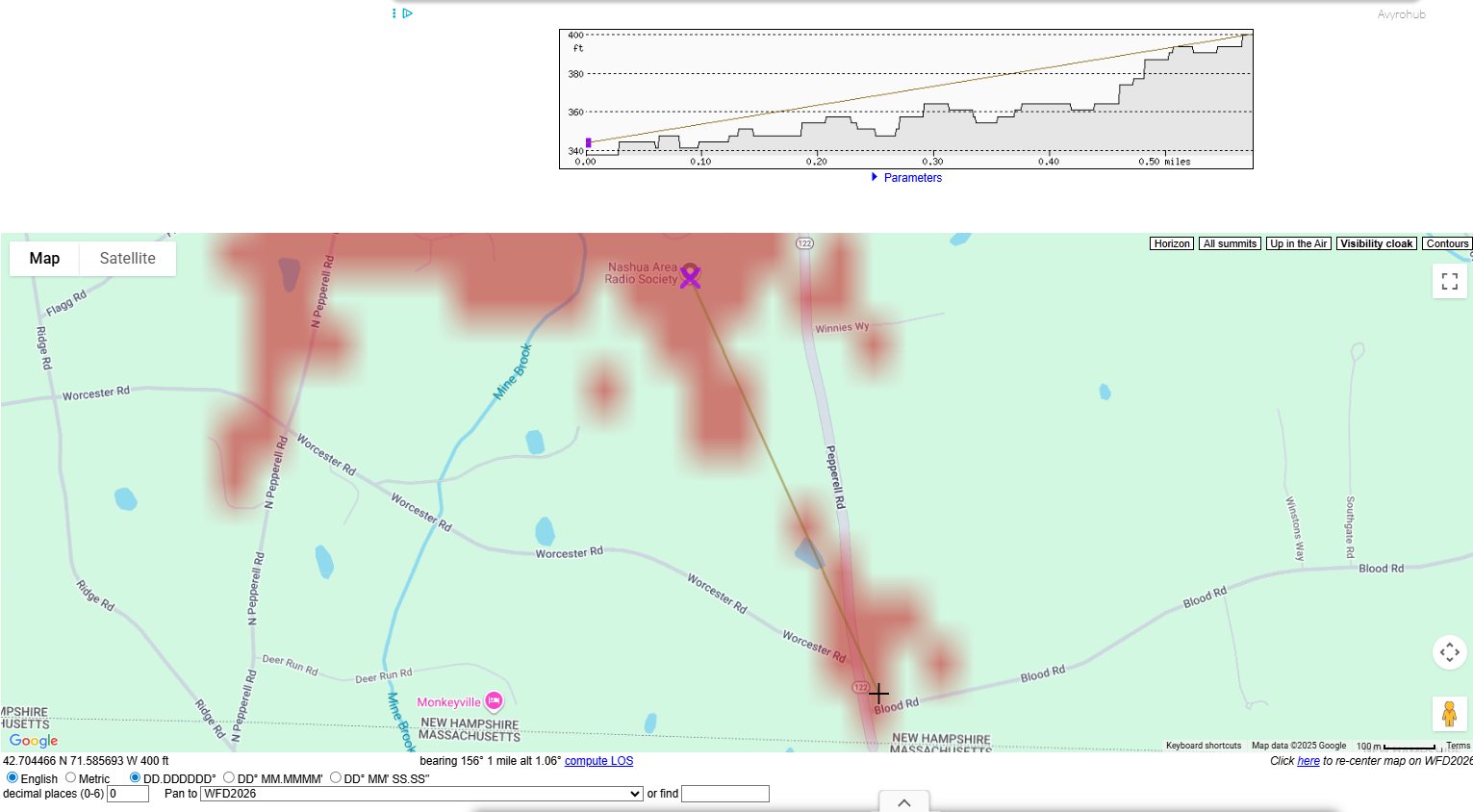
Then we used the HeyWhatsThat website to generate ideas for where we could get a signal based on the topology.

And the Scadacore LOS website to confirm the topology.

Both are very simple to use.

We looked at a few other locations, but tested this site first and had great success, so we called it a win for Winter Field Day.

Another interesting tool is Radio Mobile. This software is a popular, free radio propagation simulation software for planning wireless networks (especially for amateur radio).

They offer both web and download versions.   The download version has more features and is worth a peek.   This YouTube video is a great tutorial that walks you through installing your first propagation map.   Could be a Tech Night session!

I started loading all the variables, but since our field test was successful, I didn’t complete the simulation.

Rover Radios and Antennas

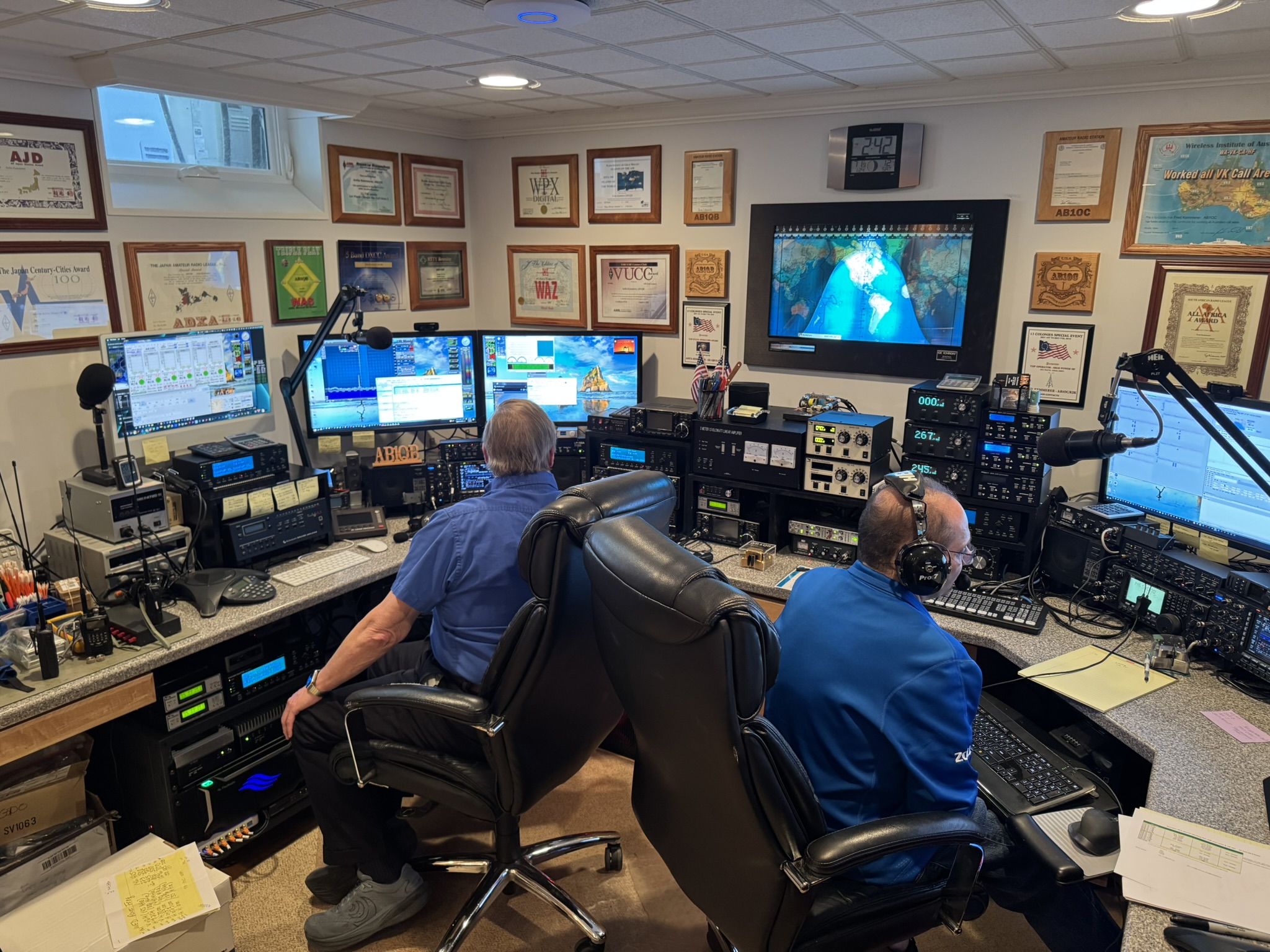
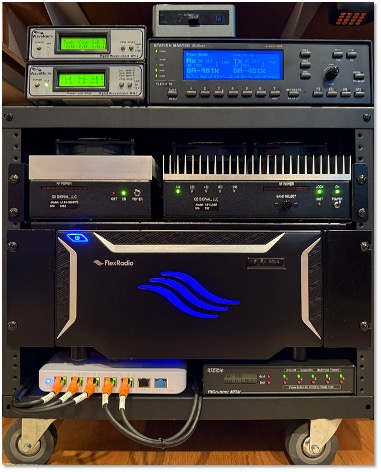
For equipment, Fred’s SDR can handle all the required bands, and his antennas are up to the task.

15 Band SDR Remote Gateway at AB1OC

Here is what we are working with for antennas at the base station:

  • 6m Loop Yagi (14.1 dBi)
  • 1.25m Yagi (11.9 dBi)
  • 2m Circularly Polarized Yagi (14.4 dBic)
  • 70cm Circularly Polarized Yagi (18.9 dBic)
  • 33cm Yagi (15.2 dBi)
  • 23cm Yagi (17 dBi)

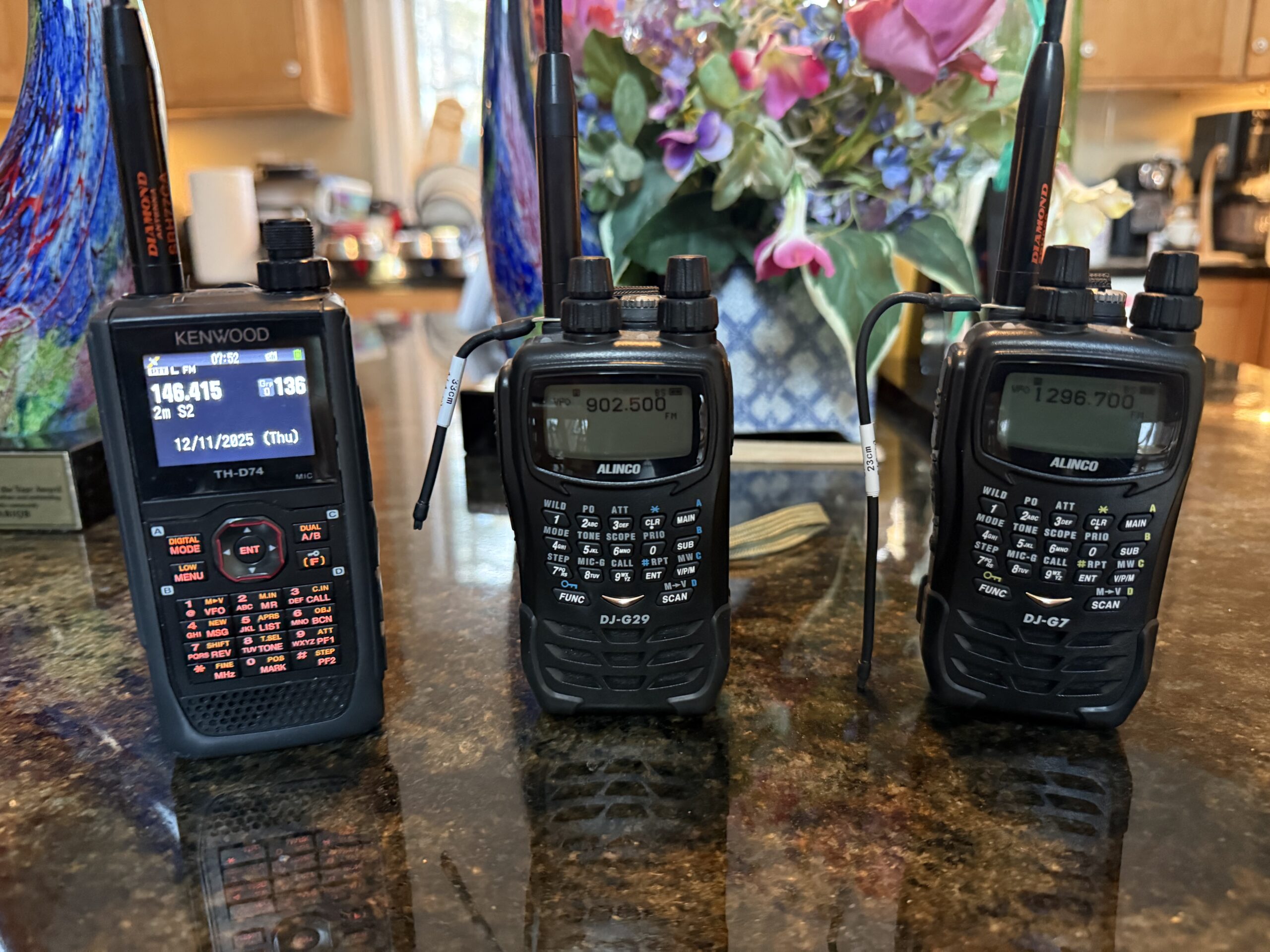
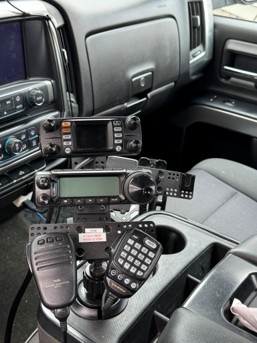
Even at the QRP level, the gain and ability to point the antennas helped overcome distance issues.  For the roving team location, I used a 33 cm Alinco HT with a short radial, a 23 cm Alinco HT also with a short radial, a Kenwood HT for 2M, 70cm, and 1.25m from Fred’s stash—finally, a Yaesu 891 with ATAS 120 Antenna for 6M as part of my mobile rig.

K1BER Mobile Station
HTs Covering 2m - 23cm
HTs Covering 2m – 23cm

Specifically, we tested the following:

2M        146.415 MHz             Vertically Polarized

1.25M  223.500 MHz           Horizontally Polarized

70CM   445.925 MHz           Vertically Polarized

33cm   902.500 MHz             Horizontally Polarized

23cm   1296.700 MHz          Horizontally Polarized.

6M        50.150 MHz SSB      Horizontally Polarized

As we cycled through the bands and our QSO, the signal reports were between 57 and 59 at both ends.  Our 5 challenges were easily overcome.

With a month to go before Winter Field Day, we are ready and excited to have fun, learn, and earn points.   We are still looking for volunteer rovers, which is an excellent opportunity for Techs.   Don’t worry if you’re new; you will have help.   If you are interested in participating in any part of Winter Field Day or in planning, please contact us or join the planning meeting.

Dave, K1BER

Low-Band Receive Antenna Upgrades at AB1OC-AB1QB

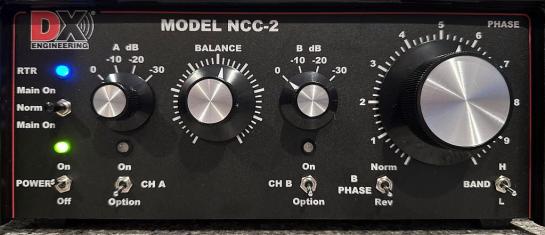
Low Band Receive System - NCC-2

We have two low-band receive systems at our station:

These antenna systems use short active vertical antennas in various combinations to create directional receive antennas for the low bands (80m and 160m).

We recently upgraded our low-band receive antennas to use the latest electronics. The upgrades improved the performance of both antennas and enabled us to contact China on 80m. You can read more about the project here.

We did a guest spot on DXendineering’s weekly video broadcast about the project. You can view the video here.

Fred, AB1OC

An Antenna for the Vertically Challenged

No, I’m not talking about short people! I’m talking about hams who may not have tall trees or the capability to put up a tower on their property. I want to tell you about a fascinating antenna design – a low-profile, high-performance solution ideal for those of us who might be challenged by restrictive antenna regulations or limited space. I’m referring to the Magnetic Radiator, specifically the Multiple-U (MU) design detailed in this article. This clever design comes to us from the inventive mind of Paul D. Carr, N4PC (SK) who had a column in CQ Magazine many years ago.

Now, you might be thinking, “Another vertical antenna? What’s so special about this one?” Well, let me tell you. This isn’t your typical electric radiator. This antenna operates on a fundamentally different principle—it’s a magnetic radiator.

What does that mean? Electric radiators, like your standard dipole or vertical, generate a strong electric field close to the antenna, leading to ground losses and less efficient radiation. This design, however, focuses on creating a strong magnetic field, minimizing those losses, and improving efficiency. Think of it as radiating power through the earth rather than into it. Some key advantages of the MU design are:

  • Low Profile: The vertical elements are less than 0.1 wavelengths high, making it perfect for locations with height restrictions. We’re talking about an antenna that’s practical for even the most compact locations.
  • No Loading Coils or Radials: No need for cumbersome loading coils or extensive ground radial systems. This simplifies construction and installation considerably.
  • Efficient Radiation: The design promotes efficient radiation, even at relatively low heights above ground. This magnetic radiation pattern offers surprisingly good performance.
  • Good Bandwidth: The MU design offers good bandwidth, which is important for modern digital modes and for those who like to cover multiple frequencies in the same band without retuning.

The article provides details design specifications and construction guidelines for various bands, from 10 meters up to 160 meters, with diagrams to walk you through the process. It even offers adjustments for different antenna heights above ground.

Now, let’s be clear—this isn’t a magic bullet. The performance will vary depending on the specific location, and like any antenna, there will be some directional favoritism. In the examples provided, there is significant performance in a certain direction. However, the overall design offers impressive performance, considering its low profile and simple construction. Remember that the measurements presented are based on real-world testing, demonstrating its practical effectiveness.

If you’re looking for an efficient, compact, and relatively easy-to-build antenna that performs well for long-haul contacts, I highly recommend taking a closer look at the Multiple-U magnetic radiator. The provided charts and diagrams will help you determine your optimal design based on your specific band and location.
Back in the 1990s, I built this antenna on my four-acre property in Boulder, Colorado. Boulder County’s strict antenna regulations prevented me from using a tower despite having ample space. After extensive research, I chose this design and started with a 10-meter version, using readily available parts from my “junk box”—speaker wire and RG-59 75-ohm coax for the matching network. I improvised support using a nearby bush and my garden fence and constructed the antenna, including the spreaders, in under an hour.
Connecting my 50-ohm feedline to the quarter-wave 75-ohm balun, I was pleased to see my ATU quickly achieve a 1:1 SWR with minimal tuning effort—always a good sign. Using my old IC-745, I tuned into a busy pile-up on 10 meters. I cautiously sent my callsign, fully expecting nothing, especially with my low power output of only 100 watts. To my astonishment, the DX station from Malta immediately answered who was the reason for the pile-up.

This unexpected success initially left me stunned. After confirming the contact with a 59 report, he responded that my signal was 59+20dB at his location. I explained my simple antenna. He compared my signal to a friend’s using a 50-foot high tri-bander in Illinois, noting that I was significantly louder. Propagation undoubtedly played a role, but switching to my vertical antenna resulted in a noticeable decrease in his signal strength (about two S-units) – this proved to me the design was effective. I was hooked and decided to build a larger version for 80 meters.

Using four 25-foot supports, I constructed a much larger 80-meter version of the antenna, requiring approximately 530 feet of wire. Bamboo served as the spreaders, and a quarter-wave 75-ohm line provided the matching. I oriented the antenna east-west for broadside radiation. That evening, I monitored an 80-meter WAS net and was amazed by the clarity of the signals. Typically, 80 meters is noisy, but this antenna exhibited remarkably low atmospheric noise, a characteristic benefit of H-plane operation, which minimizes noise typically prevalent in the E-plane. The longer “skip” characteristic of this antenna meant that distant stations came in exceptionally well, making it ideal for DX but less effective for closer contacts.

I replicated the antenna design for another ham who wanted a directional antenna specifically for 17 meters. He lived in a trailer park with antenna restrictions, so we needed a lightweight, easily repositionable solution. We constructed two supports using PVC pipe, with a central section and two horizontal PVC spreaders at the top and bottom. To ensure stability, the base of the vertical PVC support was encased in cement, allowing him to easily adjust the antenna’s direction simply by moving the cement-filled buckets at the base of the supports, effectively changing the broadside direction as he desired.

The unexpected success of my initial 10-meter antenna, built from readily available materials and achieving exceptional signal clarity, fueled my curiosity for this simple yet effective design. The subsequent construction of larger versions for 80 meters and a modified model for 17 meters further confirmed its versatility and adaptability. These antennas, built to overcome challenging site restrictions, demonstrated the principle of H-plane operation in minimizing atmospheric noise while maximizing the reception of distant signals. The experience proved that resourcefulness, ingenuity, and careful design could significantly enhance signal quality in challenging operating environments.

You can learn more about magnetic radiator antennas here.

Jack, WM0G

Radio Amateurs Developing Skills Worldwide