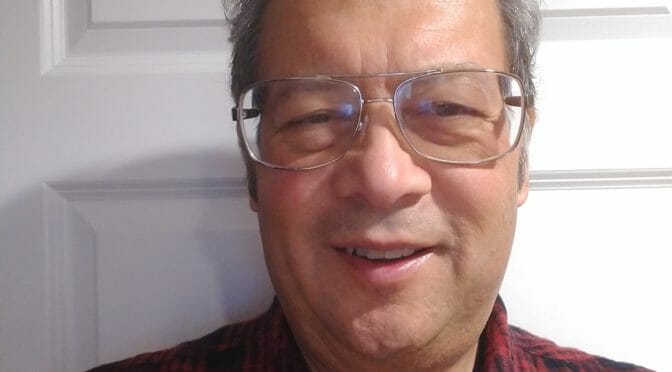
Greetings. I’m Tony Baker AA3HD, and I’m relatively new to the amateur radio world, just getting my Technician’s license in August of 2019. Getting an amateur radio license was something I had been wanting to do for a long time but hadn’t gotten around to it for one main reason…my employer of over 35 years did not allow it. One security restriction in working for the Central Intelligence Agency is that you cannot have an amateur radio license. (Perhaps this standard prohibition has been dropped or relaxed today.)
From a very young age, I remember always being interested in two-way radios. I think it was around the 7th grade that a friend of our family – “uncle” Bill – bought me a Knight 2-channel walkie-talkie kit. Uncle Bill helped me put the two kits together, teaching me how to solder, and me learning what the different parts, like resistors, looked like, and the importance of ensuring polarity was correct, etc. I remember having so much fun with my friends with those crystal-controlled radios after I got them together and the satisfaction of building them.
At age 20 I went to work for the CIA. It’s been nine years since I retired. Because of my employment restrictions, I did what I could do and got into citizens’ band radio. Probably a lot of us hams were into or dabbled in CB radio at one time. As a matter of fact, about two years ago I got out one of my old CB’s – an E.F. Johnson 40-channel SSB unit – and hooked it up in my truck, and, it worked!!! But it wasn’t like the good old days of the mid- to late 1970s when every CB channel was very active, and you could talk skip in a heartbeat. It seemed all the channels were silent. My old CB call sign was KHK-7098. Children and wives, (I’ve been divorced twice), forced me to change my priorities, and I eventually was unable to devote any time at all to my CB radio hobby.
Fast forward to last summer. (As background, I went to elementary school in Deer Isle, Maine, and have been going there for summers my entire life. Some of my relatives still live on Little Deer Isle, and my family still has a seasonal house on Little Deer Isle as well.) For whatever reason, this past summer I started reminiscing about how great the skip on CB was back in the day from Little Deer Isle, but how silent all the channels were now. I wondered to myself; why not get your amateur radio license now? After some research, I discovered you no longer needed to learn Morse code to pass the test. At that point, I decided to get my Technician’s ticket. With some more research, I found out about a two-day licensing class in Natick, MA, and after completing the course, passed the Tech test. Two weeks later I took and passed the General test, and two weeks after that, on September 7th in Boxboro at the HamXposition, I passed the Extra test. That said, I was probably the only Extra who hadn’t even made a transmission, not to mention that I didn’t have a radio either!!
Boxboro was an exciting time for me. It was here that I got exposed to some real hams, and some real radios, both new and old making and receiving transmissions. It also was in Boxboro that I first became exposed to the Nashua Area Radio Society, soaking up all the displays, taking the HAM Bootcamp course, and learning that NARS was ARRL’s choice for the best ham radio club for 2019. It also was at Boxboro that I decided to go to a NARS membership meeting and join if I liked what I saw. I realized that by living in Wells, Maine I wouldn’t exactly be close, but I couldn’t find any ham clubs in Maine that were nearly as diverse, active, or successful as NARS. Between Boxboro and attending my first NARS meeting in October, I bought two radios, the first being a Xiegu G90 HF, and the other an Anytone 868 dual-band DMR ht. I had also applied for a vanity call sign.
At that first NARS meeting, I was hoping to meet some Elmers, as I had still not made an amateur radio transmission and was hoping I could get some help getting on the air. It was at this meeting that I was introduced to NE1B – Bill Barber. He agreed to help me with my DMR radio and get me on the air. That Friday – October 4th – I went to Bill’s house. Bill is a well-seasoned ham with quite a radio shack and impressive awards to prove it. It was also the day I received my vanity call sign – AA3HD. I never made a call with my originally assigned call sign of KC1LUN. Bill helped me get my DMR radio up and programmed. At about 2:30 pm that day I made my first transmission. It was with Bill as I was driving away from his house. Not very far, but what a thrill. After literally decades of wanting to be a ham, I finally made it!
In Boxboro I also saw the instructor that helped me get my Tech license – K5TEC, Bob Phinney. When I told him I had just passed my Extra exam, he encouraged me to become a Volunteer Examiner. When AB1QB, Anita Kemmerer, made an appeal for VE’s at that first NARS meeting I attended in October, I decided to try to get my VE certification. In mid-November, I became a VE, and have, as my schedule permits, helped out at NARS VE sessions. How rewarding it is to see new hams and those getting upgrades to fulfill their dreams. Besides joining NARS, I also am an ARRL Life Member.
At the NARS holiday party, I got a Baofeng ht in the gift swap. I also have a Zumspot hotspot, and a Mirage VHF/UHF amplifier, all that I need to get up and running, and I still have to get my HF rig hooked up as well. Antenna limitations imposed by XYL have made my beginning ham journey challenging to say the least, besides the fact that in terms of amateur radio she says, “I couldn’t imagine something that I would be less interested in.” Right now I have my portable DMR radio working in both my truck and at home. My base antenna is a portable dual-band J-pole type (DBJ-2) that I purchased at Fall 2019 NEARFest. (A review of this antenna is in the March 2007 issue of QST.) In the mobile, I’m using a Diamond NR770HNMO antenna. I have plenty to figure out and explore, and I am finding amateur radio just as exciting as I always imagined it would be.
Other interests of mine include cars and motorcycles, but that will have to wait for another time.
Ann Stockbridge, Educator at Kennebunk’s Sea Road School
Regional School Unit 21 has been selected for an out-of-this-world opportunity. An international association of space agencies and Amateur Radio organizations has chosen RSU 21, represented by Sea Road School, to advance in a process climaxing in a conversation between students and astronauts aboard the International Space Station (ISS).
RSU 21 was one of 10 schools selected nationally to continue through the multi-month acceptance process. The contact event with the ISS could occur between July and December of this year.
The opportunity is provided by ARISS (Amateur Radio on the International Space Station), an association that includes NASA, the Center for the Advancement of Science in Space, the American Radio Relay League, the Radio Amateur Satellite Corporation, and space agencies in Canada, Japan, Europe, and Russia. They collaborate to enable students to communicate with ISS astronauts and help inspire interest in space, communications and STEM coursework.
Source: RSU 21 students to communicate to outer space – Portland Press Herald
As our readers may know, I have joined the ARISS program as a Mentor to help schools prepare for and make successful contacts with Astronauts on the International Space Station. I am working with RSU 21 Sea Road School teachers and local Ham Radio folks in Maine, USA to help them make contact with the ISS during 2H2020. The link above shares more about the STEM learning program that is being created around this contact.
We had a great Winter Field Day (WFD) this year! Winter Field Day 2020 provided some real practice and a great chance to develop our Emergency Communications (EMCOM) skills and to get additional practice setting up our towers and antennas.
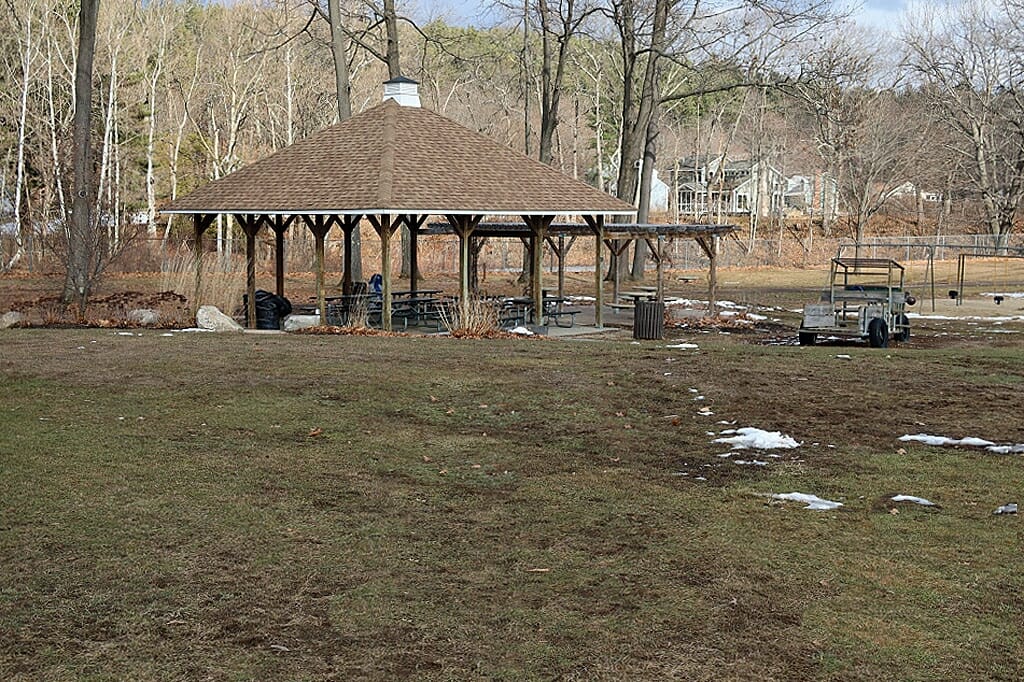
We operated from Keyes Memorial Park in Milford, NH again in 2020. Keyes provides a great public location, a large open area, and an open pavilion that could be used to construct a temporary outdoor shelter. Jerry K1OKD, Craig, N1SFT, Jon AC1EV, Jamey AC1DC, John KB1EEU, and Fred, AB1OC led the 2019 Winter Field Day Team. Jeff, AC1FX served as our Safety Officer. Also, Anita AB1QB served as the leader of an independent new activity – VHF+ Roving for Winter Field Day.
Winter Field Day Shelter, Heat, Power, and Food
Building Our Shelter
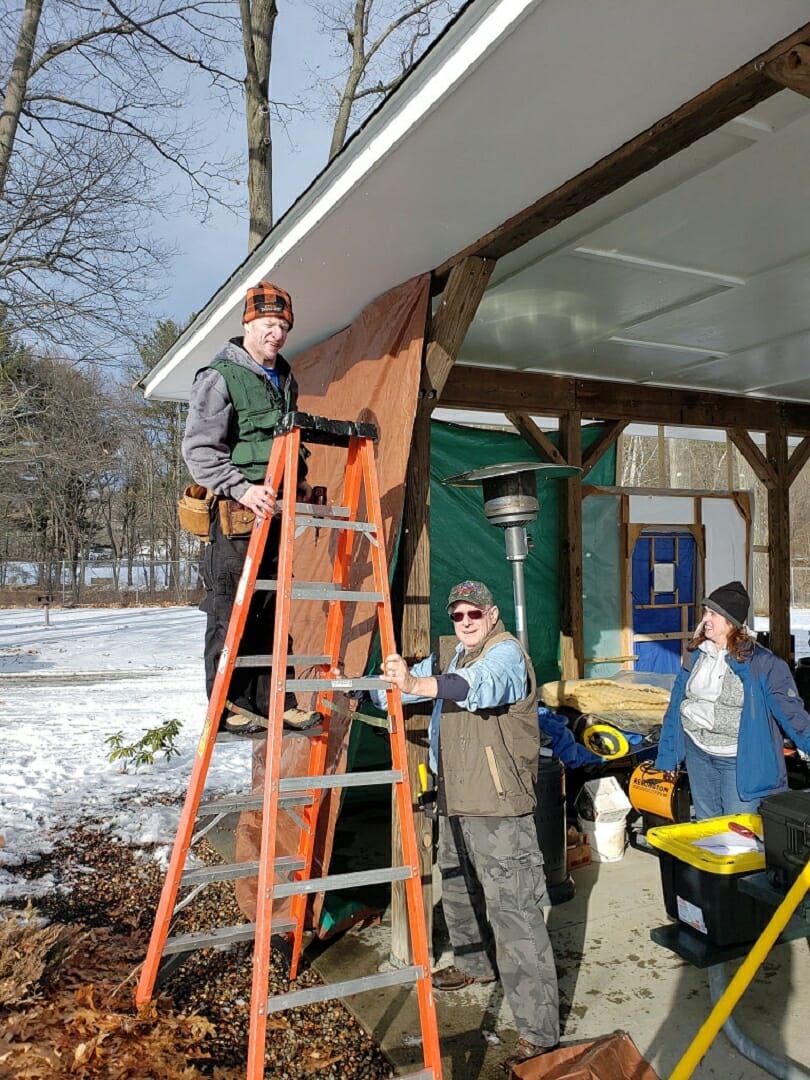
Staying warm, dry, and comfortable is essential for any outdoor operation. This is particularly important for Winter Field Day. John, KB1EEU, Patrick W1YTT, and others handled this very essential and important part of our Winter Field Day 2020 operation by turning the picnic area at Keyes Park into our shelter. They used tarps to close in the area.
WFD Shelter
The photo above shows our completed shelter. The tarps allow for a small open area at the top to allow for air circulation. This is essential for safety and comfort.
NARS Power and Light
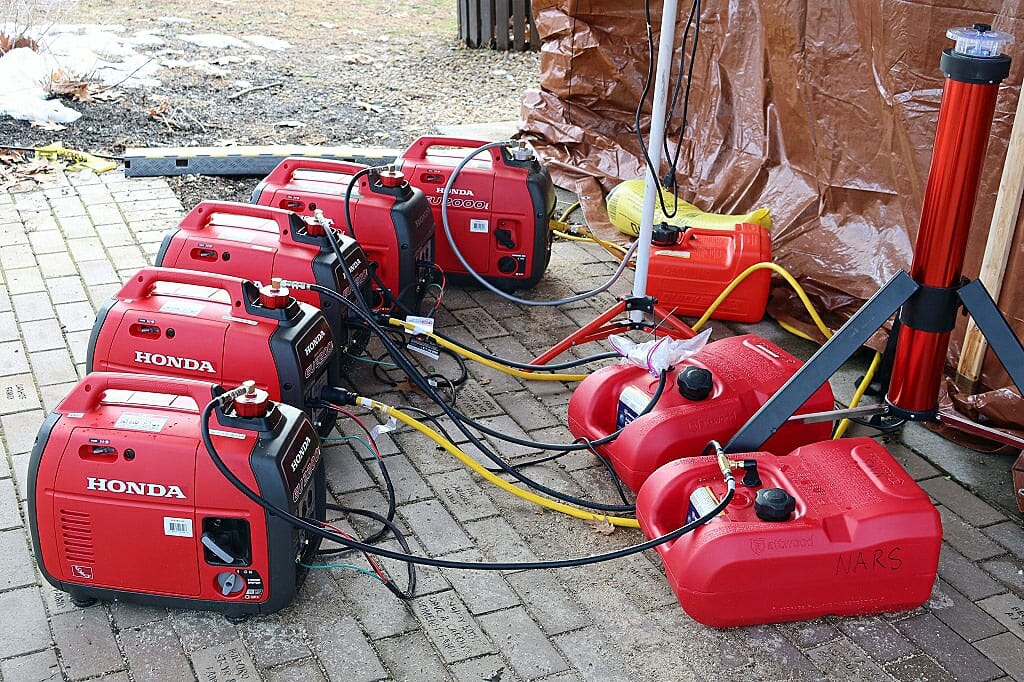
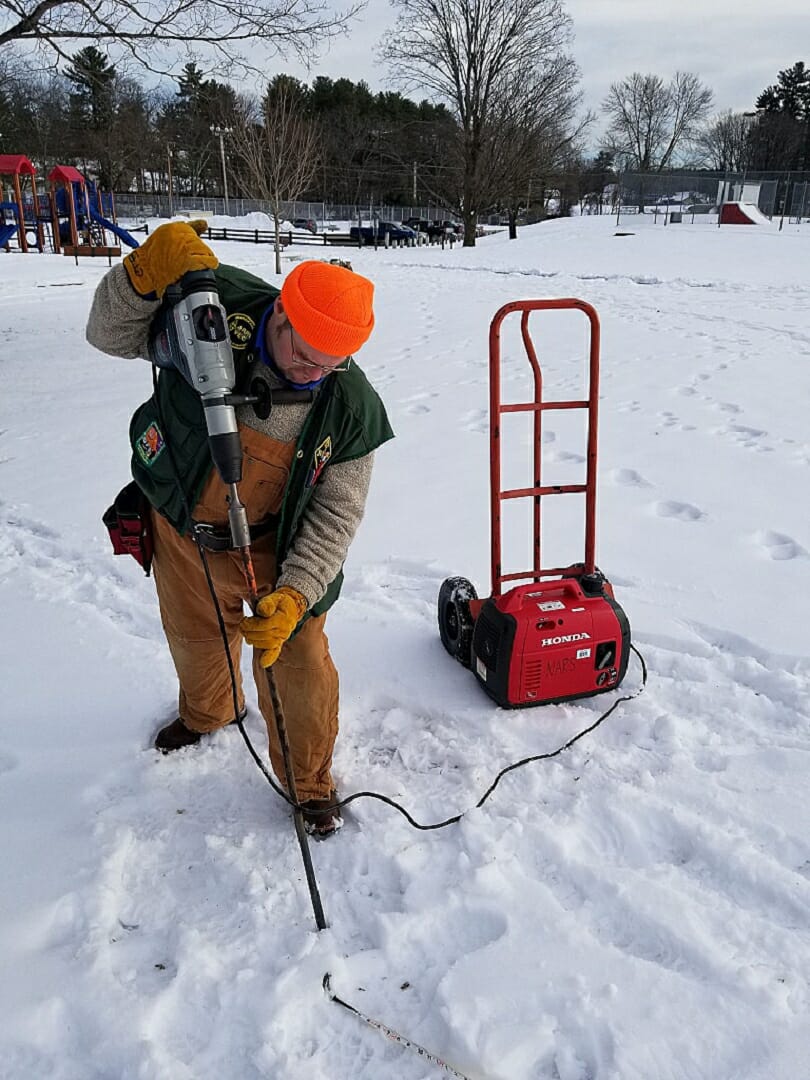
The next step was to set up our generators. Craig, N1SFT handled this task. We use Honda 2000/2200 generators in pairs with external fuel tanks. The setup shown above provides over 10,000 watts of power. The external tanks are a great safety feature. They make refueling a much simpler and safer process.
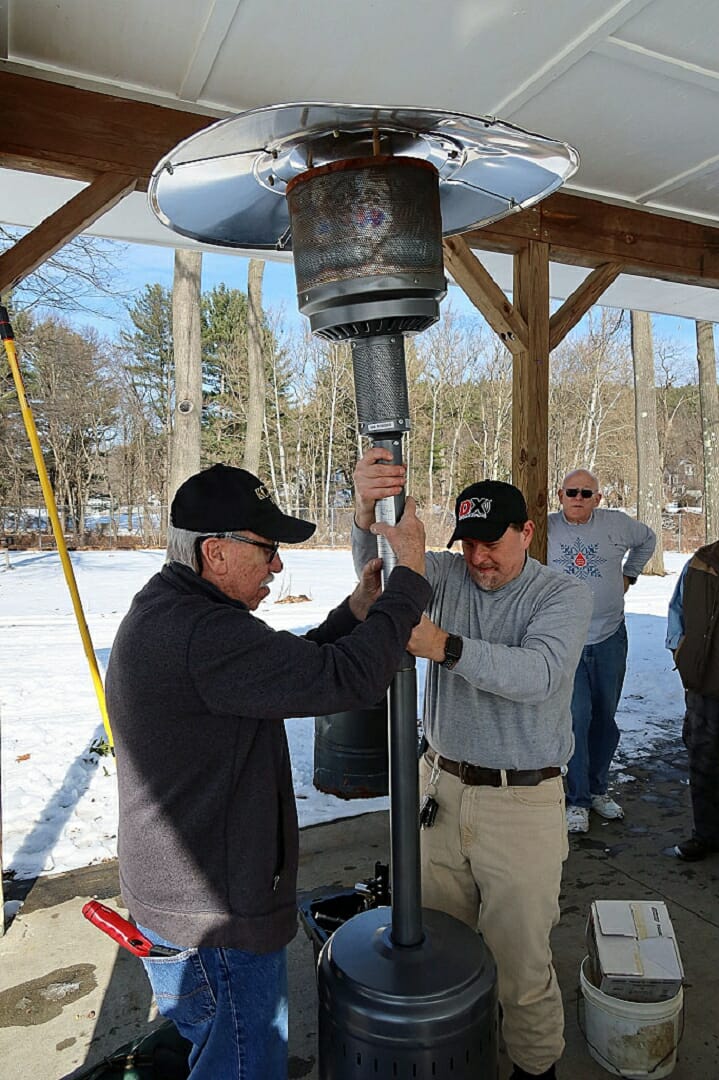
Jerry K1OKD’s Toy – HEAT! Jerry and Peter, KC1FNF set up a propane heater.
Jerry K1OKD and others brought heaters that ran on propane and kerosene. The heaters were very effective and kept our shelter at comfortable temperatures all weekend long.
Winter Field Day Food
Every army runs on its stomachs! Peter KC1FNF helped us during Winter Field Day 2020 but especially by providing meals and snacks to keep us all going. Thank you, Peter!
Tower And Main HF Antennas
Craig N1SFT Beginning Work On Our Tower
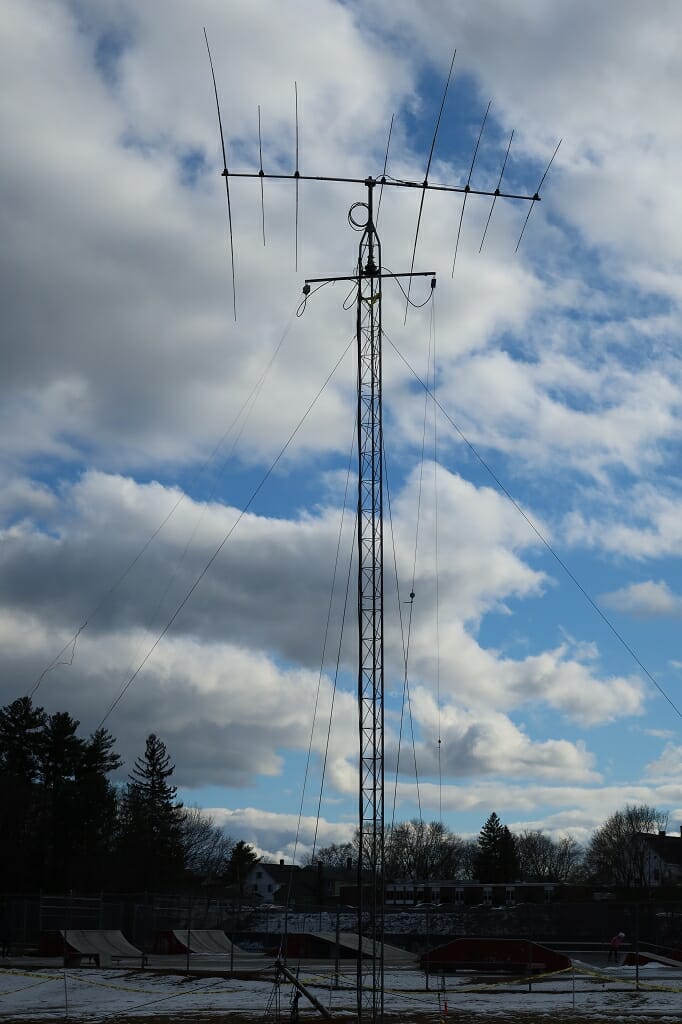
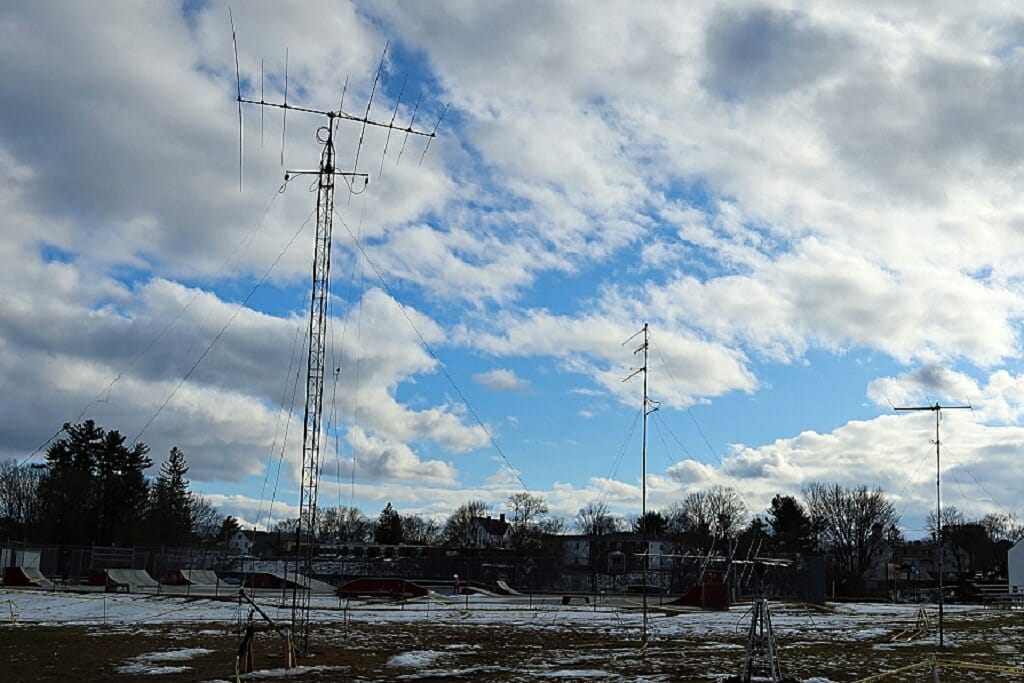
Craig, N1SFT led the tower team. Craig and Team’s great work gave us most of our HF band capability at Winter Field Day 2020. They put up a 40 ft falling derrick tower which supported a tri-band yagi antenna for 20m, 15m, and 10m as well as wire antennas for 40m and 80m.
Our Tower Going Up at Winter Field Day
Check out the video above – it shows our 40 ft falling derrick tower going up at Winter Field Day 2020.
40 ft Falling Derrick Tower
As a result of Craig and Team’s work, we had an excellent antenna system that covered all of the HF bands from 80m through 10m. It really makes a big difference to have directional antennas on 20m – 10m and having our 80m and 40m antennas up nearly 40 ft improve their performance considerably as well.
Building and erecting an antenna system of this type takes considerable engineering knowledge, teamwork, and a very intense focus on safety. Our readers should not attempt this without the proper skills and training and we do not recommend trying to duplicate any of our antenna systems including our falling derrick tower and masts.
Wire Antennas and VHF+ Antennas
160m Transmit Antenna
160m Receive RBOG Installation
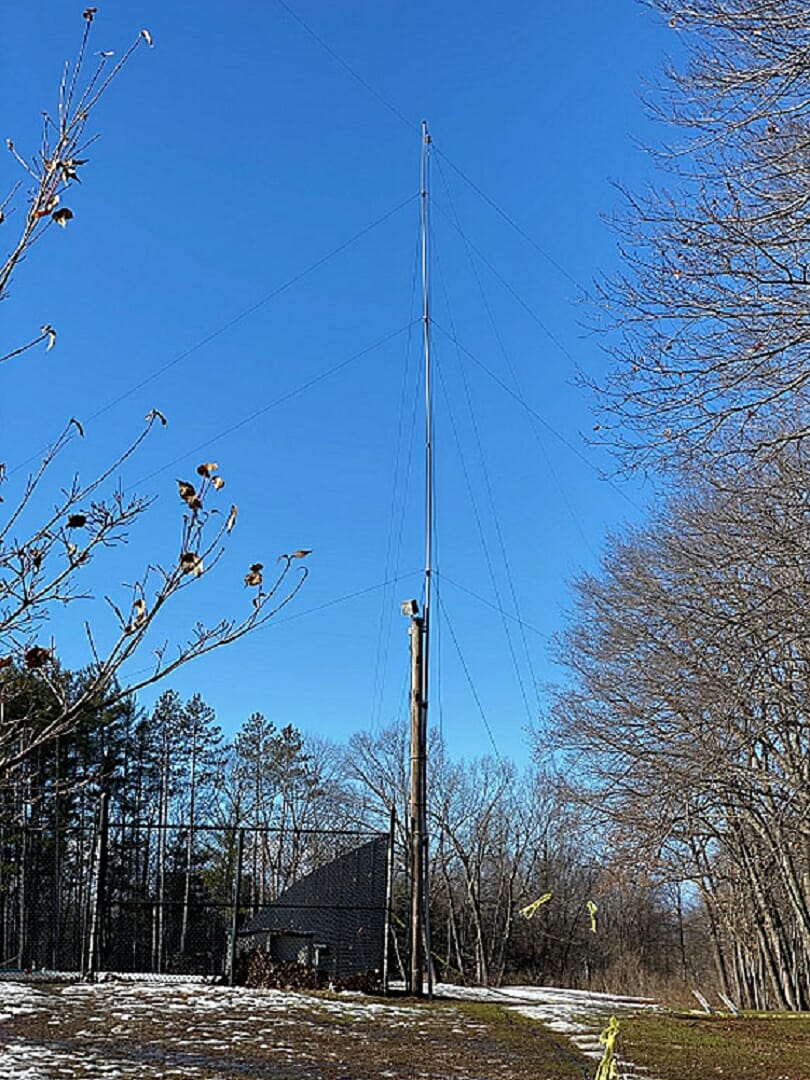
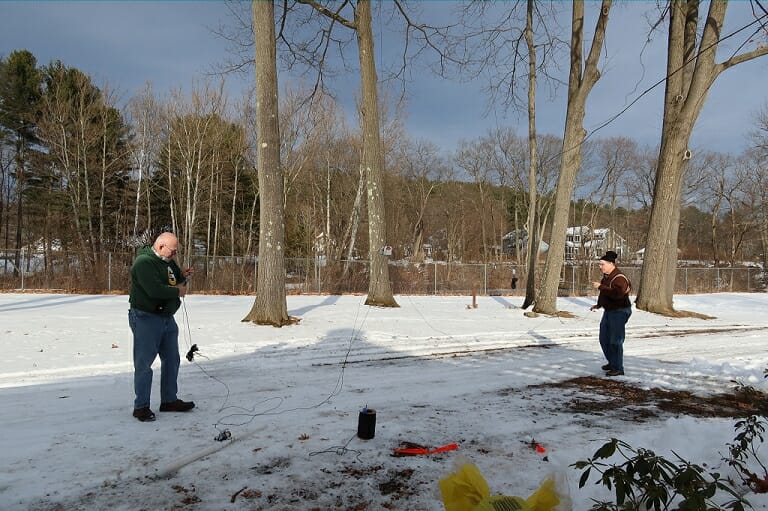
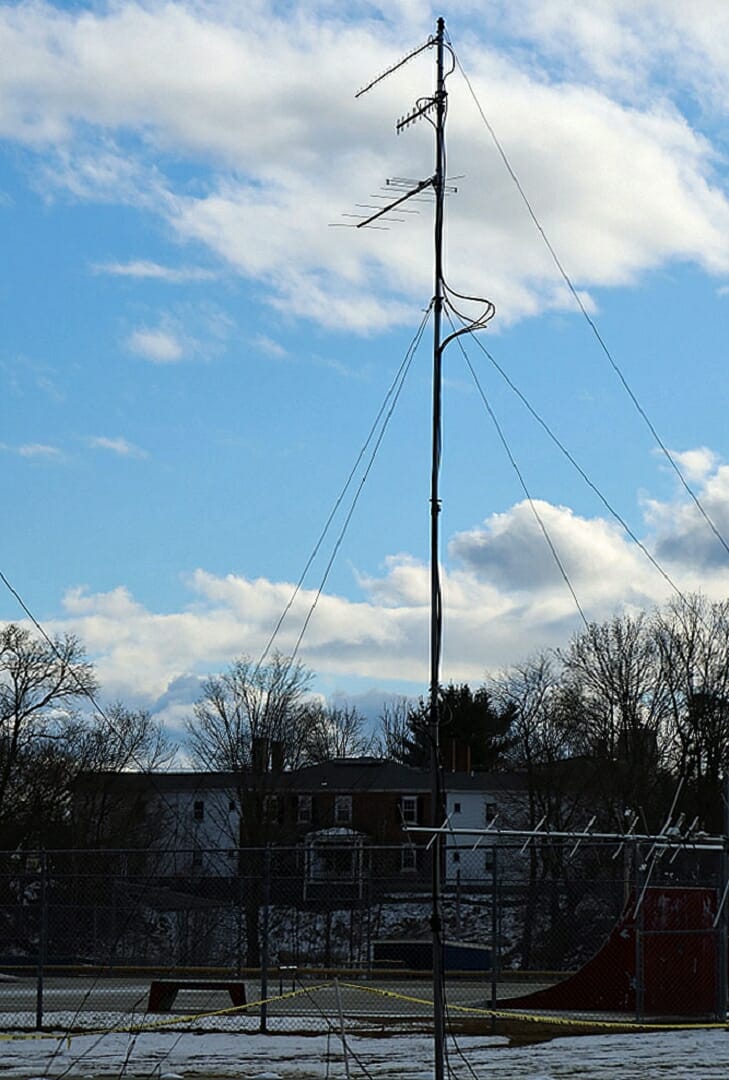
Jamey, AC1DC, and Team did a tremendous job with our wire antennas and our VHF+ antennas on our masts. The first to go up was our 160m antenna system. The 160m Transmit antenna is supported by a 50 ft guyed mast. As a result, it is probably the most challenging antenna that we put up during Winter Field Day. Jamey and his team got it up and it produced over 80 KHz of usable bandwidth on 160m.
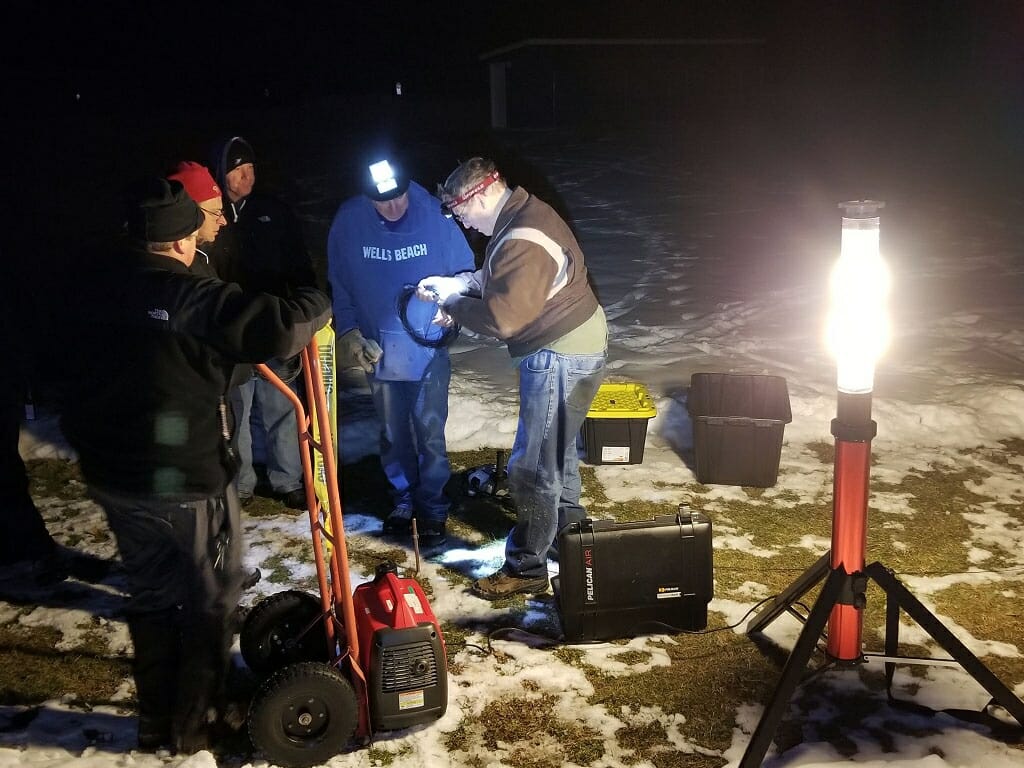
The team also put up our 160m RBOG receive antenna. The sun had gone down by the time we got to this antenna so we used a generator and our Inter-plexor Beacon Lamp to light the field during the installation.
The combination of these antennas produced an amazing 244 contacts on Top Band!
Jon AC1EV and Fred AB!OC Putting Up A 40m Delta Loop
Jon AC1EV, Andrea KC1JDX and I put up a 40m Delta Loop Antenna. This antenna is a quiet receive antenna and it works on the 40m, 20m (will a tuner), and 15m bands. As a result of this additional antenna, we were able to have two Transceivers on 40m, 20m, or 15m at the same time.
6m Yagi Going On Its Mast
Next up was our 6m antenna which features a 3 element yagi on a 30 ft push-up mast. The team made short work of this antenna. We had a great run on 6m during Winter Field Day. As a result of some more focus on this band, we made a total of 22 contacts on the Magic Band.
VHF+ Mast – 220 Mhz, 902 MHz, and 1.2 GHz
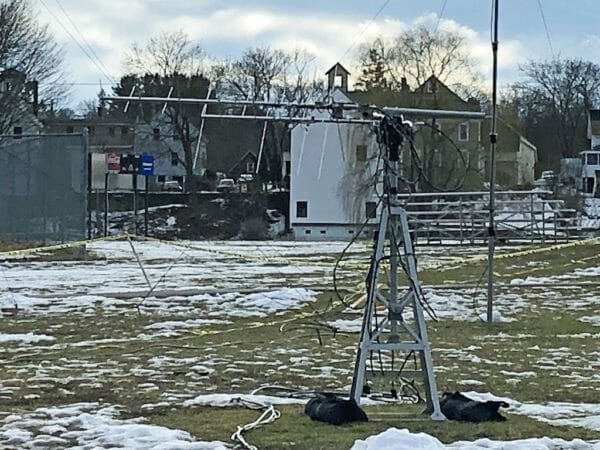
The final project of the team was our second VHF+ mast. This one featured yagis for the 1.25m, 33cm, and 23 cm bands. Thanks to the pre-test of this part of our station, it went up very smoothly at Winter Field Day 2020.
We fed all of our VHF+ antennas with LMR-600 coax which NARS recently added to our kit. As a result, we were able to get most of the 50w – 100w transmit power that our radio generated to the antennas even though some were over 100 ft away.
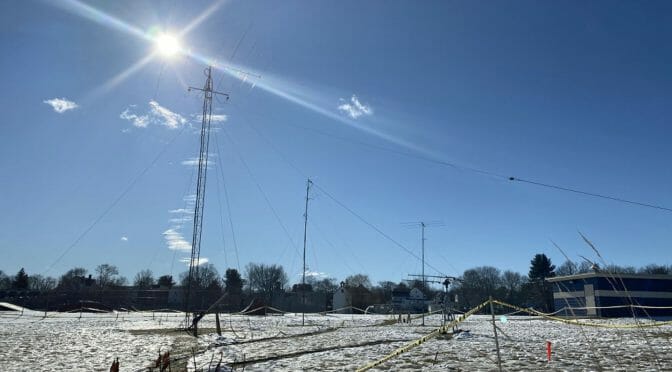
Winter Field Day’s Awesome Antenna Farm
Completed Antenna Farm
As a result of all of the hard work of the Tower, Wire, and Mast teams, we had a truly awesome antenna farm for Winter Field Day 2020. Here’s a list of just some of the highlights of the results of everyone’s hard work:
We had a rotatable directional antenna for 20m – 10m at 40 ft
We had top-performing wire antennas for 80m and 40m
We had an amazing portable 160m antenna system that continues to produce a tremendous number of Top Band QSOs with just 100w
We had a second 40m antenna, a Delta Loop, which enabled us to have multiple transmitters on 40m, 20m, or 15m at the same time
We had directional antennas for all of the VHF+ bands from 6m – 23cm (1.2 GHz). This included some non-so-often used bands such as 1.25m (220 MHz), 33cm (902 MHz), and 23cm (1.2 GHz).
Our 2m/70cm antenna system featured computer-controlled rotators and switchable circular polarity making it a breeze to make our satellite contact.
Jamey, AC1DC’s Tour Of Our WFD Antenna Farm
You can click on Jamey, AC1DC’s video above to take a tour of our Winter Field Day 2020 antenna farm.
Stations and Supporting Infrastructure
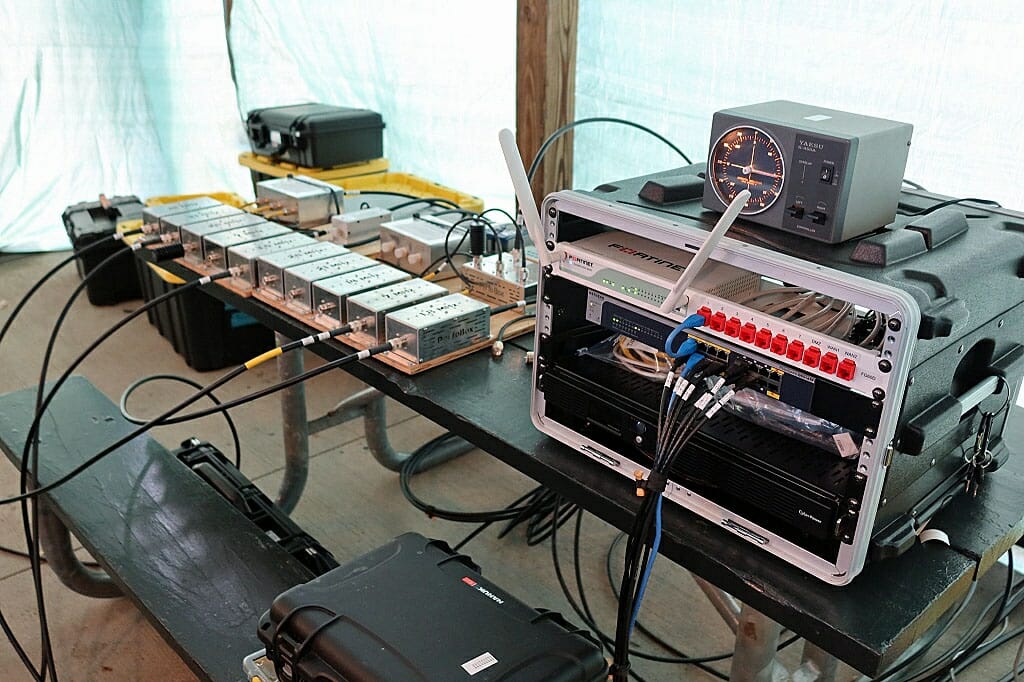
Filters Antenna Switching and Network
It takes some significant infrastructure to support a multi-transmitter station of the type that we put together for Winter Field Day 2020.
We brought our Networking Pod which allowed us to connect all of our station computers together using a local ethernet network.
We also used a combination of tri-plexors and band-pass filters to connect our HF transmit antennas to our radios. As a result, multiple transmitters were able to simultaneously use our Tri-Band Yagi and our 40m Delta Loop. In addition, the band-pass filters kept inter-station interference to a minimum.
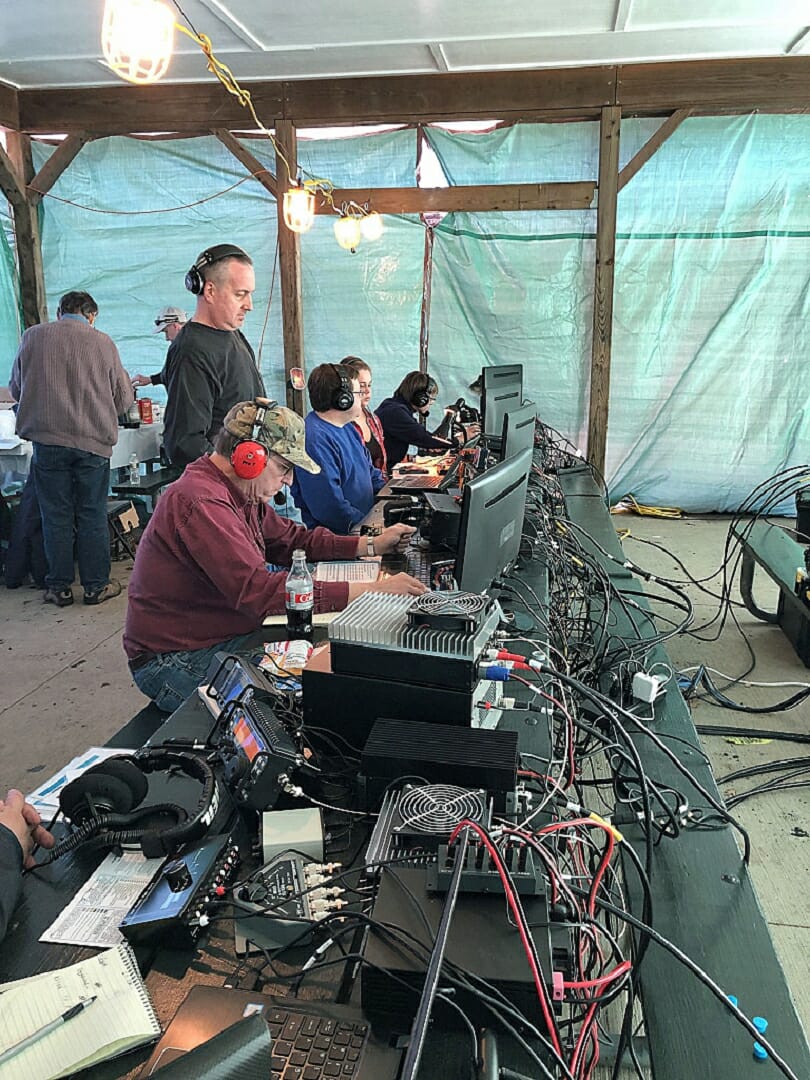
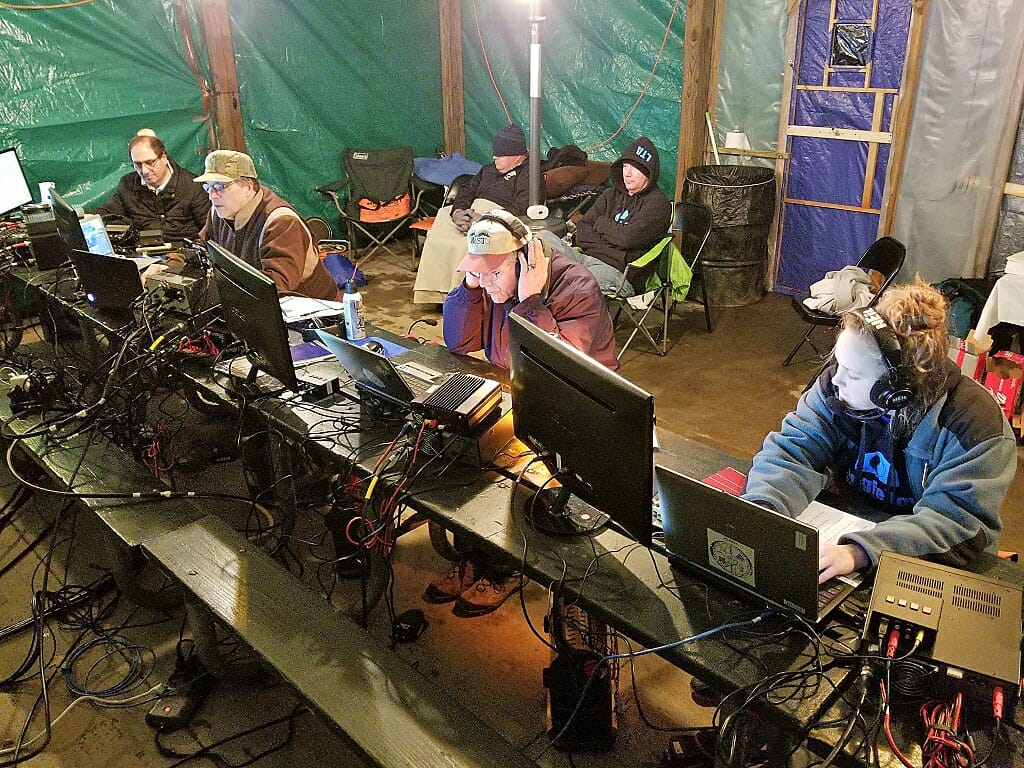
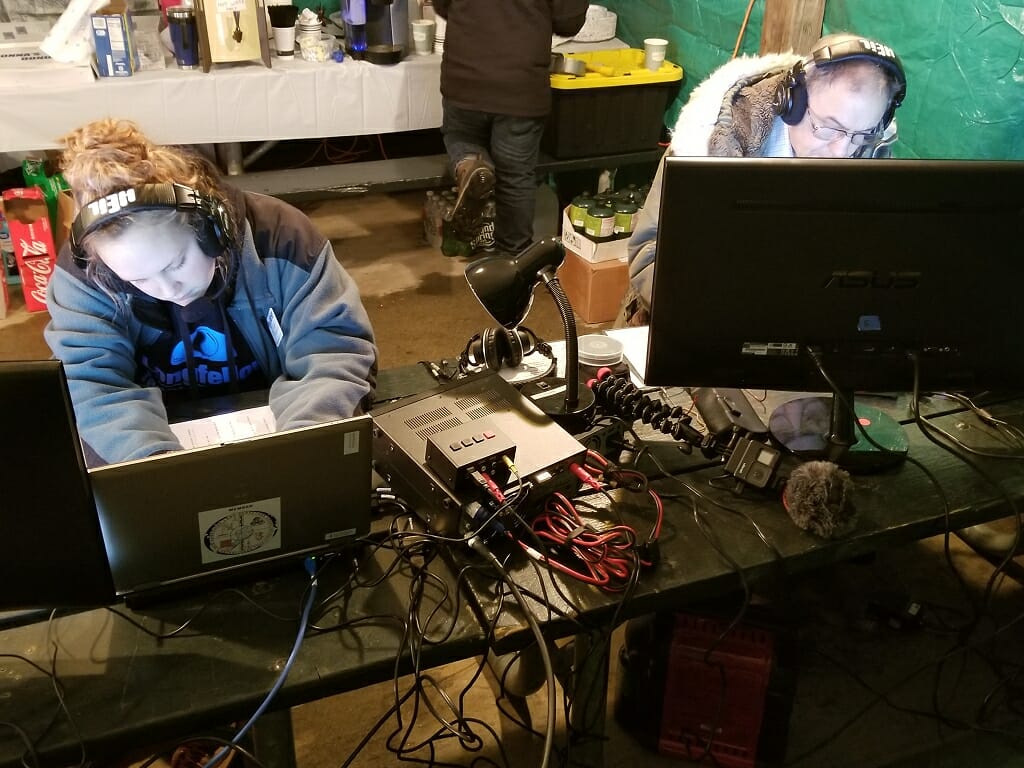
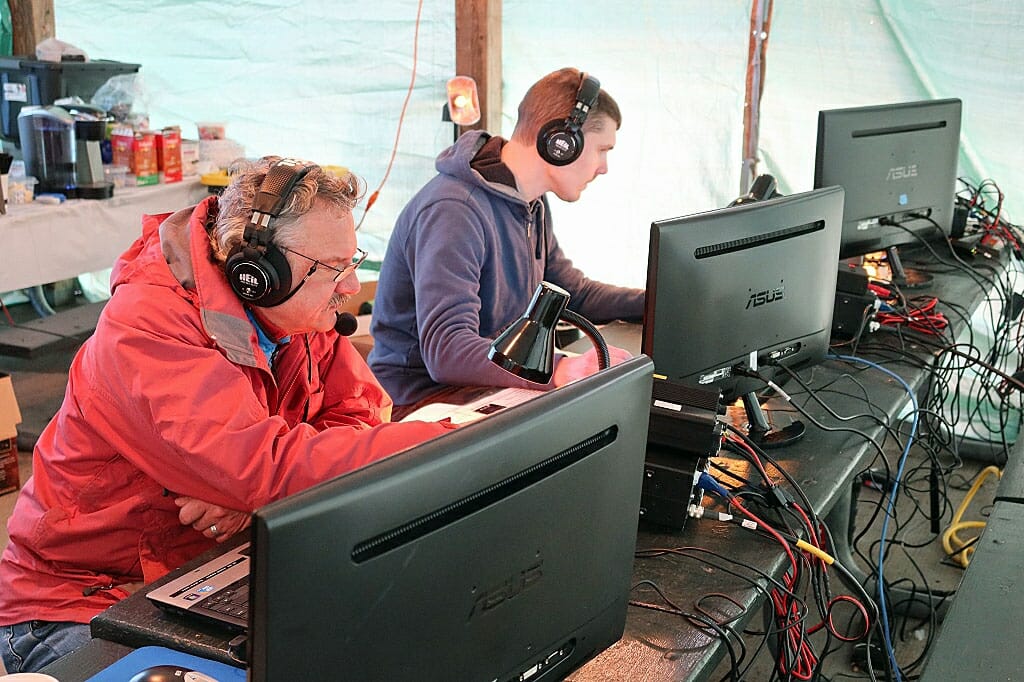
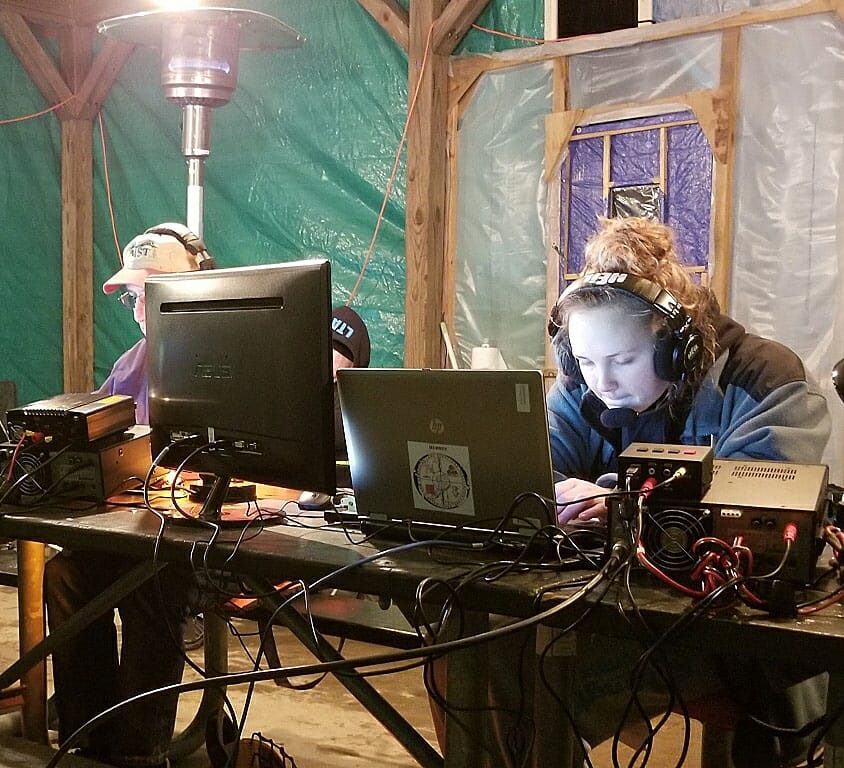
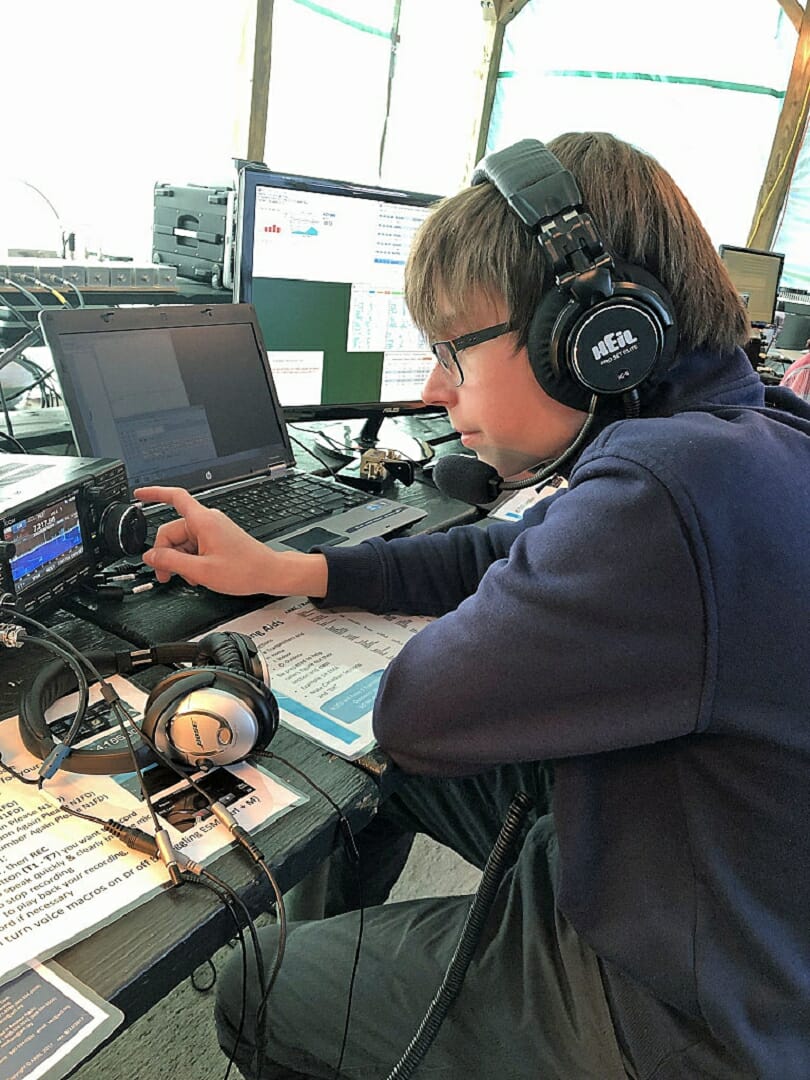
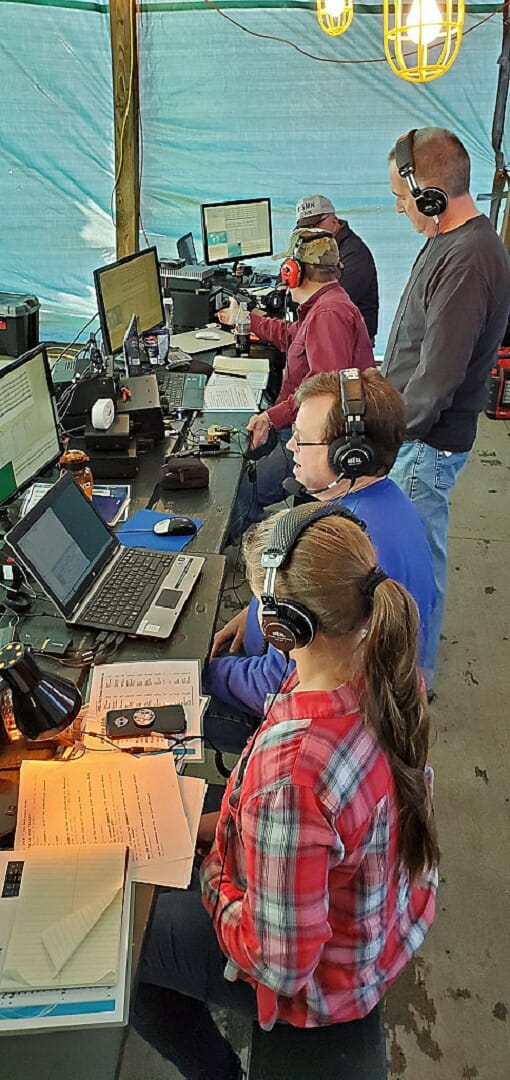
We had a total of 5 stations simultaneously on the air. This gave our team lots of opportunities to operate. The photo gallery above shows some of our stations. Each station had a dedicated computer with a second monitor running the N1MM+ logger. Our network allowed the station to create a common log which allowed onlookers to see our combined contact totals in real-time.
Jon, AC1EV and I put together our 5 stations and connected them to the network and filter system. This part of our Winter Feild Day 2020 station building project including taking the time to ensure that all of the software which supports functions such as logging, digital operations, CW operations, and our satellite station was working properly. As a result of all of our efforts on station testing before the event, these steps went relatively smoothly.
Our VHF+ stations (which also had HF capability) featured satellite support and provided 50w – 100w on all of the bands from 6m through 23cm. We made good use of transverters to get onto some new bands including 1.25m and 33cm. As a result, we were able to capture many more band-multipliers as compared to last year.
Winter Field Day 2020 Operations
WFD Operations In Full Swing
Winter Field Day 2020 operations began at 2 pm on Saturday. The start of operations is always an exciting time. This is a time when we can really determine how well our plans and station building efforts will actually perform.
As a result of everyone’s hard work to prepare and set up our station, we found that our 5O station worked very, very well.
The gallery above shows some of the many folks who operated during Winter Field Day 2020. All of these folks, as well as many others, contributed greatly to what became a record score of us (more on that later).
Our top operators included:
Operator
Call Sign
QSOs
% of Total QSOs
Dave Pascoe
KM3T
246
22%
Marty Sullaway
NN1C
223
20%
Abby Finchum
AB1BY
167
15%
Bill Noyce
AB1AV
139
12%
Dennis Marandos
K1LGQ
90
8%
Fred Kemmerer
AB1OC
76
7%
Keith Sangillo
KC1IMK
71
6%
Other Operators Combined
---
121
10%
A special thanks to Dave, KM3T and Marty, NN1C who helped us so much with our operation.
Winter Field Day Young Operators
Abby AB1BY Working SSB on HF
Winter Field Day 2020 was the first event that is eligible for our Student-Teacher Contest Series. Several of our young members came out to operate in Winter Field Day and to begin working on their entries in the series.
Keith KC1IMK Operating HF
Our young members, as well as other their young people, helped to make our Winter Field Day operation memorable and they contributed greatly to our score.
Victoria, K1VAT, and Her Dad Ted, W1TED Operating Together
It’s always great to see our young members operate with parents and friends during an activity like Winter Field Day. This makes for some great fun and creates a learning experience for everyone involved.
How Did We Do?
We posted a record score this year which was more than double that of 2019 Winter Field Day. Here’s a summary of our operating results:
We had a 5 transmitter Outdoor station (5O) for WFD 2020, adding an additional transmitter over WFD 2019
We made a total of 1,133 unique (non-duplicate) contacts during the 24-hour operating period
We worked 46 of the 50 US States
We worked all but 8 ARRL sections in the US and Canada
We had an amazing 612 CW, 486 Phone, and 35 Digital Contacts!
We added a number of bands to our station which enabled us to turn in a solid performance with 35 band-mode multipliers
Our 160m portable antenna system worked great again this year! We made 244 contacts on 160m using just 100W!
Our final claimed score (after removing duplicates) was:
Total QSO Points – 1,780
Power Multiplier (100W or less) – 2
Band-Mode Multipliers- 35
Score from QSOs – 124,600
Outdoor Bonus – 1,500
No Commercial Power Bonus – 1,500
Not At Home Location Bonus – 1,500
Satellite Contact Bonus – 1,500
Final Claimed Score – 130,600
Here’s a breakdown of our contacts by Band and Mode:
Band
Phone
CW
Digital
Total
% of Total QSOs
160m
2
242
244
21.5%
80m
19
118
7
144
12.7%
40m
226
108
6
340
30%
20m
192
128
9
329
29%
15m
3
1
1
5
<1%
10m
3
1
1
5
<1%
6m
18
3
1
22
1.9%
2m
10
3
2
15
1.3%
1.25m
3
2
2
7
<1%
70cm
3
2
2
7
<1%
33cm
3
2
2
7
<1%
23cm
3
2
2
7
<1%
Satellite
1
1
<1%
Totals
486
612
35
1,133
100%
You can read more about our 2020 Winter Field Day operation on our Blog:
Victoria, K1VAT And Her Dad Ted, W1TED Operating During WFD
Victoria, K1VAT And Her Dad Ted, W1TED Operating During WFD
WFD Operations Ended at 2 pm on Sunday
WFD Operations Ended at 2 pm on Sunday
HF Station
HF Station
HF Station #2
HF Station #2
VHF+ Station #1 - Satelites 6m, 2m, 70cm, and 23cm
VHF+ Station #1 - Satelites 6m, 2m, 70cm, and 23cm
VHF+ Station #2 - Elecraft KX3 and Transverters
VHF+ Station #2 - Elecraft KX3 and Transverters
VHF+ Station #2 - Elecraft KX3 and Transverters #2
VHF+ Station #2 - Elecraft KX3 and Transverters #2
Filters Antenna Switching and Network
Filters Antenna Switching and Network
Filters and Antenna Switching
Filters and Antenna Switching
2020 WFD Antenna Farm
2020 WFD Antenna Farmm
WFD Antenna Farm #2
WFD Antenna Farm #2
160m Transmit Antenna
160m Transmit Antenna
160m Receive RBOG Installation
160m Receive RBOG Installation
Jon AC1EV and Fred AB!OC Putting Up The 40m Delta Loop
Jon AC1EV and Fred AB!OC Putting Up The 40m Delta Loop
6m Yagi Going On Its Mast
6m Yagi Going On Its Mast
6m Yagi On VHF+ Mast #1
6m Yagi On VHF+ Mast #1
Falling Derrick Tower Ready To Go Up
Falling Derrick Tower Ready To Go Up
Falling Derrick Tower Going Up
Falling Derrick Tower Going Up
40 ft Falling Derrick Tower at Witer Field Day 2020
40 ft Falling Derrick Tower at Witer Field Day 2020
VHF+ Mast - 220 Mhz, 902 MHz, and 1.2 GHz
VHF+ Mast - 220 Mhz, 902 MHz, and 1.2 GHz
2m and 70cm Satellite and Weak Signal Antennas
2m and 70cm Satellite and Weak Signal Antennas
NARS Power and Light
NARS Power and Light
And In The End
And In The End
Additional Field Day highlights and memories can be found in the picture gallery above.
And In The End…
Our Winter Field Day Site On Monday after WFD
As we always do, we took our Winter Field Day station and antennas down on Sunday at 2 pm after operations ended. The takedown is always a challenge because most of us are tired from a very busy and active weekend. Out Team did a great job with this important step and got all of our gear down and stored during the evening hours.
We had an amazing Winter Field Day this year! Everyone involved worked extremely hard to create our best performance yet, a great experience, and a tremendous learning experience for all involved. Thank you so much to everyone involved for making Winter Field Day 2020 a success!
We use cookies to ensure that we give you the best experience on our website. If you continue to use this site we will assume that you are happy with it.