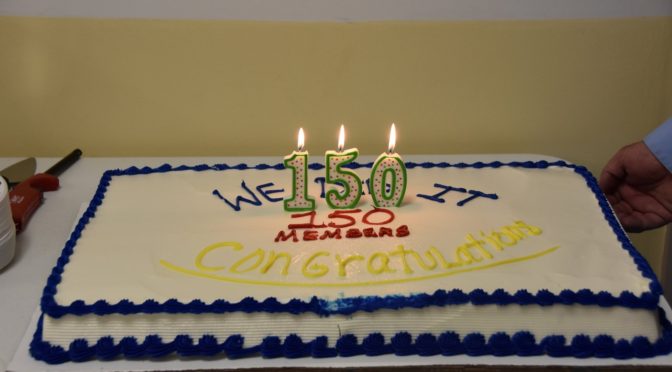
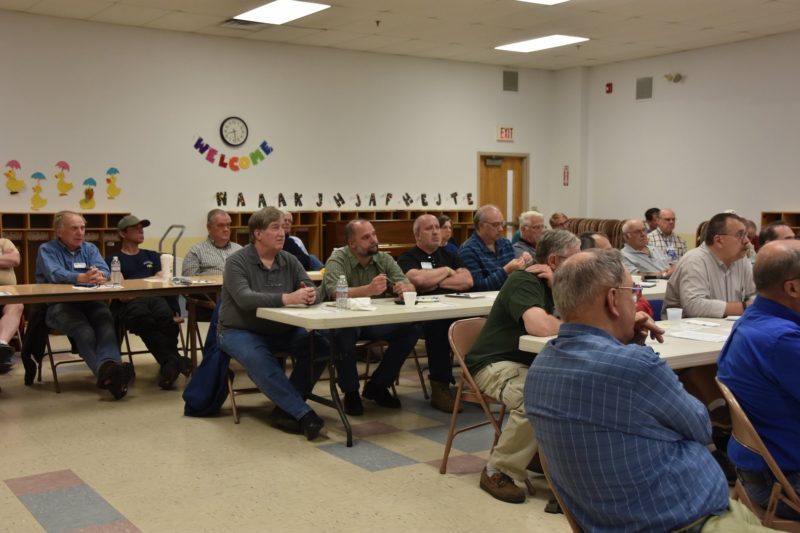
We reached another milestone as of our last club meeting – we have grown the Nashua Area Radio Club to over 150 members! This is the result of a great deal of hard work on the part of many of our club’s members. Welcome to the many new folks who have joined us!
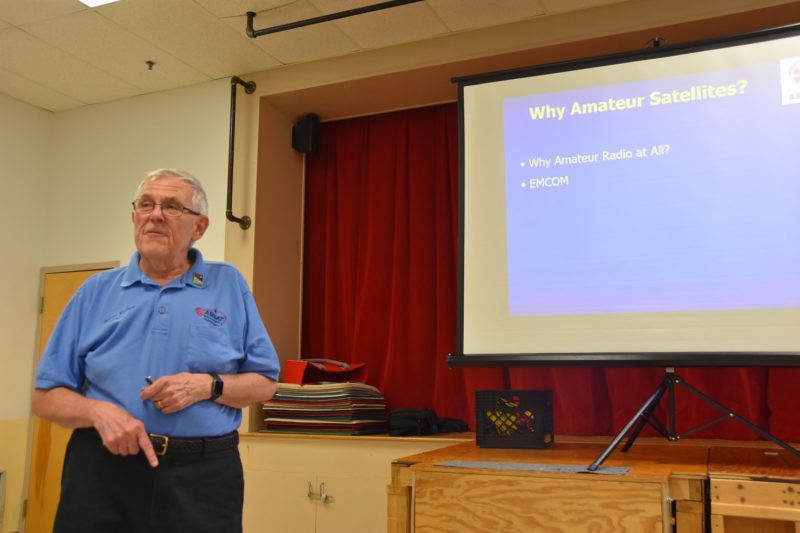
Club member, Burns Fisher W2BFJ, was our speaker and he provided an interesting presentation on AMSAT and Amateur Satellites. Burns wrote the software for AO-85 and his presentation sparked a great deal of interest among club members.
We are looking forward to lots of Amateur Radio fun in the coming months!
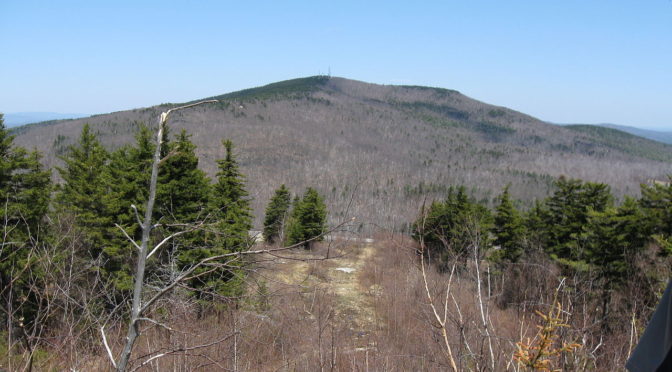
On Saturday, June 10th we’ll be activating Miller State Park (POTA KFF-2662) and Mt. Pack Monadnock (SOTA W1/HA-041) in Peterborough, NH. This is also the date of the ARRL’s June VHF contest! Miller State Park does have an auto road up Pack Monadnock and there is a $4 fee per person. There are picnic tables at the top if you would like to pack a lunch. I am thinking we should plan on arriving at 11:00 am and hopefully set up and ready to go by 12:00 pm.
This should be a great opportunity for a wide range of our members to get out and activate portable. With three activities going on we should have something to tickle your fancy. Below is a quick description of each activity with links for more in depth information.
SOTA is an amateur radio award scheme for people who want to get out and operate portable from mountain peaks. A couple of important rules for SOTA are that you can only activate a peak once in a calendar year – so if you’re using your own call sign you won’t be able to activate Pack Monadnock again until 2018 – and you must operate separately from your car (nothing attached – antenna, battery, etc) and you cannot use fossil fuels. You must operate battery, solar, wind, hydro powered. You may work all modes (CW, digital or voice) on all bands.
POTA (Parks on the Air) is much more lenient, as far as operating possibilities. You, or your vehicle, must be totally within the park and you can operate using fossil fuels (generator or car). Parks can be activated more than once in a calendar year and QSOs are cumulative for the park if you return. Here is a link to a quick description for getting started with POTA. You may work all modes (CW, digital or voice) on all bands.
ARRL June VHF contest begins on Saturday at 2:00 pm and runs through Sunday at 11:00 pm. I have never participated in a VHF contest, but being on top of a mountain can only help!
In order to keep some organization to the activation, I have created a Dropbox file for members to sign up and list any equipment they would be willing to bring.
Let me know if you have any questions, suggestions, etc.
We have been working with teachers from several local schools to create a STEM learning curriculum to help the students involved in our HAB project learn about the science associated with our High Altitude Balloon (HAB) Project.
Merrimack High School HAB Project Students and their Teacher
Our club’s HAB team has prepared materials for and delivered a series of five classroom sessions to each group of students. These sessions have included material on the Atmosphere, the Physics of HAB Flight, and the Radio Technologies (APRS and GPS) used on the HAB.
Bishop-Guertin High School HAB Project Students and their Teachers
We have also shared this material with a group of students who are not part of the two high schools that we are working with on the HAB project.
Additional HAB Project Students, Parents, and Club HAB Team Members
Altogether, we have 13 students involved in our HAB project. The students and their teachers have given us high marks for the STEM learning aspect of the project to date. Here is a sample of the feedback that we have received from the faculty members at the schools who are involved in the project:
I think you did a great job today. I was very impressed with your presentation, the clarity of the material you presented to the students and how well organized your power point was: Simple and to the point. Thank you so much for taking the time to come. … I am excited to see and hear more next week. It is evident that you have a true passion for it and that is conveyed to the students.
Once again, Thank you for the thought-provoking presentation. The students left excited to see your radio station at open house and eager to launch the HAB!
We got together to assemble and test the HAB platform a few weeks back. We did this to ensure that all of the components worked as intended and to determine the actual weight of the platform so we could estimate the HAB’s performance and flight path.
HAB Flight Platform
The platform includes GPS receivers, a flight computer to record location, speed and atmospheric temperature and pressure data, a 2M APRS transmitter to send telemetry data to the ground during the HAB’s flight, and two GoPro video cameras to record video during the flight. All of these systems are working well and the HAB platform is ready for flight. We have also secured the required Helium for our launch.
Balloon Performance Calculator
We have introduced the students to online calculators which they have used to predict the performance of our HAB. The calculator shown above was used to estimate the HAB’s maximum altitude (31,290 m or about 102,600 ft) and how much Helium we will need for the flight.
Jetstream Forecast
The students also learned about the various layers in the atmosphere and how the conditions there will affect the flight path of our HAB.
HAB Flight Path Prediction
We have helped the students use another online calculator which is used to predict our HAB’s flight path. These predictions are only valid about 5 days in advance of the flight and the flight path varies considerably based upon the daily changes in Jetstream conditions. As you can see from the prediction above, we will need to select a launch location in western Vermont or Massachusetts to avoid the risk of our HAB landing in the ocean.
We will be gathering all of the students together for an HAB and Amateur Radio Open House before our launch. The open house activities will include some hands-on work with the flight computer and radio equipment on our HAB, a chance to Get On The Air, learn about Amateur Radio Satellites, and participate in a Fox Hunt.
We are planning to launch our HAB in May from a location near Bennington, Vt. It will be possible to track the HAB while it is in flight via this link to APRS.fi.
We’d like to thank all of our donors for providing us with the funding for our HAB project. Also, a special thanks to all of our club members who have worked on the project and the preparation and delivery of the STEM classroom materials: