Hamming with a multi-band vertical on a small lot means having to compromise on what to do when it comes to being heard. The current down-slide in the sunspot cycle doesn’t help either. The emergence of weak-signal digital modes such as JT65 and JT9 a few years ago from Joe Taylor, K1JT has been a welcome addition to my operating tools. If you are familiar with Joe’s work, JT65 and JT9 are Taylor-made (sorry Joe) for modest stations and simple antennas. The modes sport S/N levels of -20 dB or lower for Q5 copy, far better than an S1 CW signal. I have been happily working DX over the past several months using the WSJT-X program that integrates with its companion JTAlert logging application to link to DXLab Suites.
Anyone who has used these digital modes knows there is a downside to them. They are SLOOOW. A typical QSO takes 6 minutes to complete with nothing more than a report, acknowledgment, and goodbye. It is like watching paint chip and peel. To keep from falling asleep between exchanges, Steve Franke, K9AN has collaborated with Joe to rev up the process.
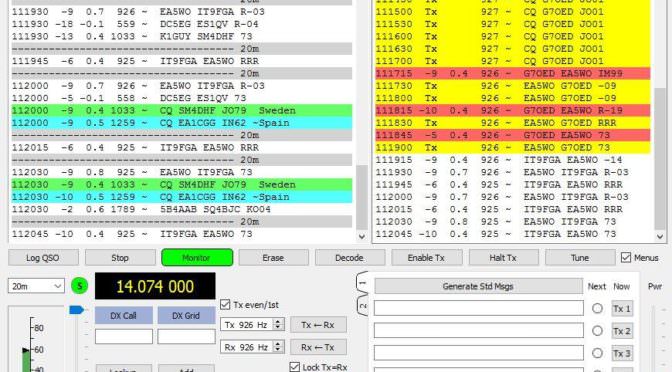
Say hello to the new FT8 mode which is the designation of the Franke-Taylor 8-FSK digital mode that Steve developed to integrate with the existing modes supported by WSJT-X. It is sort of like JT65 with a turbocharger. An FT8 receive and transmit cycle each takes 15 seconds to complete compared to 60 seconds for JT65. A transmit cycle switches to the receive mode after 13.5 seconds. When compared to JT65 that allows 12 seconds between cycles for the operator to select a station or a macro, 1.5 seconds doesn’t leave much time to do anything. Fortunately, the mode supports an auto-sequence QSO mode wherein the next macro is automatically selected during a QSO. The result: a QSO can be completed in 90 to 120 seconds.
I first started using FT8 in late July after seeing a number of spots for stations running the mode. I had to update my version of WSJT-X to the current release. Fortunately, JTAlert also has been updated to capture FT8 for logging. I jumped in to work stations on the new mode and promptly screwed up. I tried in vain to manually select a macro when working a station only to find the previous macro being repeated. After a few busted QSOs, I discovered the program automatically switched to the correct macro in the QSO sequence. This is definitely a cool feature to have.
It did not take me long to realize that I could call a DX station off-frequency to avoid competing with stronger stations calling. If he/she answered me, the program would automatically QSY me to the DX station’s frequency. Slick!
The mode is also tolerant of poor band conditions where signal strengths can change as much as 10 dB between transmit cycles. There have been a number of times where I have repeated a macro several times before getting a response and moving on to the next macro. Under such circumstances a QSO may take three minutes to complete, still better than JT65.
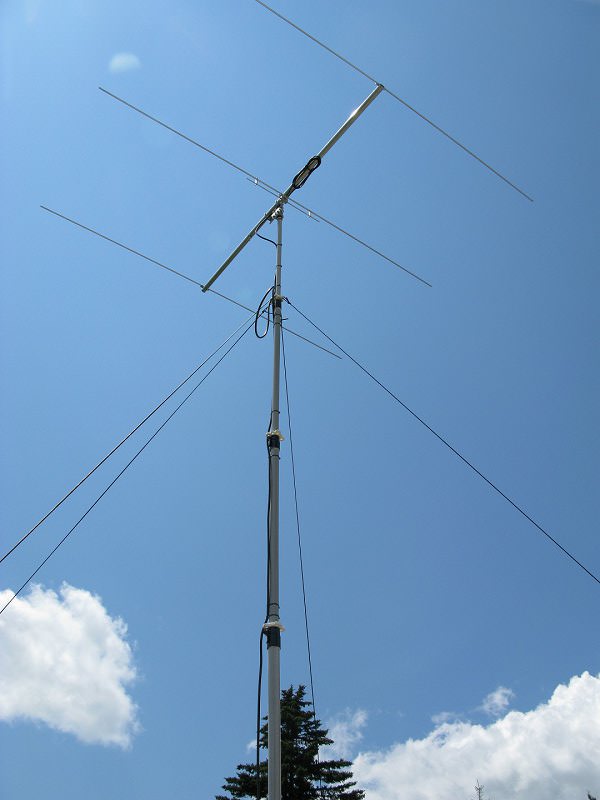
To date, I have worked some 200 stations on FT8, including 49 states, most of Europe and a handful of Far East DX stations. I run 40 watts to a 6BTV multi-band vertical and a 17-meter Moxon in the attic of my garage. QRP purists may be aghast as such a QRO level. However, remember that signal strength is about ERP. A monoband beam with 5 watts beats a quarter-wave vertical at the same power level every time. Remember that a vertical with 200 radials situated on rich Iowa loam (Ok, a salt marsh is better) has a gain several dB below a simple dipole and well below a monoband beam.
As a related note, the club here in The Villages kicked off a friendly competition the first of August to see who could work all 50 states. While most folks have parked themselves on 20 SSB, I decided to go after the states using FT8. The JTAlert logging application maintains a running list of stations heard that includes their states so I don’t have to blindly call hoping I have worked a new one. Like shooting fish in a barrel. It is only a matter of time before my elusive Montana station pops up.
To encourage you to try FT8, why not initiate a club competition to work all 50 states? The modest station requirements and free software make it easy for anyone to give it a try. Finally, if you use Logbook of the World, the ARRL has added FT8 as a recognized digital mode so you can get another neat endorsement.
Ed, K2TE