Tag Archives: VHF/UHF

NARS Winter Field Day Plans

Brian, W1XMM, has opened up his station for NARS members to operate Winter Field Day  (WFD) on Saturday and Sunday January 27th and 28th so that members can operate WFD with the club callsign, N1FD.  Brian’s station is in a great location, in Antrim, NH and should provide for some great operating.

What is Winter Field Day?

Winter Field Day is an annual event, sponsored by the Winter Field Day Association on the last full weekend in January to encourage development of emergency operating skills.  It is open to frequencies on the HF, VHF and UHF bands.  Here is a summary of the rules. The full rules can be found here.

  • All stations are limited to a maximum of 100 Watts PEP
  • QRP CW limit of 5 watts multiplier of 2
  • QRP Phone limit of 10 watts multiplier of 2
  • Each mode worked on each band counts as 1 multiplier
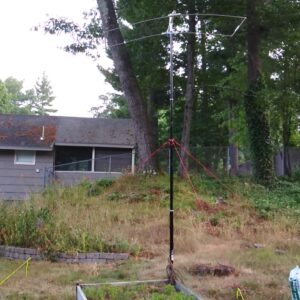
SteppIR DB18
SteppIR DB18 at W1XMM

W1XMM Station

The following stations and associated bands will be available at W1XMM:

  • SteppIR DB18 40/20/15/10/6m with an Elecraft K3S
  • SteppIR Vertical 80/40/20/15/10/6m with a Yaesu FT991a
  • Log Periodic 50MHz -1.2GHz
  • Inverted V: 80M and 160M (one cable out to both)
Log Periodic Antenna at W1XMM

Great Opportunity for New and Experienced Hams!

This is a great opportunity for newly licensed or inactive amateurs to get some operating experience and a top-notch station.  Brian and other members will be available to coach those who are new to HF and VHF operating.

W1XMM Operating Equipment

Emergency Communications

NARS member Jack Ciaccia, WM0G, who is also the ARRL New England Division Assistant Director for Emergency Communications and Public Service, is encouraging amateurs throughout New England to operate Winter Field Day to developer emergency operating skills.   

We have been challenged by the ARES group to also set up an NVIS antenna and communicate with other ARES operators at set times.  This would be both VHF/UHF and HF.  The ARES is going to use this opportunity to test their communication skills here in New England.

SteppIR Vertical Antenna at W1XMM

Join Us

Interested in joining us for Winter Field Day?  Please sign up by Thursday January 25th at 7:00 pm.  Here’s what you can do:

  • Sign up for operating times – See this Forum Post for the link to the sign-up sheet.
  • Join us on Thursday, January 25th  at 7:00 pm for our final Winter Field Day meeting.  See this Forum Post for the Zoom link.  Or contact Brian at [email protected] to get the details if you cannot make the meeting.
  • Show up at Brian’s QTH in Antrim before your operating slot.
 

DIY 6m Moxon Antenna

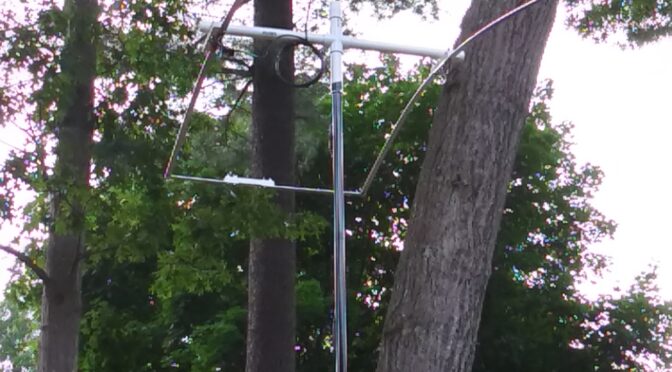
6m Moxon antenna
6m Moxon based on a plan by Bruce Walker N3JO

The ARRL book Magic Band Antennas for Ham Radio by Bruce Walker N3JO has the plans for a 6m Moxon Antenna that I found interesting because, instead of wire or tubing, it uses 3/4″x1/8″ aluminum stock available in hardware stores in 4′ or 8′ lengths.  No bending, just drilling!  I’ve worked on it bit by bit over the last few months or so, and the CQ VHF contest this weekend gave me the extra push I needed to get it up into the air!

I got 8′ sections of the aluminum stock, but I cut the center of the parasitic element (the longest piece) into 2 pieces of less than 4′ each, in case I want to pack the antenna into a car.

The boom is PVC pipe, and for the spacers between the active element and the parasitic element, I used a 1-1/2″x3/4″ vinyl substitute for wood used for trim, which is also available in hardware stores.  I cut it down to 3/4″ wide strips for the insulators between the ends of the elements.  Unlike the book, I used the full width to attach the elements to the boom so that the U-bolts could be attached beside, instead of under and through, the elements.  (It was not at all clear to me from the book’s drawing — no photographs — how the parasitic element was attached to the boom given the bolt positions as drawn.  Also, I may have misunderstood if the author meant 1″ ID or 1″ OD pipe; since it is Pipe, I assumed it was ID.)

I made a coil balun as described in the book, and the UHF connector is mounted on a right-angle piece of plastic cut from an inexpensive outlet box which is a trick suggested in the book.

I put Noalox on the stainless steel nuts and bolts to prevent them from “welding” themselves together and also to protect the aluminum from the stainless steel.

I changed my ideas on how to get it up into the air a couple of times, and today I finally just went and got an MFJ-1911 lightweight fiberglass mast and a set of MFJ-2830X guy rings at our local “candy store.”  (I wish there were a ring in the set with an even larger center hole.)  I did not extend it to the full 20′ (yet, anyway) because I was concerned that the antenna was too heavy, so it is only about 14′ up in the air now.

I used hose clamps (threaded through a water drain tube, so the clamps don’t cut into the mast) above each exposed joint in the mast to give added protection against the “twist lock” mast unlocking and collapsing into itself.  I put another one around the base with loops of paracord through it that I can hold down with tent stakes, in addition to putting the base of the mast against one of the raised garden beds to keep it from slipping.  (I’m sorry, I don’t recall which video blogging ham I learned those hose clamp tricks from.)

6m Moxon antenna
6m Moxon based on a plan by Bruce Walker N3JO before it was raised up

The 6m Moxon Antenna ended up being tilted slightly (actually, rotated around to be almost upside-down!), but I’ve got some U-bolt saddles on order to fix that.  (They’ll be the two pieces of metal besides the aluminum elements that aren’t stainless steel.  Unfortunately, I used a smaller size U-bolt than what seems to be the “standard” for antenna masts of about 2″ inside diameter for the U-bolts.)  I made an extension that screws in above the vertical piece of PVC pipe through the boom so that I could add support ropes for the insulators far out from the center of the antenna, but I haven’t put it on yet to save weight.  (I may replace the mast with a heavier-weight product from MFJ to allow this and to raise it higher.)

6m Moxon antenna
6m Moxon based on a plan by Bruce Walker N3JO

As you can see below, the minimum SWR is 1.0 at about 52,140 MHz, not the point in the 6m band where I would like it for FT8, but at least it is in the lower half of the band.  (I haven’t thought about how to tune it or if I need to.  But I do know that I want to replace the thin coax feeding the antenna now with LMR-400.)

SWR curve hitting 1.0 at about 52,140 MHz

With much-appreciated help from my XYL Merle W1MSI, I was able to get the DIY 6m Moxon Antenna up late this afternoon and try it out before the band closed for the day.  The “magic band” did what it does, and I was able to make 27 QSOs on VHF with FT8, from my shack in FN42 (southern New Hampshire) to as far as EL98 (Florida) and  EN52 (Wisconsin).  So I think the antenna is working pretty well.  It is the first beam antenna at my shack.

For a while there, I was happily collecting DXCCs and US states on HF with SSB, but then I discovered FT8, and after that FT4, and now I’ve got grid squares to collect on VHF — so I have even more paper to chase!

Aron, W1AKI

Register Now for Ham Bootcamp!

Are you a newly licensed Technician, or a General or Extra and have never been on the air or built a station?  Are you a prospective ham but would like to learn more about Amateur Radio activities?  Ham Bootcamp is the program for you.  We will be holding another online Ham Bootcamp on Saturday, May 14th, 2022.

Registration is open for the Nashua Area Radio Society’s Spring Ham Bootcamp.  Ham Bootcamp will be held online using Zoom web conferencing.   This will also let us reach out to new Hams across the country.

Jamey, AC1DC, elmers Randall, KC1KSY as he makes an HF Contact
Jamey, AC1DC, elmers Randall, N1KRB  as he makes an HF Contact

Our spring Ham Bootcamp will be held on Saturday, May 14th from 10:00 am to 6:00 pm Eastern Time.  The morning session will focus on Technician level activities and the afternoon session will focus on HF activities for General and above licensees.   New this year will be a breakout session where attendees will have a choice between 3 different sessions.

Here is the agenda:

Abby on Fox Hunting
Abby Speaks About Fox Hunting in Fall 2020 Ham Bootcamp

Repeaters and VHF/UHF Session Activities

  • Putting together a Station for Repeaters – How to pick an HT or  Mobile Radio and an Antenna
  • Making Contacts and Joining a Repeater Net
  • Radio Programming Tutorial
  • Getting Started with Amateur Radio Satellites
  • Getting started with Fox Hunting
Jamey Explains HF Station Building

HF Session Activities

  • Putting together an HF Station for SSB, CW, and Digital
  • Picking and putting up an HF Antenna, Feedlines, and Grounds
  • Operating on the HF bands using SSB Voice
  • Getting started with WSJT-X and FT8 Digital

Breakout Session

The final session of the day will be a breakout session where attendees will choose to attend one of the following 3 sessions:

  • Learning CW
  • Finding DX, Logging Contacts, and QSL’ing – Getting them logged/confirmed
  • Portable Operating

Spring 2022 Ham Bootcamp will be Online on May 14th

Registration is now open for the May 14th session.  You can get more information about Ham Bootcamp at https://www.n1fd.org/ham-bootcamp/.

Each attendee should register separately using this link.   After registering, you will receive a link that will allow you to register for the Zoom meeting.  Following the Zoom meeting registration, you will receive a personal Zoom link via email.

Any questions about Bootcamp?  Contact me at [email protected]


Anita, AB1QB

Radio Amateurs Developing Skills Worldwide