Tag Archives: NARS Event

A Portable Satellite Station Part 1 – A Simple Station for AO-85

Our club has quite a few members who are interested in space communications. We decided to build a simple portable satellite station last year for our 2016 Field Day operation to learn about satellite communications and to create something new for folks to work with during 2016 Field Day.
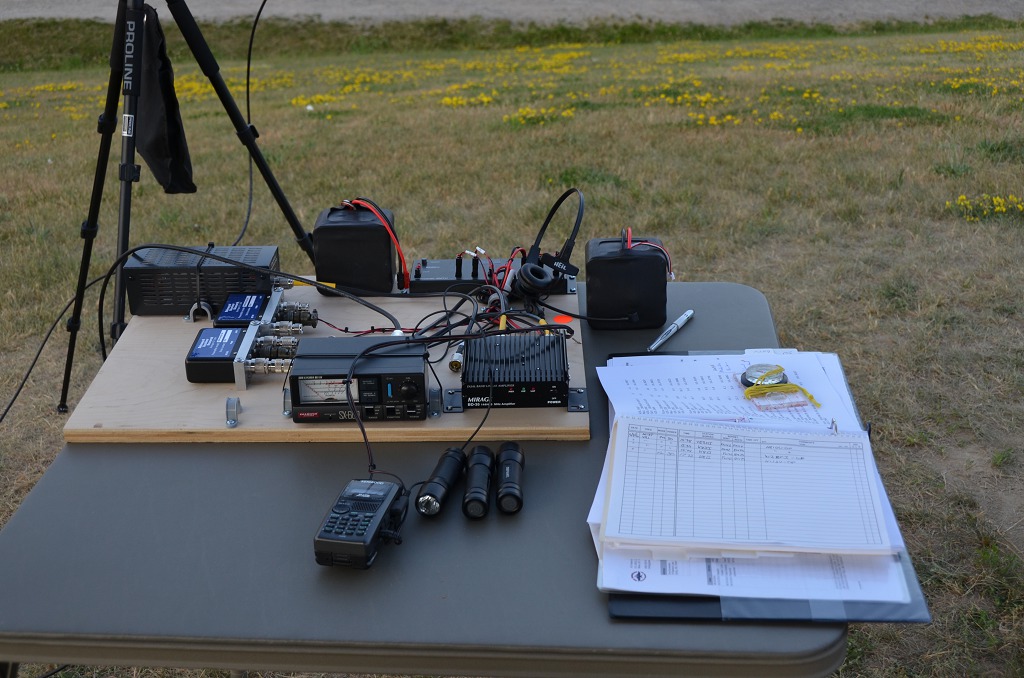
Simple Portable Satellite Station

Our 1.0 Portable Satellite Station was a relatively simple setup built around an HT, an Elk 2m/70cm satellite antenna, and some gear to improve the receive performance and transmit power output of the HT. All of the gear was mounted on a board to make it easy to transport and it is powered by a LIPO rechargeable battery. The gear in our 1.0 station is made up of the following:

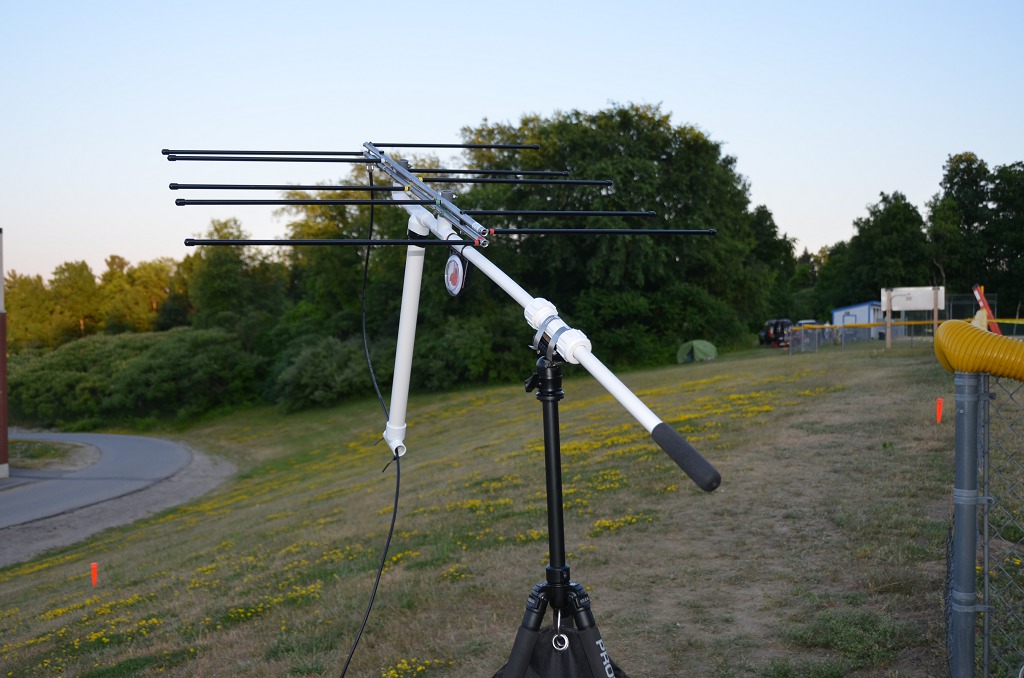
Improved Portable Satellite Station Antenna Support
Improved Satellite Antenna Support

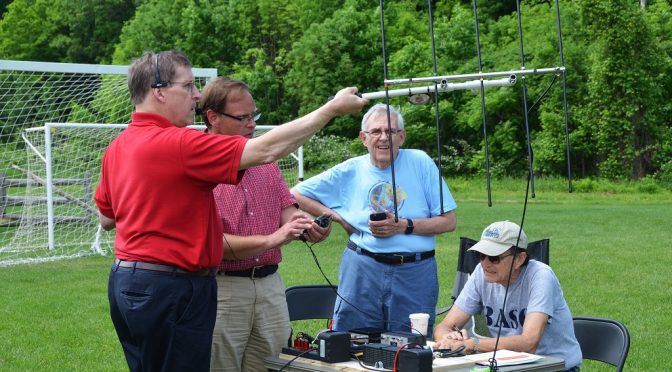
Our first contacts with our 1.0 station were made using the Elk Antenna hand-held. Later, we created a “plumber’s special” setup with a camera tripod to make pointing the antenna easier. Note the angle meter from a local hardware store which measures the elevation angle of the antenna.
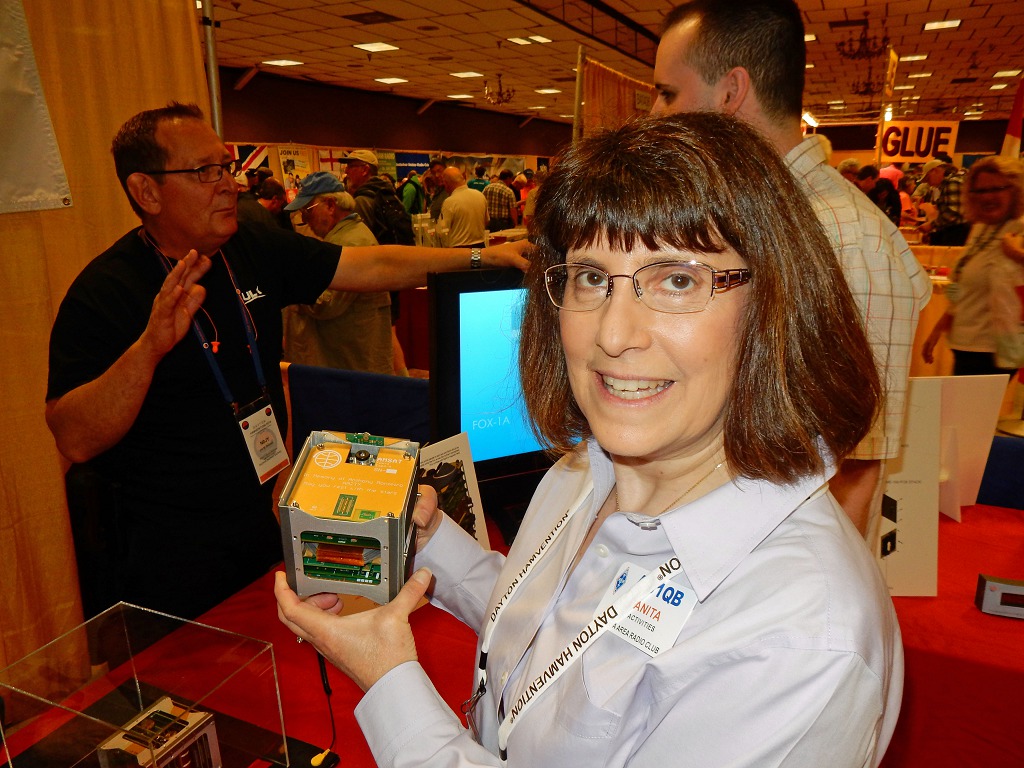
AO-85 (Fox-1A) U/V Mode FM Cube Satellite

This setup worked great for making FM contacts through AO-85 (Fox-1A), a  U/V mode FM EasySat. We used the 1.0 station on multiple occasions including Field Day 2016 and several of our club members used it to make their first satellite contacts. The Full-Duplex HT allowed us to hear our own signal coming back from the satellite which was an important tool to help with aiming the antenna properly. The ELK Dual-Band antenna is also a good choice because it uses a single feed point and a single polarization for both the 2m and 70cm bands.
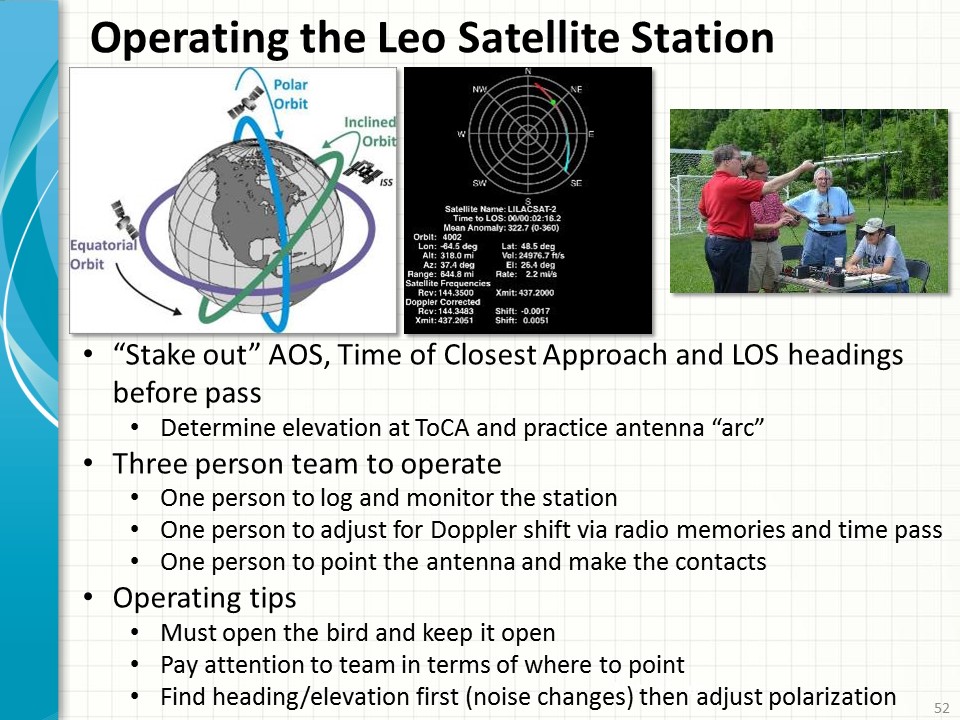
Portable Satellite Station Team Operating Approach
1.0 Station Team Operating Approach

We used the team operating approach outlined above. This worked especially well for new folks who had not made a satellite contact before as it enabled each of the three team members involved in making the contact to focus on a specific part of the contact. We used orange plastic tent stakes to make AOS, Time of Closest Approach, and EOS to mark headings for each satellite pass. Small flashlights used at the stakes made them glow for night-time passes.

We certainly had a lot of fun with our 1.0 Satellite Station and I expect that we’ll continue to use it. As we gained a little experience with AO-85, we decided that we wanted to build a more capable Portable Satellite Station which we could use to operate with linear transponder satellites and which included a tracking system and better antennas. I know from experience with our home satellite station that DX contacts are possible using higher altitude linear transponder satellites like FO-29.

We would also like to be able to use APRS and other digital modes through satellites as well as receive SSTV pictures from space.

These goals have become the basis for building our Portable Satellite Station 2.0. More on the new station in Part 2 of this series. Other articles in the series include:

You may also be interested in the satellite station at our home QTH. You can read more about that here.

73,

Fred (AB1OC)
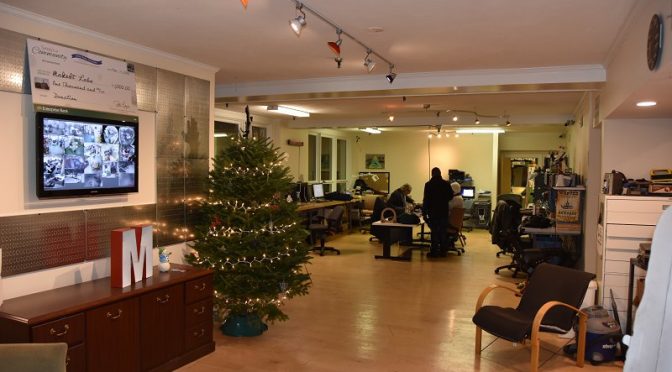
Amateur Radio at MakeIt Labs

On Saturday, January 28th the Nashua Area Radio Club (Nashua ARC) will be hosting a special event for Interested kids, parents, and friends in the community about the joy of amateur radio at MakeIt Labs in Nashua from 9:00 am – 3:00 pm. You may drop in at any time and stay as long as you like to participate! Among our activities, you can:

Get-On-The-Air Station (GOTA)

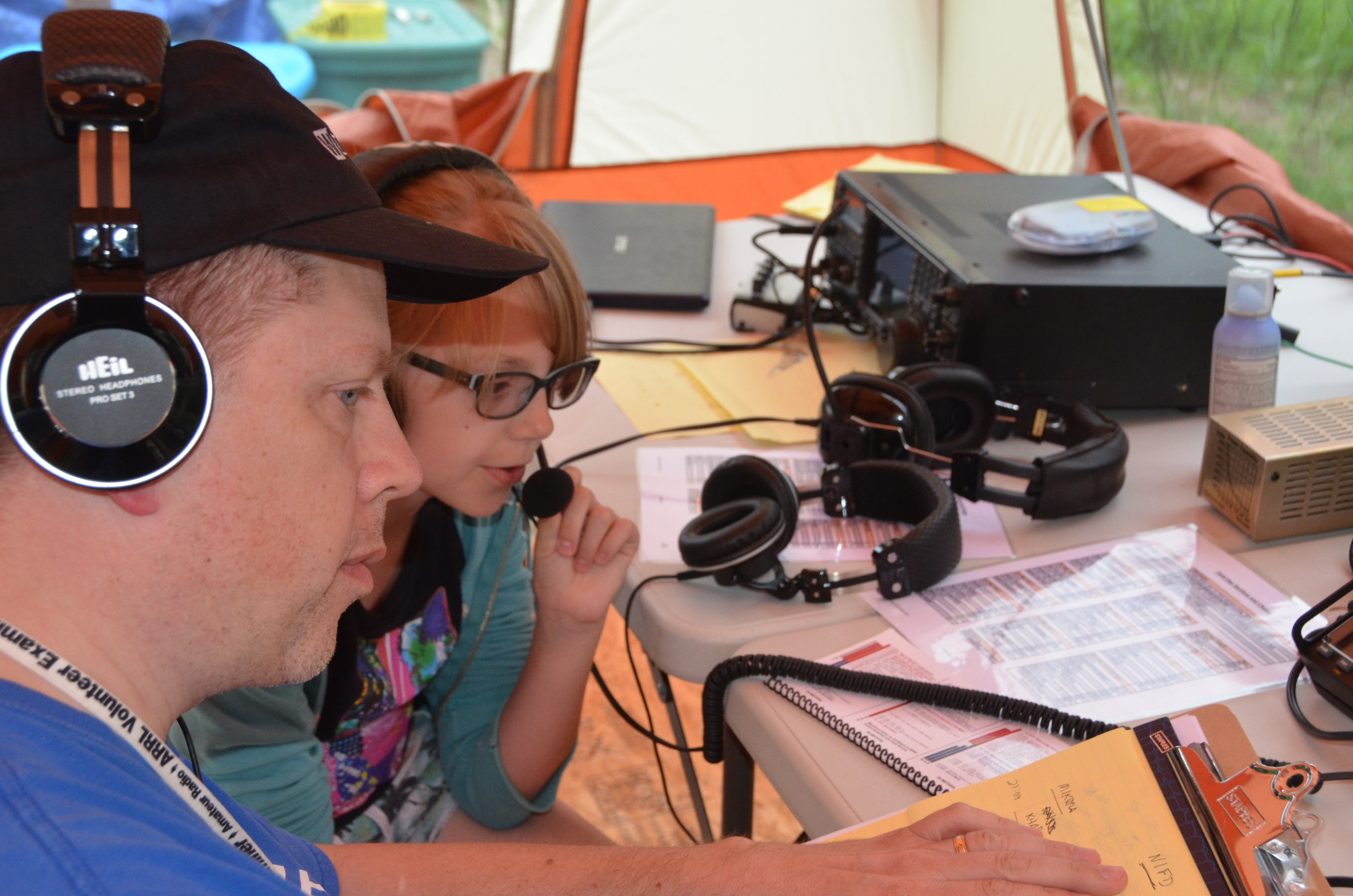
Ham Radio GOTA StationThis is amateur radio at its best and what it’s known for! We invite you to get on the air and make a contact (we call them QSO’s — pronounced: cue-so) somewhere in the world! You might be able to make a new friend in Germany or even Japan! Making contacts sits at the heart of amateur radio and is an activity that brings people together. So don’t be shy, step up, and hit the push-to-talk button!

Satellite Station Display

AMSAT LogoThe Radio Amateur Satellite Corporation (AMSAT) began in 1969 to foster amateur radio participation in space research and communication. Currently, AMSAT groups help advance the state of the art in space science, space education, and space technology. Come learn about what components go into constructing a station capable of contacting a satellite and what antennas, and smart phone apps, operators use to keep a pulse on the satellite location.

Digital Amateur Television (DATV)

DATV Transceiver RackNot only are amateur radio operators granted privileges to transmit speech, but we also can send fast-scan data such as TV signals! Many operators have experimented with how to homebrew their own fast-scan TV stations, and our club president Fred (AB1OC) and our member Skip (K1NKR) have chosen to use construct a station which uses a Raspberry Pi (RPi) with an Arduino shield to sit at the heart of the transceiver. The RPi is the brains of the TV which runs Linux and among other things is responsible for sequencing, transmit/receive control, automatic VSWR monitoring, and a touch-screen controlling interface to configure and operate the system. Learn about what it takes to build and operate one of these stations. We may even be able to make a contact! More information can be found at https://stationproject.wordpress.com/category/amateur-television/.

Kit Building with Nashua ARC

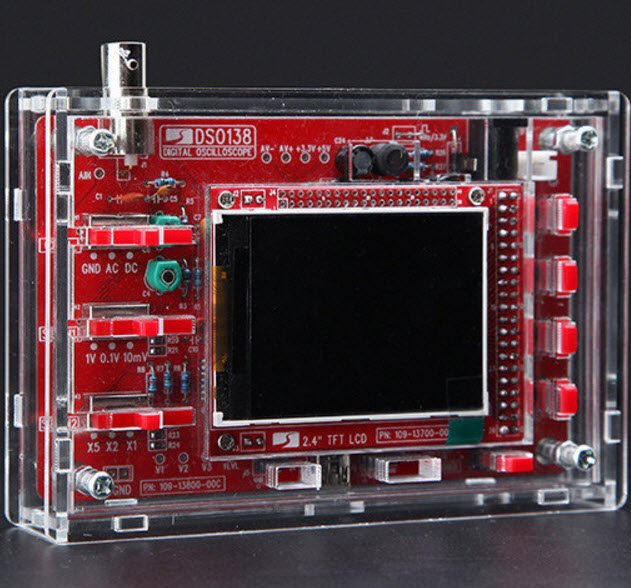
Oscilloscope KitThe Nashua ARC holds kit-building nights were both inexperienced and experienced members homebrew in a relaxed, learning environment. In the past, we have built Pixie QRP (low-wattage) kits transmitting Morse Code on the 40m amateur band. But, on February 18 from 1 – 5 pm, First Church in Nashua, Nauss Hall, we will build the digital oscilloscope kit DSO138 (shown to left). This kit comes with a clear acrylic case to protect it, build instructions, and among its specs has a 1 Msps sampling rate, 12-bit accuracy, 200 kHz bandwidth (good for audio signals), capable of freezing the waveform display, and comes with a 1Hz / 3.3V test source. We invite you to join us and will bring some kits with us. More info can be found on our website at https://www.n1fd.org/2016/03/27/inexpensive-diy-digital-oscilloscope-kit/.

We hope you will join us for our event! Please bring friends, family, but most importantly we want you to have fun and enjoy this hobby with us!!

Contact Information

Brian Smigielski (AB1ZO): [email protected]
Jamey Finchum (KC1ENX): [email protected]

Our Club Moving Forward Into 2017

Our club has accomplished a great deal in the last year. We have grown to over 130 members. We have introduced many new people to Amateur Radio, helped them to earn their Licenses and worked with them to get on the air and develop their knowledge and operating skills. We’ve also worked hard to provide opportunities to enjoy and learn about Amateur Radio for members of our club and for the Amateur Radio community which we are a part of.

Much of the credit for our club’s success this past year belongs to you, our members. We very much appreciate all that you have done to contribute to our success and the fun that we have all had as part of what we have done together. Your enthusiasm and support provide great encouragement and inspiration to the many new members who have joined us as well as to all of us who are part of our club’s Leadership Team.

We, as your club’s Executive Committee, have been working on a set of goals and plans to continue on this path during 2017 – to provide even better opportunities for our members to learn more about and to enjoy Amateur Radio, to continue to encourage people to join the Amateur Radio Service, and to provide opportunities for STEM learning for young people.

Our goals and focus for 2017 centers around continued success in and focus on the following areas to benefit both our members and our community as a whole:

To do these things and to be successful as a growing club, we are also pursuing status as a 501(c)(3) non-profit. This will enable our club to more effectively secure support from other groups to further our work towards these goals.

Each of us has taken ownership for creating a focus on meeting different aspects of our goals for this year. We are planning to share more about our plans for 2017 at our February Club Meeting.

We are asking that each of you, as members, to consider how you can get the most from all of these and the other opportunities that our club provides. We are working hard to try to create something for everyone that can provide enjoyable opportunities to have fun, to contribute, and to expand the value that we all create and derive by being part of the Amateur Radio Service. We are also asking each of you, our members, to consider helping us with these initiatives in 2017.

  • Jamey Finchum, KC1ENX – Membership Chairman
  • Anita Kemmerer, AB1QB – Activities Chairman
  • Brian Smigielski, AB1ZO – Programs Chairman
  • Mike Ryan, K1WVO – Interim Secretary
  • Wayne Wagner, AG1A – Treasurer
  • Greg Fuller, W1TEN – Vice President
  • Fred Kemmerer, AB1OC – President

Radio Amateurs Developing Skills Worldwide