Tag Archives: Mentor

20m Vertical Dipole

My main antenna is a full wave 40m delta loop which also matches well across 20m. While the match is good the pattern is not ideal for DX. EZNEC predicts numerous nodes and nulls and a high take off angle. I have been looking for a better 20m DX antenna while I wait to get a beam up.

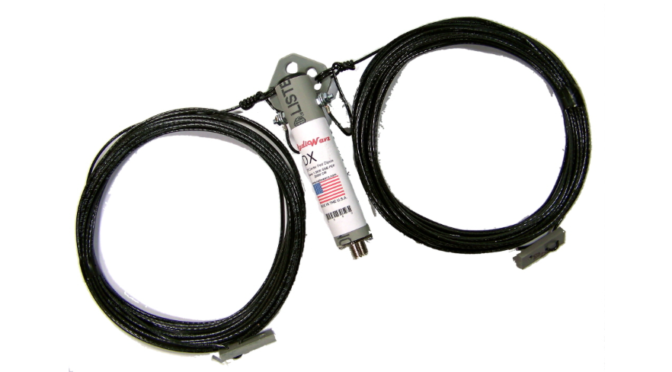
At the Club’s (N1FD) recent VE session a Radio Wavz 20m Dipole was described as having good DX performance when mounted as a vertical.  At $39 including a 1:1 choke balun, I decided to try it.

I shot a rope over a branch at 65′, attached and sealed the coax, and hauled the dipole up. The coax needs to come away from the vertical at roughly 45° to minimize the coupling to the lower antenna wire.

Vertical Dipole - The Balun is hung at a right angle
Figure 1 The Balun is hung at a right angle

A paracord is attached to Balun in the opposite direction from the coax to oppose the pull of the coax and is needed to keep the antenna wire vertical as shown in Figure 1.

I used a water bottle to weigh down the lower wire which allows the antenna to move with the tree to avoid damage during high winds.  Figure-2 shows the Delta Loop and to its right the Vertical Dipole. It is difficult to see the Vertical, the green water bottle can be seen just below the center of the figure.

Delta Loop and Vertical Dipole (right)
Figure-2 Delta Loop and Vertical Dipole (right)

After the initial installation, the first step was to measure the VSWR. This can be done using the radio’s VSWR meter or an antenna analyzer. If the antenna had to be brought down to adjust its length I wanted to do it before I secured the cables and finished the installation.

The antenna analyzer measured a <1.8:1 VSWR from 13.4 MHz to 14.35 MHz. A good match over 1 MHz of bandwidth is very good. The resonate point with a 1.2:1 VSWR was at 13.9 MHz. The antenna was long which is normal “out of the package” without any tuning. With a little shortening, the match was <1.5:1 across the entire 20m band and less than 1.2:1 at band center. This is better than EZNEC predicted. The VSWR measurement includes 100′ of LMR-400 which will improve the apparent match a little. I suspect most of the improvement is from the interaction with the angled coax. It is also possible the balun isn’t a perfect 1:1 as described by Radio Wavz. The antenna has a very good match across the full band and does not need a tuner.

The vertical dipole’s noise floor was S3 (-106 dBm 3 kHz BW) which is good. I had assumed it would be much higher because it was a vertical. It is only an S unit higher than the Delta loop which measured S2 (-111 dBm 3 kHz BW).

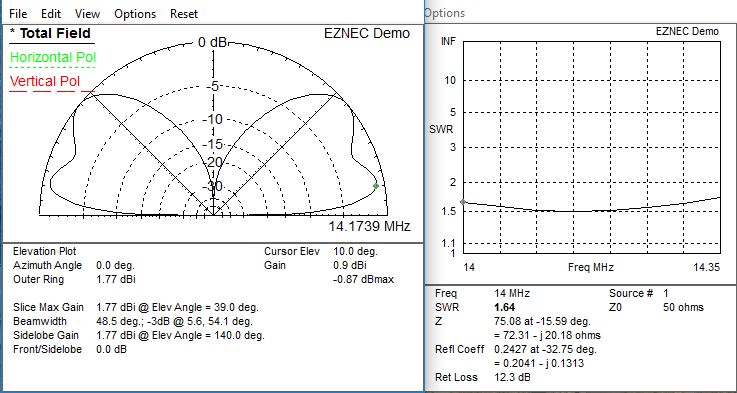
EZNEC shows a low 10-45 degree take off angle and no NVIS capability with the top of the vertical dipole at 65′ as seen in Figure 3.
Vertical Dipole EZNEC Analysis at 65' height over poor ground
Figure 3 EZNEC Analysis at 65′ height over poor ground

Based on EZNEC it should be better for DX than for local communications.  In practice, this is the case.

For the first test, I tuned into the afternoon 20m Net. Most of the stations are within 400 miles of my QTH. The Delta Loop had a 10 dB to 20 dB SNR (signal to noise ratio) advantage at this range. An Agilent spectrum analyzer was used for these measurements.  Tuning the band I found Vancouver BC, WA, OR, CA, and Ireland. Only Ireland could be heard with the Loop. I have never heard any 20m stations in the Pacific NW  while using the loop.

The next test was to use the RBN (Reverse Beacon Network) to measure the antennas DX performance. For those unfamiliar with RBN, there are roughly 140 stations worldwide that are connected to CW Skimmers. Using CW you send a series of CQs and your call sign. If you are detected you are added to a Spot Collector which is accessible on a website or via telnet.

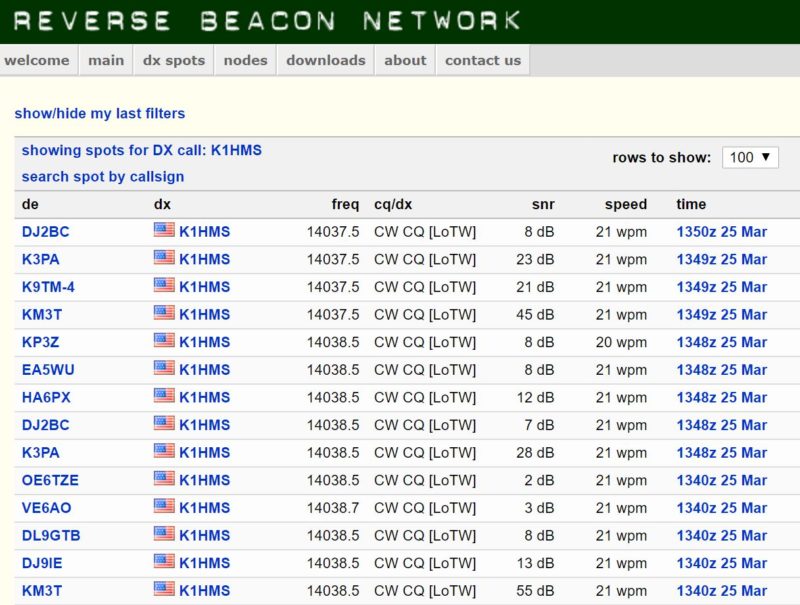
I transmitted on 14,037.5 when using the Loop and 14,038.5 when using the Vertical Dipole.  By using two frequencies I could tell which antenna the Spot was reporting. Also, most of the RBN stations will not respond to a second call too soon after reporting the first intercept. With a quick QSY, I could transmit on the opposite antenna without waiting. Figure 3 is a sample of the RBN Spots.
RBN Spots
Figure 3 RBN Spots

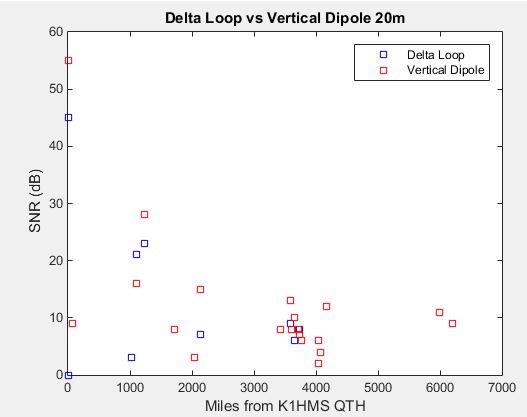
I plotted the distance to the Spots versus the reported SNR. This can be seen in Figure-4. The number of RBN nodes is limited and some of the nodes listed on the RBN website might not be available, especially during this weekends SSB contest.   Also, the band conditions will impact the range and number of stations reached.
Delta Loop vs. Vertical Dipole - SNR versus Range
Figure-4 SNR versus Range

Note that where two data points (Red and Blue) are at the same range and therefore directly above each other both antennas were spotted by the same station.   If the Spot could hear the Loop it always heard the Vertical Dipole but there were many times the Spot heard the Vertical Dipole and not the Loop.

KM3T is only 3.1 miles from my QTH. As seen in the RBN screen capture and on the plot the SNR with the Vertical is 55 dB and only 45 dB with the loop. The plot also shows an SNR=9 dB data point for the Vertical near the Y axis and no matching Blue data point for the Loop. This station was 70 miles away in MA. Both of these data points rely on ground waves and the Vertical Dipole has an advantage when compared with the Loop.

Overall beyond 1000 miles the Vertical Dipole clearly performs better than the Delta Loop and will definitely add DX to a log.

In summary when mounted high the vertical dipole retains the low take off angle of a 1/4 wave ground mounted vertical. It does not need ground radials and ground losses are reduced. It can be placed above obstructions such as a barn or house. It only needs one high support and it does not require a tuner.

It isn’t a hex beam or a yagi due to the impact of ground losses on the gain, but at $40, no tower required, it is a great antenna. It is very stealthy as well.

Hamilton, K1HMS
Why Ham Radio?

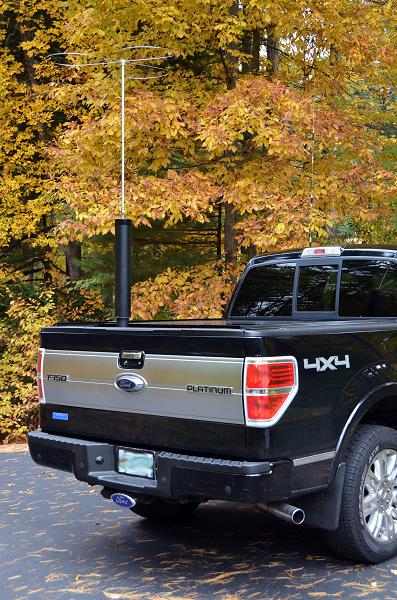
Why Ham Radio - Fred's Truck Antenna
Fred’s Truck Antenna

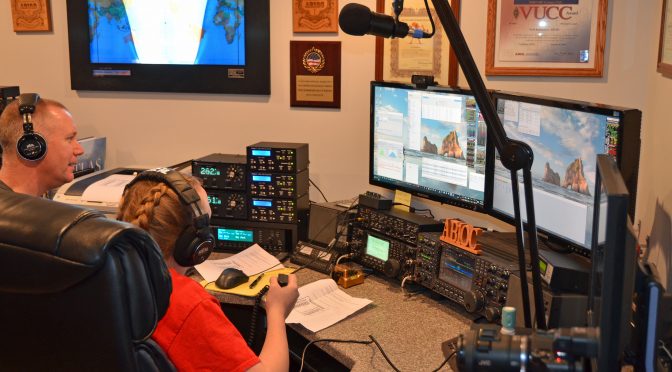
Sometimes I drive Fred’s truck into work and people ask me what that big antenna on the back of the truck is for. I explain to them that it is for Ham Radio.  But the reply is usually “Why ham radio?”  Isn’t that outdated technology?  We have cell phones and IM, etc…what do we need Ham Radio for?  Here are my thoughts as a relatively new Ham about why I enjoy spending much of my time with Ham Radio.

Why Ham Radio - Amateur Radio for Public Service
Amateur Radio for Public Service

Public Service

The number one reason we still need Ham Radio along with all the other technology is for public service.  When there is a disaster and cell phones, television, … are all not working, Ham Radio operators provide critical communication.

Ham Radio operators help locally to keep hospitals and first responders in contact with each other to help those affected by the disaster.

We also use our ability to communicate around the world to help family members to get in touch with loved ones affected by a disaster.

Ham Radio operators have been on the scene helping in every disaster from the earthquakes in Nepal to the recent flooding in California.

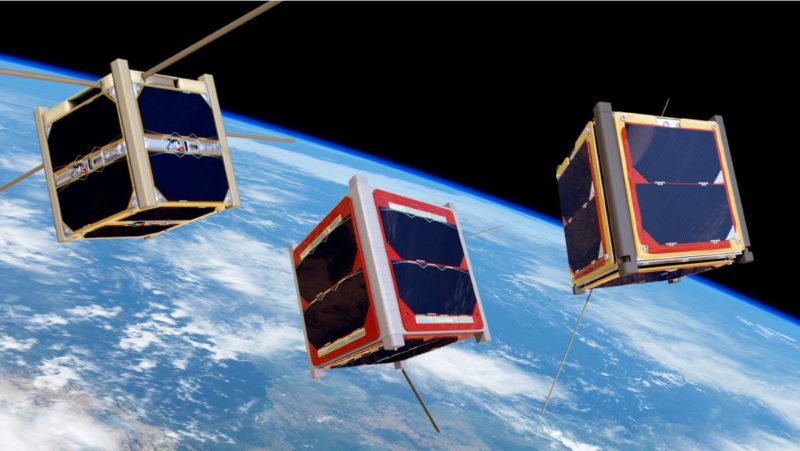
Why Ham Radio - Amateur Radio Cube Satellites
Amateur Radio Cube Satellites

Technology and the Maker Movement

I only became a Ham 5 years ago but many of my fellow Ham Radio operators got their license when they were in their early teens. Some have used what they learned to launch their careers. Many have had successful careers in STEM fields, all launched by their interest in Ham Radio at a young age.  As technology advances so does the technology used in our hobby.   We even have a Nobel laureate, Joe Taylor K1JT who is a ham. Joe has developed weak signal digital communication modes that let us communicate by bouncing signals off the moon!

As technology has advanced, so has the use of it in Ham Radio.   Most Ham Radio operators have one or more computers in their shack.  Many also have a software designed radio (SDR), where much of the radio functionality is implemented using Software. Hams use sound cards to run digital modes, which are a lot like texting over the radio. We use the internet extensively as part of operating.  We can also make contacts through satellites orbiting the earth and even the International Space Station.

Homebrewing

Most hams love do-it-yourself technical projects – building a station, home brewing an antenna, building a radio or other station component.  In my day job, I am a program manager for software development projects.  It has been a while since I have built anything myself.  As a Ham, I taught myself how to code in Python and about the Raspberry Pi and I built the DX Alarm Clock.

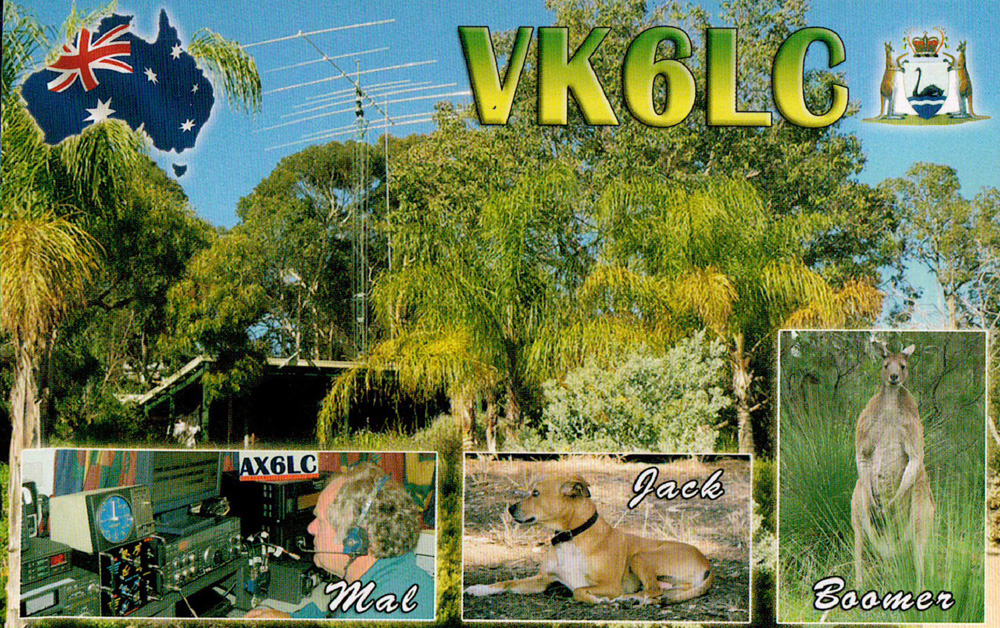
Why Ham Radio - QSL Card from VK6LC in Western Australia
QSL Card from VK6LC in Western Australia

International Camaraderie

One of the coolest things about being an amateur radio operator is that you can communicate with other hams all over the world. Ham Radio is an international community where we all have something in common to talk about.  That is our stations and why we enjoy ham radio.    The QSL card above is from a memorable QSO with Mal, VK6LC, from Western Australia, who was the last contact that I needed for a Worked All Zones award.  I must have talked to him for 1/2 hour about his town in Australia and his pet kangaroos!

Why Ham Radio - Amateur Radio Map of the World
Amateur Radio Map of the World

Geography Lesson

I have learned much about geography from being on the air and trying to contact as many countries as I can.  There are 339 DX Entities, which are countries or other geographical entities.  I have learned where each one is in order to understand where propagation will allow me to make a contact.  I have learned a great deal about world geography. Through exchanging QSL cards often get to see photos from so many areas of the world.

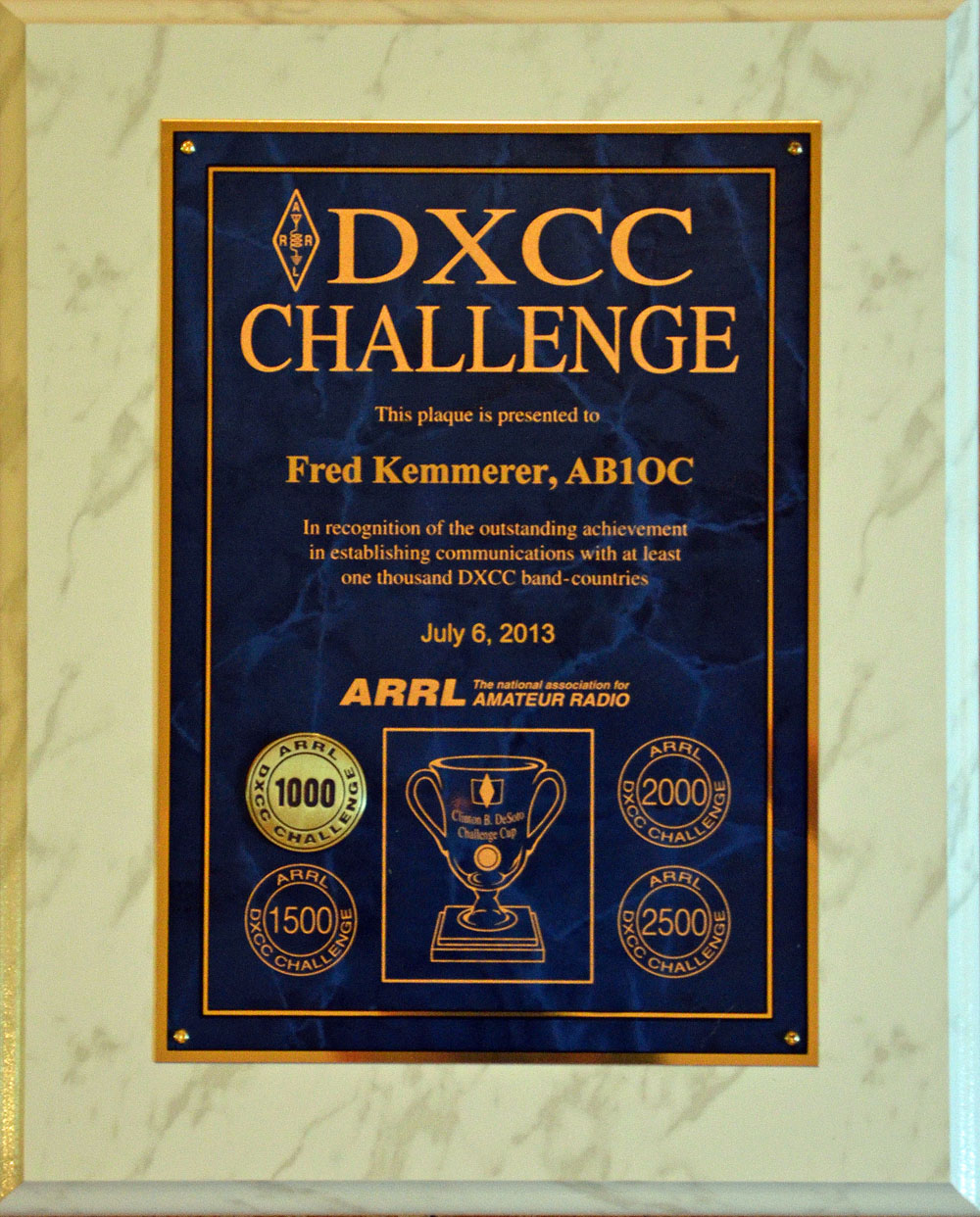
Why Ham Radio - DXCC Challenge Award Plaque
DXCC Challenge Award Plaque

Achievement – DXing and Contesting

DXing and Contesting provide a sense of achievement and exciting opportunity for competition. Many Hams work toward operating awards. You can get an operating award for contacting all 50 states or contacting 100 or more countries.  There are also awards for contacting Islands, cities in Japan, countries in Asia, or anything else you can imagine.  Each of these operating awards provides a sense of accomplishment and helps to build skills.  Contesting builds skills through competition among Hams to see who can make the most contacts with the most places in 24 or 48 hours. Contesting also improves our operating skills and teaches us to copy callsigns and additional data accurately.

Why Ham Radio - Teaching a License Class
Teaching a License Class

Teaching Licensing Classes – Passing it On

Recently I joined a team of club members who teach license classes to others who want to get licensed or upgrade their existing licenses.  Teaching provides a way to improve my presentation skills. It also helps me to really understand the material that we teach about Amateur Radio.  It is a thrill at the end of the class to see many people earn their licenses or upgrades.

There are so many interesting aspects of Ham Radio which are what makes it such a great hobby.  Getting your license can open up a world of possibilities.  Upgrading to a new license class provides more opportunities to communicate over longer distances.  Our club provides many resources to help you get your first license, upgrade to a new license class, and learn about the many aspects of our hobby.

Anita, AB1QB

January Tech Night Making the Most of Your HF transceiver

The January Tech night was about getting the most out of your HF transceiver. Fred had an interesting  PowerPoint presentation where he demonstrated how to do just that. For anyone else new to HF, I wanted to comment on it here. In his presentation, he described how you should use filtering first and digital signal processing (DSP) as a last resort. That’s the exact mistake I was doing. if you use a lot  DSP with a narrow filter selected the audio sounds hollow and really difficult to listen to. If you turn off the DSP  select the narrow filter and then bring up the DSP if needed you get less noise and a pleasing audio output. Also turning down the AF gain can be your friend too!

73 and good DXing

-Jim.   K1BMR

Radio Amateurs Developing Skills Worldwide