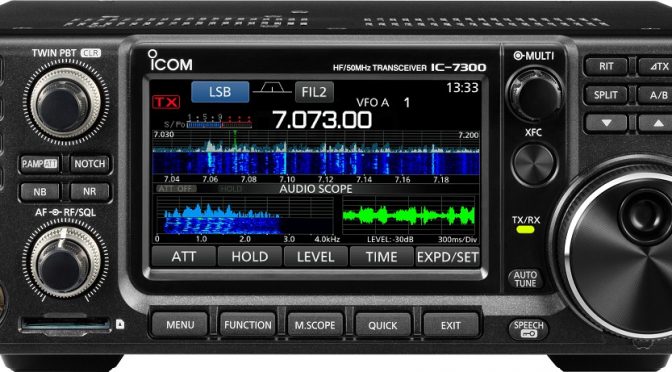
There’s one thing that was annoying me about the new IC-7300, and that was that the USB connection to the computer did it all: radio control, soundcard codec, PTT/CW. That’s great, and …
Source: Icom IC-7300 USB for Radio Control + FSK Keying By: Cedrick Johnson
This is a great article for folks who want to do RTTY with an IC-7300 transceiver. FSK RTTY is much easier to use than the AFSK/Sound Card approach. You can read more articles about digital modes on our Blog.
John Keslo, W1MBG, Jamey Finchum, KC1ENX, and I recently had the chance to again be part of SPARK Day at the Academy for Science and Design (ASD) in Nashua, New Hampshire. We attended SPARK Day to provide an Introduction to Amateur Radio for the students at ASD. ASD’s goal is to be a world-class school that specializes in science, engineering, mathematics, and design. The school provides education for students in grades 6-12. ASD periodically holds SPARK (Symposium Promoting Advancement of Real-world Knowledge) conferences, which enable ASD students to learn about areas which might help them to develop careers in Science, Technology, Engineering and/or Math (STEM).
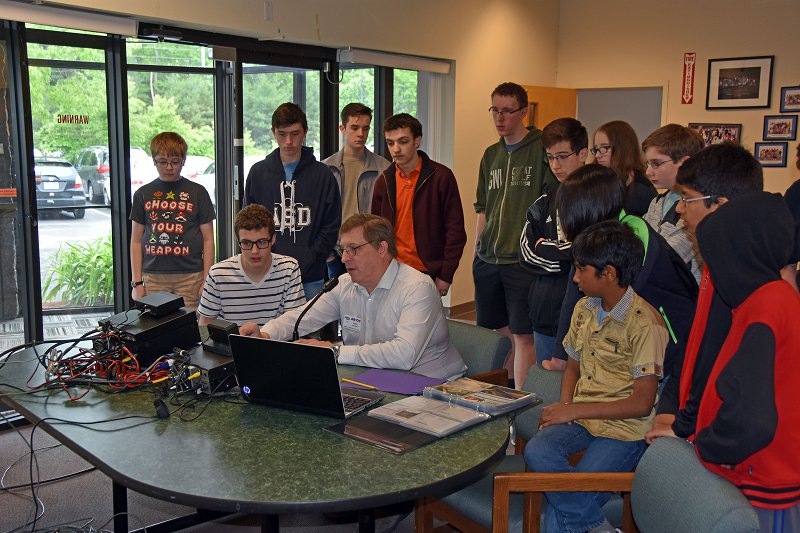
ASD Group Learning About Amateur Radio
The students at ASD are extremely bright and are highly motivated to develop STEM careers. We had about 65 students elect to attend the two sessions that we presented. The kids showed a lot of interested in our presentations and demonstrations.
SPARK Day Classroom Activities
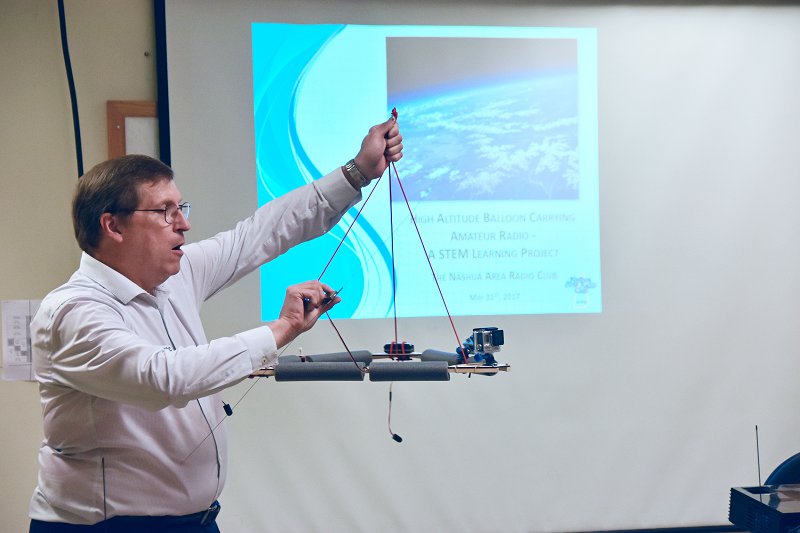
Explaining the HAB to the ASD Students
We began each session with some classroom time where we explained what Amateur Radio is about and some of our club’s Amateur Radio projects. We talked about and showed components of our High Altitude Balloon Project, our Satellite Ground Station and our Field Day activities. The interest level among the kids was high and lots of questions were asked.
SPARK DAY GOTA Station
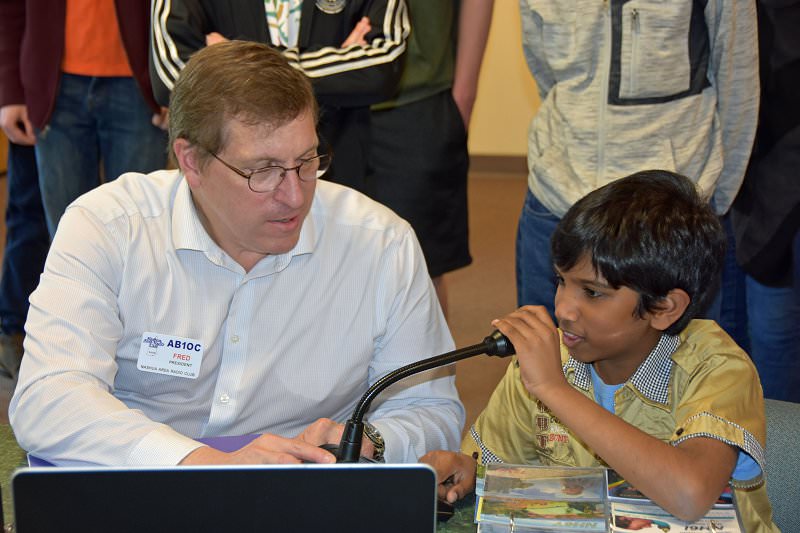
Making an HF Contact using our GOTA Station
We also put together an HF GOTA station in the lobby of the school. This gave the kids a chance to get on the air and experience Amateur Radio first hand. After the kids got over the usual “mic-fright”, they had a lot of fun.
We are looking forward to our next opportunity to participate in ASD’s SPARK Day in the fall. This is one of the most enjoyable events of the year for me.
WSJT-X developer Joe Taylor, K1JT, weighed in to express his appreciation to all who shared their ideas and experiences using JT9 and JT65 modes during recent multi-hop E-skip openings on 6 meters.
“We are very much aware that a mode with most of the excellent characteristics of JT65, but with faster turnaround time, would be a big winner in such situations,” Taylor commented on behalf of the WSJT-X development team. “We are experimenting with several such possibilities. Tentative goals include 15-second T/R sequences, sensitivity around S/N = –20 dB, occupied bandwidth less than that of JT65, and capability to decode as many as 10 or 20 signals in a 2-kHz bandwidth.”…
This is something to follow if you are interested in the JT modes for HF and VHF communications. Our experience is that a new JT variant that would trade S/N margin for a faster QSO segment speed would be just the ticket on many of the HF bands as well as 6m.
We use cookies to ensure that we give you the best experience on our website. If you continue to use this site we will assume that you are happy with it.