WSJT-X developer Joe Taylor, K1JT, weighed in to express his appreciation to all who shared their ideas and experiences using JT9 and JT65 modes during recent multi-hop E-skip openings on 6 meters.
“We are very much aware that a mode with most of the excellent characteristics of JT65, but with faster turnaround time, would be a big winner in such situations,” Taylor commented on behalf of the WSJT-X development team. “We are experimenting with several such possibilities. Tentative goals include 15-second T/R sequences, sensitivity around S/N = –20 dB, occupied bandwidth less than that of JT65, and capability to decode as many as 10 or 20 signals in a 2-kHz bandwidth.”…
This is something to follow if you are interested in the JT modes for HF and VHF communications. Our experience is that a new JT variant that would trade S/N margin for a faster QSO segment speed would be just the ticket on many of the HF bands as well as 6m.
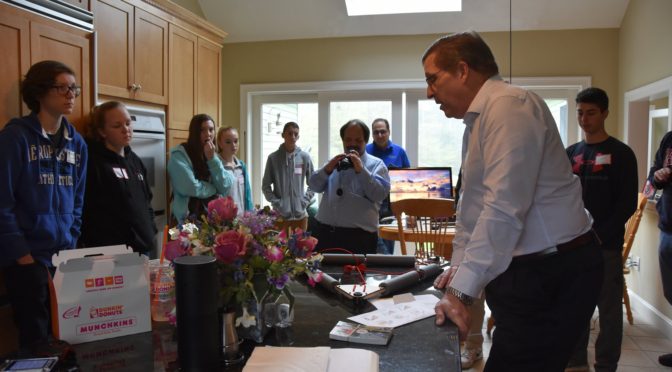
On May 6, members and friends of the HAB (High-Altitude Balloon) Project gathered at Anita (AB1QB) and Fred’s (AB1OC) QTH for an open house to introduce the students participating in our project to amateur radio and the HAB itself. The weather wasn’t exactly cooperating with us, as rain was in the forecast. In fact, this was supposed to be the week before our actual launch so we could do some prep work with the kids. Fate had other ideas for the launch, however, as it was postponed due to more rain and has been since rescheduled to June 3.
Among the students there, we had representation from Merrimack High School, Bishop Guertin High School, and our independent group of which Abby (KC1FFX) and Connor (KC1GGX) made up 2/3 of the students.
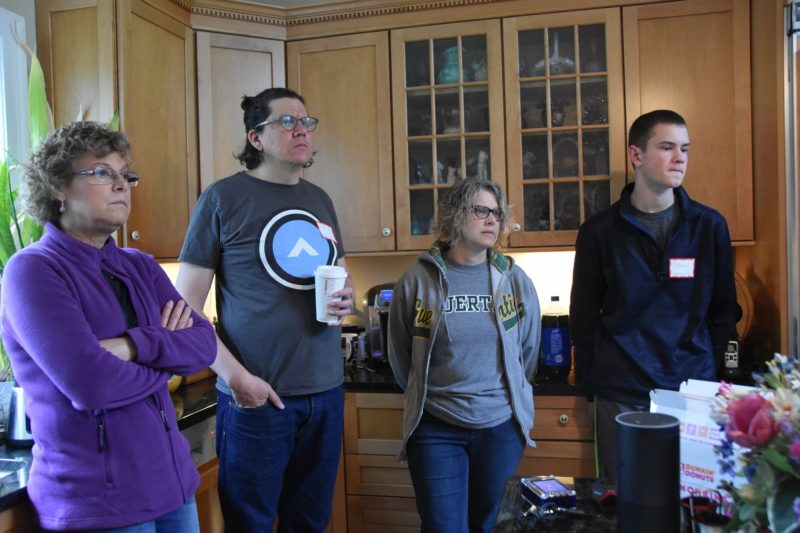
Teachers (and a student) from Merrimack and Bishop Guertin
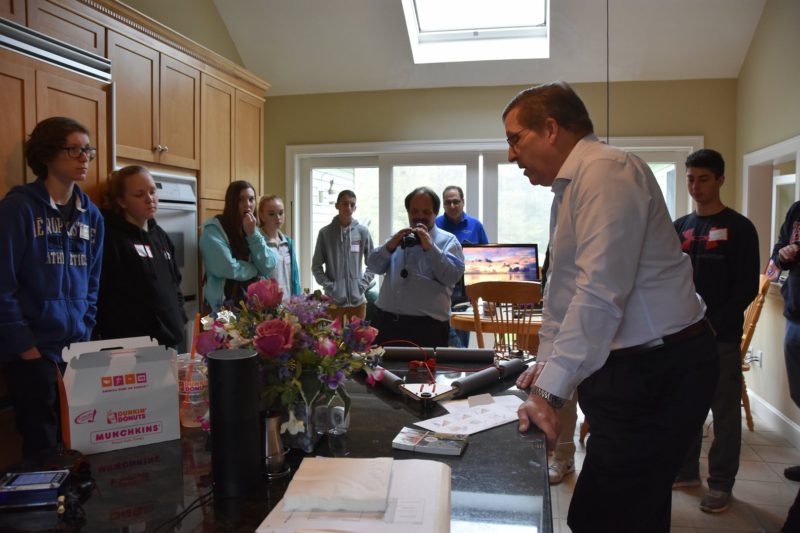
Beginning around 9 am, we crowded into the kitchen to have Fred introduce the agenda for the day.
Gathering around the table
After showing off the HAB, the components, and explaining what everything did and how it was interconnected, we broke off into three teams. The first would tour the illustrious shack, the second would get a primer on antennas and towers in the backyard, and the third would brave the elements and go on a foxhunt.
A crew going on a Fox Hunt
After each group was able to accomplish all three activities, we then invited the kids to make some QSOs in the shack and/or make some QSOs with Fred and Anita’s amateur satellite station v2.0. (I, myself, had made my first two satellite QSOs earlier that morning. A VERY cool station, indeed). A few were definitely nervous and mic shy, but most stepped up and seemed truly amazed (bewildered) that they could talk to some random person in some random corner of the globe.
By about 2 pm, there seemed to be expressions of fatigue on the young faces, and it seemed a natural time to conclude the day. All in all, it seemed the kids truly were excited about amateur radio and the HAB. We look forward to working with them in future phases of our HAB project and hope this is something that many of these freshmen can turn into a serious senior science project when they’re looking ahead towards graduation in a few years. (And perhaps, we’ll get some of them licensed too!)
My old (2012) Yaesu FT-950 lost output! I was getting maybe 5 watts out on any one band! What to do? These days, I am the proverbial “store-bought” ham … not even kit building! So the choices were to sell as a parts rig on eBay and put the proceeds towards a new rig so shipping the rig all the way to California for factory repair since no repair facilities are on the East Coast. Time for a lot of research!
I have always been a very analytical person. I guess that’s why I was so successful at my occupation: Air Traffic Controller and Air Traffic Manager.
Fortunately, I have been tracking new transceivers and their prices for some time. To this end, I created an Excel spreadsheet. I got all the manufacturer transceiver brochures from HRO and, using the specs from my FT-950 as a base, listed the comparative item and assigned it points, plus or minus, as that transceiver compared to my FT-950 specs. Admittedly, this “point-value” system is subjective. Did I say, I was analytical?
The results: If I were to buy a new radio today, it would the Icom IC-7300. I am happy to share this spreadsheet with all my friends worldwide:
We use cookies to ensure that we give you the best experience on our website. If you continue to use this site we will assume that you are happy with it.