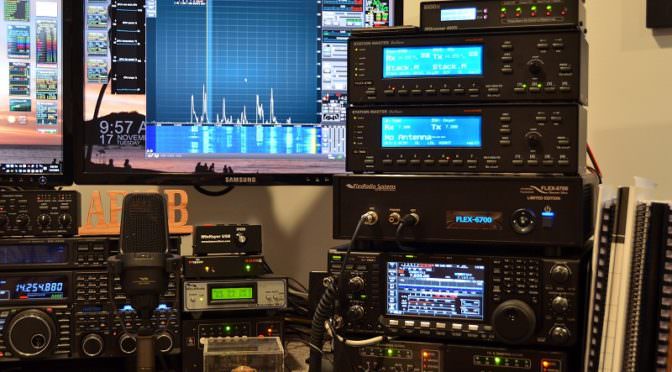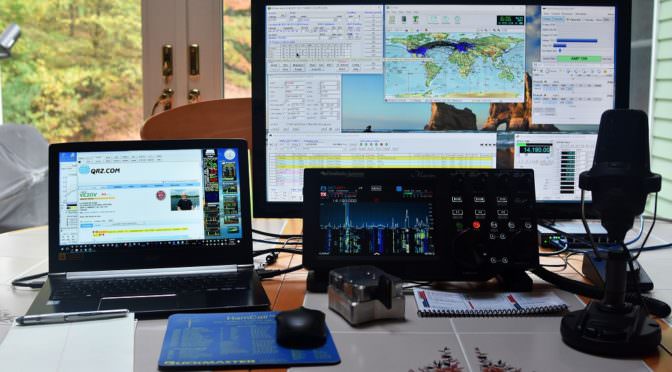
We are planning a number of enhancements at our Ham Station this fall. Our plans include:
Enhancing our FlexRadio 6700 based Remote Operating Setup to include additional remote control client options, better networking via the Internet, and better integration with our microHAM system
Adding a new Elecraft KPA1500 Solid State Amplifier to our station. The KPA1500 will be shared between the Icom IC-7610 and our FlexRadio 6700 based Remote Operating Gateway
We try to do some station upgrades in the fall of each year to maximize our operating fun during the winter months. We are at the design stage on these projects and I wanted to share some information about what we are planning from our Stationproject Blog. We always welcome members who want to join in on our projects as a means to learn about station building. More to come as we make progress with these projects.
Special thanks to Dave, K1DLM who has helped us with ideas for several aspects of this project.
Today proved out some simple, tried and true advice for me – it pays to take some time and tune through the bands. I just got a Maestro Remote Control Device for our FlexRadio SDR and I took a break around lunchtime to tune through the higher HF bands to see what I could hear. We use a Flex SDR as a Remote Operating Gateway into our station and the Maestro allows me to run our station over our home network with going down to the shack.
I am not sure why but I decided to give the 12m band a look today. When I did, I was stunned! It is about noon time and the 12m band is wide open between Africa and the US!
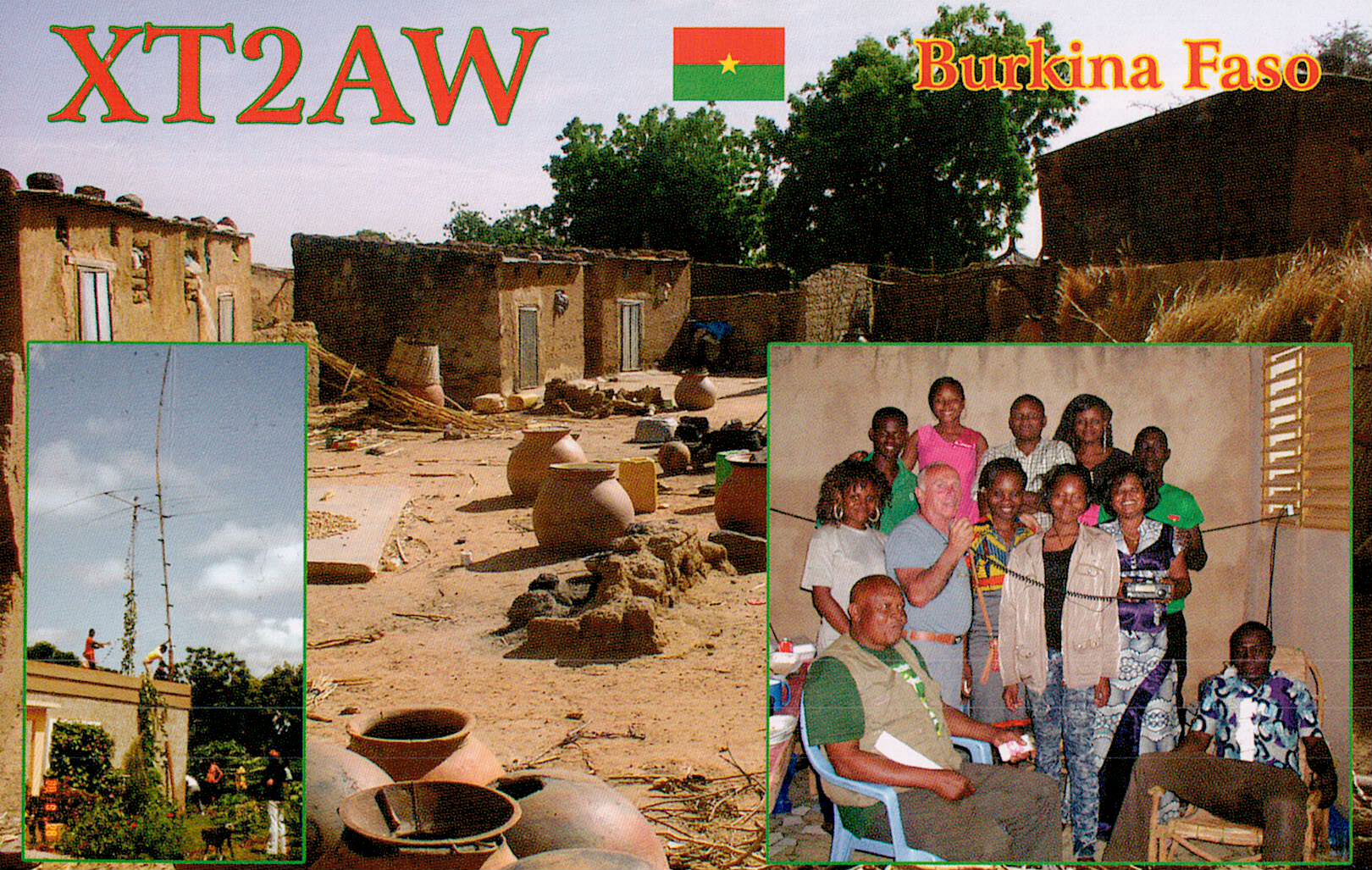
12m DX – XT2AW Burkina Faso
I worked two DX stations on 12m SSB. The first was XT2AW, Harald in Burkina Faso. Harald was working split and was not real loud but I had no trouble completing the contact with him. Excited, I tuned across 12m some more and found an old friend – Theo, ZS6TVB in South Africa. I had a very nice QSO with him. We both marveled over the propagation on the 12m band that we were experiencing. He was 57-58 here in New Hampshire!
The sunspot conditions are pretty weak (SFI 85, SN 26) to create such a good opening on 12m. I believe that we may be experiencing Transequatorial Propagation (TEP) which can provide a significant propagation enhancement on paths with traverse the equator. Anita and I experienced similar TEP propagation on 10m when we were on Bora Bora Island early in 2012 with similar solar conditions.
It just goes to show that it pays to tune the upper HF bands. Especially on days when “they are not open”. Also, 10m also appears to be open to Africa right now – I am hearing a station in Mauritania…
This past weekend Fred (AB1OC) and I (KC1ENX) participated in the New Hampshire QSO Party in the multi-op high power category operating from Fred (AB1OC) and Anita’s (AB1QB) shack using the club call sign (N1FD). We had originally planned to be a mobile operation but discovered there wasn’t a category for mobile, multi-op stations so decided to see what damage we could do from Fred and Anita’s QTH.
This was my first “real” contest. At least in the sense that I would be working more than a few hours at a time over a span of two days. The QSO Party started at 12 pm on Saturday and ran until 12 am on Sunday and then resumed on Sunday at 12 pm and ran until 6 pm Sunday. I was pretty excited and didn’t know quite what to expect. I have done the ARRL’s Rookie Roundups (SSB Voice, RTTY, and CW) in the past with the club, but those are much shorter in length. I was ready to step it up a level!
KC1ENX taking a break while AB1OC operates
Fred got the ball rolling on Saturday and shortly passed the control over to me. Anyone that has worked at Fred and Anita’s QTH it doesn’t take long to create a pile-up and it sure didn’t! Fred and I worked hard all day on Saturday until things started to dry up a bit on Saturday night around 11 pm. I decided to get a good nights sleep and headed home around 11:30 pm. Driving home, I decided to check the bands to see if anyone else was working the QSO party hard. I was shocked to hear a “CQ NH QSO Party” being called on 40 meters at close to midnight! My heart skipped a beat as I was sure someone else was working until the very end of the night! I should have recognized the voice as I then heard, “N1FD“. Fred had decided to work a few more stations – learning a lesson from the 13 Colonies Event to never give up!
As I drove back to Fred and Anita’s on Sunday I heard Fred’s booming signal coming through on 20 meters. He got started as soon as the clock struck 12 pm. He let me take over shortly after my arrival and things were pretty busy for the whole day.
We ended up making 1,464 QSOs in 18 hours for a total score of 102,410 points! We almost had a WAS missing out by three states – Alaska, Delaware, and Maine. We worked all the Canadian provinces except for two and had many DX contacts as well! Not only did we finish with a pretty impressive score, but I learned a ton!
So close to a WAS!
Here are just a few of the things I learned from the weekend:
I have a newfound respect for these guys. I know the saying, “Life’s too short for QRP” but some of these guys easily broke a pileup and the great thing was the excitement they had when they did make contact. One guy actually exclaimed, “yoo-hoo!” on the air when I came back to him with his signal report.
You make thing your signal is strong and very readable, but when there is QSB and QRM all around you, it really helps to speed things up to give call signs in phonetics.
KEEP IT SHORT
Obviously, we were trying to get as many QSOs in as possible in an allotted amount of time and sometimes people wanted to give a lot of unnecessary information. Fred taught me how to politely move things along without being rude. I did give extra time to a lot of the Florida operators who were affected by the hurricane and had just got their stations back up on the air, but I tried to keep things short for other QSOs.
This is part of N1MM logger and it was fantastic in keeping things moving. If you catch part of a call sign and type it in with a “?” for letters you are unsure of it will give you a list of callsigns. This saved me a lot of time on many, many QSOs.
MULTIPLIERS ARE IMPORTANT
As the QSO Party went on we could check on N1MM+ the multipliers that we had and the ones that were missing. This allowed us to listen for the call signs from the areas that we still needed. We ended up getting one of our multipliers in the last couple of hours of the contest!
A GREAT STATION REALLY HELPS!
Anyone that has operated at Fred (AB1OC) and Anita’s (AB1QB) QTH knows that they have an amazing setup. Everything there is top notch. Besides the great transceivers, yagis, power and everything else the other thing I really liked was the receive antenna. This allowed us to quickly change our listening direction and really pick out the weak signals quickly.
I would highly recommend working a QSO Party to get your feet wet in contesting. It is definitely long hours, but you are not working a full 24 or 48 hours which gives you some time for a good nights sleep. I really enjoyed the QSO Party and would like to thank Fred (AB1OC) and Anita (AB1QB) for putting up with me for so many hours. It does make it a lot more fun when you have a friend to work with you and show you the ropes. I’m already looking forward to my next contest opportunity!
We use cookies to ensure that we give you the best experience on our website. If you continue to use this site we will assume that you are happy with it.