

Forum Replies Created
-
AuthorPosts
-
[caption id="attachment_64726" align="aligncenter" width="1024"]
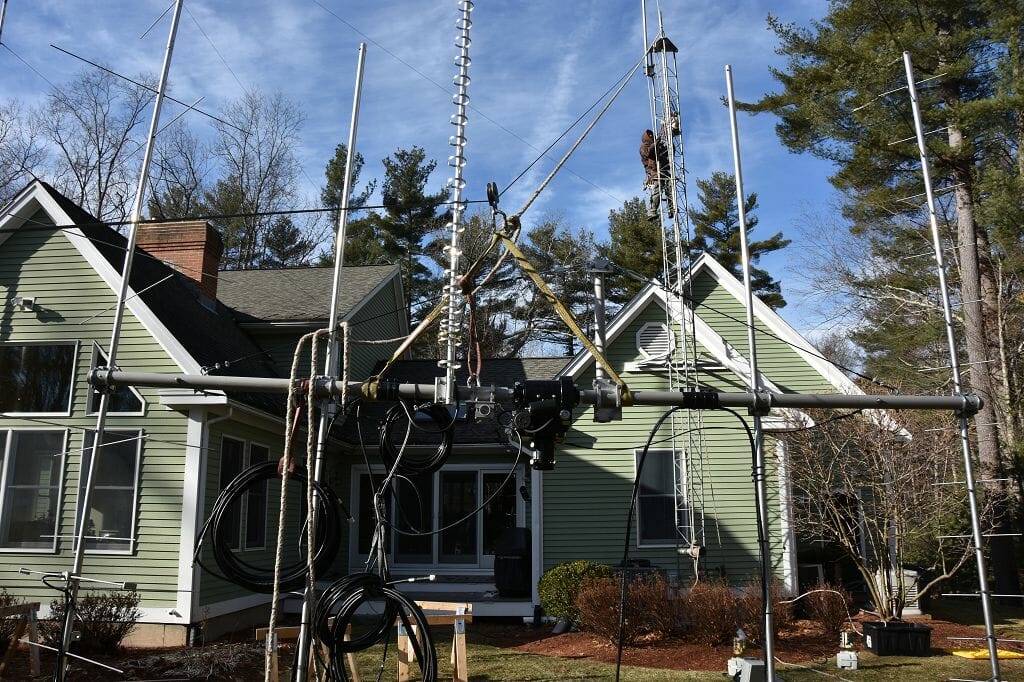 Tram Line and Harness[/caption]
Here’s one more picture which shows the tram line and harness. Note how well balance the entire setup is. The feed lines for the three antennas and the control cables for antenna polarity switch and the Alfa-Spid Az/El rotator are also attached. All of this prep work is much easier to do on the ground. You can also see one of the two truss supports which were added to transfer the weight of the antennas on the ends of the cross boom to the center.
Hi David,
WSJT-X supports a short ending mode for good conditions. Instead of doing separate RRR and 73 messages, it sends a single RR73 message at the end to save a step. This is best used when conditions are good (they usually are on 20m FT8 for example). You turn this on/off by double-clicking the Tx 4 button.
I hope this helps,
Hi David,
Is your new callsign KC1KJH? All you (or any member) needs to do to get you login changed is to send an email asking for the change to [email protected] and we’ll take care of it for you.
Hello David,
Try using USB and setting the Baud Rate on both ends to 2400 baud. See if that might help.
Here are a few more pictures from the installation of our new tower.
[caption id="attachment_63155" align="aligncenter" width="682"]
 Gin Pole Lifting Tower Section[/caption]
We used a Gin Pole to install the upper two sections of the tower. The photo above shows the top section being stacked using a Gin Pole.
[caption id="attachment_63157" align="aligncenter" width="800"]
 Mast Installation In the Tower[/caption]
Our mast is a 2″ x 22′ chrome molly one and it is quite heavy and difficult to maneuver. It is always a tricky proposition to get a mast installed on a new tower. One way to do it is to place the mast in the base, stack the tower around it and then pull the mast up through the tower at the end. This is how we handled the mast on our 100′ tower. In this case, we just pulled the mast up inside the top section of the tower before stacking the combination of the top section and the mast inside it onto the rest of the tower.
[caption id="attachment_63156" align="aligncenter" width="682"]
 View of House Bracket[/caption]
The last step in the process was to install the house bracket. This requires 2″x6″ reinforcing boards to be placed on both the outside and inside of the house wall. Large bolts are then used to fasten the tower bracket through the wall of the house and the reinforcing boards.
Our design called for about 10′ of the mast to stick out the top of the tower. We took advantage of the 22′ mast and installed the main rotator down the tower in the second section from the top. This has several advantages including:
- The rotator is easier to reach and work on
- The rotator control cables are shorter
- The mast cushions the torque load on the antennas when the rotators start or stop
- We increase the amount of the mast that is above the tower in the future without replacing it.
We are turning our attention to final preparations for our ISS Crew Contact in December. Once that is done, we’ll spend some more time to complete our new tower.
Hi Burns,
Great question. The Orion will be used to turn the 6m yagi and the AlfaSpid will be used to point the satellite antennas with the Orion parked at 0 degrees. The reason for doing it this way is that it allows the 6 m rotator to be part of the contesting system in our station here and the AlfaSpid to be connected directly to a Mac for use with MacDoppler.
It would be possible to do what you are suggesting – use the Orion for azimuth on both and only use the elevation section of the AlfaSpid to handle that part of satellite operations. Also, the azimuth section on the AlfaSpid is probably a little more precise than the Orion but that difference is probably pretty minor.
Fortunately, I have both a Green Heron Az/El rotator controller and a Green Heron Azimuth only controller here so it’s a bit of a toss-up really.
Hi Anthony,
First, it’s very difficult to get a Dipole to cover the entire 80m band. It’s pretty typical that a dipole on this band might cover about 100 KHz or so of that band.
When you tune the antenna, first put it up and run an SWR curve and the height that you’ll be using it at. The lowest SWR frequency is where the antenna is resonant at. If that’s at the high end of the band, then your antenna may be too short if you want to use it for CW. Here are some suggested spots to tune for –
- For SSB – Tune to 3.795 center frequency
- For CW/Digital – tune for 3.550 Mhz or so
It’s hard to get an 80m dipole high enough. Ideally, it would be up about 65 ft but don’t worry too much about that. Just get it as high as you can.
I hope that this helps.
Hi Burns,
I use simple bolt-on ground clamps to connect the ground wire to the rods and I use hose-style clamps to attach the ground cables to the tower legs. Exothermic binding does work well but it requires some special gear to use and it only works with uninsulated cables which are often used below ground.
Straps and copper strips do work well for RF grounding and they should be used in your station to provide RF and AC safety grounding. For lightening, you need a heavy cable that can stand some high current surges so standard electrical system ground cables are best used for that application.
The work on my tower is about lightning protection and ground so the heavy electrical ground cables are the way to go there.
I hope that this helps,
Hi Bob,
First, different loggers are useful for different purposes. N1MM+ is a good logger to use for contesting as it has may contest features. For general operating, a logger like DXlab would be a better choice. This type of logger is useful for DXing and casual contacts on the HF bands. Folks generally do not log contacts on repeaters or Echolink.
LOTW is an independent tool for confirming contacts through the internet.
For contests, we operate ad log using N1MM+, then transfer our logs via ADIF files to DXlab after the contest is over. Once the contacts are in DXlab, they can be uploaded to LoTW along with any casual contacts that are made directly in DXlab.
I hope that this helps. Good look with your selection of logging programs.
73,
Hi Scott,
I think that all of the digital choice C4FM, DMR, D-STAR all come down to how many repeaters are available and where they are located relative to where you operate. I think D-STAR is probably the most widely deployed (and oldest) digital standard. DMR is more recent and is catching up fast. I suspect that C4FM is the least popular.
I hope this helps you.
-
AuthorPosts