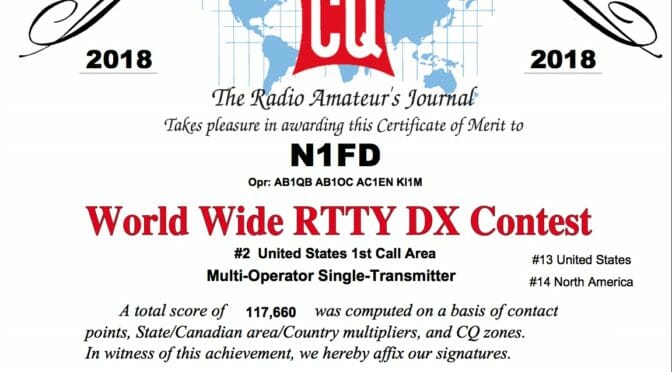
The results are in for the 2018 CQ WW RTTY Contest. The N1FD Multi-Op Entry placed #2 in Area 1 and 14th in North America!
The CQ WW RTTY Contest was held September 29-30, 2018 and the N1FD team operated from the QTH of Fred, AB1OC and Anita, AB1QB. In addition to Fred and Anita, Dan, AC1EN and Peter, KI1M operated in the contest.
N1FD Claimed Score in CQ WW RTTY 2018
As you can see from the Claimed Score above and the Final Score Below, we busted only 8 QSOs our of 389, resulting in a reduction of less than 10% of our score. We will receive a report with the details of the errors, which will help us to improve in future contests.
CQ WW RTTY Final Score
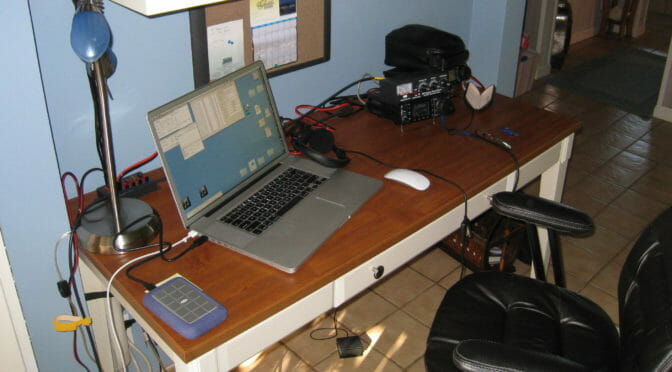
We will host the ARRL International DX Contest – SSB this weekend, March 1-3, at AB1OC’s and AB1QB’s QTH. We will again run as a multi-op using the N1FD Call. If you would like to join us, see the following forum post for more information.
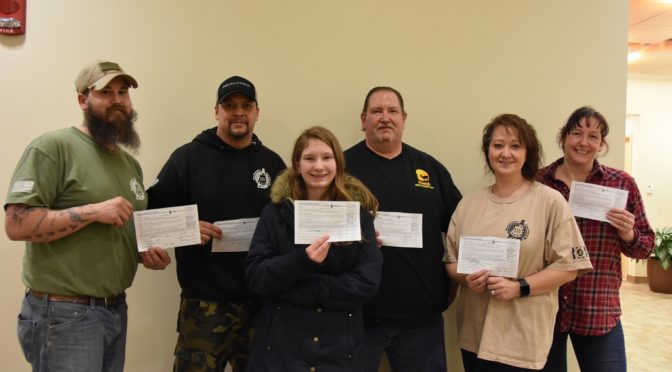
We held our latest Technician License Class the weekend of February 23rd and 24th, 2019 at Dartmouth-Hitchcock Nashua. It was a big success! We had a great set of students who were well prepared for the class. All 13 students in the class passed the Technician Exam and 11 of those students became new members of the Nashua Area Radio Society! They are now anxiously awaiting their callsigns.
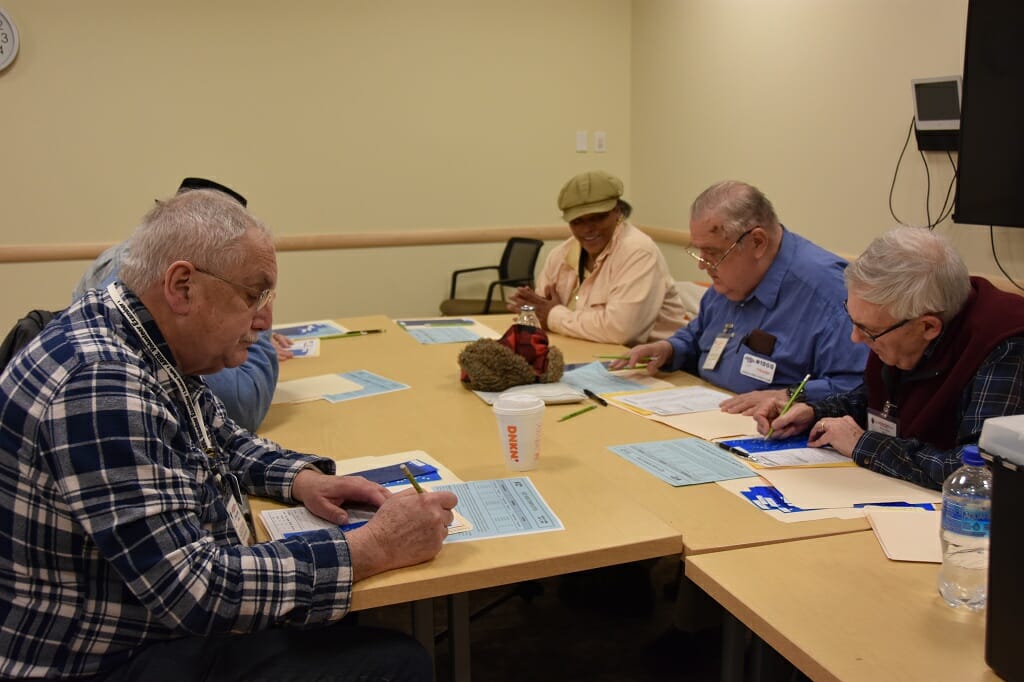
NARS VE Team Grading Exams
Thanks to all of our instructors and VEs who helped to make the class a success!
March is one of my favorite contest months of the year. The ARRL International DX Contest and the CQ WW WPX SSB Contest bookend the month and I’ve done mini-DXpeditions to compete in both contests.
Remember that each month you get a chance to put several states in your log. Even during the doldrums of the solar cycle you can capture the 50 states for that Worked All States award. This month includes four state QSO parties plus a four hour “sprint” that give you a chance at all of them.
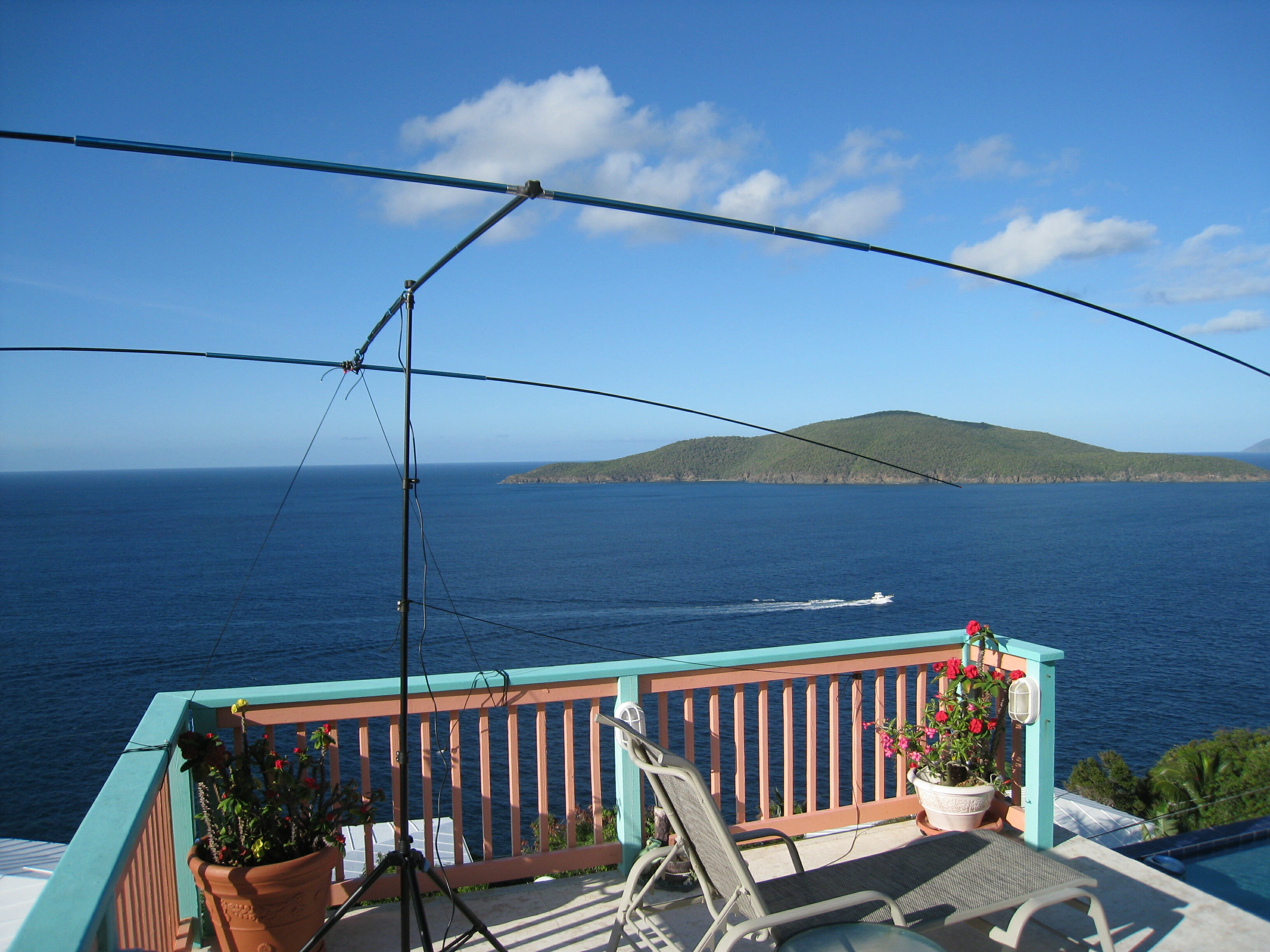
KP2/NE1RD 15m beam on St. Thomas March 2010
ARRL International DX Contest [0000Z, March 2 to 2400Z March 3] In this contest the US stations try to contact as many other countries as possible, and other countries call only the US and Canada. Do not call US or Canadian stations! Exchange: US stations send a signal report and their state; DX stations send a signal report and power. Note that power might be something like “K” (for kilawatt~1000W). Even stations running less than 1000 Watts will send “K” because it is so short, and everything over 150 Watts is considered high-power. As with all contests, just log what you hear and everything works out.
Oklahoma QSO Party [1500Z March 9 to 0200Z March 10 + 1400Z to 2100Z March 10] Don’t miss this opportunity to get this state into your log! Exchange: OK stations send signal report and county. You send your signal report and state. There are 77 counties and you should log the county abbreviation, so it might be handy to print out a cheat-sheet of county names. You can find one here.
Idaho QSO Party [1900 March 9 to 1900Z March 10] This is another rare state so don’t miss it. Exchange: ID send “Idaho” and the county (three character abbreviation); you send signal report and state. There are 44 counties in Idaho. Log the abbreviation for the county using this cheat-sheet.
Virginia QSO Party [1400Z March 16 to 0400Z March 17 + 1200Z to 2400Z March 17] This one has a slightly more complicated exchange than most QSO parties. You need to send a “serial number” along with your state. Exchange: VA sends serial number plus county; you send serial number and state. The list of counties and cities for VA can be found here.
North American SSB Sprint [0000Z to 0400Z March 24] If you’re not familiar with sprint-type contests, now would be a good time to do a refresher on the subject using my article CONTESTING JARGON EXPLAINED. Exchange: [other station’s call] + [your call] + [serial no.] + [your name] + [your state/province/country]. This is a good test of your listening and logging skills!
CQ WW WPX SSB Contest [0000Z March 30 to 2359Z March 31] I confess this is one of my favorite contests. Everybody can work everybody. Multipliers are prefixes. A change in propagation just means you have new people to talk to. Exchange: RS plus serial number. The picture of the antenna above is from my effort in 2010 on the island of St. Thomas that set the North American record for 15m QRP. (All-Buddipole construction!)
Read the rules before the contest. Set up your radio and computer and test everything before the contest. Know how to log the exchanges so you can submit your score. Try all this early. That way, if you do run into trouble, you can reach out to your fellow club members for a helping-hand.
The contesting season is wrapping up but there is still time to get in on the fun. I hope to hear you on the air!
Radio Amateurs Developing Skills Worldwide
We use cookies to ensure that we give you the best experience on our website. If you continue to use this site we will assume that you are happy with it.