Category Archives: Field Day

Club and member activities related to the Nashua Area Radio Club’s Field Day operations.

Field Day Satellite Station for 2021 – Setup and Test in Hollis

On Wednesday, May 25, Jon – AC1EV, Jeff – AC1FX, Jim – K1BRM, and Vince – KD2TMJ met at Fred – AB1OC’s QTH in Hollis, NH to set up and test the satellite antenna, radio, computers and other gear our club, Nashua Area Radio Society will be using this year at Summer Field Day. Here are some pictures of our Field Day Satellite Station test.
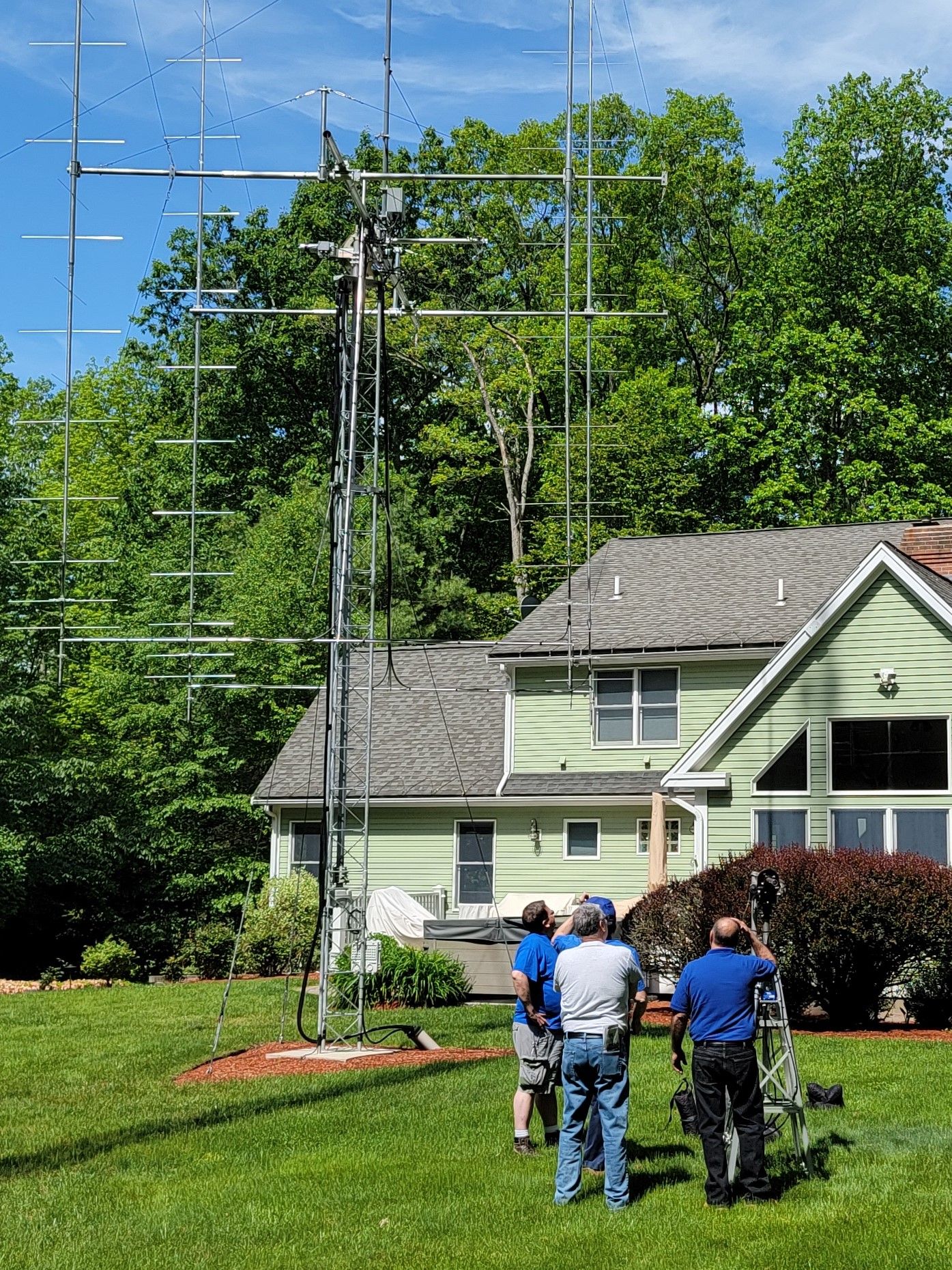
Satellite antenna Base

The satellite antenna base is on the lower right of the above picture. The much larger antenna on the left is an EME array and as you might guess, is not very portable.
Preparing the base
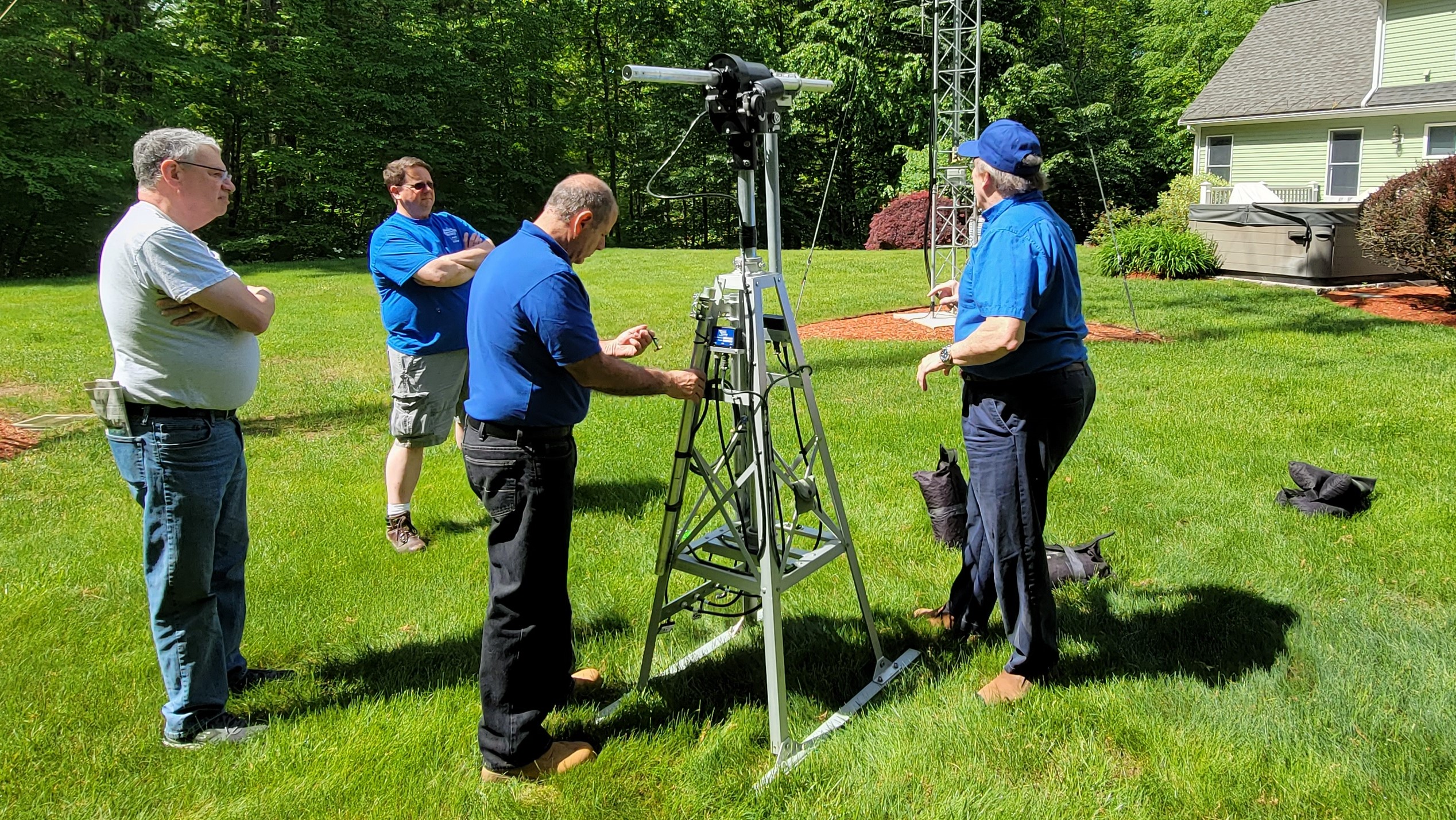
Preparing the base

We placed the small Glen Martin tower with the AZ-EL rotators installed on the lawn and aligned it using a compass.
Field Day Satellite Station - Base aligned and leveled
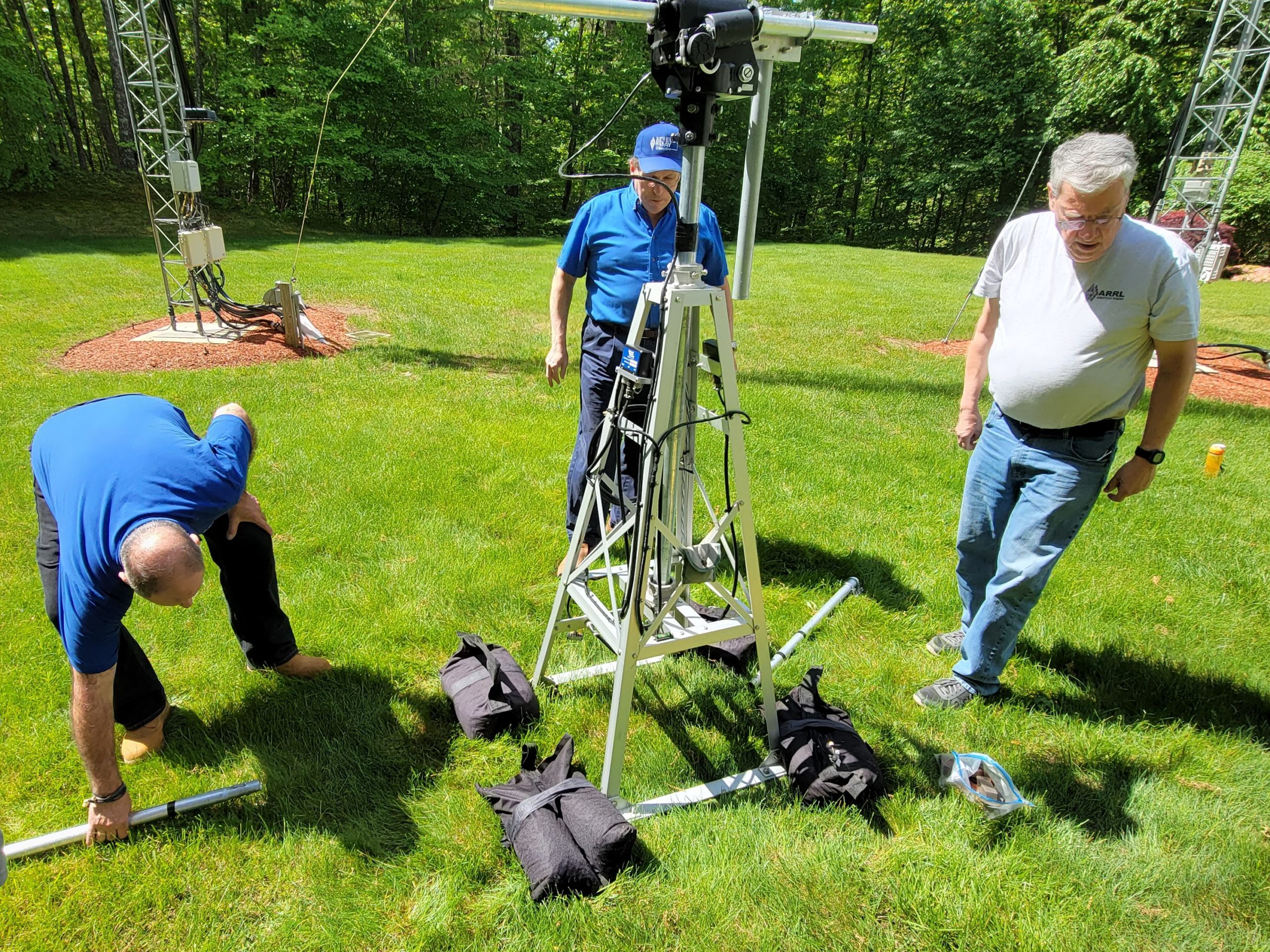
Base aligned and leveled

We used doorstops under the tower legs to level it and sandbags to hold it steady. There are bubble levels on the tower to make it easy.
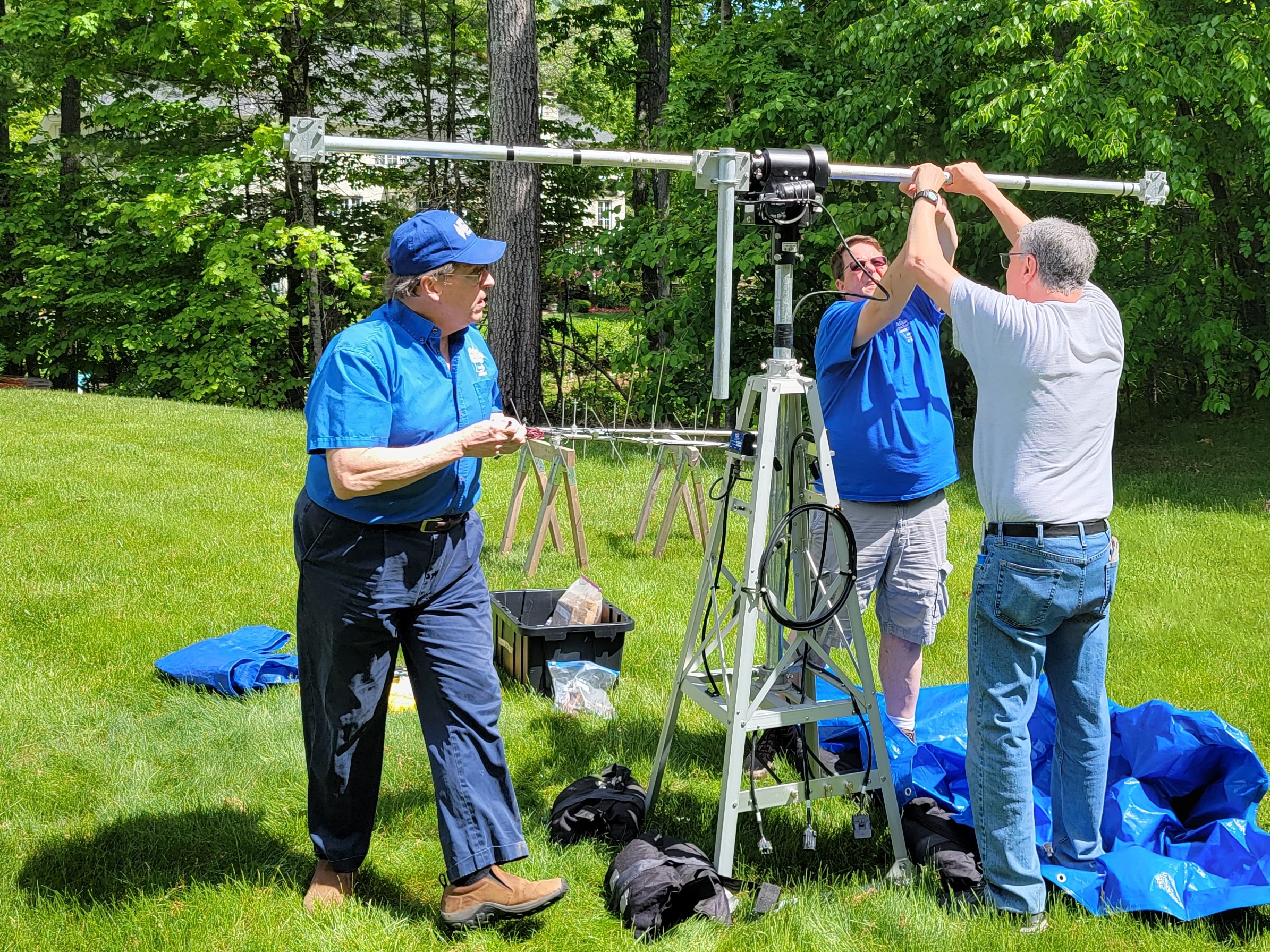
Install the support arms

The support arms will hold the antennas.
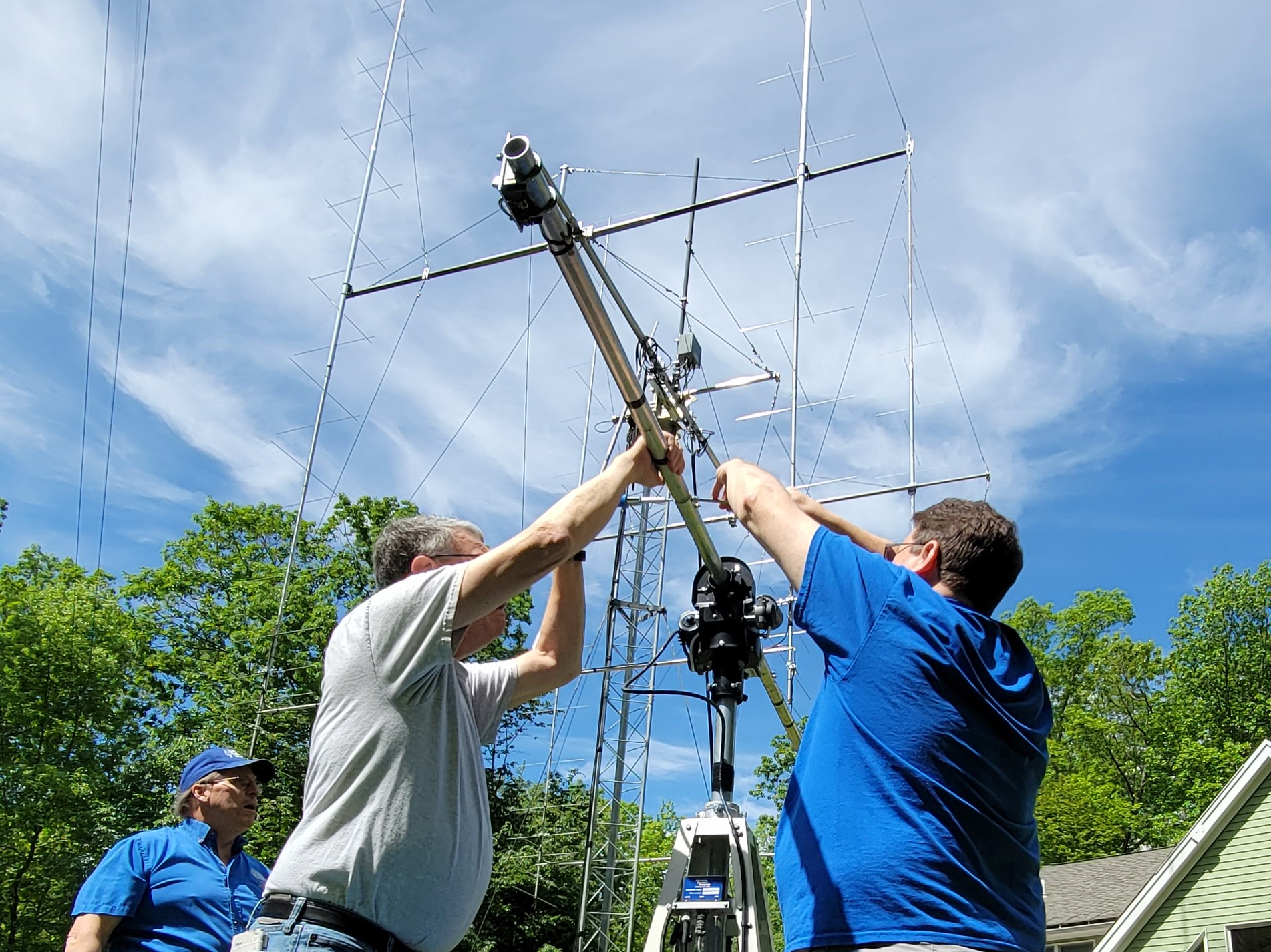
Tighten support arm bolts
Tightening the support arm bolts

All of the bolts need to be tight. The antenna moves quite a bit and needs to maintain its shape.

Field Day Satellite Station - Installing 70cm antenna
Installing 70cm antenna

Fred (AB1OC) installing the 70cm antenna and aligning it properly in its brackets.
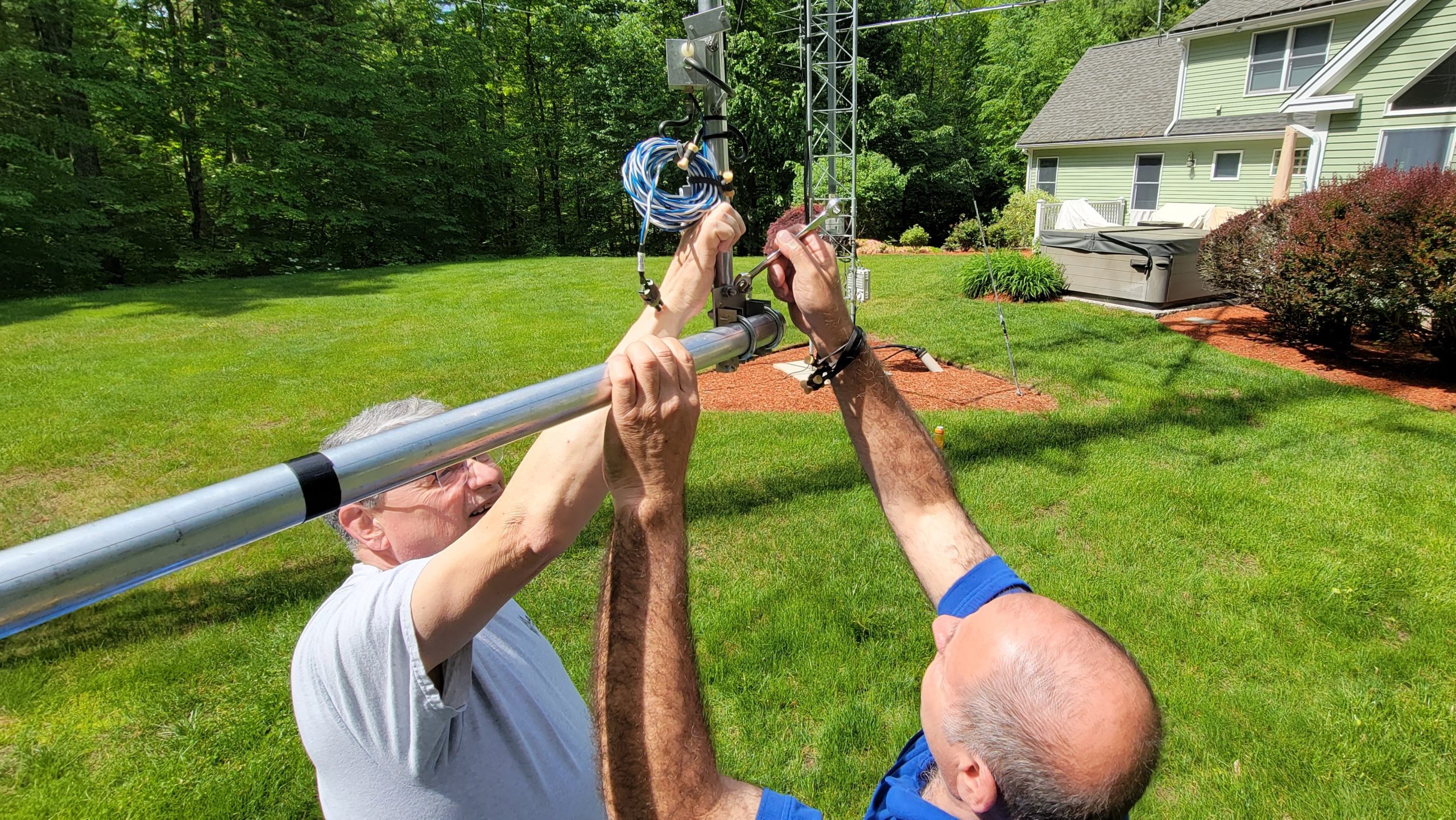
Tighten bolts on 70cm

Vince (KD2TMJ) and Jeff (AC1FX) tightening the bolts for the 70cm antenna.
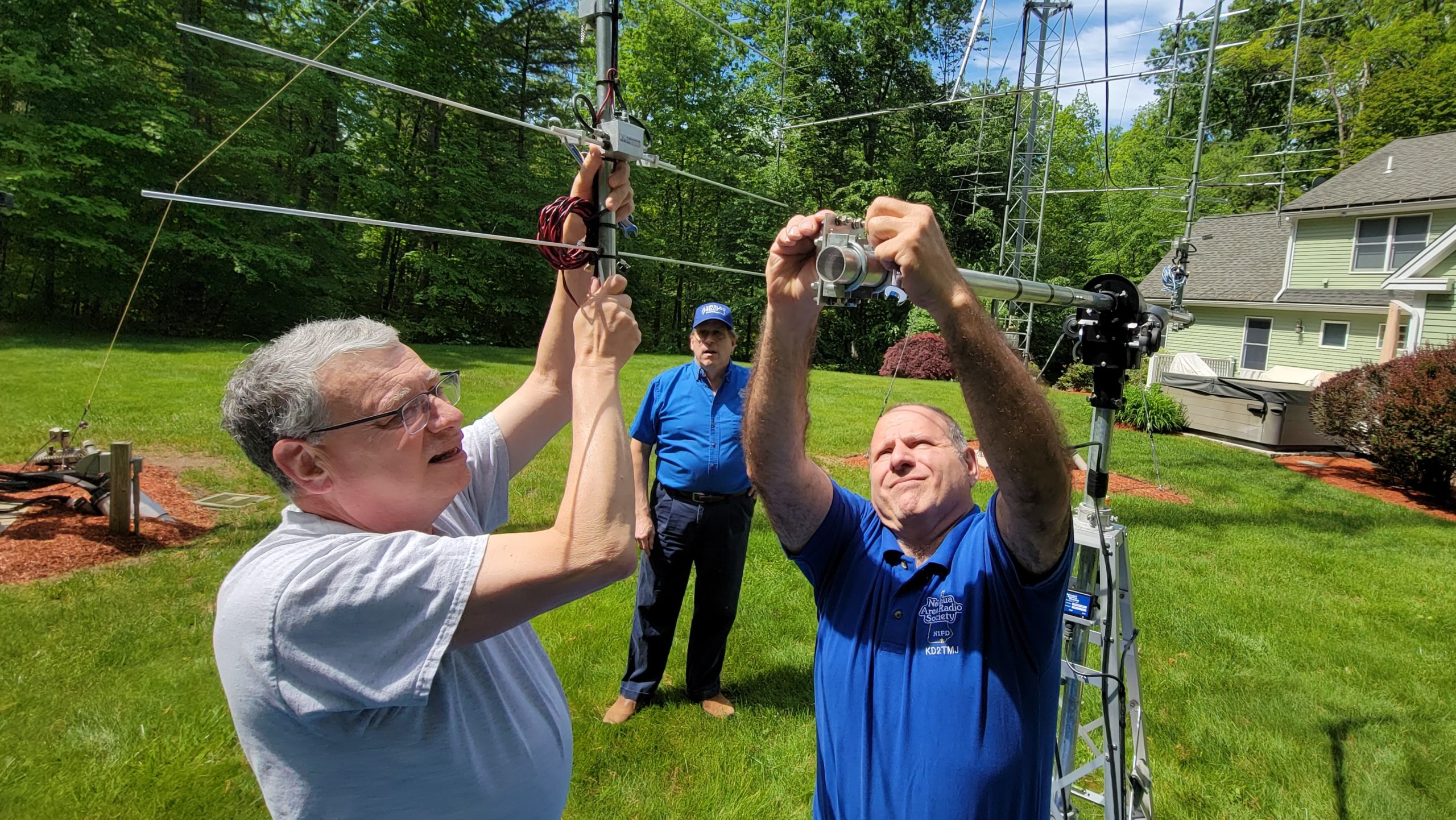
Install 2m antenna
Install 2m antenna

Vince (KD2TMJ) and Jeff (AC1FX) prepare to attach the 2m antenna.
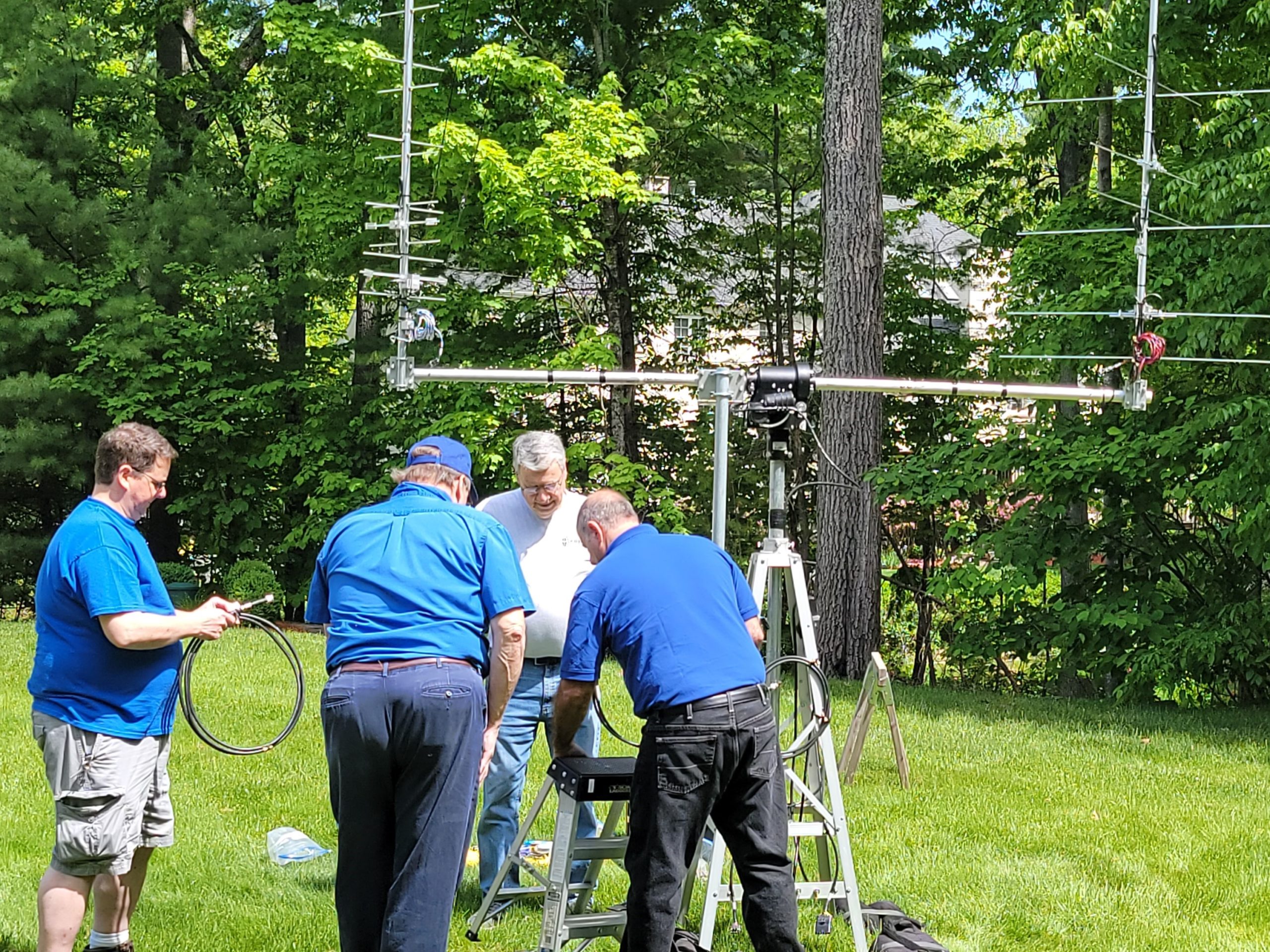
Field Day Satellite Station - Preparing to wire the antenna array
Preparing to wire the antenna array

There are many wires that need to be connected to the antenna array: control wires for the AZ-EL rotator, Coax for the antennas, control wires that shift the polarization of the antennas, etc. Every connection outside has a matching connection in the shack. There are some wires already connected to hardware that remains attached to the antenna tower, such as the pre-amplifiers.
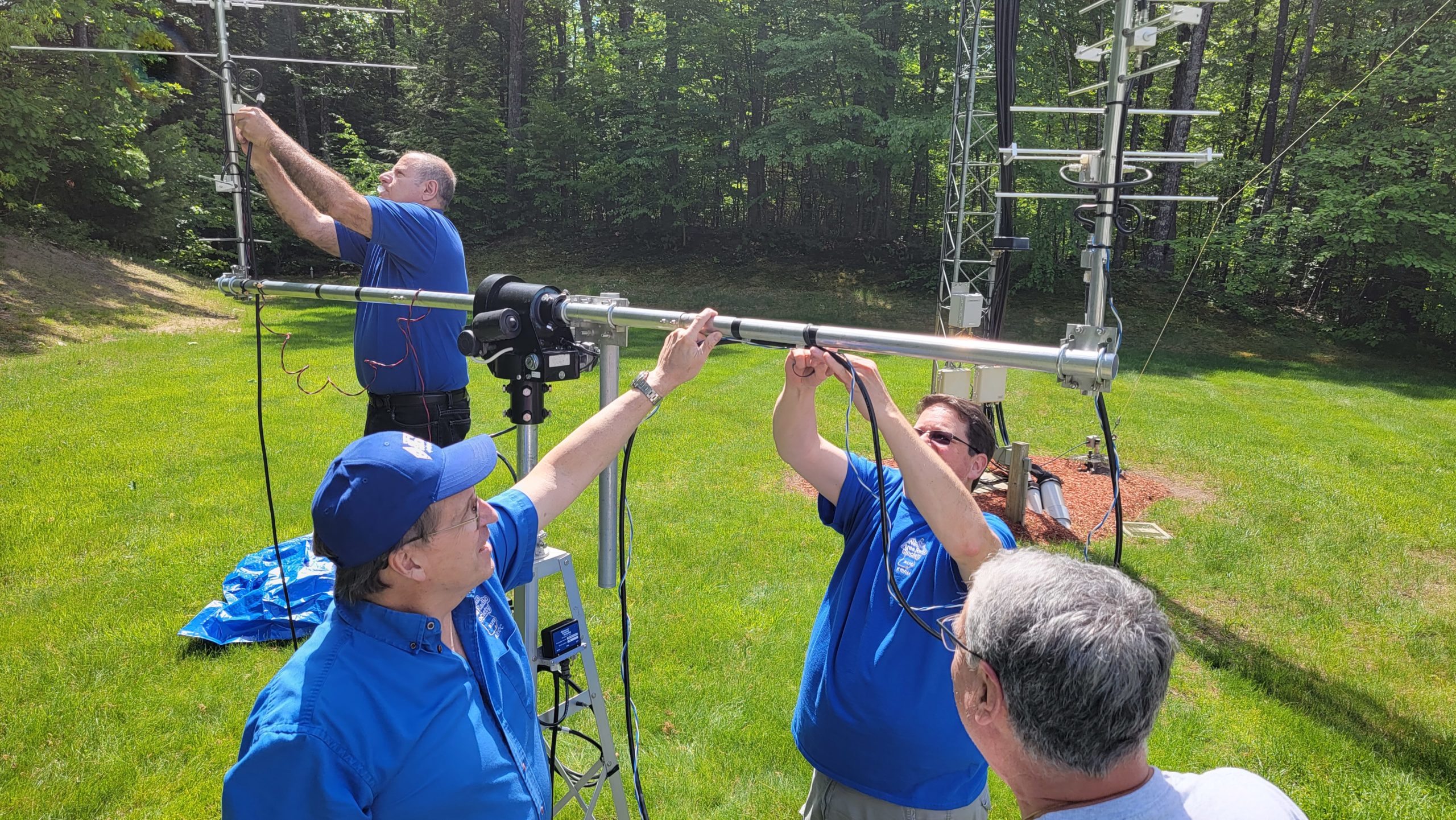
Dressing the wires
Dressing the wires

Since the antenna array can spin horizontally as well as tilt vertically all wires need to be secured so as not to tangle as the antenna moves. In addition, care needs to be taken to make sure each connection is correct to avoid any short circuits or other negative results. There needs to be enough slack to allow free movement for the antenna but not enough to allow any excess to become caught by moving parts.
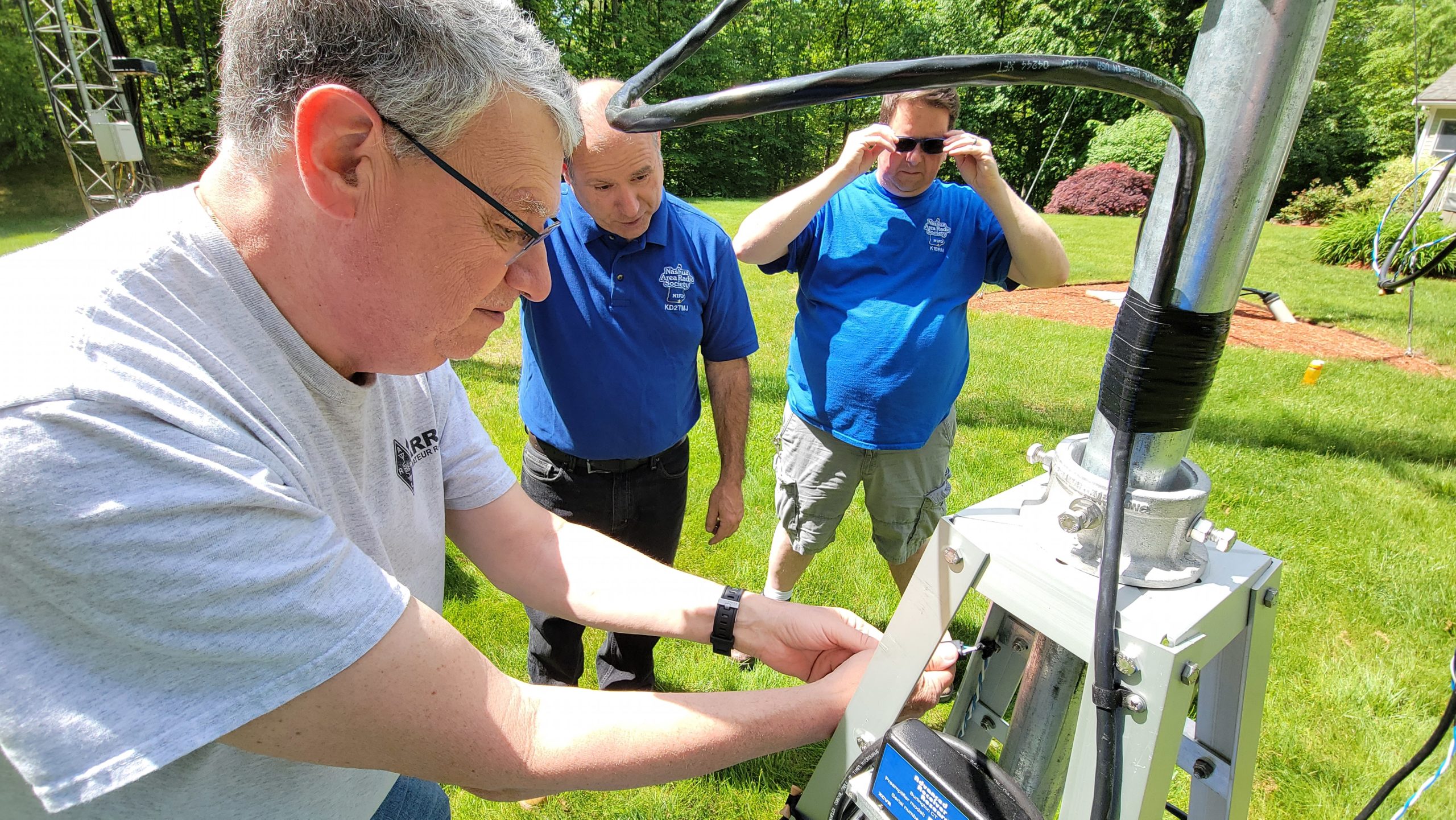
Plugging in polarity control line
Plugging in the polarity control line

Jim (K1BRM) and Vince (KD2TMJ) watch as Jeff (AC1FX) connects another control line.
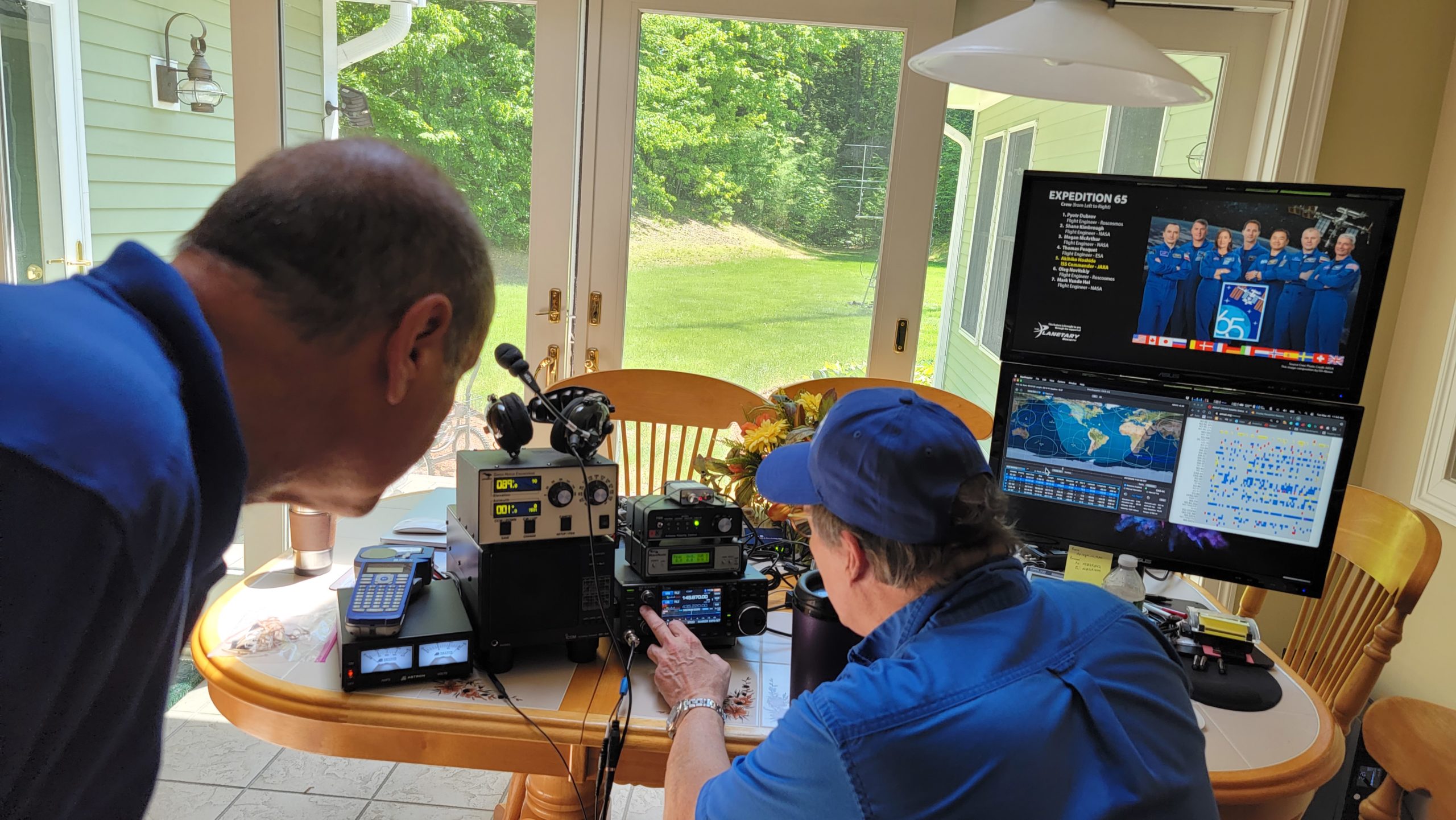
Field Day Satellite Station - Kitchen test setup
Field Day Satellite Station Test Setup

After the initial successful test of our Field Day Satellite Station, Fred (AB1OC) shows Vince (KD2TMJ) the radio setup and what he will do to make a QSO.
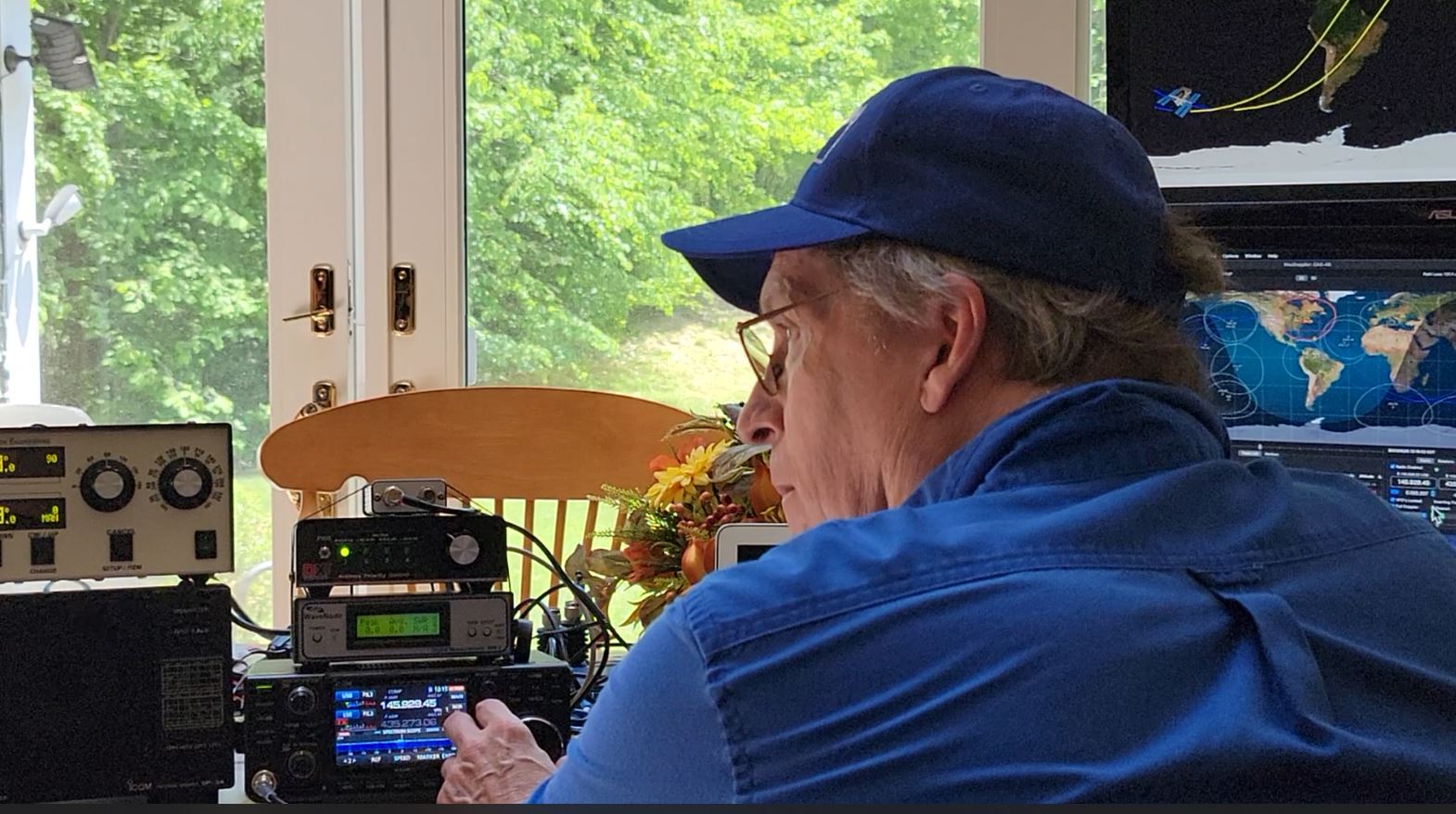
Fine Tuning on Successful Test

After a successful QSO Fred (AB1OC) makes a small adjustment by ear to a beacon from a satellite. On the monitor at the right of the screen, there are circles on the map that represent the locations on the ground that have a clear line of sight to the satellites. There is one red circle and that one indicates the satellite visible to our location and that the radio is tuned into.

ARRL Field Day is the most popular on-the-air event held annually in the US and Canada. On the fourth weekend of June, more than 35,000 radio amateurs gather with their clubs, groups, or simply with friends to operate from remote locations. There are many different ways hams participate. Some stay home and operate their normal stations’ others take their radios outside and create a simple temporary station. Small groups of friends can do likewise and take their equipment to an outdoor location and share the experience together. The Nashua Area Radio Society and many other clubs take It in steps beyond that. We have access to the equipment and skills to set up a multi-radio station that is networked together and equipped to allow multiple users to operate simultaneously. We set up towers with beam antennas to get the most out of the radios as possible. One of our primary goals for this event is to provide an opportunity for our members to operate in a sophisticated off-grid ham radio environment and we will have up to 50 different operating slots for our members to sign up to operate in. This way, even newly licensed hams with no equipment can have a chance to operate and join the rest of us in participating in this fun event.

Jon (AC1EV)
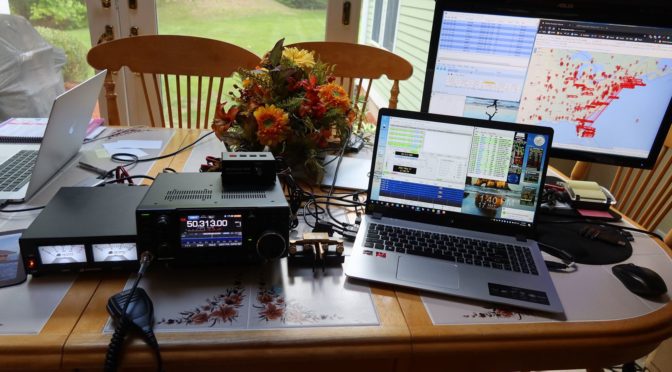
6m Field Day Station

We’ve been busy getting ready for Summer Field Day 2021 at the Nashua Area Radio Society. Our plans include putting up a Tower, a Computer-Controlled Satellite Station, and an upgraded 6m Field Day Station.

6m Field Day Station - LFA Yagi
6m LFA Yagi

Our 6m Field Day station will be a portable setup and features a new antenna – a 3-Element Loop Fed Array (LFA) Yagi from InnoVAntennas. There are some advantages to LFA Yagi’s for the 6m band and above. In particular, Yagis using an LFA design are less susceptible to noise and interference which is a big advantage for weak-signal work on the 6m Band.

6m Field Day Station - LFA Yagi on Mast
6m LFA Yagi on Mast

Our Yagi is lightweight which makes it ideal for portable applications like Field Day and Mount Topping. Aron, W1AKI, and Jamey, AC1DC helped me to assemble the antenna and put it up on a 25 ft fiberglass mast here at our QTH for testing. The antenna is fed with LMR-400uF coax and rigged with a rotator loop near the top of the mast so that the antenna can be pointed by rotating the mast at the base. The setup is easy to put up – it takes about an hour to do it.

6m Portable Station
6m Field Day Station

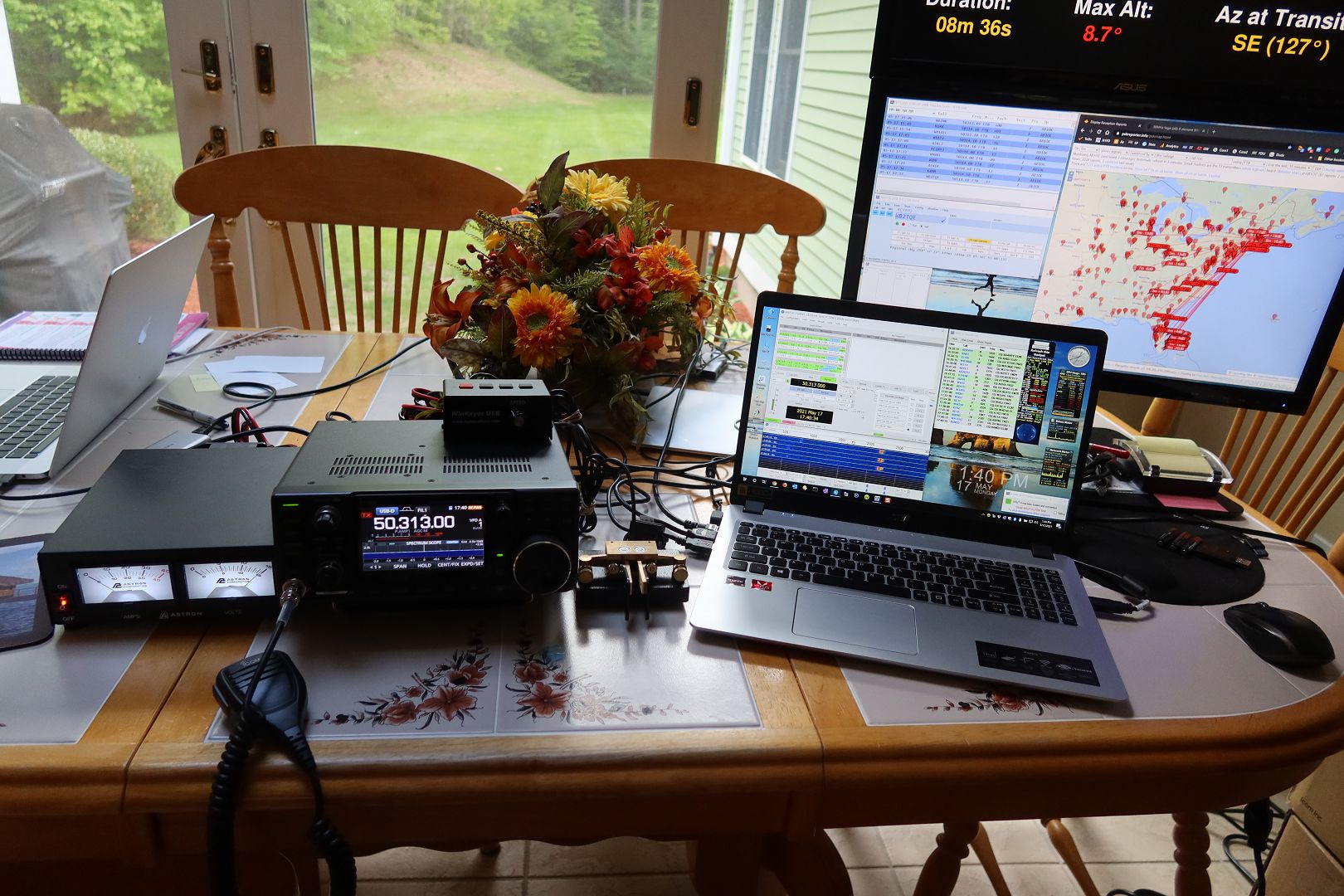
We also use the 6m LFA antenna project as an opportunity to assemble and test our 6m Station for Field Day. The station is an all-mode setup that can do SSB Phone, CW, and WSJT-X Digital (FT8/FT4, Q65, MSK144, etc.). The station will be generator powered at Field Day but it can also be run using a solar/battery setup when Mountain Topping.

The station features an IC-7300 Transceiver (100w), a Winkeyer and Paddles for CW, and a Windows laptop computer running the N1MM+ logger and WSJT-X. The station will also sport a second monitor for Field Day.

N1MM+ Logger on 6m
N1MM+ Logger on 6m

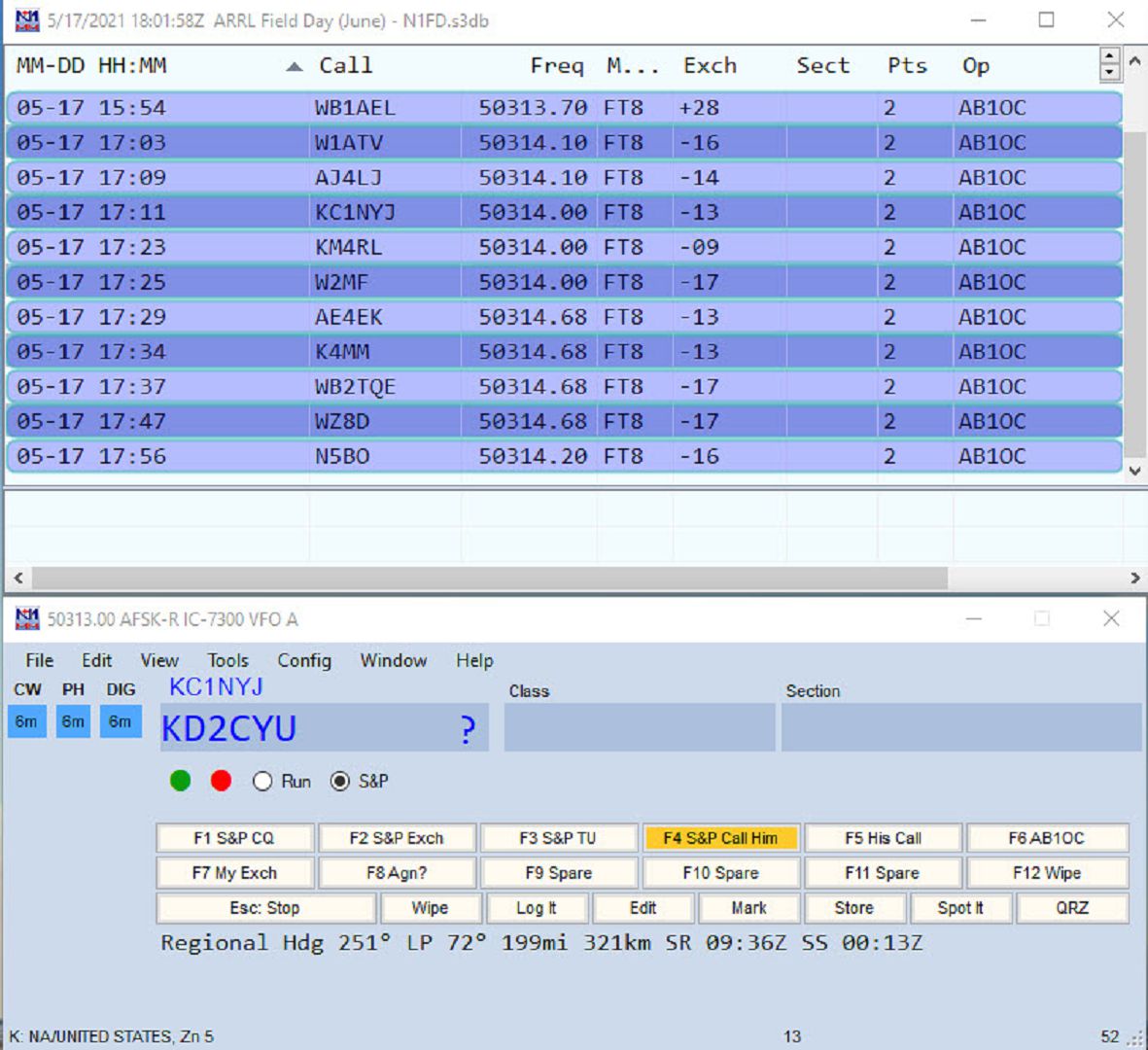
The N1MM+ Logger works great with the IC-7300 and WSJT-X digital. It supports the all-mode station configuration nicely and it is well integrated with WSJT-X making the logging of FT-8 and other Digital Mode contacts simple. N1MM+ also supports voice recording and keying of the IC-7300 which is a great aid during longer operating events like Field Day.

6m Field Day Station - PSKReporter Test of Portable 6m Station
PSKReporter Test of Portable 6m Station

So how does the upgraded setup play on 6m? Very well! The image above is a snapshot from PSKReporter during our testing session. As you can see, we were using FT8 to test the station and we were heard up and down the eastern U.S. states.

WSJT-X FT8 Decode using 6m Portable Station

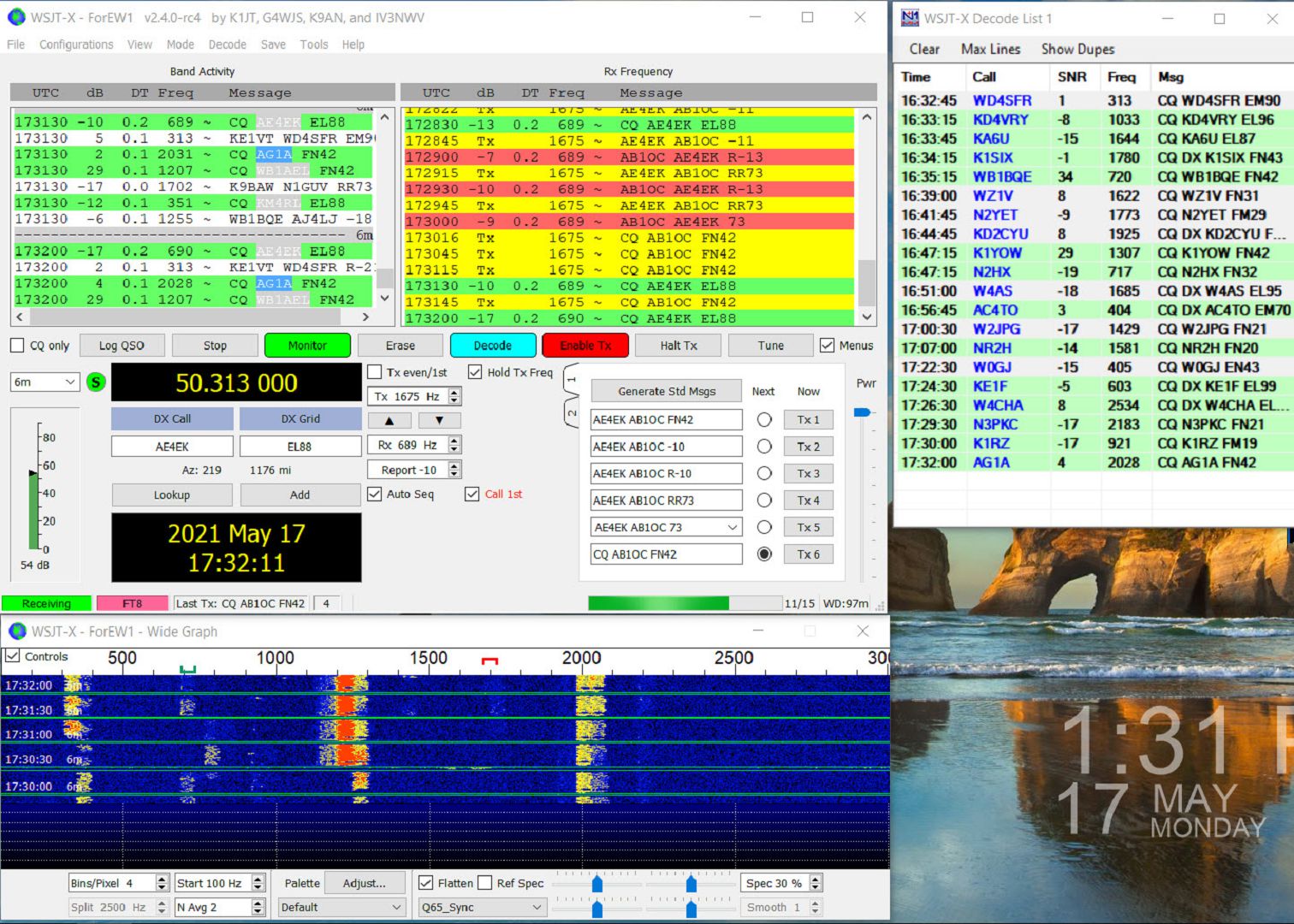
Signals were strong in WSJT-X FT8 mode and it was easy to make contacts. We made about 50 contacts during our testing of the 6m Feild Day Station.

The LFA Yagi hears really well making for reliable decodes of signals in the -18 range and often weaker.

6m Meteor Scatter Pings

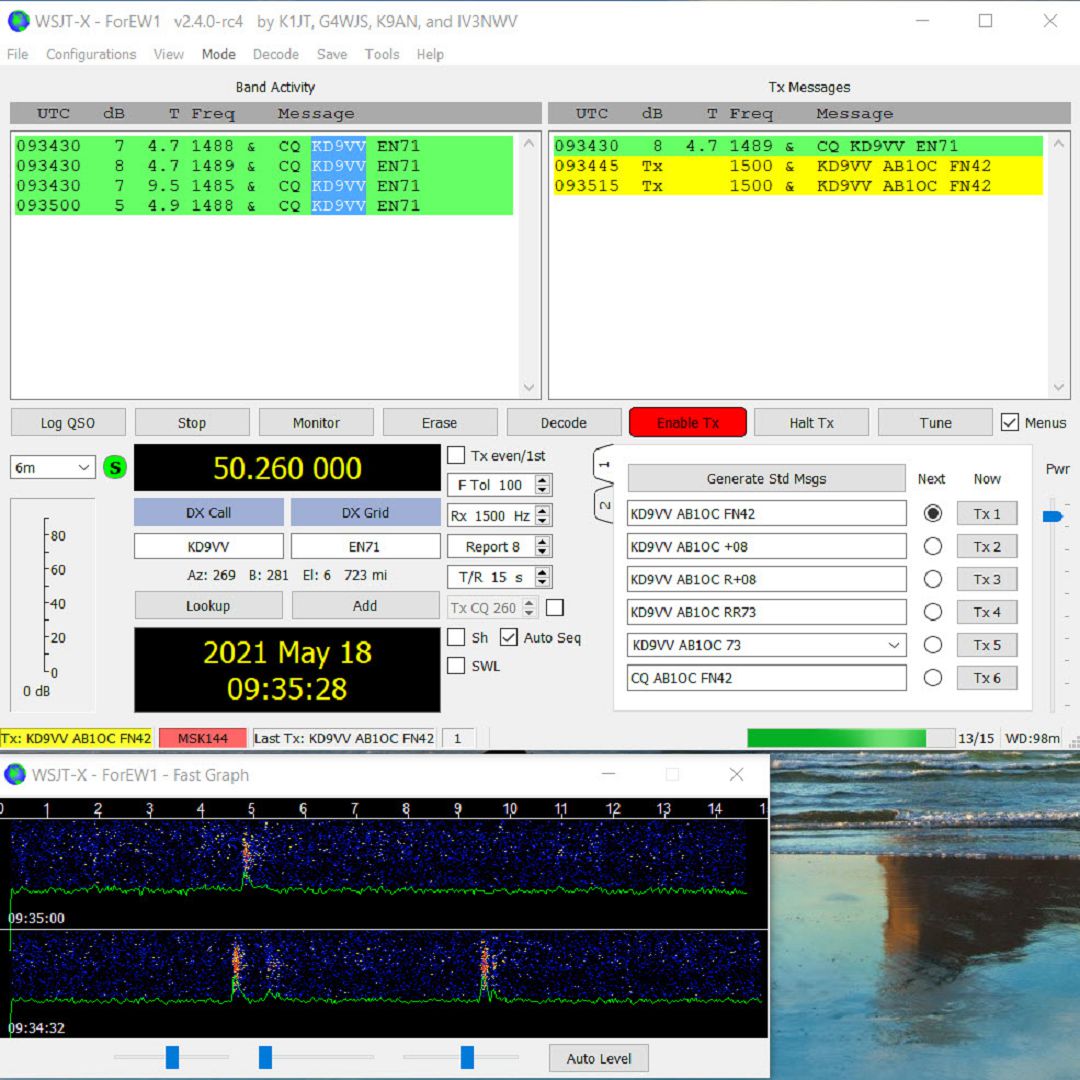
For fun, I decided to try some 6m Meteor Scatter contacts using the MSK144 mode. This is a challenge with a 100W station as Meteor Scatter general needs a bit of power to work well. As you can see from the image above, we had no problems decoding meteor pings from stations in the midwestern US. I even managed to complete a couple of contacts using Meteor Scatter on the 6m Band.

All in all, we are very pleased with the performance of our upgraded 6m Field Day Station. If we can get a similar Es opening to what we have been seeing here during the last two days, we should have a lot of fun on the Magic Band at Field Day!

Fred, AB1OC

2020 Field Day Results

The ARRL has published the 2020 Field Day Results in the December 2020 Issue of QST.

Field Day 2020 Rule Changes

Due to the pandemic, the ARRL made two rule changes this year.  The first is that stations in category 1D could contact other 1D stations.  The second is that individual submissions could specify a club affiliation and scores would be aggregated by club.

Virtual Site Visit on Zoom

NARS held several activities to help members operating in Field Day to earn bonus points toward their scores.  A virtual site visit via Zoom with Gary Gasdia (father of member Ryan, KC1KJS), who is a member of the Hudson School Board and Community Emergency Response Team Members Patrick, W1YTT, Joe, AC1BG and Dan, W1MUZ helped members with bonus points.  Sterling, AK1K, trained us all and hosted a messaging net to help us get the messaging bonus.   These bonus points helped to increase our score.

Field Day 2020 Scores

Thanks to all of our members who submitted their scores for the Nashua Area Radio Society, our efforts resulted in a total club score of 14,952.  From a quick scan of the line scores published by the ARRL and back of the envelope calculation, we placed in the top 3% of all clubs!

Jeff, AC1FX Operating at Field Day 2020

We had a total of 16 members contribute their scores toward our aggregate club score:

CallNameOperatorsClassPowerTotal
AB1QBAnita KemmererAB1QB, AB1OC, KC1IMK, AB1BY3ELow3930
AK1KSterling EanesAK1K1ELow1762
NE1RDScott AndersenNE1RD1B1BQRP1300
W1XMMBrian QuickW1XMM1ELow1278
N1CEOPeter DabosN1CEO1ELow1218
NF1HAndrew WuelfingNF1H1DLow958
AC1EVJon TurnerAC1EV1EHigh914
W1YCZMatt TrulandW1YCZ1EHigh838
K1BRMJim LajoieK1BRM1DLow506
NU1TJorgen DahlNU1T1DLow502
W1AKIAron InsingaW1AKI1DLow446
KC1IMKKeith SangilloKC1IML, KC1IMK1DLow390
KC1IMLMark SangilloKC1IML, KC1IMK1B2Low388
AC1FXJeff LalmondAC1FX1DLow214
W1TEDTed TrostW1TED1ELow194
KC1DXLAnthony RizzoloKC1DXL1DLow114

To learn more about our members Field Day 2020 operations, see the field day articles on our blog.

To review the ARRL Results Article, visit the ARRL Web site at https://contests.arrl.org/ContestResults/2020/Field-Day-2020-FinalQSTResults.pdf

To search the 2020 ARRL Field Day score database, visit http://www.arrl.org/results-database  and select 2020 ARRL Field Day from the drop down box.

Winter Field Day 2021

Winter Field Day is coming up on January 30-31.  Similar rule changes have been made due to the pandemic.  If you are interested in operating on Winter Field Day, review and reply to Craig, N1SFT’s post in the Field Day Forum.  Also, plan to join our January Membership Meeting, where Craig will talk about Winter Field Day.

Anita, AB1QB

Radio Amateurs Developing Skills Worldwide