Category Archives: Featured

This category is for featured articles that we want to include in the sidebars and other areas on our website.

The RockMite Part 2: The UI

In the first RockMite article, I described the receiver of the radio. This article will describe the user interface for the RockMite. The term “user interface” might sound a little fanciful for a radio with almost no controls, but there is plenty to discuss. We should begin with the portion of the schematic dedicated to this function.

RockMite CPU and I/O
A portion of the schematic for the CPU and I/O functions

At the center of the schematic is a PIC processor from MicroChip corporation. These are small 8-bit computers that have dedicated I/O onboard. They are simple to program and are very inexpensive, key features for a radio that must cost under $50. Two of the input lines for the processor (pins 6 and 7) go to a 3.5mm stereo connector for iambic paddle input. Pin 6 connects to the “dash” or “dah” line, and pin 7 connected to the “dot” or “dit” line of the paddle. One of the functions of this PIC microprocessor is to provide the radio with an iambic keyer function.

The other user input is a single button. This button serves multiple purposes. A press of less than a quarter second tells the processor to “shift” the radio’s frequency. More on this in a bit. A longer press (greater than a quarter second) puts the keyer into “speed adjustment mode” that monitors the paddle inputs. Tapping or holding the “dit” side increases keyer speed; tapping or holding the “dah” side decreases keyer speed. Do neither for a second-and-a-half and the processor reverts back to standard iambic keyer mode.

The “shift” mode is the more interesting effects from a button press. The RockMite is actually able to operate on TWO frequencies, not just one. There is a special circuit in with the crystal controlled oscillator that causes this frequency shift. That will be discussed in the next RockMite article. All we need to know for now is that the “shift” line comes out of pin 3 and controls a 2N7000 transistor switch.

The other two outputs of the microprocessor are to the sidetone and the transmit/receive (T/R) switch. The sidetone is the sound you hear when keying. That’s the audio feedback on your paddle operation. The RockMite sends a square wave from this pin to the audio amplifier described in last month’s article. The sound of a square wave in your ears is harsh, and there are a number of mods available to clean this up.

The T/R line controls the mode of the radio. Is it in receive mode or transmit mode? This will be discussed in the article that deals with the transmitter. 

This was a brief article but we’re left with two interesting threads to pull on: radio’s oscillator (and shift function), and the radio’s transmitter (and the T/R switch). We’ll start with the oscillator next time.

Scott, NE1RD

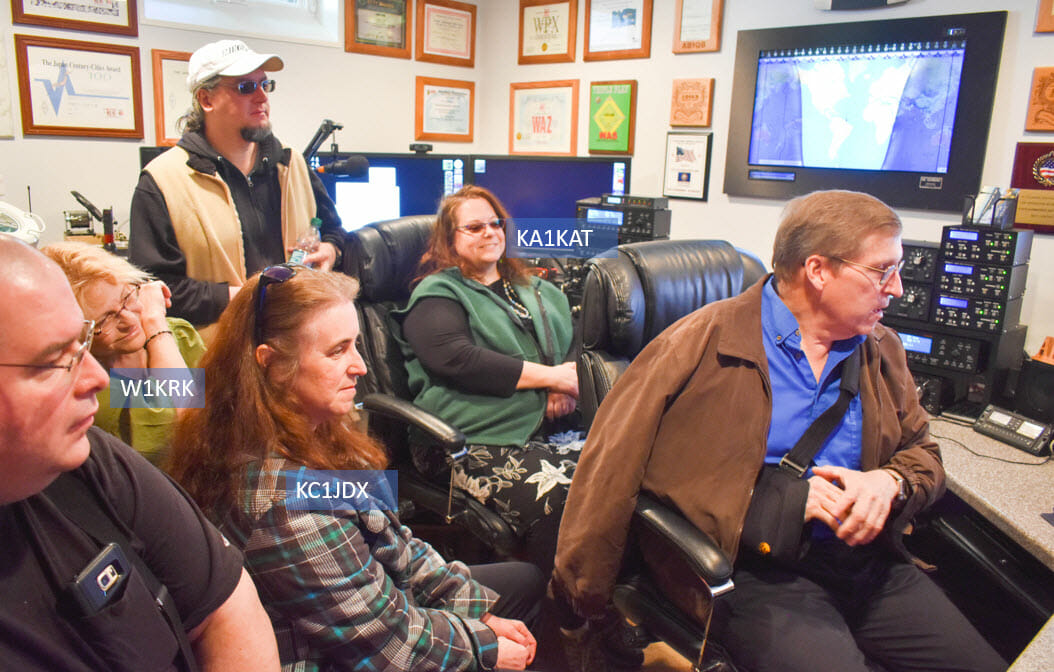
N1FD Wins 2019 ARRL Rookie Roundup SSB!

The results are in – the N1FD multi-op entry came in 1st place in the Multi-Op Area 1 Category in the 2019 ARRL Rookie Roundup SSB.   Not only did we win our category, but our score of 12,900 was also higher than any other entry.  The next closest was KD9IPO, single op entry from Michigan.

Rookie Roundup Operators W1KRK, KC1JDX and KA1KAT learn from AB1OC at Bootcamp
Rookie Roundup Operators W1KRK, KC1JDX, and KA1KAT learn from AB1OC at Bootcamp

Congratulations to the Rookie Roundup Operators:

The team operated from AB1QB’s and AB1OC’s QTH.

The Complete contest results can be found on the ARRL website  http://contests.arrl.org/rrscores.php?iid=625

May 2019 Contest Notes

May marks the end of the main contesting season. Sure, there are contests all year-round but the big contests (CQ WW, ARRL DX, ARRL SWEEP, CQ WPX) run October through May mainly leaving the Summer for state QSO parties and Field Day. There are two contests this month that are of note to NARS members: the NEQP and CQ WW WPX CW.

New England QSO Party [2000Z, May 4 to 0500Z, May 5 and 1300Z-2400Z, May 5]
The exchange for New England states is RS(T) + county + state. Outside of NE sends RS(T) + state/province/DX. Take a look at the NEQP website to see the standard county abbreviation list.

CQ WW WPX Contest, CW [0000Z, May 25 to 2359Z, May 26]
This is a serial number contest so set up your logger to automatically increment the sent serial number for each QSO. The full exchange is RST + serial. Everybody sends the same exchange. If you are not a great CW operator this is a great contest to play in. First, it isn’t quite so cut-throat as CQ WW. Secondly, the exchange is nice and simple. Listen (listen! listen!). It might take a bit to finally get the serial number, but once you do make your call and put it in the log. At risk of repeating myself, this is one of my favorite CW contests.

7th Call Area QSO Party [1300Z, May 4 to 0700Z, May 5]
First, note the overlap with the New England QSO Party! The exchange for this contest is also RS(T) + state and county. Check out the list of counties to expect here. The point is: you just record the exchange and the contact should be good for two contests.

Indiana QSO Party [1500Z, May 4 to 0300Z, May 5]
Exchange: Get RS(T) + county, we send RS(T) + state. The website has a list of five-letter county abbreviations that is worth printing out and hanging by your computer for this one.

Arkansas QSO Party [1400Z, May 11 to 0200Z, May 12]
Exchange: Get RS(T) + county, we send RS(T) + state

Hamvention and Contest University
Finally, the annual Contest University held in Dayton is one of the highlights of Hamvention. If you have any interest in contesting, it is well worth your time to sign up for one of these events. You MUST pre-register for the upcoming event on May 16th, and it is getting late for that, but I’d like to plant the seed of an idea that you should consider putting this on your “bucket list.”

I’m going to try to be in the New England QSO Party. Get on the air for 15 minutes or 15 hours and hand out some points!

Scott, NE1RD

Radio Amateurs Developing Skills Worldwide