Category Archives: Featured

This category is for featured articles that we want to include in the sidebars and other areas on our website.

Our Family Picnic is on August 27!!

Our Summer Family Picnic is scheduled for Saturday, August 27th at Greeley Park in Nashua. All club members and their family members are invited. This will be a potluck lunch and members are encouraged to bring a dish. I have created a sign-up sheet. You can view it here.

Please edit this sheet to indicate whether you will attend, how many family members including yourself will attend, and what you will bring.

We will start to gather around 10:00 am and lunch will be served at noon. Directions can be found on the club event calendar.

The rain date will be Sunday, August 28. If there is inclement weather in the forecast for Saturday, stay tuned to our Forums for updates.

See you at our picnic!

73,

Anita, AB1QB

Learning Morse Code – Our CW Training Classes Have Begun

A Big Thanks To Our Morse Code Instructor Team – Layne, AE1N, Mike, K1WVO, Dennis, K1LGQ and Wayne, KB1HYL.

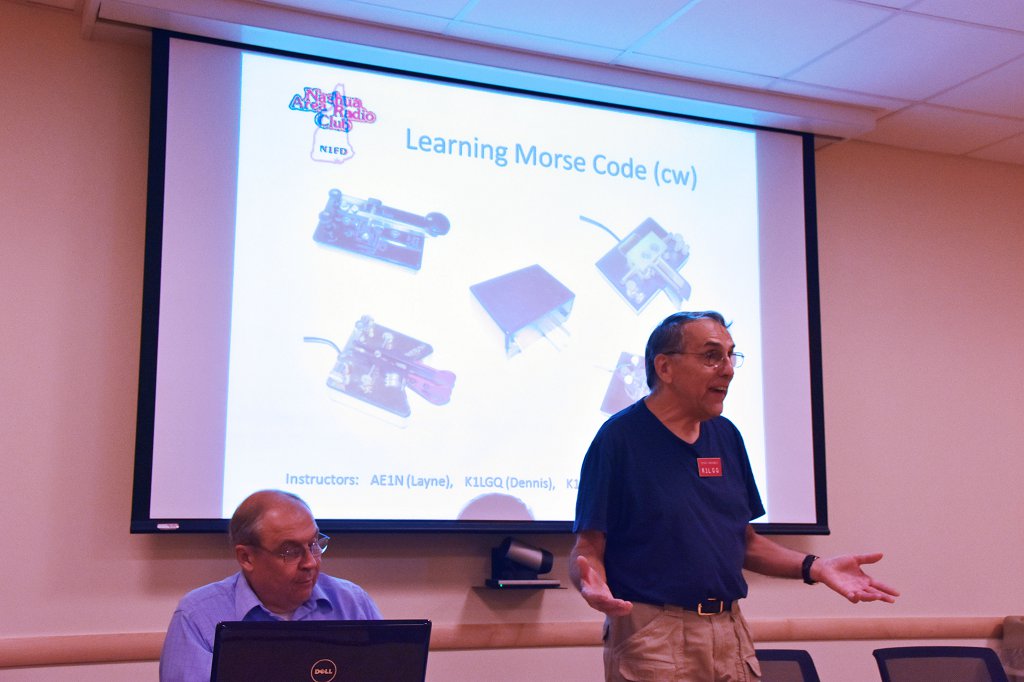
The Nashua Area Radio Club has begun teaching a Morse Code training class on Saturday, July 16th 2016.  The class was created in response to interest in learning Morse Code, expressed by several club members who are drawn to this unique mode of communication.   While this unique skill-set is no longer a licensing requirement it continues to be a long standing practice enjoyed by may radio amateurs worldwide.  Numerous groups and organizations exit to encourage and promote the practice of communications using Morse code such as FISTS; North American QRP CW club (NAQCC); CW Operators Club (CWops); and the Straight Key Century Club (SKCC). Also, you can learn more about Morse Code and CW operation on our website here.

Morse Code - Dennis K1LGQ: "didit dah dah didit"
Dennis K1LGQ: “didit dah dah didit”

The use of Morse Code is one of the simplest ways of modulating a Continuous Wave (CW) RF carrier by generating characters composed of a series of “dits and dahs” to create a message.  Most QRP (low power) operators favor CW operation because of its low circuit complexity, lightweight (for portable operation) and extreme efficiency.  A limited number of amateur radio operators find great satisfaction in operating using Morse Code aka CW as their only mode.

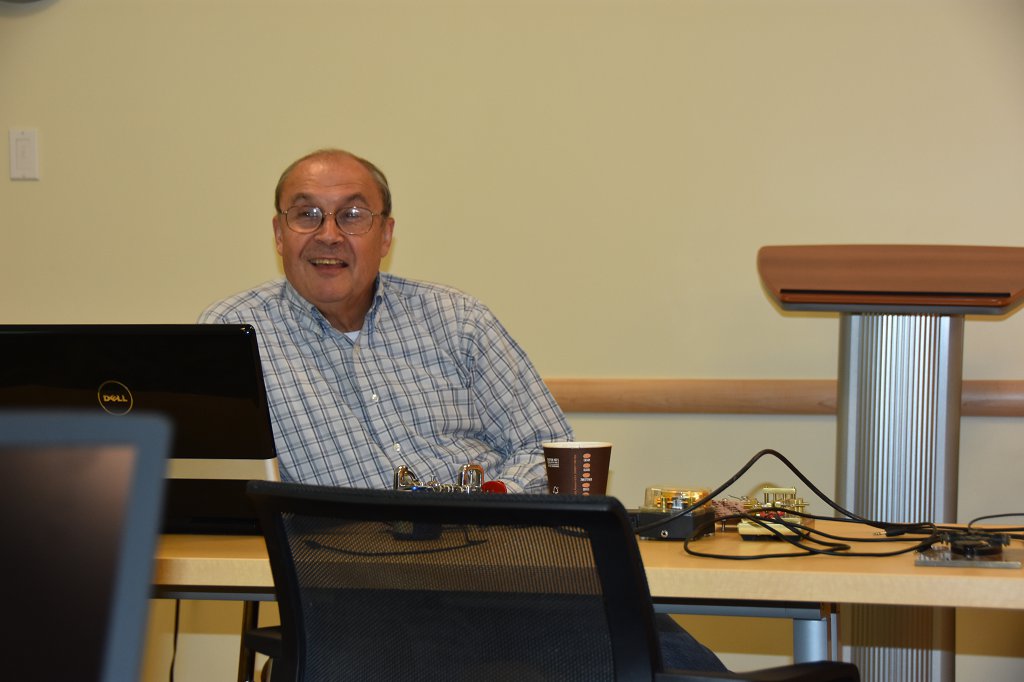
Morse Code - Mike K1WVO 'Practice Practice Practice ...'
Mike K1WVO ‘Practice Practice Practice …’

The Nashua Area Radio Club Code course employs the Chuck Adams – K7QO, training CD.  Chuck’s course is available for download free of charge and is well-organized with over 500 audio MP3 files to help learn and improve your skill levels.  Our class encourages following K7QO’s guidelines and instructions to develop good CW habits that avoid the later roadblocks to greater speed and proficiency.  Our class has introduced a few variations to Chuck K7QO’s training plan with a couple of special CW practice quizzes that help keep the classroom fun and more interesting.  The G4FON software trainer utility has added to the fun with background noise, QRM and QSB listening challenges, which adds a taste of real CW operation.  Learning and gaining proficiency with Morse Code requires practice, practice, practice.  The K7QO training MP3 files can be listened to with a PC, MP3 player or in many of the newer car CD players.

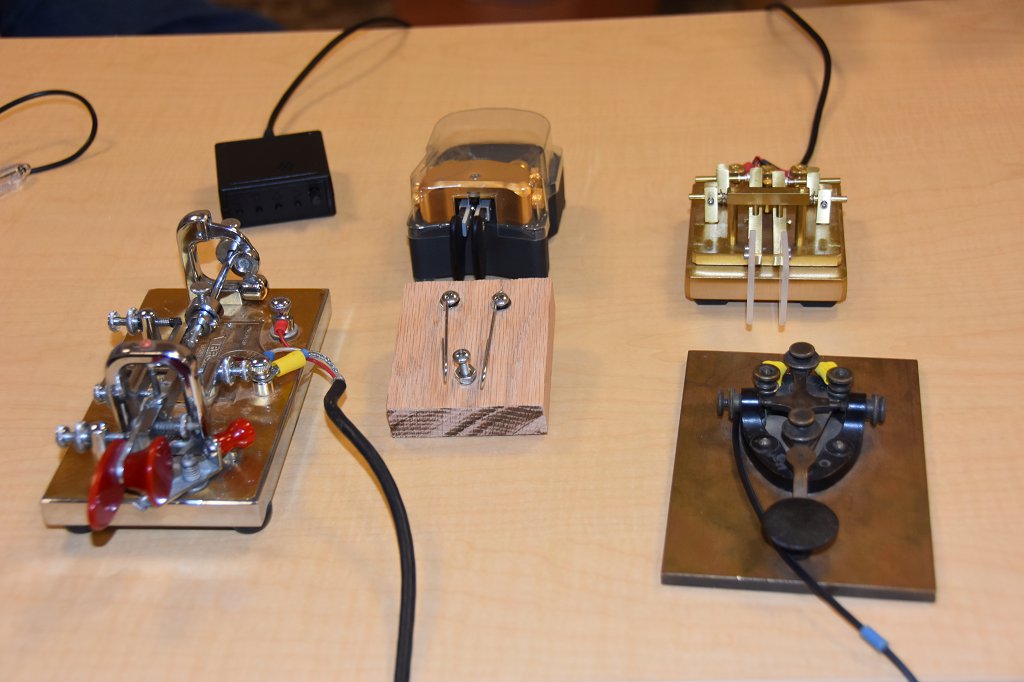
Morse Code Keys - From the $2 Paperclip to $440 Bengali Key
From the $2 Paperclip to a $440 Bengali Key

Our training class has provided an opportunity for many of the students to observe several different Morse Code keys.  A couple of students have also brought in some innovative code practice keys that were constructed from some unique household items.  Other students are building a small microcontroller based keyer that can be used with a straight key or a single or dual paddle key for training or use with a transmitter.  The class will continue for a few more weeks and then many of the students will be ready to try their first on the air CW QSO.  Each on the air QSO will help grow their CW skills and is ultimately the best form of practice, practice, practice.

Mike, K1WVO

Broadband Matching for Antennas

This article discusses some work on designing a matching network to make antennas match well (low VSWR) across the entire ham band.  This will be a described in more detail at the September Tech Night.

Antennas have an impedance (or match) that varies with frequency.   Transmitters want to see a matched antenna with an impedance of 50 ohms.    The antenna has the best match at one frequency and the match gets worse as the operating frequency changes.

Some bands and antennas are more challenging to match than others.  Shortened or loaded antennas have a narrow range of match frequencies.  The 75/80 meter band has a wide bandwidth in term of percentage.

Here’s a plot of the SWR for my 40 Meter Dipole.  It’s a good match at 7.000 MHz and degrades to about 2:1 at 7.100 MHz.  Obviously, this is not optimized.

Broadband Matching - SWR for 40M Dipole
SWR for 40M Dipole

Modern radios have built in automatically adaptive matching networks make the radios work over a wider bandwidth, but networks are lossy and reduce transmitted power.

A manual antenna tuner has a lot lower loss than the built in tuner, but it requires manual adjustment.  In fact, the extra tuned circuits generally act to make the antenna have even less bandwidth.

The QUCS RF circuit simulation program has the ability to model SWR, bandwidth, matching networks based on data about antenna performance.  The antenna data can come from either an antenna modeling program such as 4NEC2 or EZNEC.  Or the data can come from a measurement made by a good antenna analyzer.

QUCS also has a built in optimizer.  It has the ability to try hundreds of circuit values and home in on an optimal design.

The optimizer setup needs a definition of “optimal”.  For the case of a broadband antenna, “The worst case SWR anywhere in the ham band shall be as low as possible”.  In the terms that QUCS understands, “minimize the maximum SWR over the frequency range 7.00 to 7.35 MHz.

Here is the result from running the optimizer on the data for my mistuned 40M dipole.  QUCS has designed a broadband matching network that can achieve less than 1.5:1 SWR over the whole band.

Broadband Matching

QUCS achieved this by varying the components of a filter network.  I drew a general filter network and let QUCS tune the component values.  This network is designed with coaxial stubs.

Broadband Matching

The model of the antenna is stored as a file in the X1 file component. Line7 is a 30-meter coax feedline.  The actual matching network consists of Line 1, 2, 3, 4.  Each line is 50 Ohm coax.  Line 1 and 3 are configured as open stubs.  The line lengths predicted by the model are…

  • Line 1: 7.75 meters
  • LIne 2: 4.47 meters
  • Line 3: 8.49 meters
  • Line 5: 8.03 meters

Here’s another example.  160-meter antennas are often implemented as shortened loaded verticals.  The loading makes the match very narrow-band.   The red curve in the plot below shows a top loaded 160 meter vertical.  It only covers a fraction of the band.Broadband Matching

The blue curve shows the result of an optimization run that selected the values for a 7 component matching network.  It achieves about 1.7:1 across the whole band.  This network uses capacitors and inductors because coax stubs would be very long on 160 meters.

Broadband Matching

The component values for this network…

  • C1: 3450 pF
  • L1: 3.954 uH
  • C2: 3978 pF
  • L2: 6.951 uH
  • C3: 6156 pF
  • L3: 2.831 uH
  • C4: 4778 pF

I have not built any of these networks to see how they work in practice.  The 160-meter network has some extreme values and it is probably very touchy to get right.  Building that network to handle Tx power will require vacuum variable capacitors in parallel with high quality stable fixed value capacitors.   But, the 160 network doesn’t really need 7 components.  Put in one less stage of L-C and the ripple across the passband goes up a bit.

Conclusions

QUCS is a great RF circuit simulator.  This shows that it can work with data from an antenna model or analyzer and can optimize matching networks to create a broadband antenna.

Jeff, WA1HCO

Radio Amateurs Developing Skills Worldwide