Introduction
Some months ago, we reported on a commercially available, off-the-shelf 3W MMIC amplifier [1] to be used as part of a transmitter driver with receive bypass [2]. It was our intent to use as many COTS components as possible to simplify and shorten the construction timeline for a 10-band QRP SSB transceiver. An inexpensive amplifier that is widely available through AliExpress [3] is advertised to work from 2 to 700 MHz, which is more than adequate for our requirements (Figure 1. The gain of this amplifier was 45 dB.
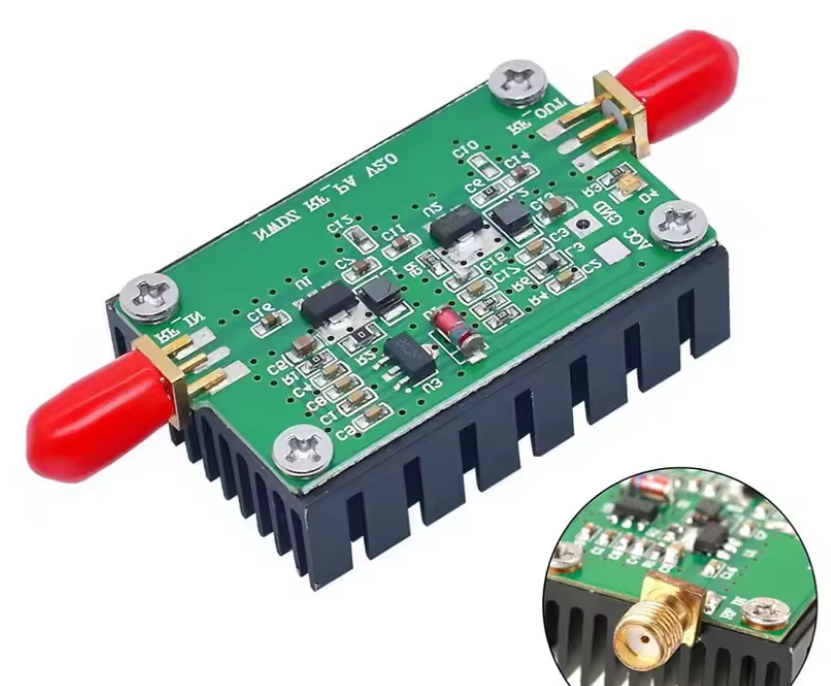
Figure 1. Wideband 3W Shortwave Amplifier. This wideband shortwave amplifier is advertised as being capable of 3W output power. Our plan is to drive it to 1W so that our 10 dB gain power amplifier can be driven to 10W. The 3W MMIC amplifier works from 2 to 700 MHz, which is more than adequate for high-frequency use. The measured gain of the amplifier is 45 dB. Power dissipation is greatly improved by the application of diamond heatsink compound between the circuit board and the heatsink. The amplifier is operated at +9 VDC to reduce its thermal dissipation. Please click on the Figure to open it in a new window.
Since our last report, some changes have been made to the original circuit to reduce its gain, increase its stability, improve its spectral purity, and enhance its receive isolation. The 3W MMIC amplifier is of single-ended construction. Consequently, there is no cancellation of even (or odd) harmonics of the signal being amplified, and it turns out that when operated at +9 VDC, or even +13.8 VDC, the MMIC amplifier is quite nonlinear.
This article discusses all of the circuit improvements. In particular, the spectral purity of the transmitter driver amplifier is demonstrated. Use of the single-ended amplifier requires the addition of another low-pass filter bank [4] between the driver amplifier circuit and the transmitter, in addition to the one that is provided at the transmitter output.
Low Pass Filter Bank
Thanks to Hans Summers, G0UPL, at QRP Labs [5] for providing bare boards so that my original filter bank, consisting of 10 low-pass filters, Figure 2, that employed the Ed Wetherhold (SK), W3NQN, design [6] could be built and tested.
As we will soon demonstrate, an additional low-pass filter bank results in greatly improved spectral purity. Since an additional low-pass filter bank had not yet been built, we have employed the transmitter low-pass filter bank, as required, for measurements in this paper.
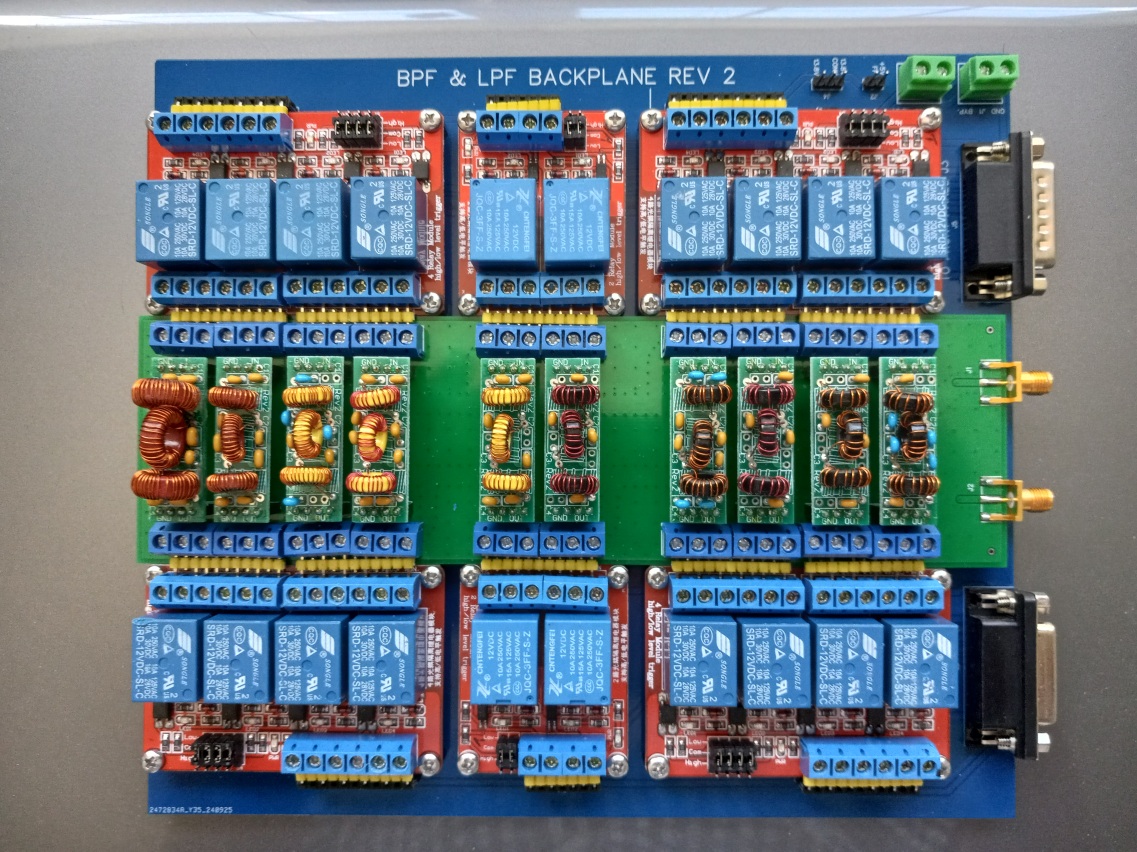
Figure 2. Ten-Band Low Pass Filter Bank on Its Interconnect Backplane. The 40m low-pass filter that was used to process the 7.1 MHz signal is located four filters from the left. All of the filters employ the Ed Wetherhold (SK), W3NQN, design. The bare boards for these filters were obtained from Hans Summers, G0UPL, at QRP Labs. Readily available Arduino relay boards were used throughout. Since these are power relays, the relay contacts are DC-wetted through bias-T’s, not shown, to reduce the contact resistance. The QRP Labs filters employ a single DPDT relay per filter band, whereas my filters employ two separate SPDT relays per band. Please click on the Figure to open it in a new window.
Revised Transmitter Driver With Receive Bypass Schematic
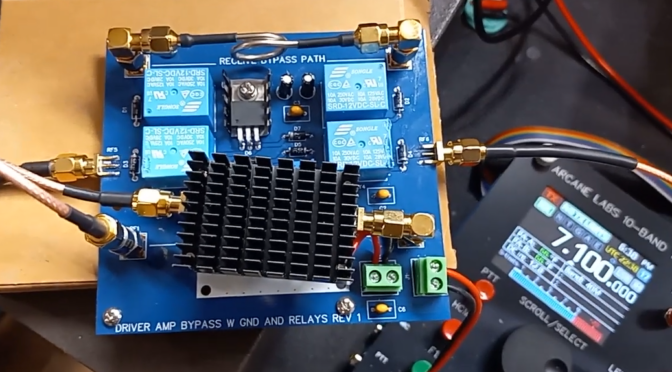
A revised schematic diagram is shown in Figure 3. Changes to the original design [7] include the removal of relay optical isolation for push-to-talk with the deletion of its attendant FET driver, and the addition of relay grounding for the receive bypass path during transmit. An additional relay pair was added to perform the grounding function. A 3 dB attenuator was added to the driver amplifier input to improve the amplifier stability and to reduce its gain. A photo of the completed design with the 3 dB coaxial attenuator installed is shown in Figure 4. If there is sufficient isolation, the 3 dB attenuator will be added to the back of the circuit card. The revised design uses a separate power management circuit board to supply +13.8 VDC to the +9 VDC onboard voltage regulator during transmit. This greatly simplifies the circuit board.
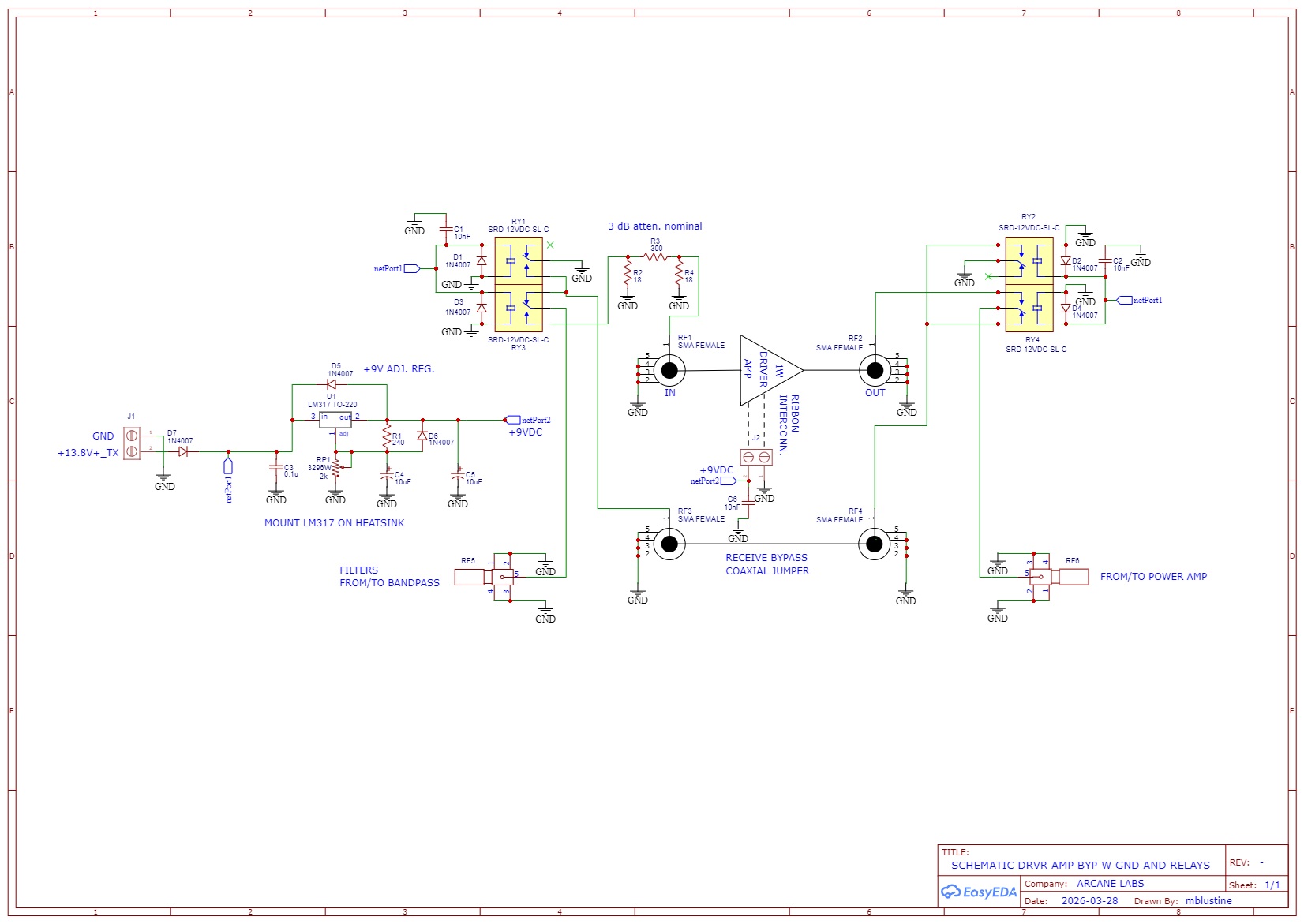
Figure 3. Revised Driver Schematic Diagram. The schematic has been simplified when compared to the previous iteration. The logic input has been removed so that the module may be keyed by the power management module during transmit. The receive bypass path is grounded at both ends during transmit. Power is supplied to the driver amplifier by an LM317 adjustable voltage regulator that receives power from the power management module during transmit. Please click on the Figure to open it in a new window.

Figure 4. The Completed Driver Amplifier Board As Revised. The black driver amplifier heatsink is visible. The lower relay pair provides the transmit/receive function. The upper relay pair grounds each end of the semi-rigid coax receive path during transmit. The LM317 adjustable regulator regulates +13.8 VDC from the power management module down to +9 VDC for use by the driver amplifier. This reduces the amplifier power dissipation. Please click on the Figure to open it in a new window.
The measured spectrum of the amplified 7.1 MHz signal without low-pass filtering is shown in Figure 5. The amplifier has been driven to 1W. Since the amplifier is single-ended, the even harmonics have not been suppressed, and the 2nd harmonic is barely 10 dB below the carrier. It is evident that this MMIC amplifier is nonlinear.
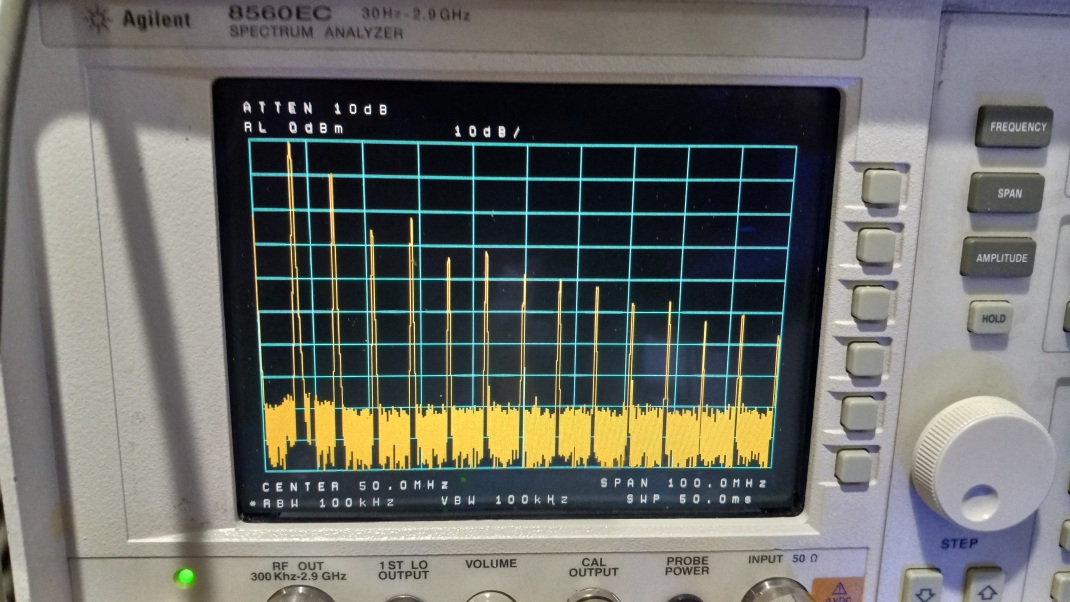
Figure 5. Spectral Purity of a 7.1 MHz Signal Prior to Low Pass Filtering. Even and odd harmonics are visible because the driver is single-ended, not push-pull. A push-pull amplifier would provide some attenuation of the even harmonics but not the odd harmonics. The spectrum analyzer display shows the 7.1 MHz carrier at 0 dBm. Since the spectrum analyzer input is padded by 30 dB, 0 dBm corresponds to 1W. The second harmonic is barely -10 dBc for this drive level. Please click on the Figure to open it in a new window.
The measured spectrum of the amplified 7.1 MHz signal with low-pass filtering is shown in Figure 6. The amplifier drive level was left unchanged from the previous measurement. With the low-pass filter applied to the signal, both the even and odd harmonics have been suppressed by nearly 60 dB.
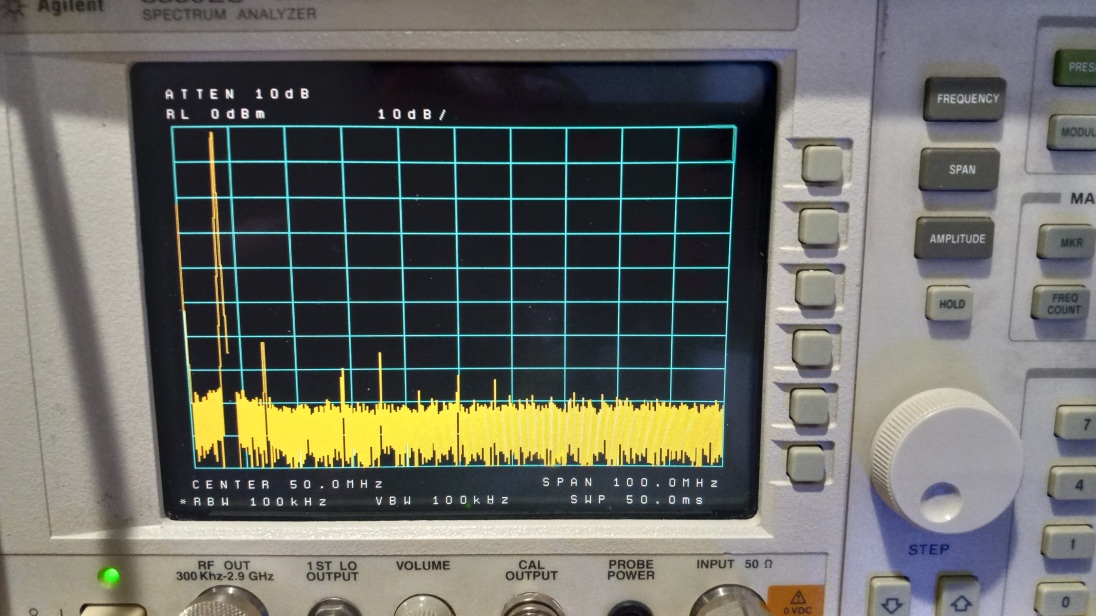
Figure 6. Spectral Purity of a 7.1 MHz Signal After Low Pass Filtering. The even and odd harmonic content of the 7.1 MHz signal has been suppressed by nearly 60 dB. The implication is that the W3NQN 40m low-pass filter is doing a great job of attenuating the 2nd harmonic and higher-order products. About 1 dB of signal attenuation is observed after passing it through the low-pass filter, as one might expect. As in the previous figure, 0 dBm corresponds to 1W due to the presence of a 30 dB pad at the spectrum analyzer input. Please click on the Figure to open it in a new window.
Summary
We have described revisions to the original circuit design that result in a much simpler driver amplifier that retains a receive bypass function. The revised circuit is keyed from the power management module on transmit so that it does not have to be keyed directly from push-to-talk.
The spectral purity of the amplified signal before and after low-pass filtering has been demonstrated. Higher order harmonics are attenuated by nearly 60 dB by Ed Wetherhold, W3NQN, low-pass filters.
The low-pass filter bank that was used for spectral evaluation is at the transmitter output. Consequently, another low-pass filter kit has been ordered from QRP Labs that will cover 5 of the 10 bands. Another kit will be ordered at a later date to cover the remaining 5 bands. Since these low-pass filters come without an integral transistor interface for microprocessor I/O, one will have to be built.
A short YouTube video [8] of a test may be viewed at https://youtu.be/nTQk9CR1W9w
References
[1] 2 MHz-700 MHZ 3W HF VHF UHF FM Transmitter RF Power Amplifier For Radio https://www.aliexpress.us/item/3256807249993037.html?spm=a2g0o.order_list.order_list_main.25.1adb1802la12vX&gatewayAdapt=glo2usa
[2] Blustine, Martin, RF Driver Amplifier With Receive Bypass, N1FD, Nov. 1, 2025. https://www.n1fd.org/2025/11/01/rf-driver-amplifier/
[3] AliExpress, op. cit.
[4] QRP Labs, Ultimate Relay-Switched LPF Kit, https://qrp-labs.com/ultimatelpf.html
[5] QRP Labs, Low Pass Filter Kit, https://qrp-labs.com/lpfkit.html
[6] Wetherhold, Ed, W3NQN, Second-Harmonic Optimized Low-Pass Filters, QST, Feb. 1999, pp. 44 – 46.
https://www.arrl.org/files/file/Technology/tis/info/pdf/9902044.pdf
[7] Blustine, Martin, op. cit.
[8] YouTube Test Video, https://youtu.be/nTQk9CR1W9w
Disclaimers
This circuit design is provided for informational and educational purposes only and is supplied “as is” and without warranties of any kind, express, implied, or statutory. No representations or warranties are made regarding the accuracy, adequacy, completeness, legality, reliability, or usefulness of this information, either in isolation or in the aggregate. This circuit design may contain links to or information based on external sources or third-party content. Endorsement and responsibility for the accuracy or reliability of such third-party information or for the content of any linked websites are not taken.