Introduction
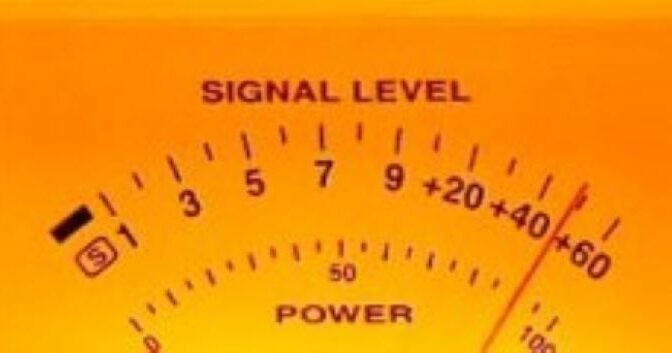
Most communication receivers and transceivers have S-meters, either analog or digital. We also know that there is a 50-ohm coaxial connector on the back of most receivers. What do S-meter readings mean in terms of the 50-ohm receiver input?
High Frequency (HF) < 30 MHz and Very High Frequency (VHF) > 30 MHz receivers work to different input signal level conventions. In other words, and to confuse matters, an S9 for HF is not the same as S9 for VHF.
Nearly 100 years ago, it was decided that S9 should be 50 uV at the receiver input. However, no input impedance was specified. A signal level of S9 was meaningless until the voltage level was standardized to 50 ohms by the International Amateur Radio Union (IARU) some 50 years later. Different voltage levels at the receiver inputs were adopted at that time for HF and VHF.
While S-meter readings are useful for signal reporting and logging, it is important to remember that S-meter readings are not perfectly linear, and linearity differs from receiver to receiver. It may depend a great deal upon receiver settings.
HF Receivers
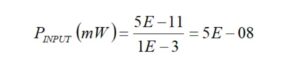
Suppose that an HF receiver is displaying a signal of S9. We are told that this signal level is defined as a voltage of 50 uV (50 microvolts) at the 50-ohm receiver input connector. This does not tell us what the signal power is incident on the antenna because we do not know what the antenna gain is, what mismatches there are, and what any other gains or losses might be. We only know that a 50 uV signal is present at the receiver input and that the receiver is displaying S9. If we perform a little calculation, we arrive at the power level at the receiver input connector.
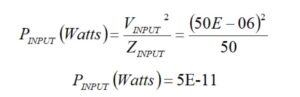
To convert this signal power to milliwatts (mW), we divide by 1E-03 or 0.001 since a mW is 1/1000 of a Watt.
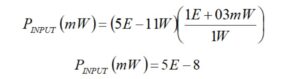
There is another way to do this if we know that there are 1E+03 mW in a Watt. We can use dimensional analysis to arrive at the right answer.
We may now convert this value in mW to dBm.
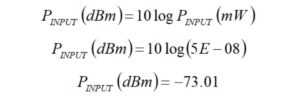
So, a signal of S9 is equivalent to a signal power level of -73 dBm into a 50-ohm input.
Example 1
Bearing this in mind, what would the power level of a signal be for an S-meter reading of S1 in units of dBm?
The signal level at S1 is 8 S-units lower. If each S-unit adds or subtracts 6 dB by convention, a signal of S1 would be 48 dB lower than S9. Subtracting 48 dB, the signal at S1 would be -121 dBm.
Example 2
Suppose we are told that the signal input to the receiver reads S9+10 dB (10 dB over S9). What would the signal into the receiver be in units of uV?
We know that a signal voltage level of S9 is 50 uV into the 50-ohm receiver input. We already know that the signal power level of S9 is -73 dBm. Thus, if we add 10 dB, the signal power level would be -63 dBm (less negative). All that is left is to convert this power level back to uV.
Let’s convert this -63 dBm input signal level to mW. In order to do this, we must take the antilog of the input signal level.
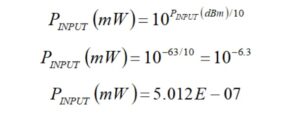
Next, let’s convert mW to Watts by dividing by 1000

Finally, we convert to Volts using the formula

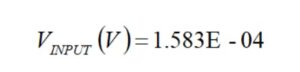
We can convert Volts to uV by multiplying by 1E+06

Since the impedance level for the 50 uV and the 158.3 uV input signals are both 50 ohms, we can check the result to see if it is 10 dB higher than our S9 signal of 50 uV. We notice that the 50-ohm impedance cancels when we take the ratio of the two power levels in
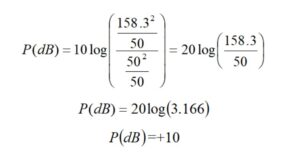
Example 3
What is the 50 uV signal in dBuV?
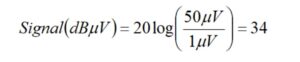
Receiver specifications are frequently written this way.
VHF Receivers
VHF uses a different standard for S9, notably –93 dBm (5 uV) into a 50-ohm receiver input. A value of 6 dB still represents 1 S-unit. All of the calculations are similar to those for HF receivers.
Example 4
Prove that 5 uV is equivalent to an input signal level of -93 dBm into a 50-ohm VHF receiver input.
Again, there are several ways to proceed. Let’s begin by converting 5 uV to Volts.

We can convert this to power
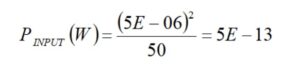
Convert to mW by multiplying by 1000

We convert to dBm using

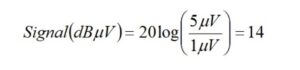
Example 5
Convert the 5 uV signal to dBuV
Conclusions
The reference levels for S9 are defined differently for HF and VHF receivers. In this article, it has been shown how one would convert between voltage and power levels at 50-ohm receiver inputs.
When discussing S-units, some receivers are more linear than others, and linearity may depend upon receiver settings. Nonetheless, S-units are useful for signal reporting and logging because everyone agrees on the same standards.
Title Photo Credit: Photo of Ten-Tec Orion S Meter, author: Martin Ewing. Public Domain, https://commons.wikimedia.org/w/index.php?curid=1575140