I have been taking a bit of time before I posted on the website about Field Day 2016. I have been recently trying to consciously temper my inherent impulsiveness both in my thoughts and words and therefore found this to be a good opportunity to reflect on my thoughts for this event. Since it was my first Field Day, and I am a new HAM, I definitely want to get this right!
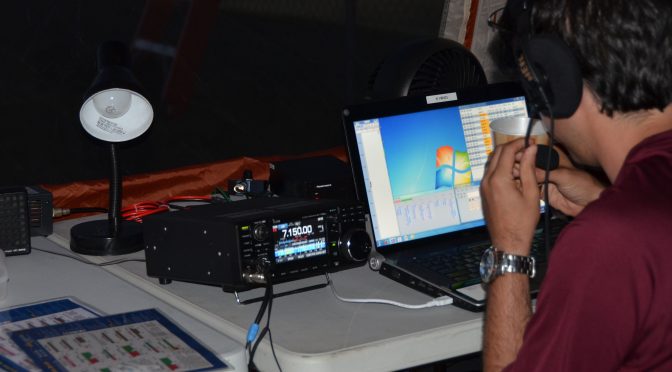
Admittedly, the build up and anticipation for the day had been steadily growing. My wife, co-workers, and family were getting sick of me talking about it. Jealous they were, I would say to myself. They just don’t get it. How could they not think it was cool that a bunch of folks would be erecting antenna towers and wire antennas — operating a myriad of SDRs — figure out how to meaningfully wire together all the hardware and electronics lying around to make some QSO a few hundreds (if not hopefully thousands of miles) away? If you asked me the Friday that we were setting up what Field Day would look like for me, I would have readily replied late nights with my IC-7300, pounding back hot coffee, and chatting up some folks in California. What I didn’t expect, however, was that Field Day became an opportunity to become further invested into a club in which I started to feel like I belonged more and more.
It was pretty obvious early on I wasn’t going to get a ton of operating time. And that was fine. There were so many folks on the air, working pileups, and not noticing the passage of time. Clearly time is a relative quantity — and I didn’t need Special Relativity to explain that one! What struck me, looking around, was that these were my people! Now, I have been to my fair share of physics conferences back in the day. Even after a day of intense workshops, folks would be sitting around in some exotic locale, drinking the local brew, and even in their free time they would talk physics. Ever since I left academia I had missed that. A lot. I became fortunate to re-encounter that again during Field Day. A lot of like-minded, technically competent, curious people, sat around the food tent and talked about something they really loved to do.
So I embraced it. So what if I got 30 minutes here, or 45 minutes there. I am going to have plenty of time to make QSO’s. What I decided was important that weekend, was to be within strike distance of the knowledge bombs being dropped by all the Elmers on the fields of Hollis Brookline High School. And in between the moments of intense radio and engineering carnage, I also found time to just shoot the breeze with folks too. We talked about families, other interests/hobbies (though we clearly do not devote as much time to them — the other hobbies that is), and plans for the rest of the summer.
Field Day 2016…my first Field Day, mind you, did not go as I planned.
But I would be remiss if I didn’t say that was totally fine! I am quite happy for how it turned out and I wouldn’t trade that experience for a different one. I hope to the people that I spoke to, that I helped put a smile on your face and made the weekend as enjoyable as you did for me. Many thanks NARC!
73,
Brian (AB1ZO)