All posts by Nashua Area Radio Society

Webmaster for the Nashua Area Radio Society

Member Spotlight – B. Scott Andersen, NE1RD

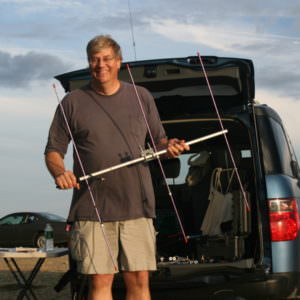
NE1RD on Mt. Wachusett

Bio of B. Scott Andersen, NE1RD

I got my start in ham radio not long ago. In 2002, after years of encouragement from a good friend, I finally looked into the hobby. “You’ll love it,” my friend said. “It’s right up your alley.” I confess I was skeptical, and even a little uncomfortable watching him make a simple call on a 2m radio he had in his car. “Go ahead and talk,” he said. I was well outside my comfort zone.

I’ve tried to remember those feelings as I show new people our world. It can seem strange, and aspects of it still seem strange, even after all these years. “It isn’t just one hobby,” my friend admitted. “It’s 99 different hobbies. You just pick the ones that interest you.”

I have taken his advice, and now I’m involved in some of the ones that most intrigued me. Not long after being licensed, I entered my first contest. It was October of 2002, the sunspots were still active, and I worked over three hundred stations in just a few hours. I was completely hooked on contesting! A lot of the things that made me nervous in the car that day were absent here. There were no long conversations; they just wanted my exchange (5905), and on they went!

The thing that really captured my attention, though, was a DVD of a DXpedition run by the Microlite Penguin team and their trip to South Sandwich Island and Southern Thule. These guys were amazing! Small radios, lightweight gear, well-conceived but modest antennas, and they worked the world. This was something I wanted to do.

So, in the next few years, I spent most of my free time thinking about ham radio, and lightweight DXpeditioning in particular. Contesting just helped me increase my DXCC totals, and hone my skills. The culmination of all that thinking was captured in my blog “The 100 Pound DXpedition.” You can get a PDF of all these brief articles from a link on my website www.bsandersen.com

As part of this DXpeditioning interest, I also spent a great deal of time thinking about antennas, and portable antennas in particular. My book “Buddipole in the Field” was the result of some of this work. You can get the free PDF from the Buddipole User Group on Yahoo!, or from a link on my website. The Buddipole has provided a good platform for many of my experiments, and DXpeditions.

I’ve always been a nerd, interested in electronics, physics, mathematics, and the like. Ham radio has provided me a way to transition from the abstract to the concrete. It is one thing to think about radio theory. It is another to build a working radio. I’ve been building kits since the 1970’s, but ham radio has given me many new opportunities. I’m particularly fond of Elecraft kits having built two K2s, three K1s, and two KX1s. They are all fabulous radios, and building them was deeply satisfying.

I am still working, so ham radio sometimes takes a backseat to my responsibilities, but it is never far from my mind. I’ve also learned just a little patience through all this. Building up a country list for DXCC, and chasing various radio awards must be done over time (usually years) and it has paid off. I now have 8-band DXCC, WAS in Massachusetts, New Hampshire, and the US Virgin Islands, ARRL Challenge, and various CQ WPX awards. They look great on my wall and are a reminder that anything worthwhile requires both hard work and patience.

After all this time, I’m still very much a student of the hobby. I’m shameless about asking questions and always try to take advantage of any opportunity to see and try new things. I can only hope that this passion continues through the coming years. It has been a joy for this first fifteen, certainly!
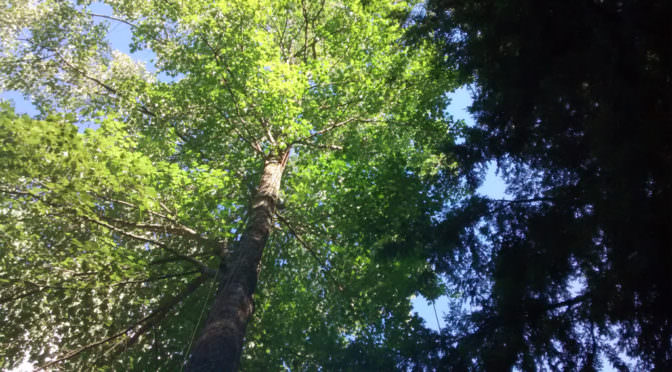
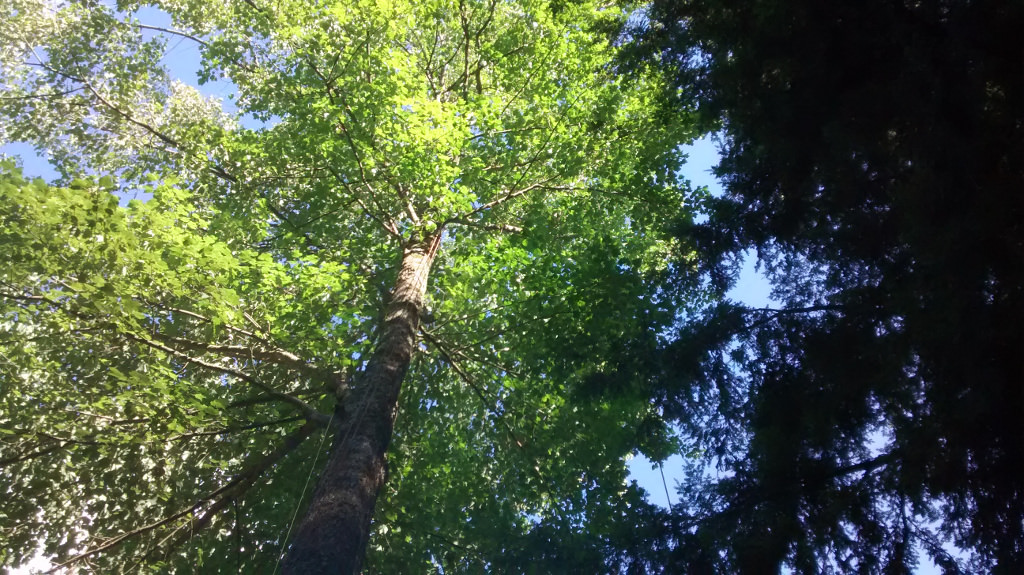
How did I hang my dipole 50+ feet high in the trees?

Dipole Antenna Tree

I wanted to make an article that would explain to anyone who visits my home or QTH that would answer the question on “How did you get that rope so high in the trees and how did you get that rope over the perfect branch?

I started out with a fishing pole and a 4-inch long stick from the woods.  After a few attempts of getting the stick up and over the tree with the fishing line it finally made it over the tree and back to the ground.  I then reeled in all the fishing line while pulling a string over the tree.  After the string, I used it to pull over 3/8” poly rope.

I came up with the following idea to get a rope over the perfect branch.

Dipole Antenna Tree

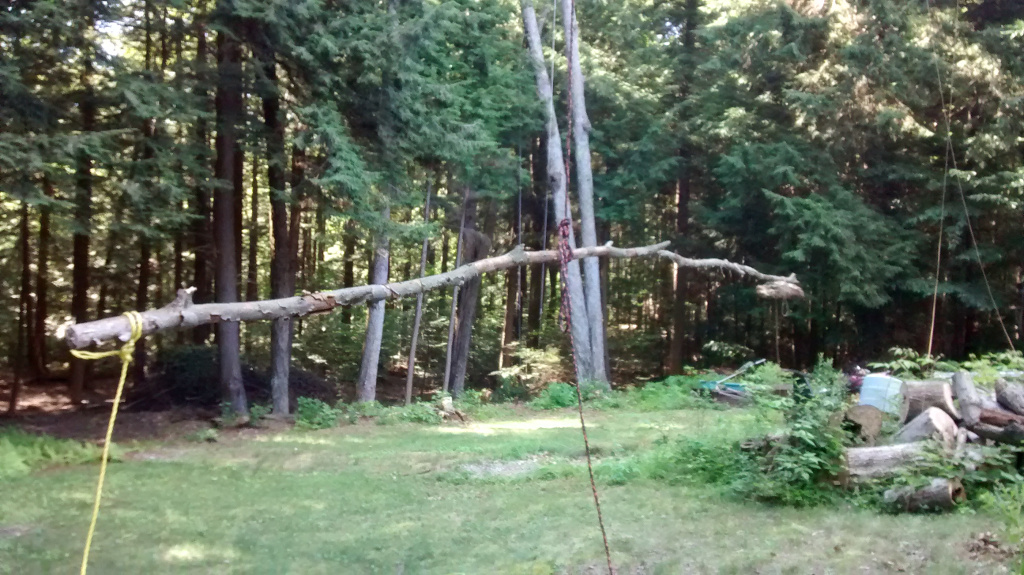
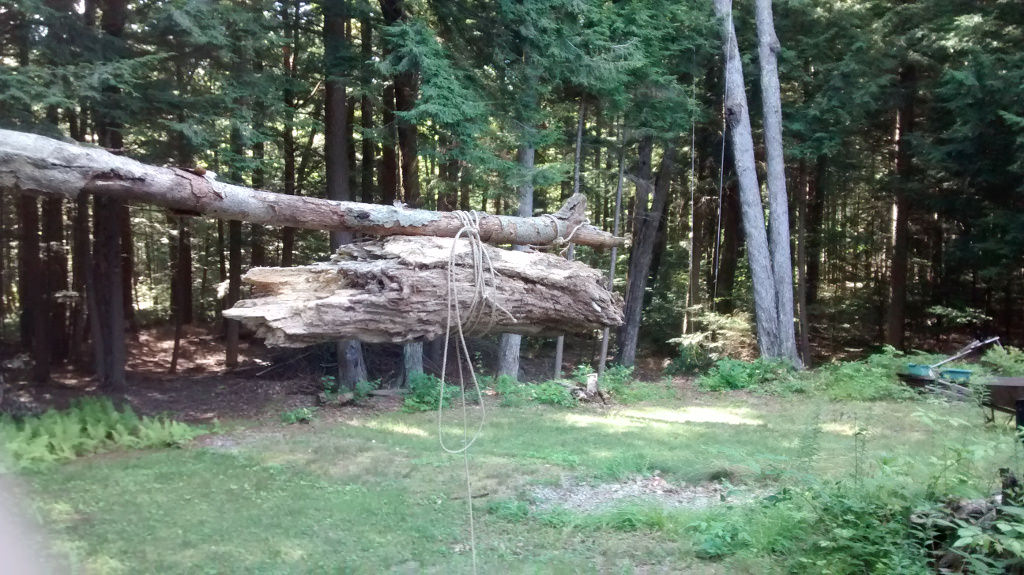
The 3/8″ line holds an old branch from the woods in the center. The yellow rope to the left is the “control line” and the right side has a half rotten log as a weight secured with a slip knot as shown below.

Dipole Antenna Tree

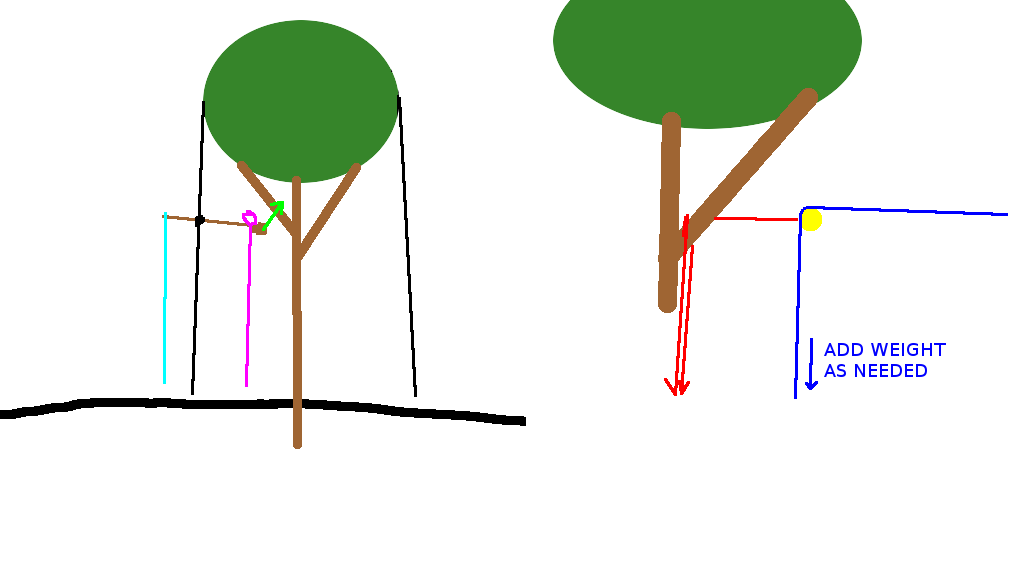
In the diagram below the light blue line represents the yellow control line from the photo.  As you lift the whole unit you should consider that the weight of the control line may offset your balance as you go higher.    The magenta line shows the string with a slip knot.  When the half rotten log made it over the desired perfect branch by combinations of pulling the 3/8″ rope at either end (shown black) and/or the control line (shown light blue) I pulled out the slip knot and the half rotten log fell over the perfect branch along with the string (shown magenta).

Dipole Antenna Tree

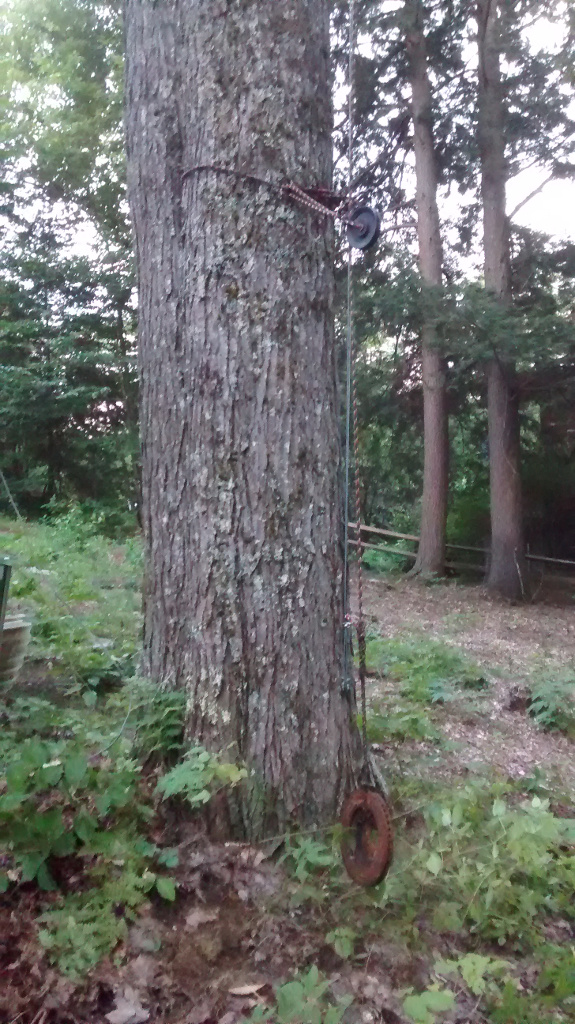
I replaced the string with rope and then a wire rope loop (shown red). The wire rope will not fade and fall apart from the sun’s UV rays. The yellow circle represents a pulley for the poly rope that holds up the dipole. When the poly rope breaks down from UV, wear and tear it can easily be replaced by lowering the pulley.  I added weight to maintain proper tension on the dipole antenna as shown below.

Dipole Antenna Tree

In theory, the tension will remain the same even in wind storms when the trees swing back and forth. It turns out that an old cast iron rotor from my Toyota was the perfect weight for the application!

73,

Mike AB1YK


Member Spotlight – Desmond Johnson, WK1V

Name: Desmond Johnson
Callsign: WK1V Licensed since 1992)
License Class: Extra

Current Age: 54

How and when I became Licensed:

Years prior to obtaining my HAM license, I do recall when the fascination with 2-way radio began for me. Between the age of 6 or 7 from a pair of walkie talkies, my parents once purchased at Christmas to my bugging and convincing dad who eventually purchased a CB radio back in the mid-seventies as I wanted to fit in with the rest of my sixth grade. Most of the guys in class had one. While growing up in NYC and being heavily involved in CB radio in my early 20’s, I remember being approached by a couple local hams who use to also frequent the 11-meter band at that time. They were encouraging me to join the amateur ranks. Unfortunately, at the time, it just wasn’t high on my list, I was having a blast on Citizens Band. I also remember this time because I knew that it was said to be illegal to work skip on 11 meters and the skip was very intense daily that you almost had no choice to engage. However, I couldn’t ignore these exciting phenomena and wasn’t going to turn my radio off, nor did a lot of other CB’ers. Looking back during that time, I think was one of the better cycles, cycle 21. I’m not sure why I didn’t pay enough attention to those guys now that I think about it.

Perhaps they just didn’t convince me enough that being a HAM was the better choice when you can work skip and use a kilowatt legally. Maybe it was the material I had to study and the Morse code was definitely a factor. On a couple of occasions, I was shown their shacks which I saw these guys had very sophisticated equipment compared to what I had. I knew I would pursue my ticket one day. As the years passed by with radio was always a thought in my mind, I eventually became employed as an installer at Motorola Inc in Elmsford, NY. This job was right up my alley. The Installers position entailed mobile cell phone installs, at that time no, mobile phones were not as portable, commercial mobile, base and repeater 2-way radio systems for any business and industry requiring 2-way communication technology. After 3 years I transferred to a Motorola shop in Baltimore. I first acquired my novice ticket in 1992 when I lived in Maryland as KB3AIJ. After waiting for my license in the mail, I purchased my first 2-meter radio from the sale of a collection of CB radio’s I have had over the years.

Many thanks to my Elmer, Fred Joyner WB3GBF, who lived not too far from me who assisted me in obtaining my ticket. I also added Fred to the log as I operated as one of the 2017 K2K team members for the 13 Colonies Special Event earlier this month. That was a special memorable contact.   Thanks to another Fred, AB1OC,  and Anita   Kemmerer, AB1QB for all allowing me  to use their very nice competitive contest station during the event,  not a shack by any stretch. Thanks to the hard work to all of the members who participated, we were the top club and state in the event this year.

Desmond Johnson

My current work schedule doesn’t allow me to get on the air very much.  I can see that radio technology is ever changing and I started to feel I a bit left behind. I ran across the Nashua Area Radio Club , N1FD.org  website while surfing online at work one day looking for more info on increasing my CW proficiency. The club offered CW classes on Saturday morning which I attended and it helps me tremendously to get better. Its still a work in process for me which I welcome the challenge. I decided to join the N1FD  club because I see they were very involved in amateur radio. It was also a great experience to get involved in this year’s Field Day activity with the club. I learned a lot and had fun. In addition, I took video and still images with my DJI  Phantom 4 drone.

After a reduction in workforce at Motorola, I returned as a full-time student completing college at the University of Baltimore. Upon graduating, I decided to relocate and took employment at Raytheon Systems in Tewksbury, MA in 1998. Not long after, decided to change my call sign to reflect the area I currently live in. I became KB1EDF. Living in an apartment at the time, the majority of my operating was mobile for a few years until I moved to my current home in Merrimack.

I’ve always desired a shorter call sign, so when I upgraded to Extra in 2006, I changed again and became WK1V. At this time I also worked part-time at HRO in Salem, NH only on Saturdays.

Other Hams in Family: None

Other Ham Organizations: OMIK Radio Association Inc.

SKCC #17099

How Often Do I Operate: I try to get on a few times a week, even if just shortwave listening

Bands I Operate: 2 meters, 6 thru 80 meters

Types of Operation: Chasing DX or Ragchew, CW, PSK31,

Do I build Equipment:

Very little, once made home-brew G5RV with Elmer’s assistance when first licensed. As time permits, I would like to try kit building

Has Ham Radio Influenced My Profession: Yes and No

While at Motorola in the early 90’s you can see the industry start to change. Radios became more portable and more computer like.
This is one reason I’ve decided to go back to school.
I earned a BS degree in Information Systems.
Currently employed at Oracle Inc.

Other Hobbies: Cycling, Photography, Flying my Drone.

Desmond, WK1V

Radio Amateurs Developing Skills Worldwide