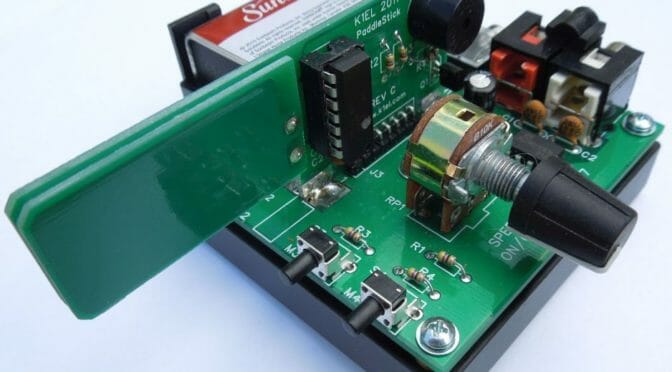
January 9, 2018, Tech Night meeting will feature Steve Elliott, K1EL, the owner of www.hamcrafters.com and the designers of the many amazing kits Hamcrafters offers. Steve will discuss aspects of kit design and building, including the PaddleStick CW Keyer that will be built during our February 13 Tech Night.
You can order your kit online, or buy one directly from Mr. Elliott after his presentation. (Mr. Elliott will bring a limited number of kits for purchase.) The PS2B kit is $59 (cash). We will be looking for a rough count of those interested in purchasing this kit during the regular members meeting on January 2.
Don’t miss out on the fun. This is a great little kit, and you’ll have a great tool to practice CW or to get on the air. Shoo away those wintertime blues by heating up a little solder with friends. See you there!
For our October 2017 meeting, we had Professor Donna Halper speak about the history of amateur radio and its heroes. Having heard her speak at Boxboro 2016, I knew our members were in for a treat. So in keeping with this theme, I searched for some interesting nugget, some salient morsel about the history of amateur radio that was somehow linked to Christmas time. I struck gold when I came across Reginald Fessenden.
A brief segue into the life of Reginald Fessenden
Reginald Fessenden, looking dapper and scholarly.
Reginald Fessenden was born in 1866 in Quebec and showed an aptitude and high interest in mathematics / engineering from a young age. Though he did not have a degree, he desired to work in the field of electricity, and so he went to the Mecca of electrical work in the U.S., namely NYC in 1886 to work with Thomas Edison. He personally wrote Edison saying “Do not know anything about electricity, but can learn pretty quick,” to which Edison replied “Have enough men now who do not know about electricity.” Luck had different plans, however, and he ended up obtaining a job with Edison and rose through his company quickly to even work directly with Edison at his new laboratory in NJ. He was laid off in 1890, however, due to financial problems Edison encountered, and so Fessenden searched for additional opportunities.
In 1900, Fessenden went to work for the U.S. Weather Bureau with the goal of “proving the practicality of using a network of coastal radio stations to transmit weather information, thereby avoiding the expense of the existing telegraph lines.” The Bureau would have access to any devices he created but he could retain the rights to ownership. He quickly advanced receiver design with one notable achievement being the development of the heterodyne principle among other advancements such as the invention of a barretter detector and electrolytic detector.
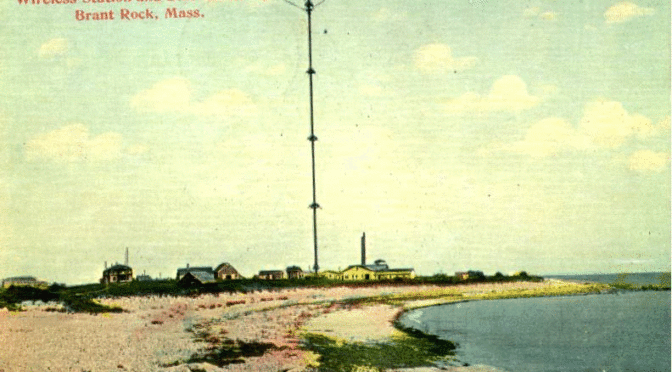
After his time with the weather bureau was up, Fessenden was able to secure funding for his research that led to the design and implementation of a rotary-spark transmitter (continuous wave phenomena was not thought to produce wireless communications and it was in fact Fessenden himself who championed the theory and practice of CW signals as understood by Hertz) and the world’s first trans-atlantic transmission — that of Morse code. Unfortunately, at the time, the destruction of one of the radio towers led to the end of the project.
Fessenden soon became obsessed with audio radio transmissions as opposed to his colleagues of the day (Marconi included) that advocated Morse code transmissions. He in fact applied for and was awarded a patent in 1901 for essentially inventing a CW transmitter! The man was unstoppable. Soon after he learned how to modulate speech on his CW waves to create Amplitude Modulated (AM) radio waves.
Upon reading more about Fessenden, his career seems to have comprised breakthrough after breakthrough in the field of radio engineering. I could go on and on regarding all his accomplishments, but if I did, I still would have not arrived at the point about what any of this has to do with the holidays.
The connection to Christmas Eve
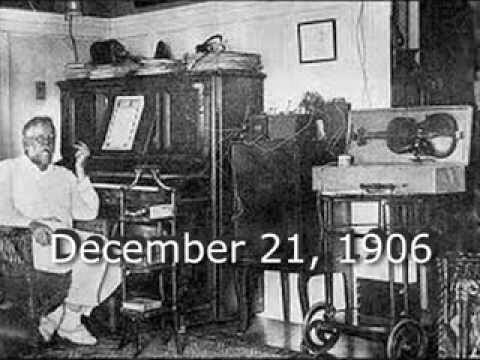
Until the early 1930’s, it was widely believed that a gentlemen by the name of Lee de Forest was the first person to transmit music and speech by radio in February 1907. Fessenden, however, challenged this notion when it was advertised by other scholars that Fessenden had in fact accomplished the pioneering benchmark by broadcasting on Christmas Eve 1906. Specifically, he claimed that he played a phonograph of Handel’s Ombra mai fu (Largo) and then he himself played a violin rendition of O Holy Night and also sang Adore and be Still by Gounod. Furthermore, he also stated he broadcasted on December 31st of the same year and that his transmissions were heard as far as Norfolk, VA on Christmas Eve and the West Indies for his New Year’s Eve transmission.
Now the interesting bits are that in 2006 (the centennial of the broadcast) renewed interest was sparked into Fessenden’s groundbreaking feat. But, surprisingly, questions were raised. Some of these were that there seemed to not exist any independent corroborations that the transmissions were heard. It is widely believed Fessenden had the technical means to make the transmissions, in the first place, but that it was uber QRP and so may not have been heard by many. Additionally, it was uncovered, that in 1956 more detective work went into verifying the Dec 24th transmissions but again, it failed to uncover any evidence.
If one continues to read about this intriguing individual, you will even learn that Donna Halper (the same one I mentioned at the beginning of this post) and Christoper Sterling argued “that debating the existence of the holiday broadcasts was ignoring the fact that, in their opinion, the December 21 demonstration, which included the playing of a phonograph record, in itself qualified to be considered an entertainment broadcast”. (I think instead of Dec 21, they meant Dec 24)And other scholars argued there is no reason to discount or doubt Fessenden’s account since it was not challenged immediately following an article, in 1932, originally detailing Fessenden’s story.
So, where do things lie now? Well, the IEEE recognizes this event to be a IEEE Milestone. And, from the little investigative work I did for this post, it seems his account is widely believed. But, even if it weren’t true, it’s pretty dang cool that Fessenden gets to share his achievement with St. Nick’s biggest work day of the year.
Hope you all enjoyed the history lesson and Happy Holidays everyone!
If you’re like me, then you try to be judicious with your $$$. Ideally, it would be great to spend $ and get the highest quality in return. But, the world does not work this way. So, if I am going to spend $$$ (on a scale of $, $$, and $$$), I want to make sure not only am I obtaining quality, but also multi-functionality. In other words, it’s easier for me to spend more money when I feel like my purchase is not exactly a swiss-army knife but also not a one-trick pony.
I could be wrong, but antenna analyzers kind of feel like a one-trick pony to me. When I first strung up my Buckmaster 7-band OCF dipole, I borrowed the RigExpert AA-30 from Greg W1TEN, in order to measure the VSWR, since I wasn’t thrilled about spending $200 for the analyzer. Especially because I would rather put that money towards a Heil headset and foot pedal (to be ordered for Xmas 2017).
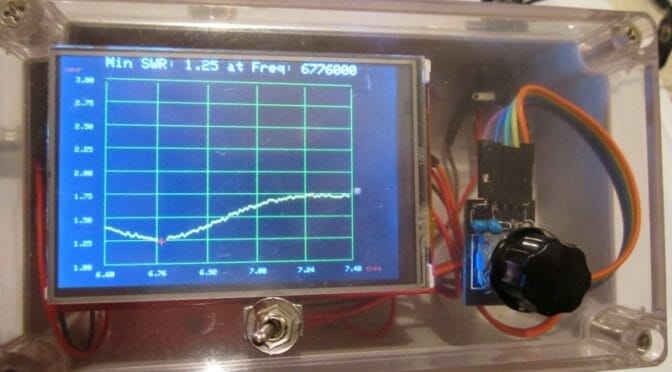
At the October Board of Directors (BoD) meeting, Fred AB1OC mentioned that in the Nov 2017 issue of QST, there was an article entitled “Build Your Own Arduino-Based Antenna Analyzer” by Jack Purdum W8EEE and Farrukh Zia K2ZIA. The attractive thing about this design is the authors quote a price point of $50. The major components are comprised of an Arduino, AD9850 Direct-Digital Synthesizer (DDS) board, and TFT display. Additionally, on the main website, one can also download the associated software to load on the Arduino. So, this leaves the user with the experience and satisfaction of homebrewing a really useful component for the shack. There seems to be a lot of documentation on the assembly, parts, etc. so this makes it relatively easy for the user.
Completed assembly of analyzerView of Arduino, PCB, and components for analyzer
A downside is that the number of components required seems to be somewhat large as seen from Farrukh’s website which could potentially be overwhelming if you are just beginning. The authors also quote that one helpful component is purchasing their own custom PCB for the job itself. Though this is not essential, it may aid in the build.
Having not built this yet, I would say this would be an intriguing build for someone. I would certainly like to tackle it and have added it near the top of my to-do list since it seems like it can be accomplished within a weekend.
A Cheaper Alternative?
After I read the article, I emailed Mike AB1YK to let him know about it. He replied with yet another option in the form of a PDF by K6BEZ who claims to accomplish the same feat in < $50. Definitely attractive! It’s built on the same premise: AD9850 DDS board, Arduino, etc., but seems to use fewer components. Instructions also seem to be located here.
Some pitfalls of the build from the PDF link provided above:
I located some Yahoo forums discussing that the analyzer as spec’d out did not seem to work for some builders. It’s unclear if the schematics were incomplete or if it’s due to another reason entirely.
The build does not seem to be that much cheaper. For instance, the PDF lists the AD9850 DDS as being $4 on eBay. Having looked there myself, as well as on Amazon, the going rate seems to be in the neighborhood of $18-$19. Given this, along with looking up some of the other items in the bill of materials, the price point seems to approach $50 pretty quickly.
If I endeavor upon this, I will be sure to document and write another article about it. If someone attempts the “cheaper option”, I would be interested to hear how well it works.