Back in December 2017, I was awkwardly stuffing my face with food at my group’s annual Christmas party. In the middle of munching some seriously tasty treat, one of my bosses approached to me and says he heard I was a ham. I nodded my head (b/c verbally acknowledging his comment would have caused food to spew out) and he subsequently asked if I would be interested in organizing an Intro to Amateur Radio Course via the Technical Education Committee at my place of work (MIT Lincoln Laboratory). I felt the need to clarify. I said something to the effect of: “So wait, you’re going to pay me to essentially do my hobby at work?” He nodded and told me to take some time to think about it. Yeh…so…didn’t need a whole lot of time.
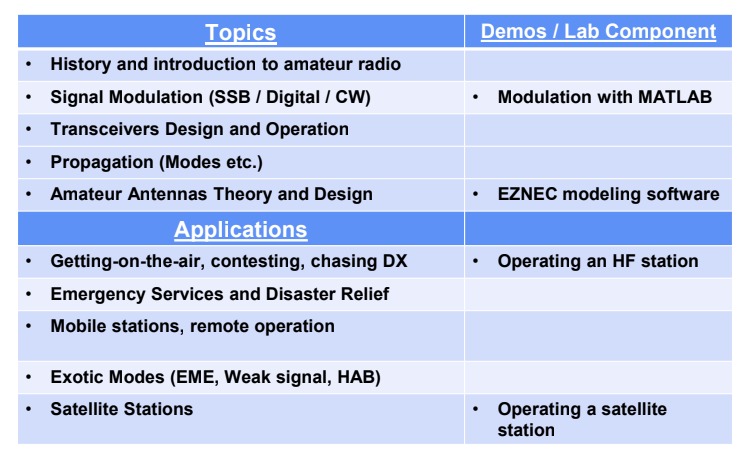
First order of business: What am I going to make this course about? I tried to do my HW and research what are the essential topics to cover. I decided I would do a 10-week course: 5 weeks to technical topics, and 5 weeks for applications of the hobby. You can see in the image below what I decided on. That’s a relatively concrete outline:
Secondly: who’s going to help me out? I pinged a generic bulletin board at work asking for volunteers to be lecturers and demo preppers for various topics. The response I received back was phenomenal. Numerous folks (order 30 people or so) offered to help out. After attrition, and various folks realizing this was a serious time commitment, the list whittled down to around 10 or so. I was still happy. Additionally, I was even able to recruit our very own Burns Fischer to participate and do an AMSAT lecture! (Thanks, Burns)
Thirdly: how to keep the lecturers honest and encourage them to follow through. I borrowed a strategy that my colleague used for his digital communications course at work. You have a slide deck laydown 1 month out (that means the speakers come prepared with printed out copies of their slides and they lay them out on a table and we go through them for 1.5-2 hours) and enforce a dry-run 2 weeks out from their dedicated class time. Because this was all volunteer work, I couldn’t rip apart people’s slides too much, so the deadlines were more to stay on top of folks and gently remind them of their obligation.
The admin aspect of the job threw me for a loop. I didn’t expect to have to get so down in the weeds. From security issues to generic scheduling of dates, it was slow-going. Especially in the summertime.
But the reward of doing it all — oh the reward. After some pretty effortless advertising on my part, I was told by HR that we had 60 people enrolled in the course with a solid waitlist; this was the most popular course in the Fall. My. Mind. Was. Blown. I mean it was and it wasn’t. I work at a place with a ton of engineers who love RF as much as their children. But at the same time, I didn’t expect so many young people want to learn what this hobby was all about. I’m glad they signed up.
Our kickoff class was September 12. Myself and my co-organizer spoke to a packed room plus full of interested people. I remain in awe of the interest level of the students and feel fortunate to be a part of this entire ordeal. Maybe this is the beginning of something lasting. The hard part is determining what are the next steps once the class has concluded.
The pronunciation of “contesting” seemed strange when I first heard it. “CONtesting.” I knew about “conTESTing” something. That was to oppose it in some way. But “CONtesting” seemed like a weird construction. The meaning of it is pretty simple, though: to participate in a contest.
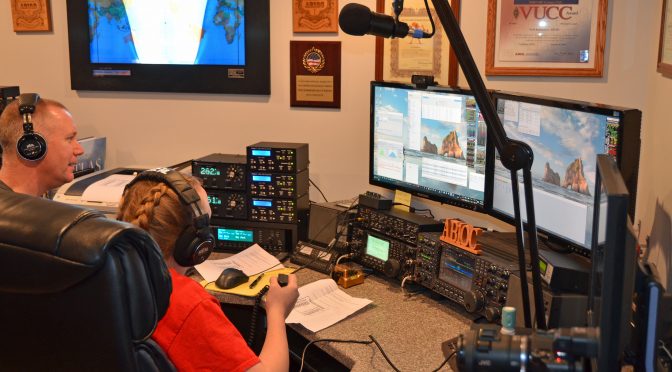
Charlie, W1CBD operating the pileups from AB1OC station
Radio contesting is concerned with competitions on the air. Don’t think battle to the death or professional sports where there is one winner and everybody else is disappointed. Instead, contesting is like a fun run held on a Saturday morning where some people run for time, others just run with their friends for some companionship, and some just walk. It is OK to push a buggy with your infant as you go. Everybody is there to just have fun.
In some of the larger contests, such as CQ Magazine’s CQ World Wide DX SSB contest, thousands of people participate. In 2017, over 8600 logs were submitted, and I’m certain that some people played in the contest without sending their login. That’s a lot of people! Note that there are only about one hundred “winners” that topped their categories. Everybody else played in the contest without expecting to “win” anything. They just wanted to have fun.
How Does It Work?
What does it mean to have a contest on the air? In general, these events are held within a certain time frame measured in hours, or at most, a couple of days, and the general idea is usually to talk to as many people as you can, as quickly as you can, on as many bands as you can, being careful to record information you get from those other stations. You capture all this into a logging program on your computer. When the contest is over, there is a special way to package up your log and submit it to the contest sponsor like CQ Magazine.
What happens next is kind of amazing, and it could only happen in our age of computers. The contest sponsor usually feeds all these logs into a computer which then checks the logs for accuracy. If you think you’ve worked me (NE1RD) in the contest at a certain time and on a certain frequency, then that QSO should be recorded in your log and in my log. If we exchanged information (such as our name) then the computer will verify that I captured your name properly and vice-versa. If we disagree on the band we used, or the mode we claimed to have used, or something else, the computer program that analyzes these logs makes a determination for who is right.
It is a competition so there are points. Usually, things work like this: You get a certain number of points for each QSO you make. Sometimes the number of points depends on how far the contact is from you. For example, the CQ Magazine Worked All Prefixes (WPX) contest gives you three points for talking to a different continent on the 10m/15m/20m bands and six points for talking to a different continent on the 40m/80m/160m bands. Working someone within your continent (but different country) yields a different number of points, and so on.
This would all be very tedious if we didn’t have computers! But, computers sort this bit out easily. What makes things even more complicated is a typical contest has “multipliers.” Your multipliers are tallied based on some criteria like the number of countries you talked with. Remember the typical goal of a contest is to have you talk to as many people as you can (maximize QSOs) in as many places as you can (maximize your multipliers).
Your final score will be the total number of points you earned by doing QSOs multiplied by the number of multipliers you accumulated according to the contest rules. Again, as a participant, you don’t need to know any of this. The computer figures it all out. All you have to do is make QSOs and have fun.
Why Contest?
Some people honestly think they can win the contest. Though as the numbers showed thousands enter and only a handful win accolades. So, in reality, the number of people who enter for this reason is small.
Most enter the contest because they like making QSOs. Given that there are thousands of people on the air participating there is ample chance to talk to somebody. And making QSOs can have other benefits if you’re competitive with the hobby. If you like collecting awards like the ARRL’s Worked All States (WAS) or DX Century Club (DXCC) then a contest is a wonderful way to find all those stations you need for your award. It is not uncommon, for example, to have a small station with a hard-working operator complete DXCC in a weekend.
Another reason to get on during a contest is that this is a perfect opportunity to do some assessment of your station. Say you’ve just put up a new antenna. How is it working? With thousands of people on the air from all over the world, you can quickly determine if you can hear Japan or talk to South Africa. If you can’t hear them (but you find out your buddy who lives down the block did) then you know you have work to do.
Like road races for runners, some people contest just to see if they can do better than they did last year. Phrases like “personal best” for a higher score than ever before are commonly heard. And, with all these stations on the air, “all-time new one” (ATNO) is often heard when a station works a country for the very first time. There are little victories along the way. Pay attention and bask in their glory!
There’s also something fun about seeing your callsign in CQ Magazine, or on the results page for an ARRL contest. Who doesn’t like seeing their name in lights? And there is always bragging rights with your friends. You may not have been top dog in the All-Band-High-Power category, but if you got a higher score than your buddy then there still something to crow about.
People contest because making QSOs is fun, and there’s no better time to make QSOs than when there are thousands of people hopeful of doing the same thing.
Rules Rules Rules
The first thing to do is learn the contest rules. Every contest has a set of rules published and it is important to understand what is expected of you. Knowing the rules makes it fun for you and for others. (Not knowing the rules leads to embarrassing gaffs.)
What will the rules tell you? Here is a list of typical things outlined by the rules:
When is the contest? There will be a list of dates and times.
What are the categories for the contest? These contests are typically not just one big category where everybody competes. It wouldn’t be fair to pit an operator running 5 Watts QRP against a station running 1500 Watts! So, contest sponsors create categories. Some typical categories are:
Power: High Power (HP) for greater than 100 Watts, Low Power (LP) for 100 Watts or less, and QRP for a maximum of 5 Watts.
Bands: All Bands (that are legal for the contest), or a single band. You can typically compete by operating in a single band (like 20m) and then you’ll be pitted against anybody else who limited themselves to that one band.
Mode: Single Side Band (SSB), CW, data modes like RTTY, or All Modes.
Time limit: Some contests allow you to operate within a limited time (such as 12 hours instead of 24 or 48 hours). If you choose this category you’ll only be competing against others using that same limit.
Assisted: This is a little complicated, so I’m going to defer to a later post I’ll do about being assisted. The answer to “Assisted” is either “yes” or “no.” Don’t use anything to help find contacts or decode QSO information and the answer is “no.”
Where are you located? The contest sponsor will compare your score to others in the same geographical region.
The exchange. This one is key. What information are you required to give out and capture during your QSO? Here are some examples of exchange information from contests:
Your name. This is your first name or nickname, like “Scott” or “Jack”)
Your state, which is often used in domestic contests.
Your CQ Zone. The world is divided by CQ Magazine into 40 different zones. We are in zone 5 here in the Northeast.
A serial number. You have a running counter and you give out the number as your exchange. So, your first contact gets 1, your second contact gets 2, and so on.
Something more complicated. The ARRL Sweepstakes contest is particularly tedious demanding: a serial number, a “precedence” indicating your power level (like “Q” for QRP or “A” for low power), your callsign, the last two digits of the year you were first licensed, and your ARRL section from their official list. Ugh. You have to really want to make contacts to be in this contest!
There are other rules about how to submit your log that I’ll cover later.
Readying Your Station
Looking ahead, we need to be able to produce an accurate record to present to the contest sponsor of our activities. That means we need to have the following in each QSO record:
Date and time of the contact.
The frequency and/or band used.
The mode (SSB, CW, etc.) used.
The other station’s callsign!
The signal report for the contact (always 59 or 599 please!)
The exchange information.
Just a note about signal reports. In a contest, people want to go as fast as they can. So by convention signal reports are always 59 or 599. In fact, in CW that 599 is shortened to 5NN. We want to spend the smallest amount of time sending and receiving information we can.
While it is possible to enter some of these contests using only a piece of paper for your log, it is impractical for any serious effort. You need a computer that is running a logging program that supports this contest. Further, your computer should be talking to your radio capturing the frequency, band, and mode information automatically. The computer knows the time, and it learns these other things from the radio. The signal report is preprogrammed in. So, the only thing interesting that you need to capture is the callsign and exchange information. Learn your logging program, how to set it up so that it operates in a manner described above, and know how to capture exchange information for each QSO. If you goof any of this up then your log will be worthless.
Once you have a computer, logging program, and radio set up properly, you should ensure that the rest of your station is as squared-away. Get a comfortable chair and put it and your work surface at the right height. Get a proper set of headphones, a foot pedal to key your transmitter, and a CW keyer system that works with your computer to send. Preprogram the memories of your voice and CW keyers to things important to the contest (like your callsign and exchange information).
This last bit is for CW operators. Modern contest logging programs can run everything from the keyboard. Preprogrammed CW keyer memories have your callsign, the signal report and exchange information, and can even receive from the computer the callsign of the station you are working and send that. A well-constructed station enables you to go through the whole contest without touching your paddles.
A voice keyer (often built-in to our modern transceivers) can record your voice and play it back over the air with a press of a button. It is especially handy to have your callsign preprogrammed. You will say your callsign thousands of times over a contest weekend. You can lose your voice quite easily with that kind of workout. Using the voice keyer saves your voice and significantly reduces fatigue.
You should have read the rules and selected the operating category you wish to compete in. If you are using “low power” then make sure your output is less than or equal to that limit, for example.
Making a Contest QSO
Like so many things in life, there is a protocol to be observed and behavior to be learned. Here is a typical interaction:
A station far away calls “CQ” or perhaps “CQ contest” and gives their callsign.
You (and dozens of others) transmit your callsign. Say it once clearly and quickly. Use standard phonetics. For example, I would say “November Echo One Romeo Delta.” Don’t use weird stuff like “Nobody Else One Radical Daemon.” Stations are trying to work as quickly as possible so don’t make them have to do any additional work decoding what they hear. Stick to standard phonetics.
The far away station chooses one of these callers. It will respond with the callsign and exchange information. There won’t be an “over” or “back to you” spoken. They will just say the minimum and then listen.
Respond. Do not give your callsign again. Do not say their callsign. Just give the exchange information. So, in the CQ WW SSB contest I would say “595.” That’s it. That’s what they are expecting. Anything more makes them think, which is bad.
The other station will ask for a repeat if they need one. Again, just give the exchange information and nothing more unless the other station specifically asks for it.
The end of the encounter happens when the other station says “QRZ” or does a new CQ.
That’s it. If you keep everything to a minimum then everybody is happy. I will sometimes give my exchange and then say “thanks”, but even that is too much in some circumstances. In this social context, less is more.
While you’ve been trying to make this contact you should also be updating the data entry fields of your log. Once the contact has finished and is successful then commit the log entry and clear the fields, readying yourself for the next QSO.
Search and Pounce Versus Running
There are two terms you might hear when talking about operating in a contest. They are “search and pounce” and “running.” Search and pounce is just as it sounds. You tune your radio until you find somebody you walk to talk to, you “pounce” on them by giving your callsign, you complete the interaction, then repeat the process by tuning the radio in search of another station. Small stations, and especially those new to contesting, will do “search and pounce.” It is much easier than “running.”
Running means sitting on a frequency and calling CQ. You solicit contacts and work pileups. In practical terms, given many contests have hundreds or thousands of participants, if you don’t have a big station then you’ll never be able to hold a frequency. Somebody bigger will just start calling CQ over the top of you, and nobody will hear you again. Running also takes some skills to do data entry quickly, correct errors quickly, and sort out other problems like garbled exchanges, operators who don’t know the rules (don’t be that person!), and more. I recommend getting comfortable doing search and pounce before you attempt running.
BIC
“BIC” is a somewhat crude term that means “butt in chair.” You can’t make QSOs unless you are sitting at your radio operating. If you are eating, then you are not BIC. If you go to the bathroom you are not BIC. Certainly, if you sleep (the horrors!) during a part of the contest then you don’t have your butt in the chair. Serious contesters will operate nearly all of a 48-hour contest. They will begin Friday night and sleep only 90 minutes on Sunday morning before the bands open to Europe. It sounds extreme and ridiculous, but that’s just part of what it takes to win.
If you are new to contesting I recommend that you take some breaks, review what you are doing, determine if you need improvements. Mostly, though, if it stops being fun you should probably stop. The point is to learn contesting, make QSOs, and have fun. Don’t make butt in chair time drudgery.
I will say this, though, when I see my score published and I see how close I came to doing much better (score-wise), I often wish I had operated more. This is a great incentive for your next contest. Build up to it and you will enjoy it more.
When the Contest is Over
One option is to do nothing. You aren’t required to turn over your log to the contest sponsor. If you were only in the contest to make QSOs (perhaps you were chasing an award) then you’ve accomplished your goal. You don’t owe anybody anything. Lots of people participate in the contest but don’t submit their log.
But, if you want to “officially” be in the contest then you need to submit a score. Most contest sponsors want your log in a particular shape called Cabrillo. (Cabrillo is pronounced “cab-re-oh” as best I can tell.) This is not the standard interchange format used by loggers called ADIF. It is different.
Contest logging programs like N1MM+ for Windows will convert your log to the proper format. Most general purpose logging programs will not do this. It is important to figure this out before the contest!
If you are a Macintosh user then you can use a logging program called MacLoggerDX to do your logging, and my program Cabconverter to convert your log into the proper Cabrillo format. Other solutions are available for Windows, Linux, and the Macintosh. Shop around.
Contest sponsors are beginning to demand that logs be submitted quickly, sometimes within a week of the conclusion of the contest. Read the contest rules so you don’t miss the deadline.
Even More
Oddly enough, there’s, even more to know about contesting. For example, it is sometimes possible to start the contest in one category, but submit your log with a different one. Perhaps I’ll cover this (and much more) in a future installment.
I’m going to try to put out a little something once a month saying which contests are coming up and how best to prepare for them. In the meantime: see you in the contest!
The New Hampshire QSO Party (www.w1wqm.org/nhqso) is held in the third full weekend of September. This year the contest is held on Saturday, September 15th from noon to midnight, and September 16th from noon to 6 PM. (That’s 1600 UTC Sat to 0400 UTC Sun, and 1600 UTC Sun to 2200 UTC). To encourage participation in the event, the Nashua Area Radio Society will have a “contest in a contest” competition. To enter, just do the following:
Get on the air and operate in the contest following all NHQP rules.
At the conclusion of the contest post your score to the 3830 website (details below).
Email me notifying that you’ve entered, and tell me which category you operated within.
Don’t forget to submit your log to the contest sponsor and specify the “Nashua Area Radio Society” as your affiliated club.
Categories
Operating categories make it possible to compare “apples to apples”. It isn’t fair for a station with three towers to compete with a little pistol station with just a dipole! So, the following categories for the NARS competition will be used (single operators only except for Superstation):
QRP. Any antenna configuration is OK. Power output is limited to 5 watts CW/digital, and 10 watts SSB.
Small Station. This can be any single radio with output power no more than 100 watts using vertical antennas or dipoles only. No receive-only systems.
TB-Wires. Same as Small Station except that one antenna with gain can be available. Wires/dipoles/verticals must be used for everything else. No receive-only systems.
Superstation. Multiple operators OK. Multiple gain antennas available. Receive-only antenna systems or listening arrays available. Power greater than 100 watts.
New Hampshire stations and stations outside NH will be ranked separately.
Note that “assistance” (spotting systems, repeaters, etc.) is allowed in the contest, and in this competition.
Submitting your entry
Go to the 3830 Scores website (3830scores.com) and navigate to the New Hampshire QSO Party entry. Enter all of the information demanded by the website and submit your score. (If you are having trouble computing your score, contact me directly.)
Once your entry is live on the 3830 site, email me ([email protected]) and tell me the call sign you used, and which entry category for the club competition you’ve selected (QRP, Small Station, TB-Wires, or Superstation). That’s it! I’ll use the submitted scores to determine the winner in each category.
RESULTS
The results of the competition will be announced at the October general meeting of NARS.