All posts by Fred Kemmerer

I enjoy station building, contesting and helping new folks to join and have fun with our hobby.

Our Club Moving Forward Into 2017

Our club has accomplished a great deal in the last year. We have grown to over 130 members. We have introduced many new people to Amateur Radio, helped them to earn their Licenses and worked with them to get on the air and develop their knowledge and operating skills. We’ve also worked hard to provide opportunities to enjoy and learn about Amateur Radio for members of our club and for the Amateur Radio community which we are a part of.

Much of the credit for our club’s success this past year belongs to you, our members. We very much appreciate all that you have done to contribute to our success and the fun that we have all had as part of what we have done together. Your enthusiasm and support provide great encouragement and inspiration to the many new members who have joined us as well as to all of us who are part of our club’s Leadership Team.

We, as your club’s Executive Committee, have been working on a set of goals and plans to continue on this path during 2017 – to provide even better opportunities for our members to learn more about and to enjoy Amateur Radio, to continue to encourage people to join the Amateur Radio Service, and to provide opportunities for STEM learning for young people.

Our goals and focus for 2017 centers around continued success in and focus on the following areas to benefit both our members and our community as a whole:

To do these things and to be successful as a growing club, we are also pursuing status as a 501(c)(3) non-profit. This will enable our club to more effectively secure support from other groups to further our work towards these goals.

Each of us has taken ownership for creating a focus on meeting different aspects of our goals for this year. We are planning to share more about our plans for 2017 at our February Club Meeting.

We are asking that each of you, as members, to consider how you can get the most from all of these and the other opportunities that our club provides. We are working hard to try to create something for everyone that can provide enjoyable opportunities to have fun, to contribute, and to expand the value that we all create and derive by being part of the Amateur Radio Service. We are also asking each of you, our members, to consider helping us with these initiatives in 2017.


  • Jamey Finchum, KC1ENX – Membership Chairman
  • Anita Kemmerer, AB1QB – Activities Chairman
  • Brian Smigielski, AB1ZO – Programs Chairman
  • Mike Ryan, K1WVO – Interim Secretary
  • Wayne Wagner, AG1A – Treasurer
  • Greg Fuller, W1TEN – Vice President
  • Fred Kemmerer, AB1OC – President

A High Altitude Balloon Project To Generate STEM Interest And Learning

Several members of our club have been working on a High Altitude Balloon Project to promote STEM interest and learning by young people. Our project team currently includes the following folks:

Other interested club members are welcome to join us.

We want to provide a STEM learning opportunity and project to be planned and executed by young people ages 10 – 16. We are actively seeking engagement and support from local schools, Scout Troops and other youth organizations to help us with this project.

Our goals for the project include:

  • Building and launching a high altitude balloon carrying Amateur Radio to near space and back
  • Enabling young people to plan and execute the project with help and guidance from members of the Nashua Area Radio Club and supporting adults from organizations that wish to assist us
  • Helping young people gain STEM-based experience and learnings by handling all phases of the project including:
    • Planning the flight, the balloon, and its payload
    • Building the balloon and testing it on the ground
    • Launching, tracking and recovering the balloon’s payload
    • Analysis of the flight data and the creation of a presentation to be delivered to fellow students and other interested groups

We plan to introduce new technology, experiments, and flight elements and develop team member skills and expertise across multiple launches. Later phases of the project are expected to include design and construction of additional payload electronics, high altitude/longer duration flights, and additional on-board atmospheric science experiments.

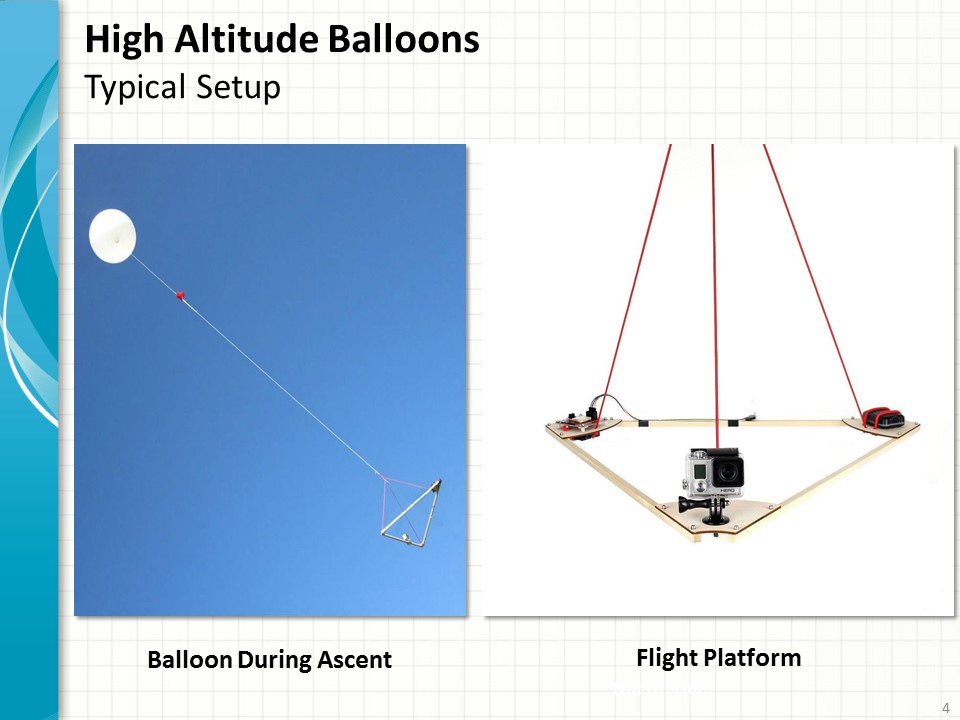
Typical High Altitude Balloon System

Our goals for the initial flight mission of this project will include:

  • Building a helium filled balloon which carries a payload of < 4 lbs. to altitudes in excess of 90,000 ft (27,400 m)
    • Parachute controls decent rate after balloon bursts
  • Capturing a video of flight using on-board GoPro video camera(s)
  • Flying an on-board APRS transmitter allows tracking from the ground via Amateur 2m APRS and aprs.fi
    • Flight computer plus APRS provides altitude, position and temperature data throughout the flight
    • Anyone with a device that has internet access and a web browser will be able to track the flight
  • Augmenting the APRS system with commercial satellite tracker to assure successful recovery of our payload by the project team
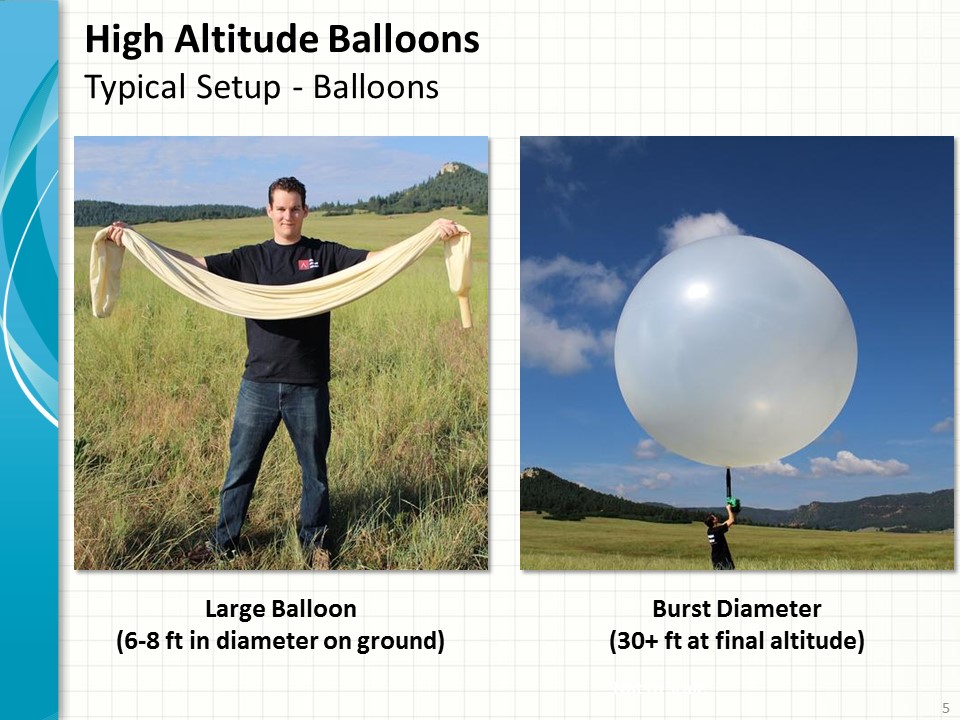
High Altitude Balloon
High Altitude Balloons

The balloon is filled with enough Helium to carry its payload to a target altitude in excess of 90,000 ft and then burst. A parachute will deploy to control the rate at which the payload descends and will ensure a controlled safe and soft landing.

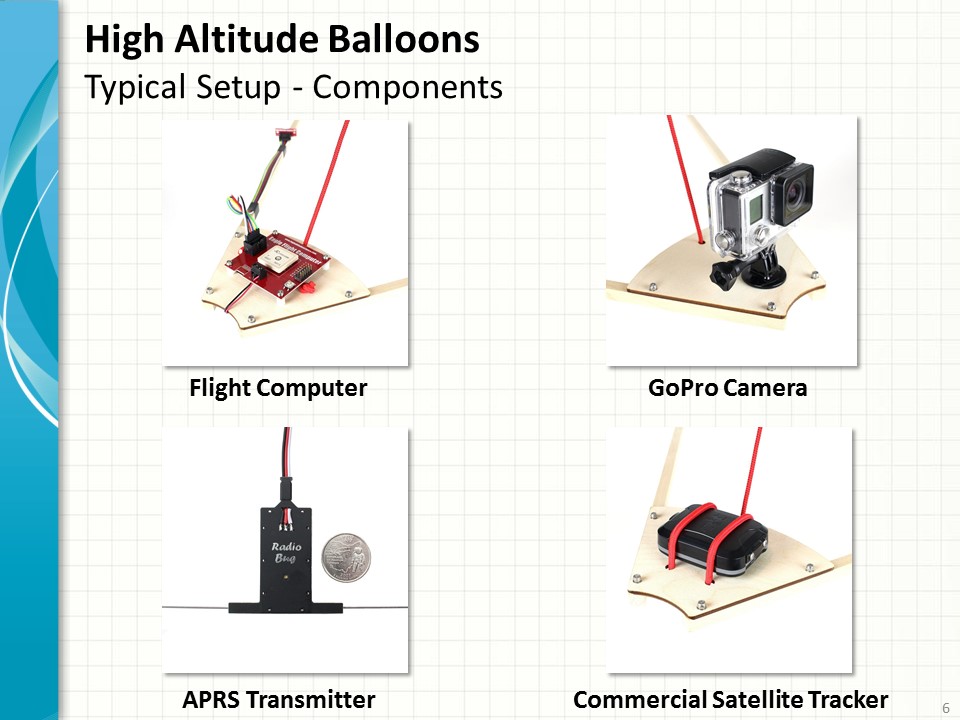
High ALtitude Balloon Payload Components
Payload Components

The payload will be built around a light-weight platform which will carry a Video Camera, a Flight Computer/APRS Transmitter, and a Commercial Satellite Tracker. The camera will capture a video of the flight and the flight computer will record altitude, temperature and position data and relay this information to the ground via APRS on 2m. A commercial satellite tracker would be included to ensure we could locate the payload once it is back on the ground.

High Altitude Balloon Flight Planning
High Altitude Flight Planning

A key part of the project will involve planning the target altitude and flight path for our balloon. There are some good resources available to help us do this. Check out the Balloon Performance Calculator here. Tools also exist to estimate a balloon’s flight path and track based on Jetstream and other flight parameters.

High Altitude Balloon Tracking

Once we launch our balloon, we can track it in flight via the Amateur Radio APRS network on 2m. The payload will transmit position and other information via APRS that will be received by the many APRS receiver stations that have been built by Amateur Radio Operators. The data from our balloon will be relayed to aprs.fi in real-time and will be able to be displayed on any device with internet access and a web browser.

High Altitude Balloon Flight Data Analysis

Once we recover our balloon payload, we will guide our young team members in analyzing the data from the flight to help them to learn about atmospheric conditions and to prepare to share the results along with the video captured with classmates and other interested groups. You can get an idea of the video that we can expect below.


We are working to raise the necessary funds to support our project.  We are counting on the generosity of our members and friends to help us.  Please consider making a donation here.

Fred, AB1OC

Radio Amateurs Developing Skills Worldwide