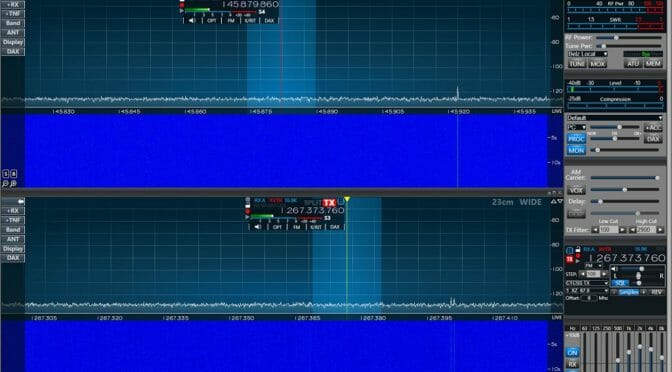
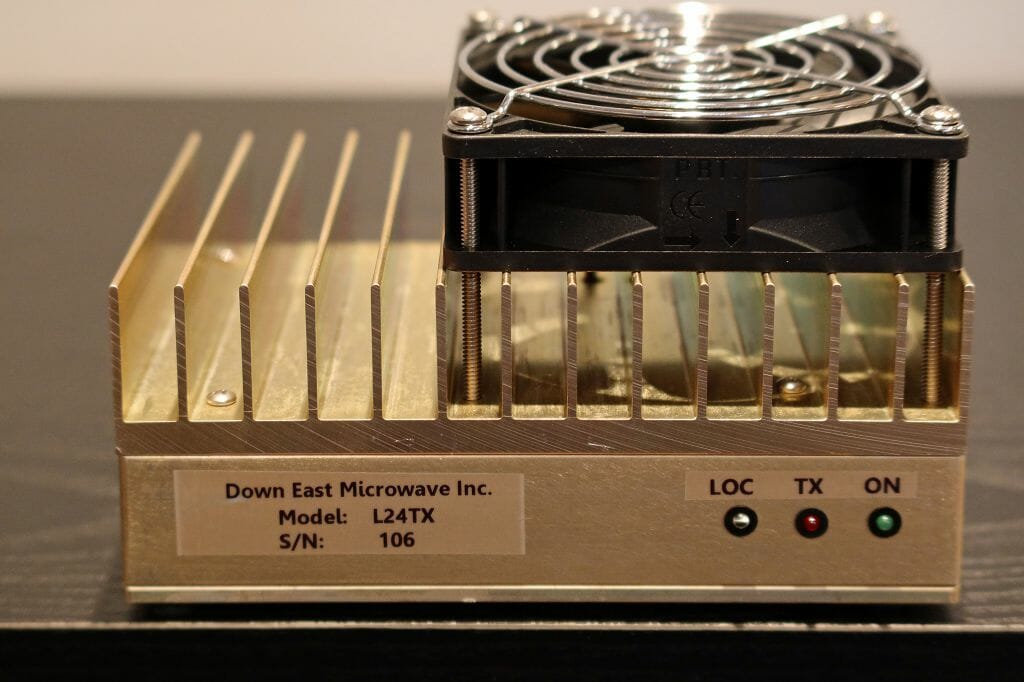
We’ve recently received our L24TX Transmit Converter from Down East Microwave. The unit is compact, simple, and produces up to 25W output in the satellite section of the 23 cm band (1260 MHz – 1270 MHz, actually 24 cm). The L24TX is a transmit-only device that is intended to enable L-band uplinks for Satellite use. This article is about our most recent project which involved integrating the L24TX into our Flex Satellite SDR System to enable L-Band Satellite operation …
We are making progress on our project to enable remote Satellite operation via the Internet. The latest step is the addition of L-band (24 cm) uplink support to our Flex Satellite SDR System.
L-Band 24 cm Transmit Converter
We’ve also made some good progress on custom software to link MacDoppler and our Flex Radio Satellite System via the Internet.
The article in the link above shares information about how to go about adding Transverters and Band Transmit Converters to a Flex SDR. the step needed to configure the Flex SmartSDR software, as well as links, cover other aspects for our Satellite System 4.0 Project are included.
You can read the latest updates about this project via the link above.
Burns, WB1FJ approached me a few weeks ago doing some portable satellite activations as part of the AMSAT 50th Aniversary Celebration. The idea was to use the AMSAT Callsign WZ3M/1 to put the states of CT and RI on satellites.
Preparations for our activations included creating a Pass Summary of predictions for the day of our activation using prediction data from MacDoopler. You can take a look at our pass summary here.
W3ZM/1 Activation in RI
Our first activation was near the fire station in Burrillville, RI. We found an open spot and set up our station, antenna, and solar power system. This was a great public spot and we had several visitors come by to take a look at our setup and ask questions about satellites and Amateur Radio.
We made quite a few contacts at this location using both FM satellites like AO-92, AO-92, and SO-50 as well as a few contacts using linear satellites like CAS-4A and CAS-4B.
W3ZM/1 Activation in CT
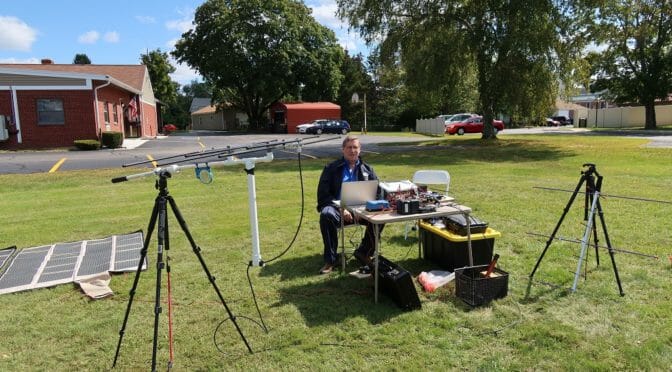
We moved to a Church in CT for the next part of our activation early in the afternoon. This site was a little less open than the first one but we were still able to make a number of contacts here.
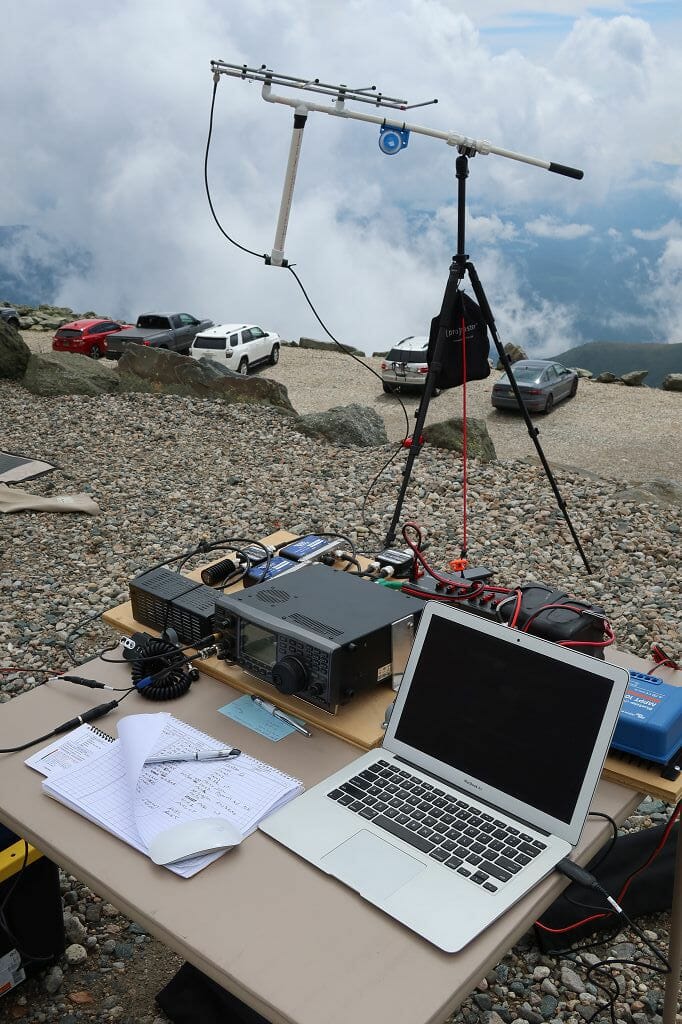
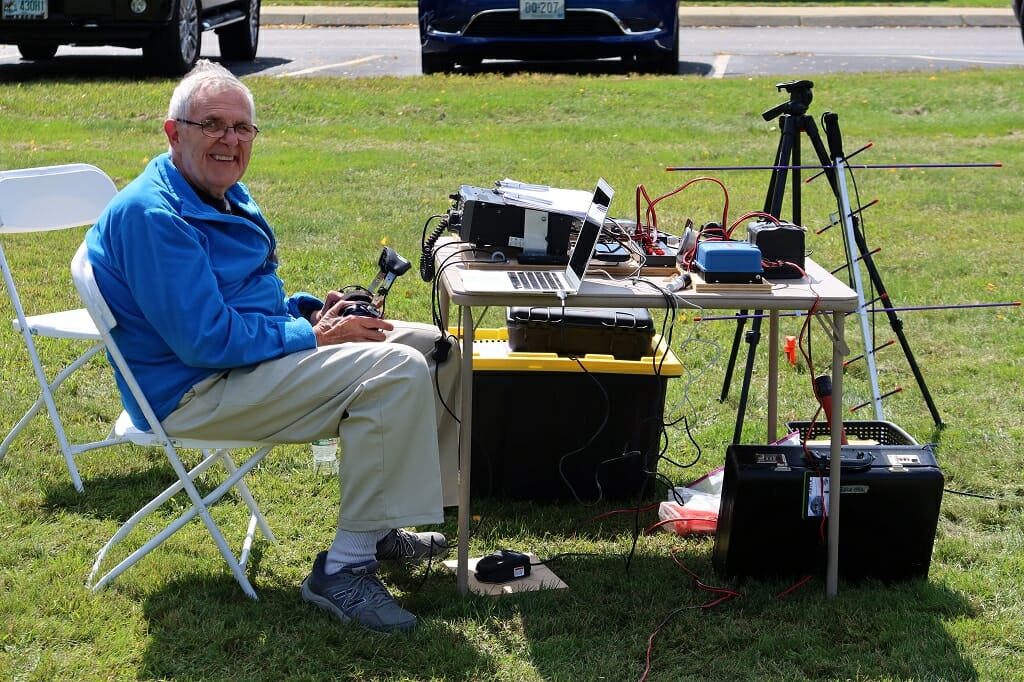
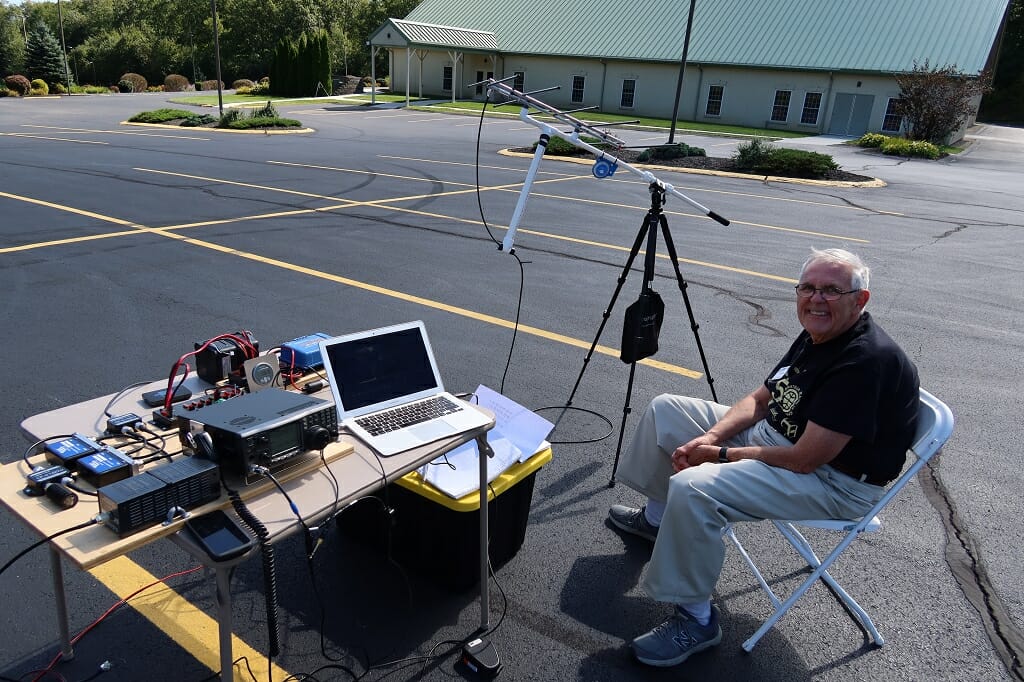
The photo above shows a view of our portable setup which consisted of an Icom 910H transceiver, a MacBook Air Laptop running MacDoppler, and an Elk Log-periodic antenna on a tripod. The computer and MacDoppler controlled the radio VFOs to automatically correct for Doppler shift which enabled us to do contacts using linear satellites. We used an iPhone running a satellite tracking app to help point the antenna during satellite passes.
We used a pair of 90W portable solar panels, a pair of LIPO batteries, and an MPPT charging system to provide power for our radio and the computer. It was a sunny day and our solar power system kept our batteries fully charged through both activations.
We did pretty well overall making a total of 15 contacts between. The downlink side of our antenna system was the weakest link in the setup. Folks that we worked on linear satellites indicated that our uplink signals were solid but we had some trouble hearing weaker stations on the downlinks. We have some ideas for an improved antenna system for our next portable activation – stay tuned for more on this.
All in all, Burns and I were pretty pleased with these activations. We had a lot of fun, helped a few folks some new states, contributed to AMSAT’s 50th Celebration, and we learned some things that we can use to improve our portable station.
It seems that many Hams struggle a bit to get their HTs programmed with the right set of repeaters and other memory settings. The Nashua Area Radio Society will be offering a custom HT Programming Clinicat HamXposition @ Boxboro 2019 to help hams get their HT’s programmed.
HTs That We Can Program
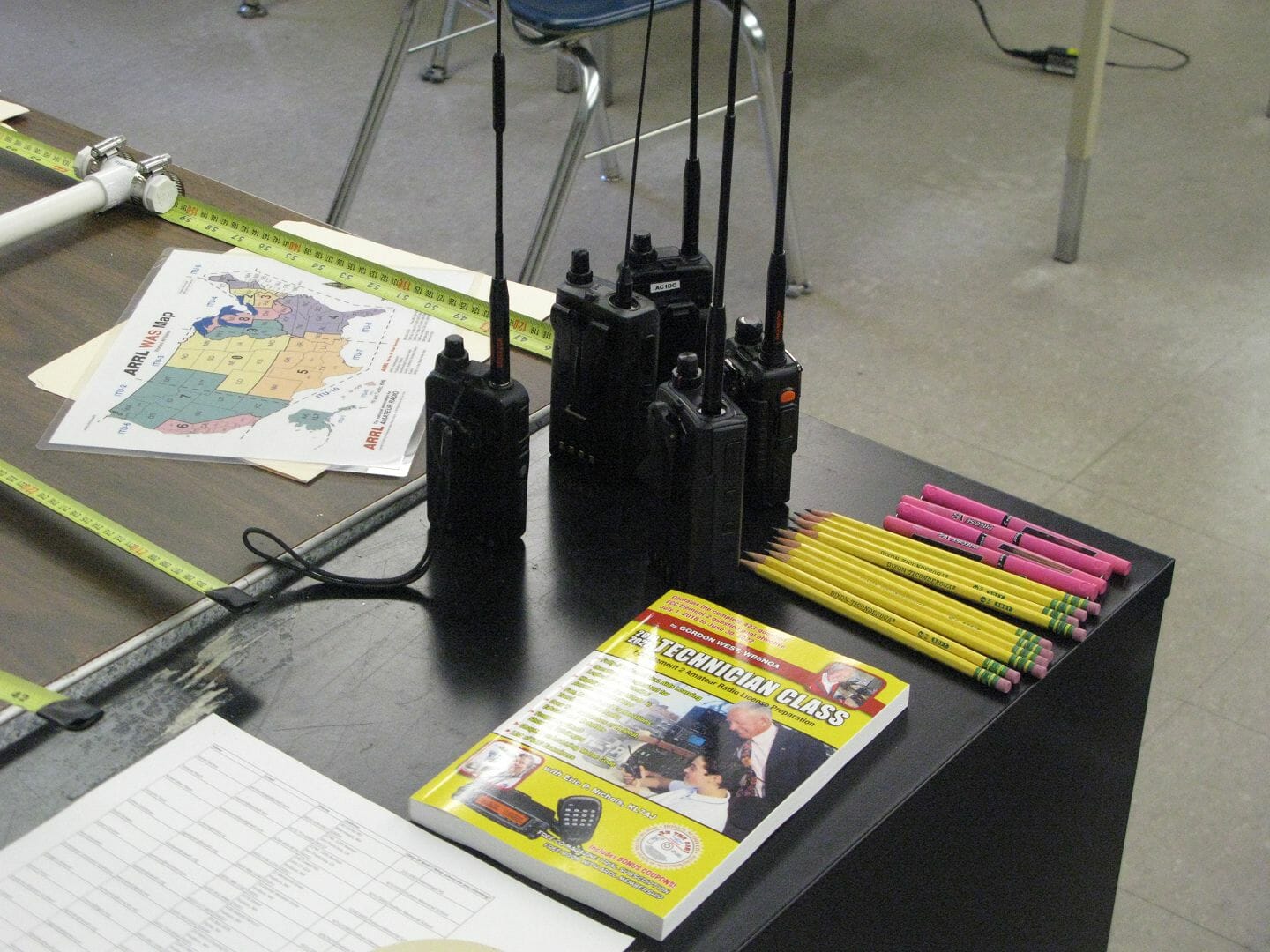
HTs at Tech Class
We will offer custom programming for the following HT models:
Icom HTs
ID-31
ID-51 (all models)
Kenwood HTs
TH-D72
TH-D74
Yaesu HTs
FT-4X and FT-4V
FT60
FT65
FT70D
BaoFeng HTs
UV-5R
BF-F8HP
TDXone
TD-Q8
How Will It Work?
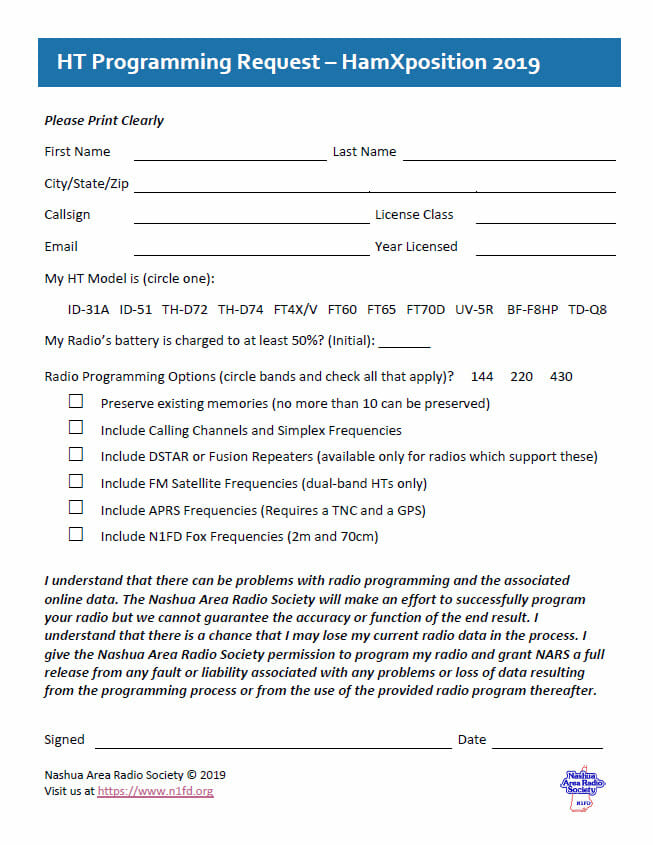
Custom HT Programming Request
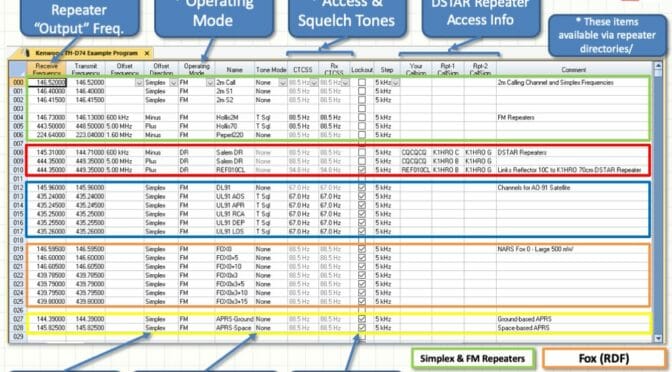
The programming process will be with the completion of a request (shown above) that includes some basic information about the radio to be programmed. Each person can select from a list of options for their custom program which includes:
Preserving a limited number of existing memories in their radio
Calling Channels and Simplex Frequencies
Custom Repeater List for your location including DSTAR and Fusion Repeaters
FM Satellites Frequencies with Doppler Correction (AO-85, AO-91, AO-92, SO-50, and PO-101)
APRS Frequencies
The Nashua Area Radio Society’s Fox Frequencies
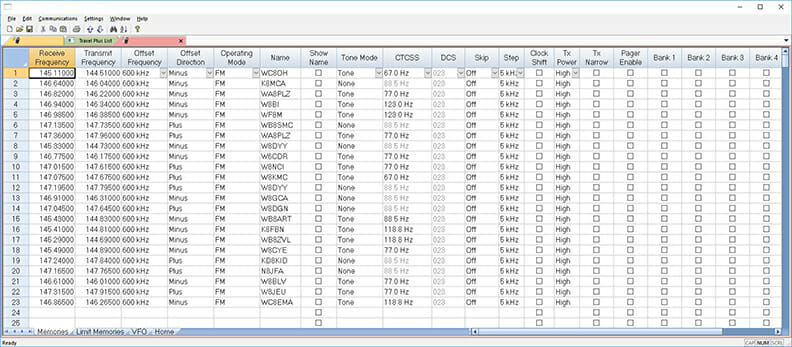
The NARS Member who is running the HT Programming Clinic will save a copy of the existing program as a backup and then use an RTSystems programmer to assemble the custom program from a combination of on-line apps and stored program components.
The user’s location is used to generate a custom list of repeaters with a 10-15 mile radius of their location. This list can include DSTAR and Fusion capable repeaters if the user’s radio supports these.
RTSystems Program for Yaesu FT65
The completed custom program will be loaded into the person’s HT and checked out.
We use cookies to ensure that we give you the best experience on our website. If you continue to use this site we will assume that you are happy with it.