Contesting, as per my last post, is an on-air activity where many (often thousands) of people get on the air and exchange small pieces of information for fun and bragging rights. This little corner of our hobby has its own nomenclature. I’m here to help decode some of this and help you get ready for your first contest.
The Cabrillo File Format
It might be helpful to work backwards a bit through this problem. At the end of this endeavor, you’ll want to submit your log to the contest sponsor. This will be your official entry into the contest. Since the vast majority of contests are all the same or at least the data demanded by the sponsors is the same, folks got together and made a common computer file format to do this work. That file format is called Cabrillo (pronounced Cab-Re-Oh).
The Cabrillo file format is important not just because it is the standard way to submit your entry to a contest sponsor, but because the common definitions for concepts in contesting are defined in this standard. This article will walk through some of the most common and most important of these concepts. (I’ll use the Cabrillo 3.0 specification for this discussion.)
Categories
Competitions often have different categories. For example, the Boston Marathon is a road race that has at least three major categories: Men, Women, and Wheelchair. Radio contests are the same way, except there are often many more ways of dividing the participants. These divisions fall into categories. When you enter a contest you will be required to select the categories you wish to compete within, and then you must limit yourself to the boundaries outlined by that category.
NOTE: A contest may not support all the different categories listed below. It is crucial that you read the contest rules and understand the categories that are supported.
Here is a list of categories most commonly used:
CATEGORY-ASSISTED:
To be assisted means that you got direct help in your contest effort to find people to talk with, or to decode or capture the information during an interaction such as the call sign or the exchange. Here are some examples of things that could make you assisted.
- DX Spotting Network. If you use the internet (or even the off-the-air packet spotting network) to find people to talk to, then you are assisted. Some logging programs have this feature built-in, or you can use websites such as www.dxheat.com.
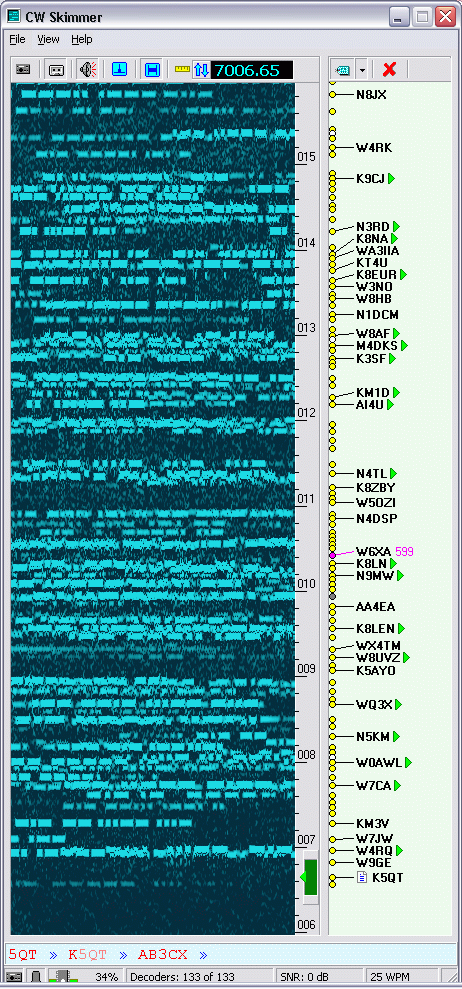
- CW Skimmer. A fellow named Alex Shovkoplyas, VE3NEA, made something remarkable a few years ago and his invention turned contesting on its head. CW Skimmer is a piece of software that works in conjunction with a software-defined radio to look over a wide swath of a band (or bands) and decodes any CW signals on those frequencies. It understands enough about CW to extract the callsign and show it next to the signal. Figure 1 below is a screenshot from this system (original from DX Atlas).
- Any CW decoding software or hardware. If you are using the CW mode then you are considered assisted if you use any computer software or hardware to help decode the signal. You have to do this work in your head to be considered unassisted.
- Anything that could be argued to help to make QSOs. If you have a friend do logging for you then you are assisted. Similarly, you are assisted if somebody works a second radio helping you find stations, or if somebody helps you fix a problem with your station during the contest. [Help outside the contest is OK.] In short, if you had help, then you are assisted.
So, the two possible answers to this question are:
- CATEGORY-ASSISTED: UNASSISTED
- CATEGORY-ASSISTED: ASSISTED
CATEGORY-BAND:
You can indicate which bands you wish to use with your entry. You can either declare ALL bands (legal for this contest), or a single band. Entering the contest as a single band entry means you compete only with others limited to that band.
Single band entries are a lot of fun. I have run single band efforts in the CQ WPX SSB contest from St. Thomas (KP2) on both 10m and 15m. Each night when the band closed I would turn off the radio, get dinner, and spent the rest of the night lounging or swimming in our pool. When the sun rose the next day I was back on the radio. It was a wonderful way to spend a couple of days of my vacation.
The choices for this category (HF entries, at least) are:
- CATEGORY-BAND: ALL
- CATEGORY-BAND: 160M
- CATEGORY-BAND: 80M
- CATEGORY-BAND: 40M
- CATEGORY-BAND: 20M
- CATEGORY-BAND: 15M
- CATEGORY-BAND: 10M
CATEGORY-MODE:
You can declare you used a single mode (like CW), or have a mixture of modes in your log. The choices for this category are:
- CATEGORY-MODE: SSB
- CATEGORY-MODE: CW
- CATEGORY-MODE: RTTY
- CATEGORY-MODE: FM
- CATEGORY-MODE: MIXED
CATEGORY-OPERATOR:
You either work alone, or within a group. So, the choices are typically:
- CATEGORY-OPERATOR: SINGLE-OP
- CATEGORY-OPERATOR: MULTI-OP
- CATEGORY-OPERATOR: CHECKLOG
A CHECKLOG category means you wish to have your entry included in the contest analysis, but you don’t want to have a score computed for you, or to enter the contest formally. CHECKLOGs are helpful to contest sponsors to verify that stations were really on-the-air when they said they were. (If you violate the rules, your entry might be reduced to a CHECKLOG at the whim of the contest sponsor.)
CATEGORY-POWER:
The three categories defined in Cabrillo 3.0 are:
- CATEGORY-POWER: HIGH
- CATEGORY-POWER: LOW
- CATEGORY-POWER: QRP
But, please note that the precise definition for these things might vary contest-to-contest. For example, some contests declare that the upper bound on LOW power is 100 Watts, where other contests declare that limit to be 150 Watts. As always, read the rules.
CATEGORY-STATION:
The station category is a good example of where the standard identifies a potpourri of choices, but typical contests only support a small subset of them. Most of the time we operated FIXED in our house or a friend’s house. Similarly, the categories MOBILE and PORTABLE are from your car or from a location where you set up your equipment away from home.
I’ll not go into the definitions of the remaining ones here as they are defined in the contests they support (and those definitions vary).
- CATEGORY-STATION: FIXED
- CATEGORY-STATION: MOBILE
- CATEGORY-STATION: PORTABLE
- CATEGORY-STATION: ROVER
- CATEGORY-STATION: ROVER-LIMITED
- CATEGORY-STATION: ROVER-UNLIMITED
- CATEGORY-STATION: EXPEDITION
- CATEGORY-STATION: HQ
- CATEGORY-STATION: SCHOOL
CATEGORY-TIME:
Some contests allow you to limit your participation time, and you’ll be competing with others that lived within those limits, too. Cabrillo defines three such categories.
- CATEGORY-TIME: 6-HOURS
- CATEGORY-TIME:12-HOURS
- CATEGORY-TIME:24-HOURS
CATEGORY-TRANSMITTER:
The number of simultaneously available transmitters is defined in this category. ONE and TWO are self-explanatory, and the others are defined within their respective contest rules. Here are your choices:
- CATEGORY-TRANSMITTER: ONE
- CATEGORY-TRANSMITTER: TWO
- CATEGORY-TRANSMITTER: LIMITED
- CATEGORY-TRANSMITTER: UNLIMITED
- CATEGORY-TRANSMITTER: SWL
CATEGORY-OVERLAY:
This is a layered category that allows you to compete within a smaller group of similarly declared operators. While definitions can vary contest-to-contest, in general, these things include CLASSIC (a 24 hour time limit within some CQ Magazine sponsored contests), ROOKIE (an operator licensed recently), TB-WIRES (your station only has a tri-band antenna for 10m/15m/20m that probably has some gain, and you have wires for everything else). Your full range of choices in this category are:
- CATEGORY-OVERLAY: CLASSIC
- CATEGORY-OVERLAY: ROOKIE
- CATEGORY-OVERLAY: TB-WIRES
- CATEGORY-OVERLAY: NOVICE-TECH
- CATEGORY-OVERLAY: OVER-50
Contest-Specific Notions
One of the reasons why it is important to read the contest rules is that many smaller contests have additional, or at least more specific categories. For example, the California QSO Party has the following categories that are combined with the CATEGORY-OPERATOR: and CATEGORY-POWER: items:
- Fixed
- County
- Expedition
- Mobile
- School
- YL
- Youth
- New-Contester
Also, this particular contest identifies LOW power as 200 Watts or less. That’s vastly different from most other contests where LOW power is limited to just 100 Watts. That’s 3 dB or one half of an S-unit difference. It might make the difference between being heard or lost in the noise!
Contest Types
Contests each have their own rules, but there are some general categories of contests that can be defined. Here are some.
- DX contest. In this type of contest, your main objective is to talk with people outside of your home country. Some contests insist on this (or insist that good contacts are only with one country, the United States, as with the ARRL International DX contest). Check the rules to see if contacts within your home country are even allowed.
- Domestic contests and QSO Parties. There are many contests where the main objective is to speak with those inside the United States, or to those inside a specific state (or set of states). Most states have a “QSO Party”, a contest where points are awarded by making contacts within that particular state, and multipliers are counties within the state. Some contests limit power to 100 Watts (no HIGH power entries). QSO Parties are fun because they are much more friendly (and less cut-throat!) than those big DX contests. People are on to have fun during QSO Parties more than in any other kind of contest.
- Sprints. A Sprint is a contest that tries to level the playing field between big stations and smaller ones. The idea is this:
- Person A calls CQ on a frequency.
- Person B responds to the CQ and the exchange is made.
- After the QSO is over, Person A must vacate the frequency, ceding it to their caller.
- Person B now calls CQ on that frequency.
- Person C responds to the CQ and the exchange is made.
- Then Person C owns the frequency.
- And so on…
- Single-band contests. The ARRL 10m Contest is an example of a contest where all activity is limited to a single band. In single-band contests, you can usually talk to anybody on that band for points.
- Special-station contests. Sometimes the point is to talk to a particular kind of station such as a school. The ARRL School Club Roundup is such a contest. In this contest schools count for many more points than other contacts.
Exchange trivia
There are a number of different types of data that are exchanged during a contest QSO. The easy ones are call sign and signal report. And, I covered most of the really common ones in my last post such as name, state, serial number, etc. There are others that are less common. Here are a few that might come up in popular contests:
- Zone. Here we need to be careful because there are two types of zones used for contests. The first is the CQ Magazine zone. We in the Northeast are located in zone 5 with that system. The other system is the ITU zone numbering. We in the Northeast are in zone 8 for that system. These two zone maps appear below in figure 2 and figure 3.
- Precedence. I’ve always found this term to be confusing and non-specific. What the ARRL Sweepstakes contest is looking for here is a single letter. This single letter is part of every exchange you make on every QSO. Here are the choices:
- Q ~ for Single Operator QRP
- A ~ for Single Operator Low Power
- B ~ for Single Operator High Power
- U ~ Any Single Operator station using assistance
- M ~ Multiple Operators
- S ~ School Club
- Maidenhead Locator. This is also known as a “grid square.” The name is derived from the meeting place where this system was created: Maidenhead, England. The locator for Nashua is FN42. There are many websites you can use to find yours (such as QRZ).
- ARRL or RAC section. The ARRL has divided the United States into sections. Canada also has subdivided its country into sections. A comprehensive list of these sections can be found on the ARRL website. Other countries also have states or sections, also. Japan has prefectures and Russia has oblasts. Section usage is common in regional contests.


A Language of Its Own
Contesting, like any hobby, has its own words and its own language. I hope this small outline of terms helps you feel more comfortable jumping into the world of contesting!
Scott, NE1RD