Tag Archives: CW

6m Field Day Station

We’ve been busy getting ready for Summer Field Day 2021 at the Nashua Area Radio Society. Our plans include putting up a Tower, a Computer-Controlled Satellite Station, and an upgraded 6m Field Day Station.

6m Field Day Station - LFA Yagi
6m LFA Yagi

Our 6m Field Day station will be a portable setup and features a new antenna – a 3-Element Loop Fed Array (LFA) Yagi from InnoVAntennas. There are some advantages to LFA Yagi’s for the 6m band and above. In particular, Yagis using an LFA design are less susceptible to noise and interference which is a big advantage for weak-signal work on the 6m Band.

6m Field Day Station - LFA Yagi on Mast
6m LFA Yagi on Mast

Our Yagi is lightweight which makes it ideal for portable applications like Field Day and Mount Topping. Aron, W1AKI, and Jamey, AC1DC helped me to assemble the antenna and put it up on a 25 ft fiberglass mast here at our QTH for testing. The antenna is fed with LMR-400uF coax and rigged with a rotator loop near the top of the mast so that the antenna can be pointed by rotating the mast at the base. The setup is easy to put up – it takes about an hour to do it.
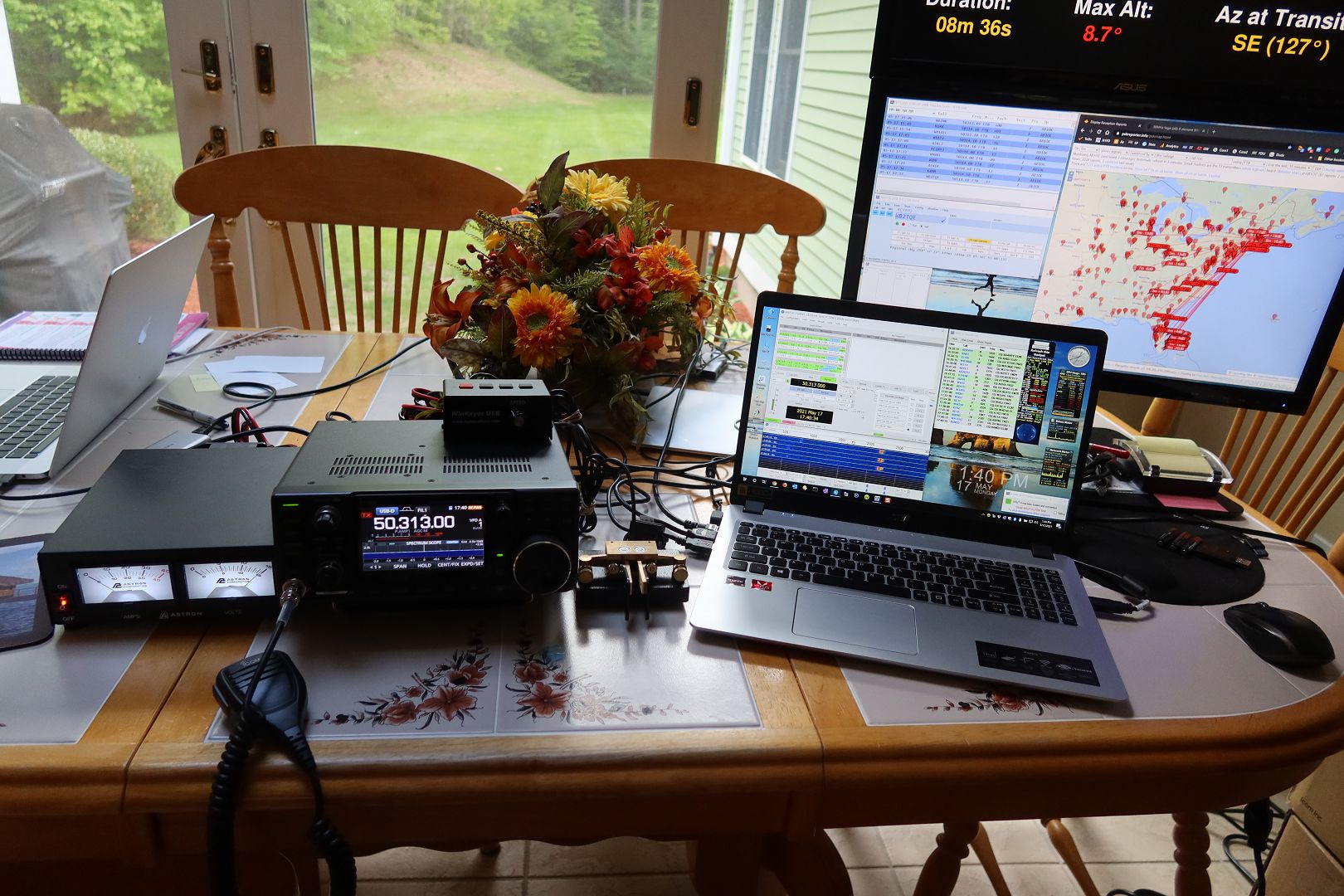
6m Portable Station
6m Field Day Station

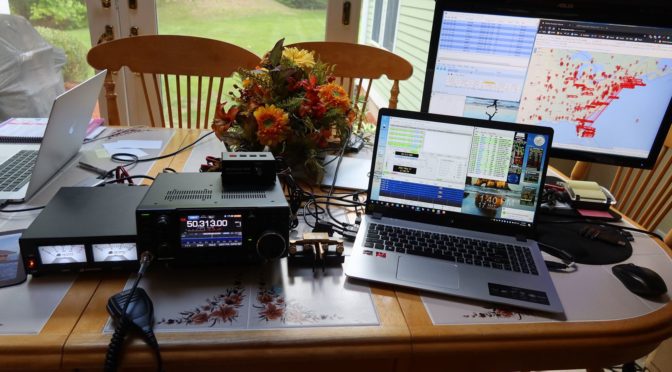
We also use the 6m LFA antenna project as an opportunity to assemble and test our 6m Station for Field Day. The station is an all-mode setup that can do SSB Phone, CW, and WSJT-X Digital (FT8/FT4, Q65, MSK144, etc.). The station will be generator powered at Field Day but it can also be run using a solar/battery setup when Mountain Topping.

The station features an IC-7300 Transceiver (100w), a Winkeyer and Paddles for CW, and a Windows laptop computer running the N1MM+ logger and WSJT-X. The station will also sport a second monitor for Field Day.
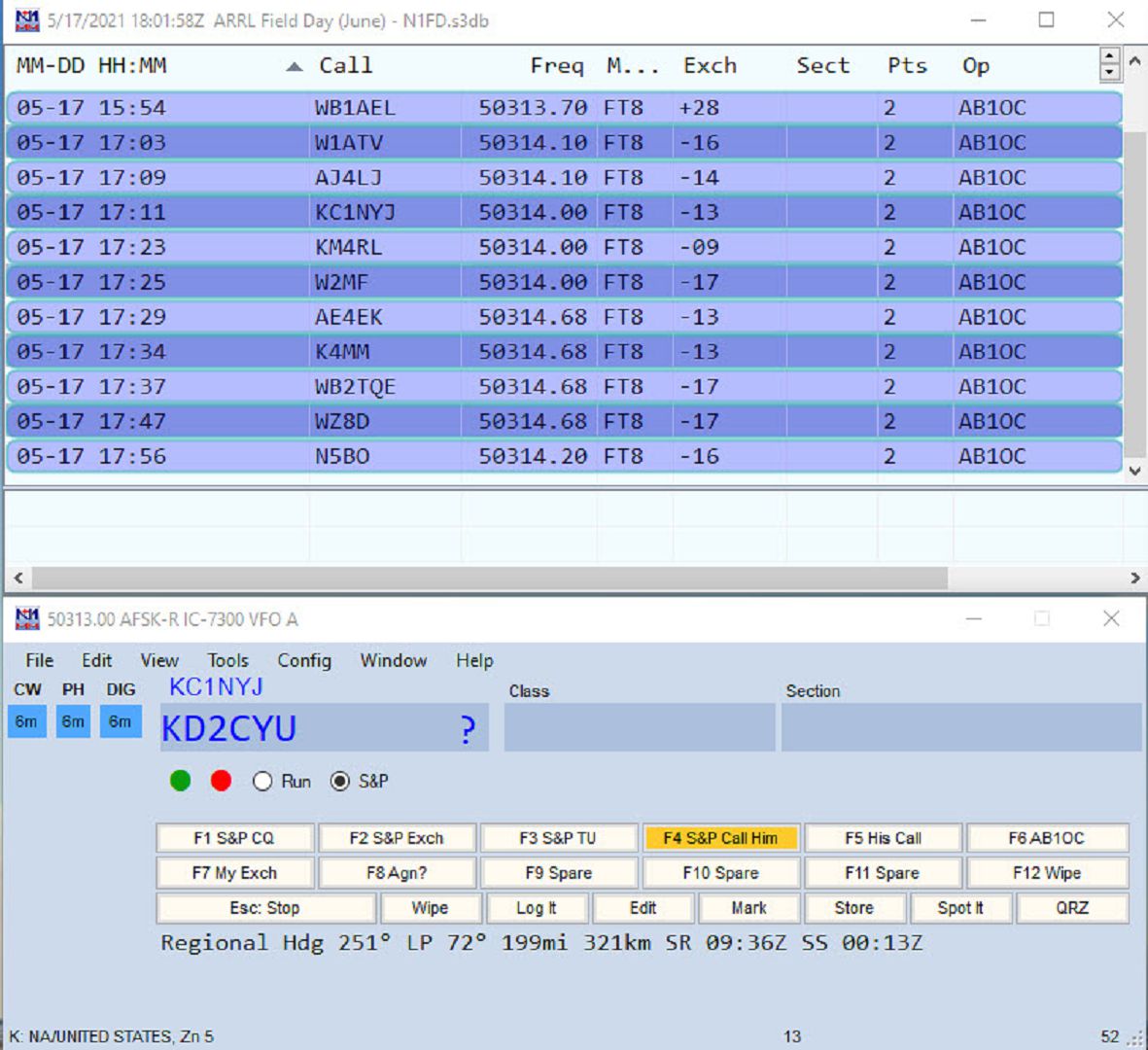
N1MM+ Logger on 6m
N1MM+ Logger on 6m

The N1MM+ Logger works great with the IC-7300 and WSJT-X digital. It supports the all-mode station configuration nicely and it is well integrated with WSJT-X making the logging of FT-8 and other Digital Mode contacts simple. N1MM+ also supports voice recording and keying of the IC-7300 which is a great aid during longer operating events like Field Day.

6m Field Day Station - PSKReporter Test of Portable 6m Station
PSKReporter Test of Portable 6m Station

So how does the upgraded setup play on 6m? Very well! The image above is a snapshot from PSKReporter during our testing session. As you can see, we were using FT8 to test the station and we were heard up and down the eastern U.S. states.
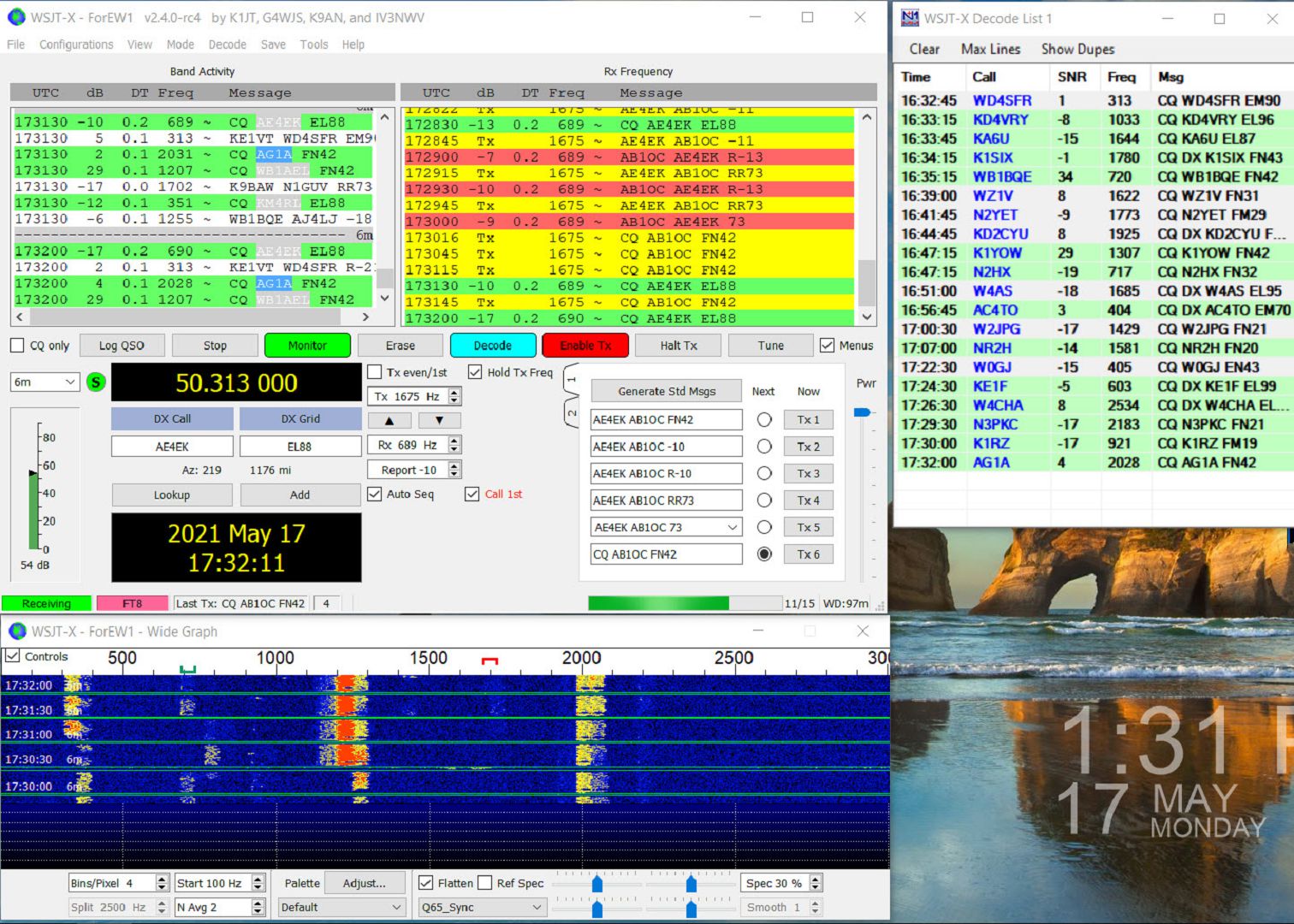
WSJT-X FT8 Decode using 6m Portable Station

Signals were strong in WSJT-X FT8 mode and it was easy to make contacts. We made about 50 contacts during our testing of the 6m Feild Day Station.

The LFA Yagi hears really well making for reliable decodes of signals in the -18 range and often weaker.
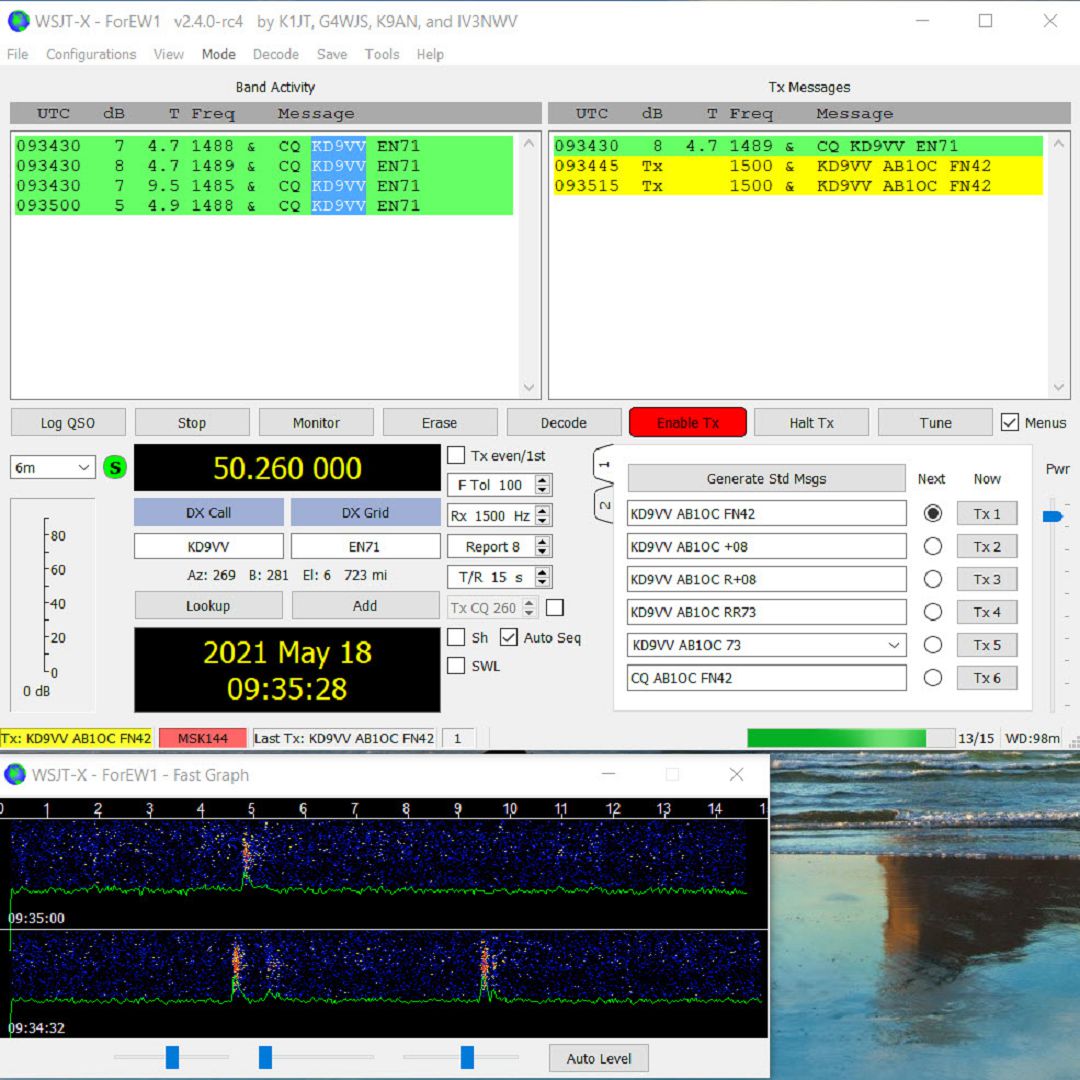
6m Meteor Scatter Pings

For fun, I decided to try some 6m Meteor Scatter contacts using the MSK144 mode. This is a challenge with a 100W station as Meteor Scatter general needs a bit of power to work well. As you can see from the image above, we had no problems decoding meteor pings from stations in the midwestern US. I even managed to complete a couple of contacts using Meteor Scatter on the 6m Band.

All in all, we are very pleased with the performance of our upgraded 6m Field Day Station. If we can get a similar Es opening to what we have been seeing here during the last two days, we should have a lot of fun on the Magic Band at Field Day!

Fred, AB1OC
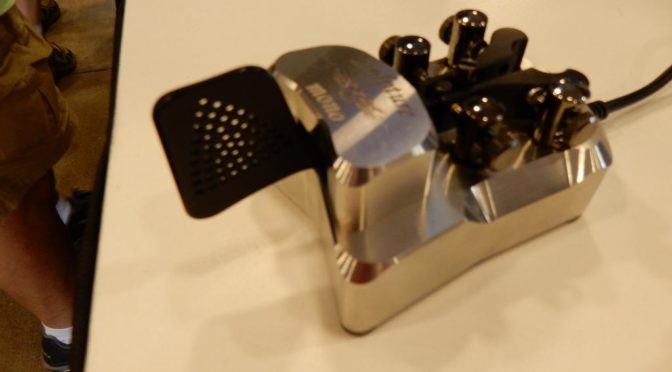
Ham Radio Home Schooling – Learn Morse Code

Do you have youngsters stuck at home looking for fun and safe activities? How about learning Morse code?

The Long Island CW Club Offering Free Online Code Instruction for Homebound Youngsters

The Long Island CW Club in New York is offering free online Morse code instruction for the “many youngsters at loose ends as a result of school closings due to COVID-19 concerns.” The club’s co-founder,Learn Morse Code Howard Bernstein, WB2UZE, pointed out that learning Morse code is “a fun and educational activity for children of all ages that can fill part of the gap left by the current unfortunate situation that has closed so many schools across the country.”
Ongoing classes will take place Monday through Friday, specifically for school-agers anywhere across the country or overseas, via Zoom online video conferencing.

A computer equipped with a microphone and camera is required. Classes for elementary schoolers run 30 minutes starting at 1600 UTC, followed by 45-minute classes for middle- and high school-aged students, starting at 1645 UTC. Parental permission is required through advance registration.

Contact class instructor Rob Zarges, K2MZ, by e-mail or call 508-831-8248. — Thanks to Mel Granick, KS2G, ARRL New York City-Long Island Section Public Information Coordinator

The Long Island CW Club (W2LCW) offers over 25 on-line classes each week for learning Morse code.  Classes are held at various levels from rank beginner to the seasoned expert. Check out the schedule page at https://longislandcwclub.org/events/

TU es 73!
Jerry,  K1OKD

This article was re-print from the March 26th ARRL News Letter available at http://www.arrl.org/arrlletter?issue=2020-03-26

October Contest Notes

It Begins!

October marks the unofficial beginning of the radio contesting season. In the next few months, we’ll have CQ WW SSB, CQ WW CW, ARRL Sweepstakes CW, ARRL Sweepstakes SSB, ARRL 160m, ARRL 10m, and a whole bunch of little but fun contests like ARRL School Club Roundup. There are still QSO parties to chase on a random weekend, too, including CA, NV, AZ, PA, SD, NY and, IL.  If you’ve been having trouble making time to get on the air (as I have!) then there are a lot of excuses to put yourself in the saddle and make some Qs!

October Contest Highlights

CQ Worldwide SSB [0000Z, Oct 26 to 2359Z, Oct 27]

Exchange: RS + CQ Zone (5905 for New England)

This was the first contest I ever entered. It was 2002 and the bands were hopping. I had just hung a stealth antenna and was curious about what I could hear. It was amazing. The bands were full, all the other guy wanted was “5905”, and he was off to work the next one. No microphone jitters here—there wasn’t time! If you’re new to contesting give this a try. Do search-and-pounce (S&P), listen, listen, listen, then work them. By the end of the weekend, you might have DXCC!

California QSO Party [1600Z, Oct 5 to 2200Z, Oct 6]

Exchange: CA: Serial No. + County; non-CA: Serial No. + (state/VE area/DX)

Nevada QSO Party [0300Z, Oct 12 to 2100Z, Oct 13]

Exchange: NV: RS(T) + “NV” + county; non-NV: RS(T) + (state/province/”DX”)

Arizona QSO Party [1600Z, Oct 12 to 0600Z, Oct 13 and 1400Z to 2400Z, Oct 13]

Exchange: AZ: RS(T) + county; non-AZ: RS(T) + (state/province/country)

Pennsylvania QSO Party [1600Z, Oct 12 to 0500Z, Oct 13 and 1300Z-2200Z, Oct 13]

Exchange: PA: Serial No. + County; non-PA: Serial No. + ARRL/RAC Section

South Dakota QSO Party [1800Z, Oct 12 to 1800Z, Oct 13

Exchange: SD: RS(T) + county; non-SD: RS(T) + (state/province/country)

New York QSO Party [1400Z, Oct 19 to 0200Z, Oct 20]

Exchange: NY: RS(T) + county; non-NY: RS(T) + (state/province/”DX”)

Tip: Sometimes those close-in states like VT, NY, ME, and MA are hard to get on the higher bands. They tend to be in the skip-zones a lot of the time. Take advantage of these QSO parties to fill in the close-in states on the high bands.

Illinois QSO Party [1700Z, Oct 20 to 0100Z, Oct 21]

Exchange: IL: RS(T) + County; non-IL: RS(T) + (state/province/country)

Wrapping up

These contests give you your last big change to test and repair station equipment and antennas before the weather gets uncomfortable. (My poor SteppIR has died of neglect, for example!) So, don’t be like me! Get on and tune up your station for the long winter ahead.

Pumpkins image courtesy of
Aaron Burden

Scott, NE1RD

Radio Amateurs Developing Skills Worldwide