Station Updates At K8EZB

I saw Scott Andersen’s recent plea for articles, including on the topic of station improvements, so I thought I’d respond with a short article on some station updates at K8EZB. Nothing as sophisticated as some here can report, but, for me, meaningful progress. As previously reported, I am back OTA after a 50+ year lapse in amateur radio activity. I have been working mostly on acquiring/restoring equipment for vintage HF SSB stations but decided to first get going with an SDR radio or two, and also get some experience with digital modes. I started with an IC-7300 in late 2017 and after several months of QSOs on SSB, I moved on to FT8. This was a bit of a challenge as it was difficult to find accurate, comprehensive information on radio and software setup. It seemed that everyone offering advice had slightly different ideas on configuring everything. After consulting several online sources as well as Fred and Hamilton, I was able to conduct my first FT8 QSO in late 2018. I was pleasantly surprised at how well FT8 worked, especially considering the highly compromised antenna I am using.

The antenna is a My Antennas EFHW-80-10HP, an end fed half wave (130 ft) wire with a matching network at the feedpoint. This antenna is advertised as resonant on most bands 80m-10m, and I am generally seeing SWR numbers below 3.0 in all cases, and much lower on some bands. These SWR numbers are higher than the manufacturer specifies, but I suspect this is due to certain compromises on my part. The compromises come about due to installation constraints. My location necessitates a bit of stealth, so the antenna is low (15 ft at the highest point), sloping, and folded back into a sort of V shape; it is also below and in close proximity to several steel clad industrial type buildings. Not optimum by any means. However, this antenna has performed far better than expected. Using WSPR and PSK Reporter, it is clear that the propagation pattern strongly favors northeast-southwest. With this antenna, I am consistently able to work stations throughout the U.S. and western Europe on 20m using FT8. And, on a good day, it does even better. One of my early contacts was Rodrigues Island in the Indian Ocean. I have also been heard in Japan on 40m but have not completed a QSO on this band in Japan. The DX is pretty amazing, some due to the antenna, but more likely due to the weak signal capability of FT8.

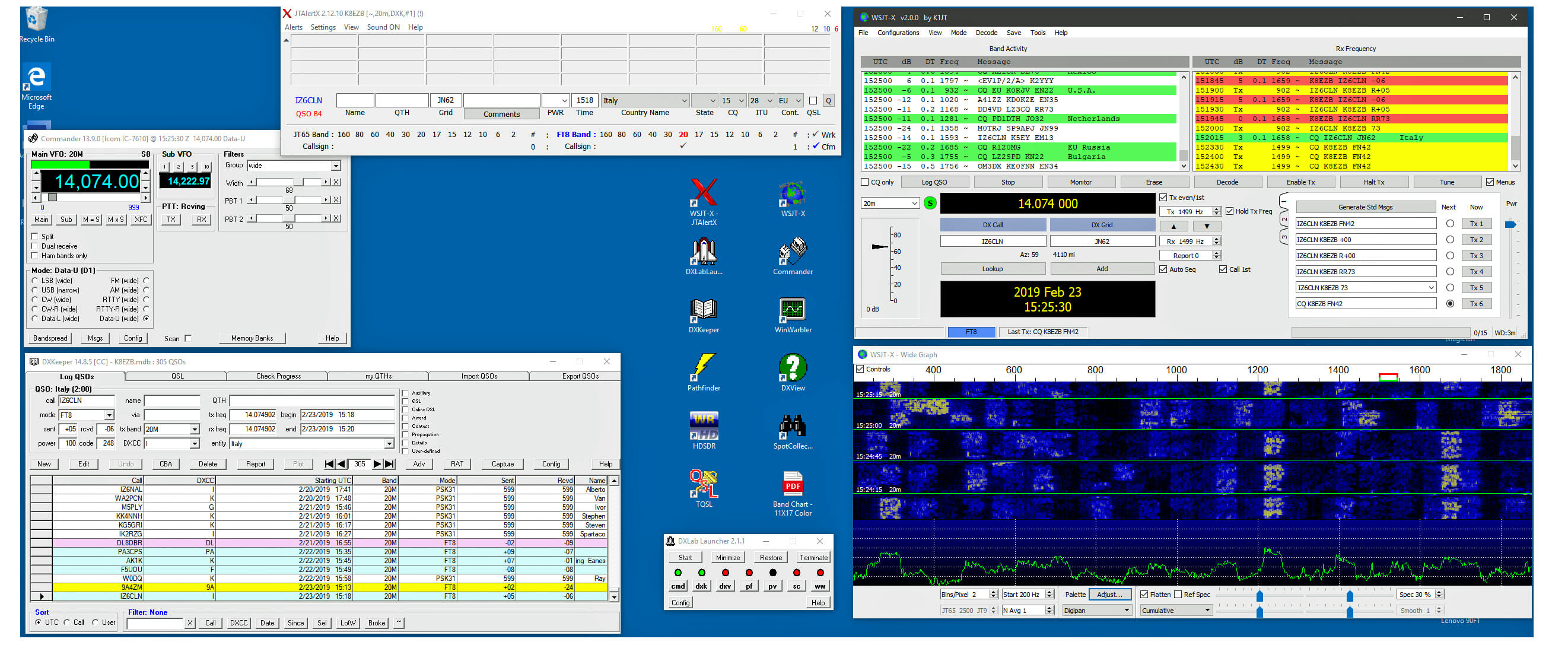
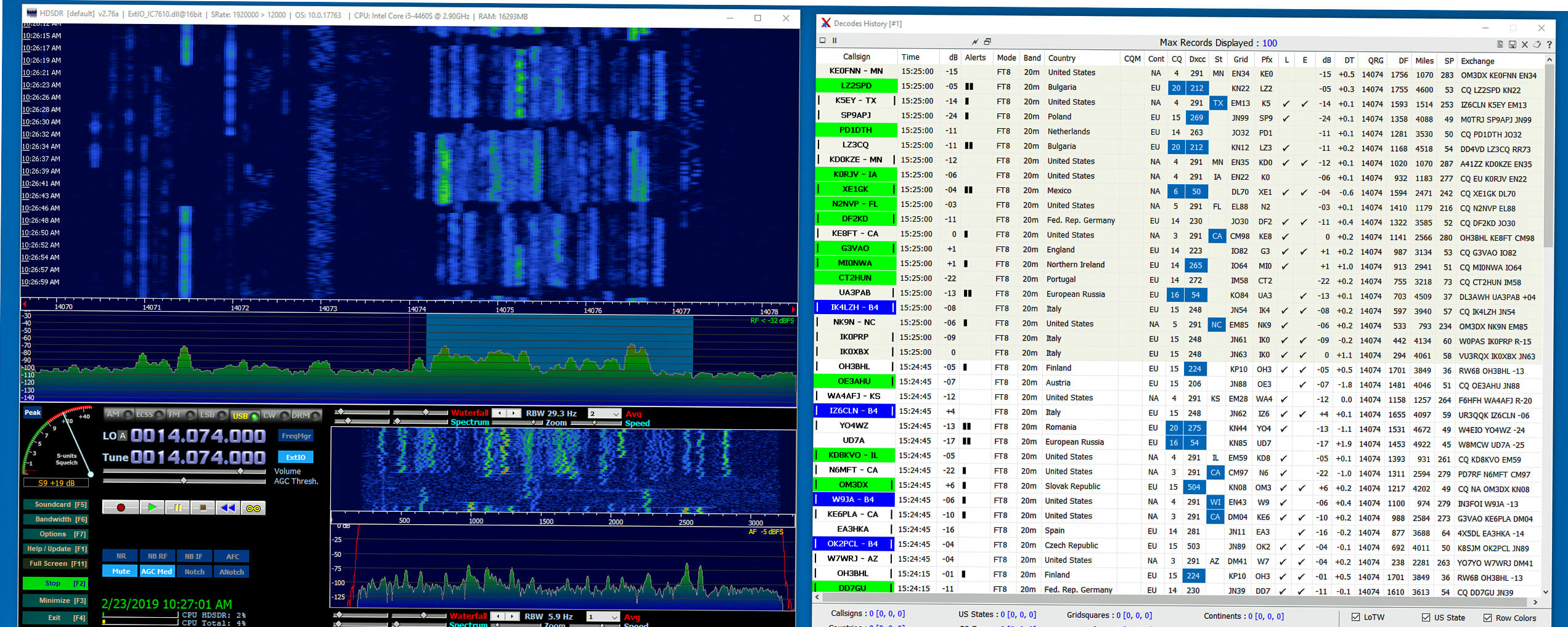
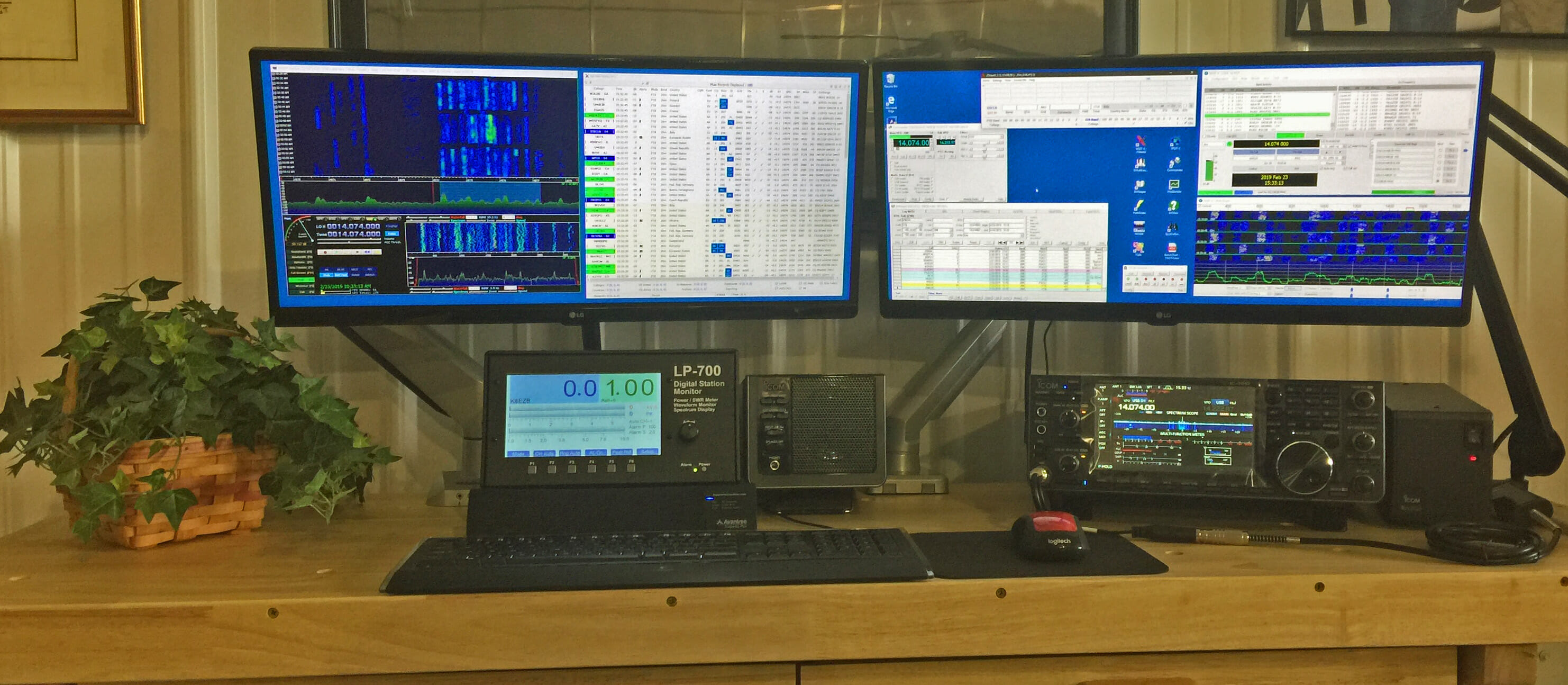
With this early success, I was motivated to upgrade my radio to an IC-7610 in January 2019. This is quite the sophisticated transceiver and I am still learning how to fully utilize its capabilities. Getting the 7610 configured for digital modes was relatively straightforward as much of the setup was very close to the IC-7300. In the process of moving to the 7610, I also added the DX Lab software suite, JTAlert, and HDSDR applications. The DX Lab suite, for me,  is not so much for DX use as for basic logging and support of digital modes. This suite is a software tour de force in terms of capability, but also daunting for a newbie to install and integrate with other apps. There is a very active DX Lab forum at groups.io and the pros there answered my question in short order. Dave, AA6YQ, the developer of DX Lab, has spent a good part of his life developing and supporting this FREE software and is on the groups.io forum daily to answer questions and accept bug reports. I also added HDSDR, an app that is driven from the I/Q output of the 7610 and provides a much expanded and configurable bandscope type capability, well beyond what the native 7610 bandscope can do. (The left window in the Screen 2 photo below shows an example of HDSDR capability).

In the process of adding all this software to my “radio” computer, I decided to upgrade this Core i5 processor by doubling RAM to 16 GB, adding a video card to drive a second hi-res monitor, and replacing the HDD with a SATA type SSD. This went smoothly enough and significantly boosted overall performance. At about this time, the TelePost LP-700 digital station monitor I ordered about a year previous (long waiting list!) finally arrived and I added this to the station. This quite an impressive instrument and I am not yet using anywhere near its full capability.

Once the computer was updated, I branched out a bit to add the Win Warbler module of the DX Lab suite to support RTTY, PSK31 and other digital modes. Both modes worked quite well after getting the setup squared away, and DX in these modes was almost as available as with FT8. My first RTTY and PSK31 contacts were in Europe. In recent days I have installed the latest version of WSJT which supports the new FT4 mode and have made several FT4 contacts. FT4 is said to be optimized for contesting, and while I have minimal interest in contesting, I thought it worthwhile to give it a try. Very easy if one already has FT8 running. JTAlert does not yet fully support FT4 but this is said to be coming soon.

Below are a few photos showing the station and some relevant screenshots.

Next on the station upgrade agenda is the addition of an Acom A1200S solid-state amp and companion 04AT antenna tuner. Also considering adding a Yaesu FTdx-101MP once the reported bugs  have subsided. No such thing as too many radios!
Station Updates
K8EZB


Station Updates
Screen 1


Station Updates
Screen 2

Rick
K8EZB

Latest Tech Night – Putting Up A Tower

July 2019 Tech Night – Putting Up A Tower

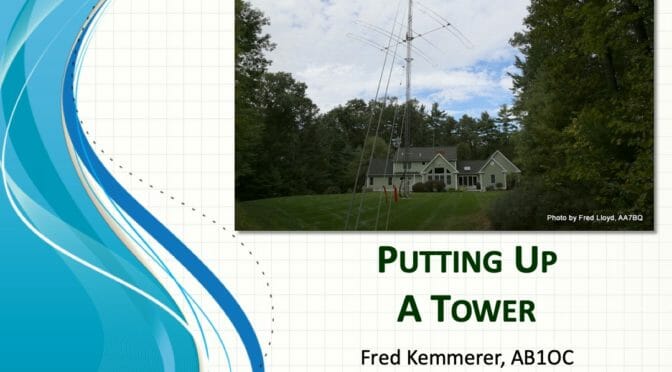
We recently did a how-to presentation on Putting Up A Tower at a Nashua Area Radio Society Tech Night. The video from this presentation can be viewed above.

Putting Up A Tower Video - Topics Covered
Putting Up A Tower Video – Topics Covered

We covered a variety of information related to planning, building and integrating Guyed and House-Bracketed towers. You can view the accompanying presentation materials here.

The Nashua Area Radio Society produces similar how-to training materials on almost a monthly basis and we make these materials available to our Members an Internet Subscribers (folks that live too far from our location to be regular members) for a small cost which supports our new Ham development programs and covers the production and storage costs associated with the video material. Here’s a list of the training topics that we’ve produced to date:

2019 Tech Nights

  • Almost Everything You Need to Know About Antenna Fundamentals Part 1 by Spencer Webb, W2SW and Steve Golson, W1SEG
  • Raspberry Pi for Portable Digital Communications by Jamey Finchum, AC1DC
  • HFTA, Feedline Design and Busting Pileups by Fred Kemmerer, AB1OC
  • QSL’ing and Awards by Anita Kemmerer, AB1QB
  • Fox Hunting: Radio Direction Finding for Beginners including a Tape Measure Yagi Build by Jamey Finchum, AC1DC
  • Surface Mount Technology by Hamilton Stewart, K1HMS
  • RF Design with Smith Charts, Building a First HF Station, and Begining with CW – Hamilton Stewart, K1HMS; Anthony Rizzolo, KC1DXL; and Jerry Doty, K1OKD
  • All About Field Day 2019 by our Field Day Planning Team
  • Putting up a Tower by Fred Kemmerer, AB1OC

2018 Tech Nights

  • Operating Your Station Remotely by Fred Kemmerer, AB1OC
  • Transceiver Frequency Measurement and Calibration by George Allison, K1IG.
  • DMR Radios and Programming by Bill Barber, NE1B
  • WSJT-X: FT8, WSPR, MSK144 and More by Fred Kemmerer, AB1OC
  • Getting Started with Raspberry Pi Computers by Anita Kemmerer, AB1QB, Jamey Finchum, AC1DC,  Brian McCaffrey, W1BP, Fred Kemmerer, AB1OC, and Craig Bailey, N1SFT
  • All About Field Day 2018 by our Field Day Planning Team
  • Portable Operating Gear – demonstrations by Nashua Area Radio Society Members
  • K1EL Kits by Steve Elliott, K1EL
  • Antenna Modeling I by Scott Andersen, NE1RD.
  • Building and Operating a Mobile HF Station by Fred Kemmerer, AB1OC

2017 Tech Nights

  • High-Altitude Balloons: Amateur Radio at the Edge of Space and was presented by our HAB Team.
  • Getting On The Air 2.0 by Fred Kemmerer, AB1OC, and B. Scott Andersen, NE1RD
  • All About n1fd.org – Getting the most from our Website by Fred Kemmerer, AB1OC.
  • Digital Modes: RTTY, PSK, and WSJT-X by Mike Struzik AB1YKAnita Kemmerer AB1QB, and Fred Kemmerer, AB1OC
  • Bonding and Grounding by Jeff Millar, WA1HCO and Fred Kemmerer, AB1OC.
  • All About Field Day 2017  by Dave Merchant, K1DLM, and our Field Day Planning Team.
  • Building and Operating a Satellite Ground Station by Burns Fisher, W2BFJ and Fred Kemmerer, AB1OC.
  • DXing and QSLing by Anita Kemmerer, AB1QB; Bill Barber, NE1B; Fred Kemmerer, AB1OC; and Dick Powell, WK1J.
  • Weak Signal VHF and UHF Stations by Jeff Millar, WA1HCO and Bill Barber, NE1B.
  • Getting the Most from your HF Transceiver and More by Fred Kemmerer, AB1OC and Dave Michaels, N1RF.

2016 Tech Nights

  • Popular Loggers – Ham Radio Deluxe and DXLab Suite by Dave Merchant, K1DLM and Fred Kemmerer, AB1OC.
  • Low-Band Antennas by Dennis Marandos, K1LGQ; Hamilton Stewart, K1HMS; Brian McCaffrey, W1BP; and Fred Kemmerer, AB1OC.
  • RF Simulation and Matching by Jeff Millar, WA1HCO
  • Directional Antennas by Fred Kemmerer, AB1OC; Dave Michaels, N1RF; Brian Smigielski, AB1ZO; and Greg Fuller, W1TEN
  • All About Field Day 2016  by our Field Day Planning Team.
  • Surface Mount Soldering and Desoldering, a Hands-On Presentation by Jeff Millar, WA1HCO
  • Building Your First Station and Getting On The Air by Fred Kemmerer, AB1OC, and Dave Michaels N1RF
  • Software Defined Radios by Fred Kemmerer, AB1OC and Skip Youngberg, K1NKR
  • Advanced Repeaters (DMR, EchoLink, DMR, and D-STAR) by Anita Kemmerer; AB1QB, Fred Kemmerer, AB1OC; and Bill Barber, NE1B
  • Antenna Modeling with EZNEC by Fred Kemmerer, AB1OC

You can gain on-going access to the full library of Amateur Radio Training and How-To materials by supporting our work to bring new people and young people into the Amateur Radio Service as a Nashua Area Radio Society Internet Subscriber. You can learn more about how to become an Internet Subscriber here.

Fred, AB1OC

NARS is Featured in QST and CQ Magazines

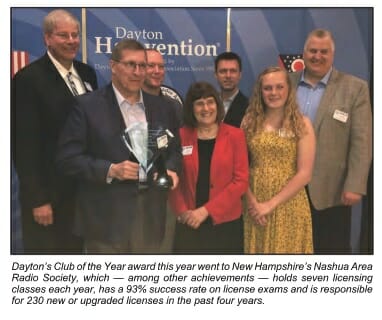
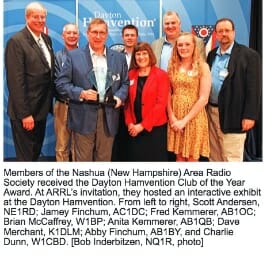
Both QST Magazine and CQ Magazine published articles on the Dayton Hamvention this month.  The Nashua Area Radio Society (NARS) was recognized the Hamvention Club of the Year award this year, where the Hamvention theme was Mentoring the Next Generation.  NARS is featured in QST and CQ Magazines.

NARS in CQ Magazine
NARS in CQ Magazine

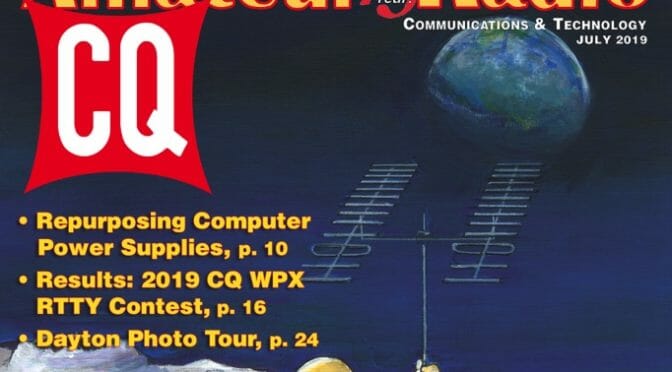
In CQ Magazine, the article titled “The Dayton Trifecta” starts on page 24.  There is a nice spread on the Hamvention Awards Dinner on pages 30-31, where you will see the Nashua Area Radio Society included in pictures of the award winners.

NARS in QST Magazine

The electronic version of QST, published by the ARRL is out and we are featured in the article titled “The 2019 ARRL National Convention at Dayton Hamvention” on pages 72-74 – we are featured on page 73.  If you look closely, you will also see some members in the group photo at the beginning of the article.  The print version should be arriving in the mail shortly.

NARS is featured in CQ and QST Magazines this month.  Make sure you pick up your copy of both magazines!

Radio Amateurs Developing Skills Worldwide