WM0G Rain Gutter Antenna

Several years ago, I wrote an article on the use of the rain gutter on my Colorado home as my HF antenna. This was the antenna I was relegated to use for my HF operating due to the oppressive rules of the local Home Owners Association regarding external antennas. Although I did remind them at the time that it was illegal to ban small outdoor satellite dishes and Yagi’s for TV reception per the FCC, so they amended that clause in the HOA covenants, but still continued their ban on any outside ham antennas. I’ll not complain, as I knew what the HOA rules were when I got this house and accepted them as a challenge to my ingenuity.
Rain Gutter Antenna
Rain Gutter Antenna

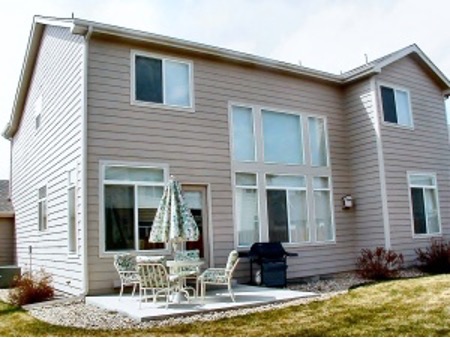
One day I was looking around to see what I could use to support a wire on the roof and got an idea to try to use the aluminum rain gutter on the east side of my house as my HF antenna instead. The gutter measured 25 feet vertically and then ran 35 feet horizontally for a total of 60 feet in overall length and resembled a ready-made inverted “L” or what is also known as a Marconi antenna configuration. That antenna needs a decent counterpoise to work correctly so I planted fifteen random length radials under the lawn. I then wired together the three aluminum window wells that were on that side of the house and added them to the planted radial wires. Additionally, I bolted together all of the aluminum lawn edging around my lawn and added a wire from that into the other counterpoise elements. According to the accepted theory, the more metal and wire you use in your radial system, the better. You might consider connecting to your radial system any nearby chain link fencing, metal lawn sprinkler piping, buried metal screening, water standpipes, underground water storage tanks, metal drainage culverts, railroad tracks, etc.

After the installation and in the initial trials, one of the drawbacks I noticed on the rain gutter antenna was that it was somewhat tricky to load on some of the bands using a conventional antenna trans-match. It was impossible to find a decent matching combination on 160 meters at all. Although, loading on the 80, 40, 30, 20, and 15 meters bands did not present as much of a problem and I could get an SWR match under 3:1 in a few small portions of those bands. Tuning on 10 meters was a bit tricky as well as finding any sort of decent match on 12 meters and 17 meters.

I looked at several possible solutions including one developed by my good ham friend, stealth antenna compatriot, DX’er, celebrated author, and renowned Physicist – Dr. Yardley Beers, WØJF (now SK) who volunteered to do all the complex mathematical calculations on my rain gutter antenna system. In a few days, he gave me a coil design that could be added to the feed point of the rain gutter in order for it to load on 160 meters. There was no doubt in my mind that his design would work.

Ultimately, though, I had decided on using a different approach. I had read a lot about the SGC-230 Smartuner™ Automatic Antenna Coupler in ham magazines and on the Internet. It seemed like a plausible solution to this problem IF it worked as advertised. The automatic antenna coupler is designed for use with end-fed unbalanced antennas such as whips and long wires. It can be configured to be used with dipoles and inverted vees as well. This automatically tunable antenna coupler is an ideal solution for this type of installation due to the fact that a rain gutter looks like a non-resonant end-fed unbalanced antenna.

What is the difference between an antenna coupler and an antenna tuner? According to the SGC manual, “antenna couplers” are placed at the antenna and match conditions of the antenna to the feed line in a very precise manner whereas, “antenna tuners” on the other hand, are generally located at the transmitter output at the transceiver end of the coaxial feed line. Furthermore, antenna tuners placed at the transmitter allow substantial losses in feed lines to be corrected at that point in order to “fool” a transmitter into working correctly. The losses are dissipated through heat or to ground. Conversely, a coupler installed at the antenna eliminates these losses by providing a proper match of the antenna at the feed point. The SGC-230 Smartuner™ is a true antenna “coupler”.
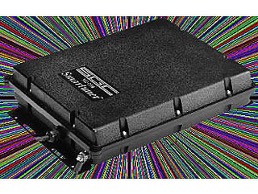
SGC-230 Smart Tuner
SGC-230 Smart Tuner

After purchasing the SGC-230 Smartuner™ from my local Denver HRO store I couldn’t wait to get it installed. Included within the formidable packaging of the box was an impressive and informative 81-page installation and operating manual that explained the coupler’s inner workings and it suggested various antenna applications for the SGC-230 with illustrations. Upon physical inspection of the unit, I was impressed by the ruggedness of the construction of the SGC-230. This hermetically-sealed antenna coupler was obviously meant to be installed outdoors and was even suitable for installation on shipboard. At a major military show,

I even saw one mounted on the side of an Army Humvee connected to their whip antenna! SGC builds other models of these types of antenna coupling devices but the SGC-230 Smartuner™ is rated at 200W input. I probably wouldn’t ever run more than 100 watts, but it is comforting to know that you are not running on the hairy edge of the limits of its power capabilities. I figured that the additional margin would translate into many extra years of trouble-free operation.
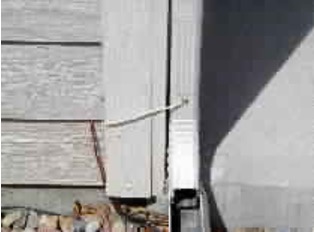
The feed to the rain gutter is barely visible in this photo as well as the braided connection to the radials.

The installation was a snap. SGC gives you an additional quick installation guide for those of us that don’t like to read the whole manual. First, I mounted the antenna coupler as close as possible to the feed point of the rain gutter per the specification in the installation guide. This is because any portion of the feed wire that is connected to the SGC-230 becomes part of the overall length of the antenna too.  So, I mounted my unit on the inside wall of the foundation of the basement just above the wooden base plate and below the flooring. This location was just opposite the downspout of the rain gutter, which served as my antenna feed point on the outside. A short distance of 8 inches away. I drilled two holes just larger than the O.D. of the intended feed-thru wires through the 2×12 inch base above the concrete foundation and on through to the outer siding. Then I took apart a piece of RG-8X coax and separated the inner conductor from the braided shield. The inner conductor would serve nicely as the feed wire from the coupler to the downspout. You are cautioned in the instructions not to use coax to hook up these auto couplers on the antenna feed side. The now-separated braided shielding served as the hookup to the outside radial wires and was then connected to the ground lug provided on the SGC- 230. Now all that was left was to connect the RG-8X coax from my rig to the input of the cable harness provided with the SGC-230. There is a set of control wires and voltage wires included in this coaxial cable harness. The +12 VDC hot wire and ground went to my 12 VDC power supply. There are control signal leads that are also provided that are used for an indication of the coupler`s tuning. An LED “antenna tuned” indicator was connected between +12 VDC and the control signal wire. When the antenna coupler has found a match, the coupler drives the signal to ground on the control wire, which causes the LED to light. It provides a good visual indicator close to my operating position because I can’t hear the quiet auto coupler relays engaging from my operating position. The total time for installation, from getting the unit out of the box to starting the initial testing, was under an hour.

To me, the “proof is in the pudding” and my acceptance would be how well it performed in on the air tests. First, I tried to load up the antenna on all the bands from 10 through 80 meters. Wow! no problem whatsoever! All bands indicated a 1:1 SWR and the initial tuning time on each band was from 3 to 4 seconds for finding a match. The Smartuner™ automatically evaluates and switches 64 input and 32 output capacitance combinations plus 256 inductance combinations in a “pi” network which equals over a half-million matching combinations. Once it finds a match, the SGC-230 has 500 memories in which it stores the LC combination in its non-volatile computer memory so that the next time that you operate on that same frequency it tunes almost instantaneously, usually in less than 10 milliseconds. Now for the band that I hadn’t been able to get a match on before… 160 meters. I went down to the CW portion where I usually operate and it found a match within 4 seconds. Life is good again! I also did not notice any “hunting” by the SGC antenna coupler once it has been tuned to a frequency.

I decided I would wait until the evening to perform some on the air experiments with some people I knew. I checked into a WAS Net on 75 meters that I have been active on for over 20 years and knew most of the hams there. These unwitting participants in my on-air tests were giving me S7 to S9+ reports from New England to California and from British Columbia to Florida. I had not let on to anyone before the net that I had done anything to my antenna system and thought I’d gather a few willing souls after the net to give me some further signal reports.

I was getting reports of S6 in New England later on as the band seemed to be changing a little but I was still getting S9+ reports from the southern states and was still S7 into British Columbia and Washington State and S9 into California. Most of these good folks know that I am using a rain gutter for an antenna but some of them think I am kidding them about it and using something more formidable for an antenna and maybe even a linear! So, after telling everyone on the WAS net about my latest antenna configuration and new addition, I got a comment from a station in Arkansas who said, “If I could put a signal like that out from my rain gutter, I’d get rid of my dipole and my linear too!” He said that my signal had been over S9 all night at his QTH. The band conditions were decent this particular evening but the reports were consistently well above previously logged reports I’ve had with those very same stations in the past under similar band conditions without the coupler. The signal reports remained fairly constant, plus or minus band conditions over the years.
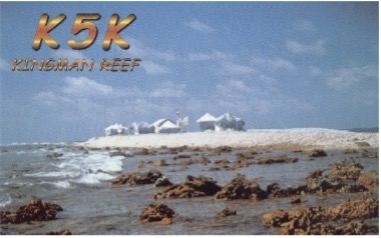
K5K Kingman Reef DXpedition QSL

Later that same week, I noticed on the DX-Cluster that the long-awaited K5K Kingman Reef DXpedition was up and running. This would be an ATNO (all-time new one) for me if I could get through the pileups. I knew that CW would be my best chance early on and I’d try for the SSB contacts later on during the DXpedition when the “big guns” had gotten their fill and their “feeding frenzy” was over. I caught K5K easily on 30 meters – no problem, as everyone on that band is fairly equal due to the power limitation. Later, I worked K5K on 15, 17, and 40 meters CW. I even got them on 40 meters SSB too! Finally, one evening I saw a spot for K5K on 160 meters. I hadn’t actually operated down here before with the rain gutter due to the problems I have previously noted. I heard him and set up split about 1.5 kHz up and slipped in my callsign fully preparing to be there for a while as his presence had attracted a fairly good pileup. He came back to me on my very first call! I was so shocked that I didn’t answer right away. I just kept staring at my radio – it was like having “buck fever” when you are out deer hunting. He sent my callsign again. I hurriedly snapped out of my trance and jumped onto my Vibroflex key and gave him the usual 5NN 5NN CO TU ES 73 DE WMØG. He acknowledged my reply and continued on to work the rest of the pileup. Not too bad! My very first 160 meters contact on the rain gutter was a rare DX station in a pileup. I was even more impressed now with my new antenna coupler. It had ‘played’ as advertised and had already justified its pricey self in my mind. I like to imagine that the other guys in that pileup thought that they had initially lost out to some “big gun” top band DX’er with his quarter wavelength high 160 meters 4-square vertical array and multi-KW amplifier — HI!

Since that time, I casually worked over 220 countries (all bands), and had enough confirmed QSO’s for WAS on 75 meters SSB. I even participated in the ARRL SSB Contest and managed to work 45 different countries in just 98 contacts, mostly on 20, 15, and 10 meters. These were accomplished in a little under three hours of actual operating time while being particular on who I called while “searching and pouncing”. While this is certainly not an impressive “run-rate” it is still is not a bad testimonial to the capabilities of the rain gutter antenna and SGC-230 automatic coupler combination. Even if one considers that most of the contest ops on the receiving end were using much more impressive antennas in order to hear me. Most stations I called were still coming back to me on my first or second call, except for a few of the rarer ones who had lots of QRM on their frequency.

I know now that when I install my next mobile HF radio installation, it too will have an SGC antenna coupler just ahead of the whip. Reports I’ve read on the resultant combination of the SGC series automatic antenna couplers used with plain steel whips have been very good from 160 meters on up. I also have read independent reviews that it works incredibly well with the equally pricey, but efficient, matching the SGC-303 9-foot tall mobile antenna. No, I don’t work for SGC, but I am a satisfied customer, and I don’t mind spreading the word about their quality products.

With regards to my experiences using a rain gutter for an antenna, I write this article in the fervent hope that some covenant-restricted or apartment dwelling ham, somewhere, will be inspired to replicate some form of stealthy antenna system as I, and many others, have done too. I would hope he or she would also then share their enjoyment of being on the HF bands with a respectable signal, despite the covenanted restrictions and physical obstacles around them.

This article is certainly not technical in its content, nor was it meant to be so. It is, however, testimony that one need not have ideal antenna conditions in order to operate effectively on the HF bands. Many books have been written on the subject of stealth amateur radio operation and all of them offer some very sound advice regarding the subject of stealth antennas. I suggest that if you have a desire to run a stealthy ham station you consult these books first. Also, go to the SGC web page and download one of their online manuals for their antenna auto couplers where you will find even more ideas and solutions. In the back of their manual under “Smartuner™ Installations & Applications,” you will see my rain gutter antenna article as well. Also, Steve Nichols, GØKYA published my article in the RSGB. I’m always interested in anyone who has been inspired to try this combination and hear about their success.

Jack, WM0G
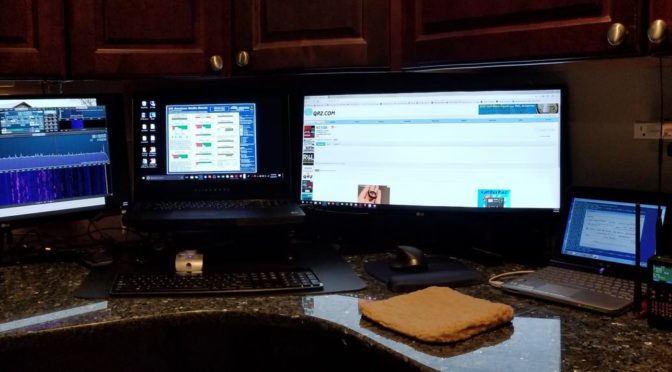
AC1EV’s Ham Radio Adventure: Part I

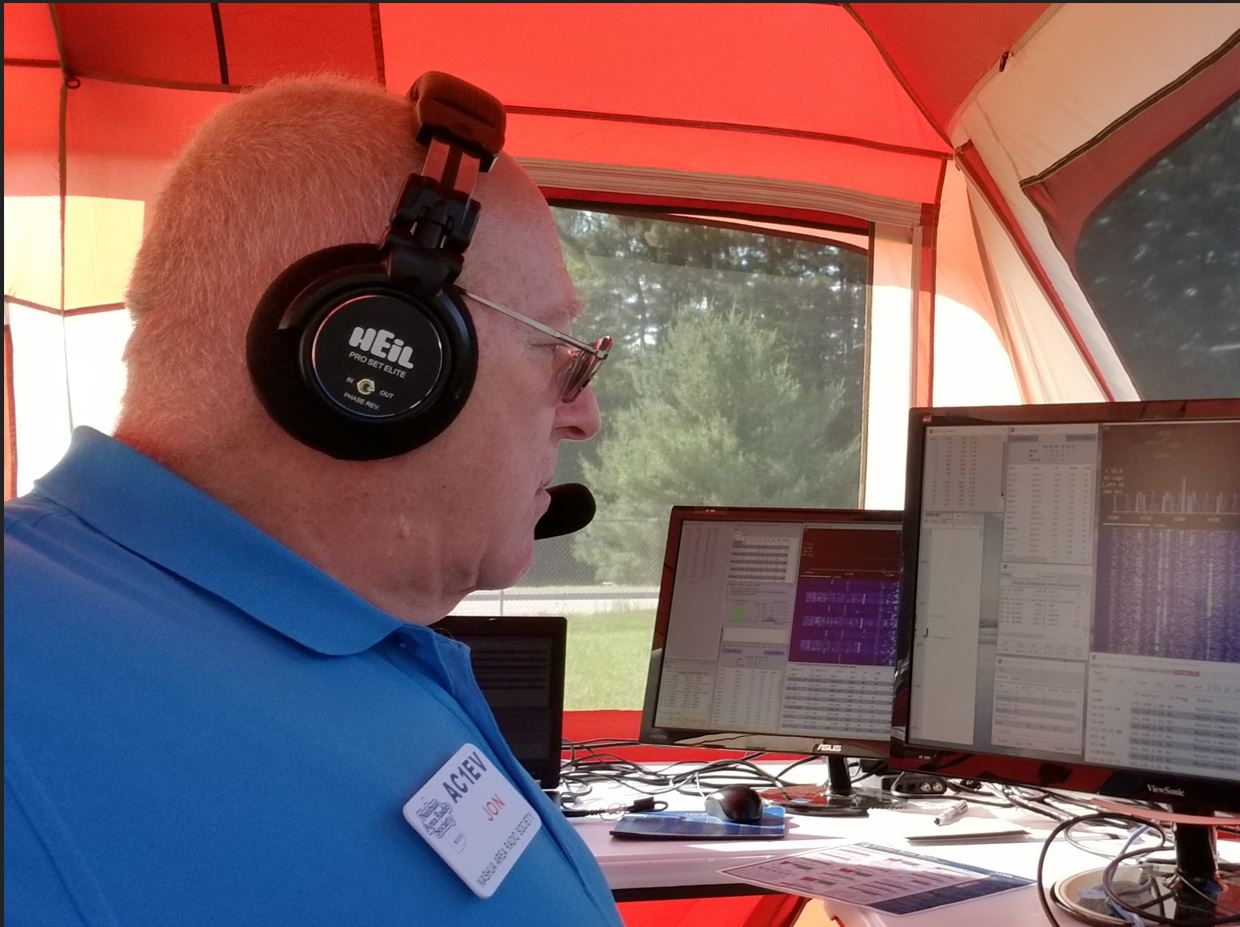
AC1EV - Jon
AC1EV – Jon

Starting Out

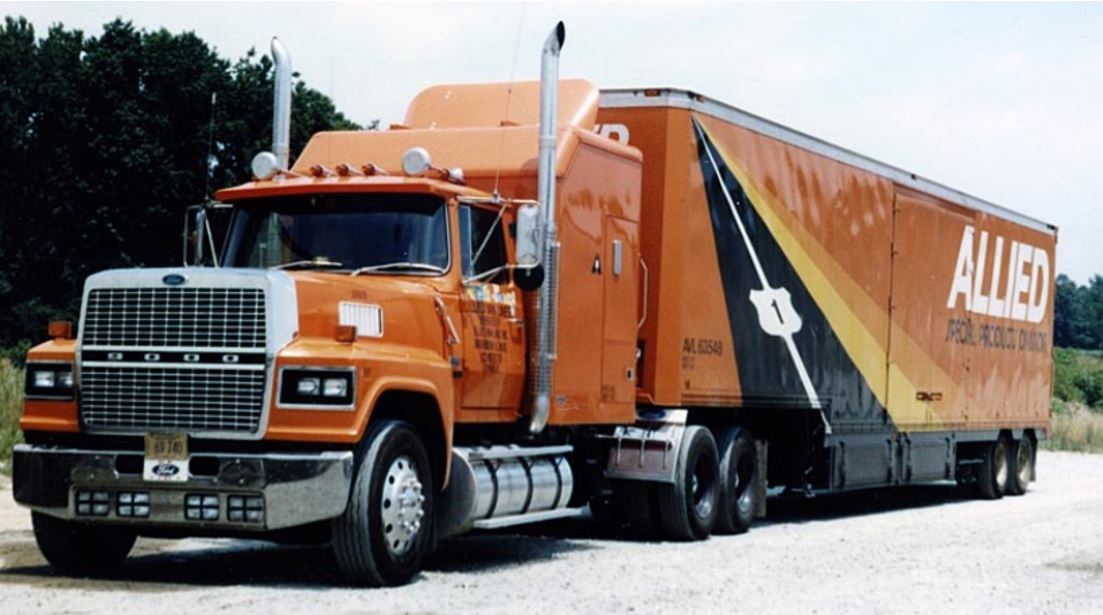
Hi, I’m Jon Turner, AC1EV and I’d like to tell you a bit about my Ham Radio Adventure.  In late 2017, my wife Stephanie began pestering me to let her know what I wanted for Christmas.  This was a perennial problem for us.  I usually had problems thinking of something that was not ridiculous, like a new RV.  I heard about a new thing called “SDR” radio and found out about the RSP1A SDR.  It’s affordable and hooks up to a computer. There are lots of things to do with it.  On Christmas morning, I had a new toy, and my adventure began.  30 years earlier I used to have a Sony ICF-2010 Shortwave radio that I listened to while I traveled the country in my job as an owner-operator trucker.

Jon's 1984 Ford LTL 9000
Jon’s 1984 Ford LTL 9000

In addition to the shortwave bands, it also had Ham bands and I explored them all.  As a trucker, I also had a pretty good CB radio setup, including SSB so was not new to being behind the mike.

Training

After a month or so of listening to the RSP1A SDR, it was obvious to me that I needed to be able to join in on the conversations (now I call them QSOs) I was monitoring.  After trucking, my second career was in IT, so I was very familiar with using internet resources to learn new technologies.  I self-studied and prepared for the Technician exam, which I took with the Billerica Amateur Radio Society in Chelmsford, Ma at the end of February 2018.  Already in study mode, I kept going and studying for the General exam.  My self-study program was a combination of the ARRL Exam Prep books, ARRL Exam Review for Ham Radio™, and YouTube videos produced by the Hurst Amateur Radio Society in Texas.  After I passed that exam, I began to build my station.  I often visited Ham Radio Outlet in Salem, NH to buy items to build or improve my station.  One day in mid-April I was talking with another customer there and mentioned that I was studying for the Amateur Extra test.  He told me that his club, Nashua Area Radio Society was putting on a boot-camp license training for Extra the upcoming weekend!  I was about halfway through my own studying for the test and decided to sign up for the training.  That decision turned out to be one of the most significant of my life.  Sure, I got the license that weekend, which was great, but more important was that I ended up joining the club.

Welcome to NARS

As a new ham I was eager to engage with the hobby and make contacts to far away exotic locations.  I knew the basics of what Hams can do but didn’t realize how much more was available or what being a member of a first-rate ham club could offer to me.  First, I started with building a station.  I didn’t realize at the time that this part of the hobby would never really end.  There is always something that needs to be tweaked or improved. When I began, I worked on getting my new IC-7300 and a 63-foot end-fed antenna to work.

Field Day 2018

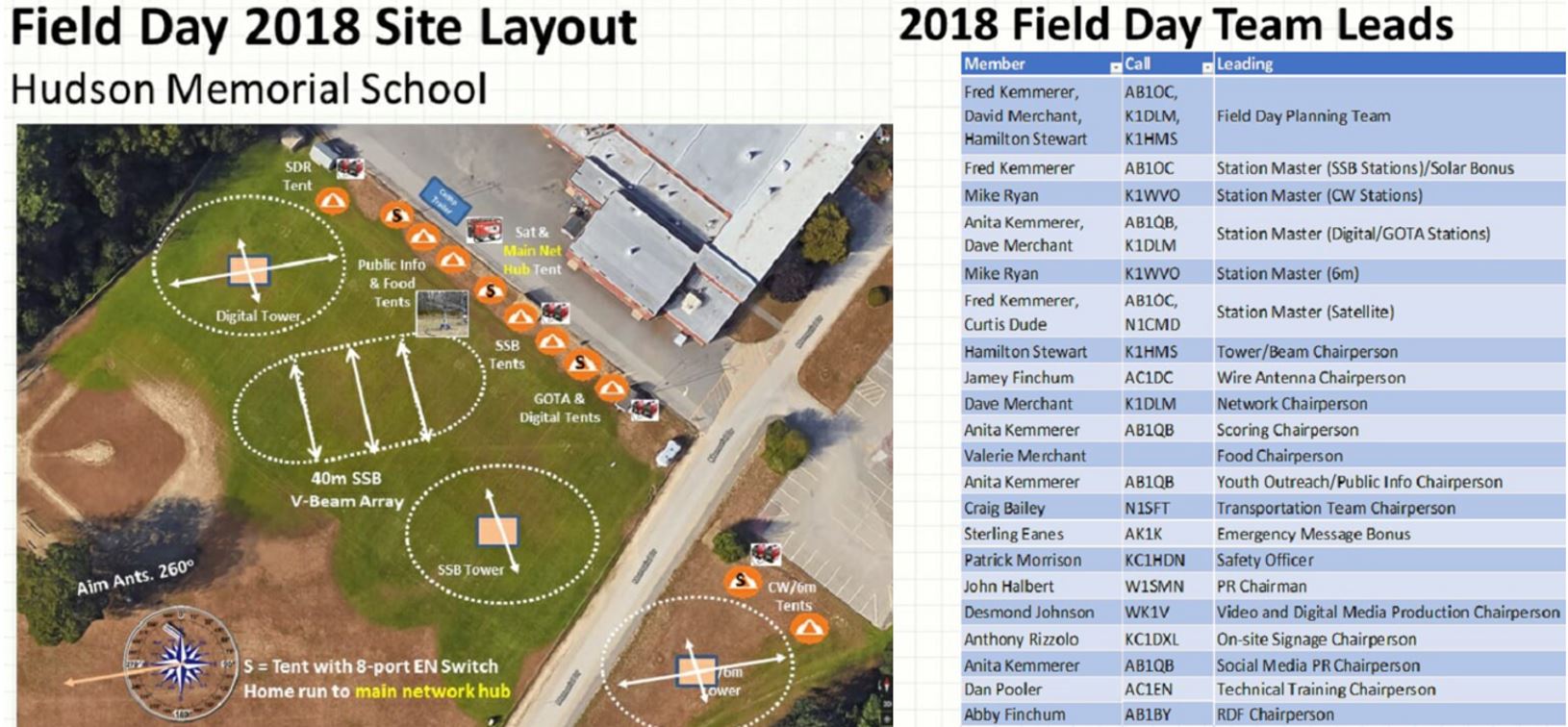
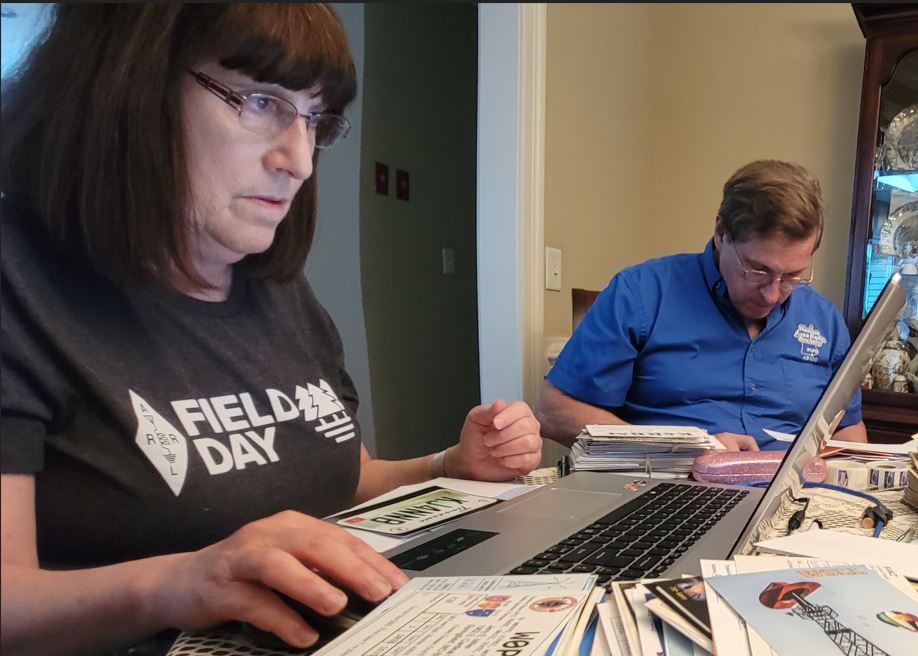
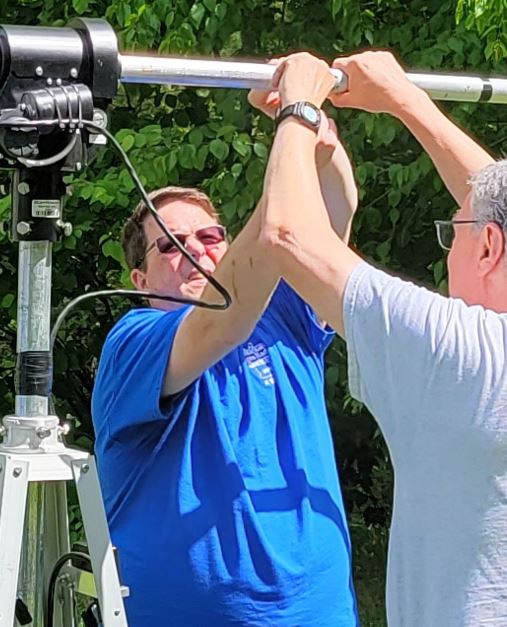
At the same time, the club was getting ready for Field Day 2018 and 13 Colonies.  As a new member of the club and living 30 miles away, I hadn’t been involved with working on club projects and events by then.  I went to visit Field Day to see what was going on and spent a few hours there with the club checking out the setup and taking pictures.  The club had 10+ stations, 3 towers, and a 40-meter V-Beam and made over 2000 contacts.  I had no idea of the scope of this event or how much planning and work was involved in it.

Field Day 2018 and Team Leads

Wow, once I saw this and had some time to think about it, I decided I wanted to be a part of it next year and also to join in on other projects and events with the club.  It turns out I didn’t have long to wait.

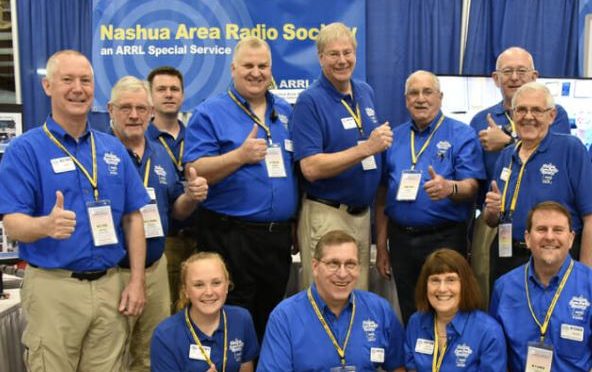
I want to take a moment here to point out something about NARS, it is a primary goal of the club to give anyone who is interested in participating in any club activity the opportunity and support to help make that happen.  Some organizations are so competitive that newbies are rarely allowed to have access to operate in special events or otherwise participate in the planning and setup of other club projects.  I found out that Nashua Area Radio Society makes a deliberate effort to include all, especially new hams, or hams inexperienced with a particular technology in whatever activity is underway.

13 Colonies 2018

13 Colonies is a special event each year during the week of the 4th of July.  This is an extremely popular event for hams around the world. In 2017 NARS was the top club and made NH the top state in the event, beating the next state, PA, by only 5 contacts!  Only a few minutes of operating time over a 7-day event made the difference!  An overly competitive club might want to restrict access to new or unproven operators to try and maximize the chances of repeating the win again.  NARS’ philosophy was to bring as many members as interested in participating into the action and give them a chance to experience the event (and hobby) at the highest level.

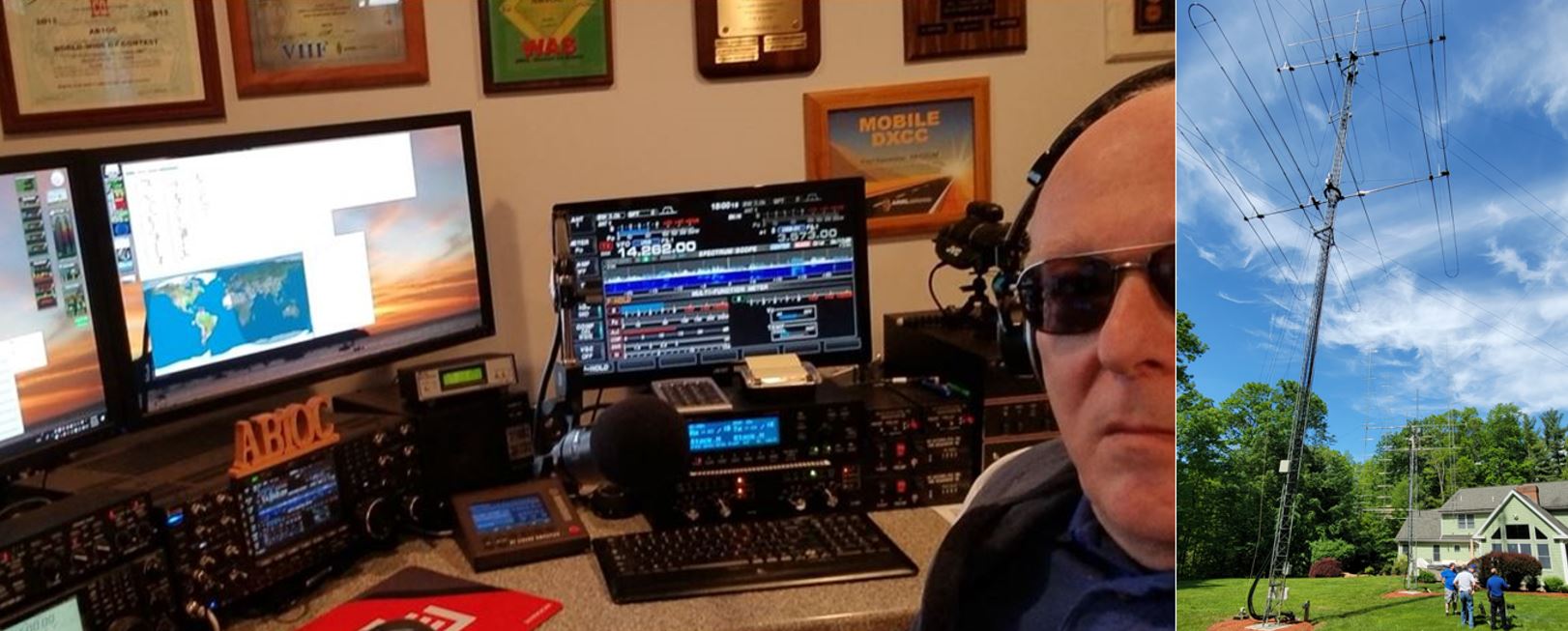
AC1EV at AB1OC-AB1QB Station

With only 2 months experience operating on HF SSB I had a chance to operate at the club’s president Fred (AB1OC) and wife Anita’s (AB1QB) world class station.

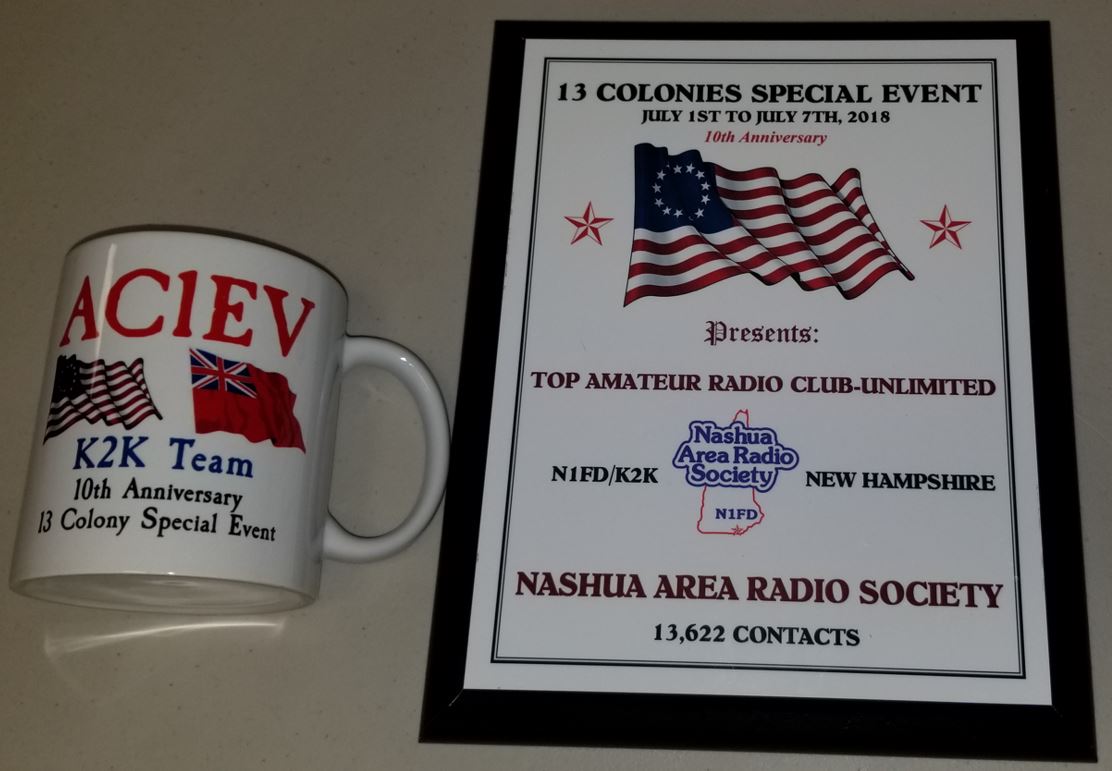
K2K Mug and Award
K2K Mug and Award

I was not just given a chance to operate, but to be included on the team of operators.  I made a meaningful contribution to the club’s effort in the event.  In July 2018 I had my Amateur Extra license for around 2 ½ months. According to QRZ.com, I had less than 250 QSOs in my log.  Presently, I have 10,990 QSOs in my log.  There are many more stories to tell about how I got here from there.  This is just the beginning; I will continue my story in future posts.

Jon, AC1EV

2022 NARS Executive Committee Spotlight

Jon Turner (AC1EV) – President

Jon AC1EV
Jon AC1EV

“Here is AC1EV.  My name is Jon.”  I started saying this back in February of 2018 and have said it almost 11,000 times since then.  I self-studied and passed my Technician exam in February 2018 and self-studied and passed my General exam in March 2018.  I was in the middle of self-study for my Extra when I had a chance meeting with Charlie, a member of the Nashua Area Radio Society, at HRO in Salem, NH.  As we talked and discussed ham radio, I mentioned my study efforts and he said, “My club has a boot camp for Extra next weekend” Well, I knew what I was going to be doing that weekend, so I contacted Anita and joined the class.  Friday, Saturday and Sunday and at the end of Sunday I passed the exam and was an Amateur Extra.  The club gives a year’s free membership to people who pass their exams with them, and I was so impressed with the whole operation that I joined.  I live in Tewksbury, so attending meetings meant a 30-mile ride, each way, but It was completely worth it.  Within months I saw the club’s field day operation and was able to operate in 13 Colonies.  Both events were very exciting.  I quickly saw that NARS had lots to offer new hams and had the philosophy that if you wanted to participate, they would not only let you but would actively assist in helping make it happen.

From that quick start I had a chance to be engaged at all levels with many club activities, write for the newsletter and website and even help Fred with getting students to contact the ISS.  A little over two years ago the club secretary moved away from the area and created an opening on the NARS Executive Committee.  Fred asked me if I would be interested in the position, and I was.  Last year I was elected again as Secretary and have enjoyed working with the leadership team to help make NARS what it is today.  This year, with Fred becoming the ARRL New England Division Director, there was an opening on the Executive Committee for President.  I think I declined the role 2 or 3 times.  Still, I knew that it was an important thing to do and eventually with much discussion with my wife Stephanie, I decided to go for it.

In my time in the club, prior to being elected President, we’ve trained many dozens of new hams, helped more dozens of hams upgrade their licenses, finished with top scores in Field Day, 13 Colonies and other operating activities, and were selected as the Dayton Hamvention 2019 Club of the Year.  (Just to name a few) BTW, NARS was on the cover of the ARRL flagship magazine twice in the past year and a half.  My immediate goal is to help the club to continue to do those things that made the above possible.  Next, I want to become fluent with the club’s operations so I can take advantage of any new opportunities to help grow our membership and help our members grow in the hobby.  Above all, I want to keep the spirit of the club that welcomes anyone with interest and desire to participate in any activity at the highest level they can.

I’ve asked each of the EC members to put together a few sentences about themselves to help you get to know them a little better.  We have two new members this year and some of us old hands have new roles.  Fred becomes our new Programs Chair; Lee is our new Treasurer and Peter is our new Secretary.  I moved from Secretary to President.  Jamey remains our Vice President, Anita remains the Membership Chair and Jim remains our Activities Chair.  Thanks to all the members of the EC for their hard work and support of the club.  Here are some of their thoughts.

Jamey Finchum (AC1DC) – Vice President

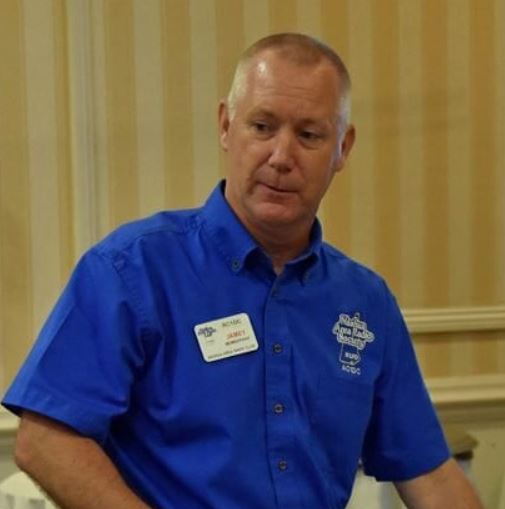
Jamey AC1DC
Jamey AC1DC

I was first licensed in 2015 through the NARS classes that I found while doing a web search. I wasn’t sure of all that was involved in amateur radio, but really enjoyed the class and was convinced to take the general course the following month. I’m not sure why, but during one of our breaks Fred (AB1OC) had a station set up and we were hearing someone talking from Cuba. It blew me away that we could be hearing someone from as far away as Cuba from a radio set up in a break room attached to an antenna on a truck! I have been hooked ever since!

I enjoy contesting, portable, and mobile operations and I’m always learning something new. I am looking forward to the new year with the club and hopefully having some in-person events with SOTAs, POTAs and other activities.

Lee Duval (KC1GKJ) – Treasurer

Lee KC1GKJ
Lee KC1GKJ

I received my technician license in 2016 through the Nashua Area Radio Society around that time I also became a member of ARES. This spring I started looking through the website for NARS and was impressed by all the training information available and decided to join and go to field day. Field Day was a great experience. Everyone was very welcoming, and I was able to learn all about new things available to amateur ham radios. I was thrilled to participate in K2K and learn about contesting and digital modes and this of course led to my desire to become a General and set up an HF station. After getting advice from some members, I have set up my station with an ICOM 7300 and a Buckmaster dipole. With the help of Fred, I was able to set up my digital side to be able to do FT-8. In December I upgraded to my General and have loved being able to use the extra frequencies and both SSB rag chewing all over the world and making digital contacts in places I have never even heard of!

Talking with Fred and Anita one day we were talking about the treasurer’s position, and I asked him if he knew I was in banking for 14 years? They did not but this let me to becoming the Treasurer. I look forward to being your treasurer. All reports are reviewed and approved by the Executive committee and audited. If anyone has any questions, please feel free to email me at [email protected] along with a phone number and I will be glad to call you back and answer any questions you have.

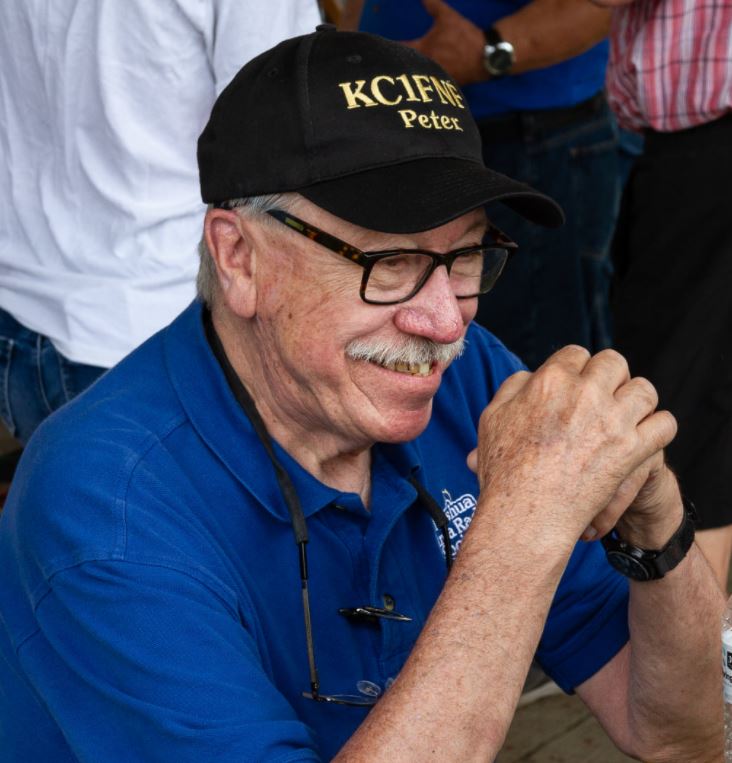
Peter Wolczko (KC1FNF) – Secretary

Peter KC1FNF
Peter KC1FNF

I joined Nashua Area Radio Society in March of 2019 with a very warm welcome.  At the time I had been a Ham for about 3 years with a General License.  In April of 2019, I studied for the Amateur Extra license and attended the 3-day Extra Class training at Fred and Anita’s home, where there were several instructors teaching with a broad knowledge of Amateur Radio topics.  I really enjoyed the class.  I passed and received my Amateur license.  I am very honored to have been nominated and elected to the position as Secretary of the Nashua Area Radio Society.

Fred Kemmerer (AB1OC) – Programs Chair

Fred AB1OC
Fred AB1OC

2021 was a busy year for the Nashua Area Radio Society. Our licensing and new ham development programs were all online. We held a total of 7 license classes and two Ham Bootcamp sessions. We held our first post-COVID in-person Field Day in June. The turnout was great, and it was nice for folks to be together in person doing Amateur Radio again. NARS also returned to HamXposition with our Ham Radio Display in 2021. We also had the opportunity to teach classes about Amateur Radio in a local middle school and I was involved in helping five schools to make contacts with astronauts on the International Space Station via Amateur Radio. NARS partnered with Bishop-Guertin HS to help them make their contact. I also helped a school in Maine prepare for their contact and I served as the ARISS ground station for contacts with groups in Arizona, Canada, and Ohio. ARISS activity is continuing into 2022 with work to help Sussex County Charter school in New Jersey to make their contact early in February 2022 and I will be serving as the ground station for a Scout group in Australia who will make their contact on Tuesday, January 4th. The second half of 2021 began a new chapter in my Amateur Radio experience with a successful campaign to become the ARRL New England Division Director. I am looking forward to this new role which begins today. I will also begin serving as NARS program chairperson in 2022 and I am looking forward to this new role as well.

It would be impossible for NARS to accomplish all these things and more without the dedication of many member volunteers. Giving back to Amateur Radio the way we do at NARS is a model for the entire Amateur Radio community. I want to personally thank all of the folks at NARS who contributed to our many projects – Licensing, Bootcamp, Field Day, ARISS, Classroom work, HamXpositon, and other projects. You all make NARS what it is – one of the best Amateur Radio Clubs on the planet. Happy New Year as we look forward to 2022.

Anita Kemmerer (AB1QB) – Membership Chair

Anita AB1QB
Anita AB1QB

As membership chairperson for the Nashua Area Radio Society and coordinator of our licensing and new ham development programs, I would like to thank all of our volunteer instructors, volunteer examiners, and Bootcamp instructors for helping us in 2021 to continue our mission of bringing new hams into amateur radio and helping them to get on the air.  Through our online classes we helped 72 people get a new license or upgrade and helped over 600 hams or prospective hams get on the air via our spring and fall Ham Bootcamp.

I would also like to welcome all the new members who have joined us this year.  In 2021, we had 79 new regular members and 101 new internet subscribers join the Nashua Area Radio Society.  I would like to thank all our volunteers for making the Nashua Area Radio Society one of the best clubs in New England and I am looking forward to an even better 2022!

Jim Lajoie (K1BRM) Activities Chair

Jim K1BRM
Jim K1BRM

Jim was elected to the role of Activities Chair in the 2019 club elections.  He has been busy arranging activities such as SOTAs and POTAs along with monthly club breakfasts.  The weekly repeater net and HF chat nets are also among the activities Jim helps to manage.  We look forward to more activities as conditions allow.

Jon, AC1EV

Radio Amateurs Developing Skills Worldwide