Category Archives: On The Air

Articles and other information related to On The Air Operations, Special Events, Activations, DXxpeditions, Portable and Mobile On The Air Activities, Nets, etc.

Making Contacts Through LEO Satellites

I’ve been having a lot of fun this past week learning to operate using satellites. It is amazing how many LEO satellites are operational right now!
LEO Satellites - Antennas
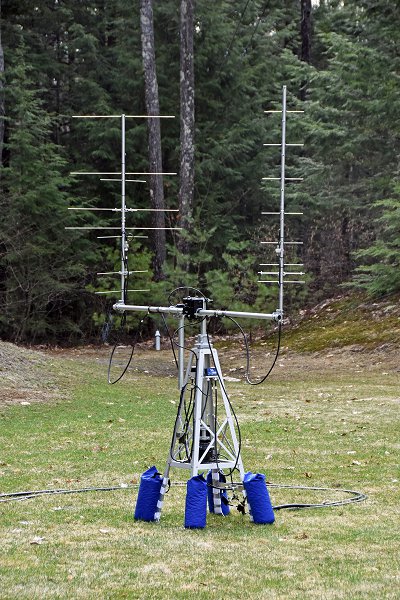
Satellite Antennas

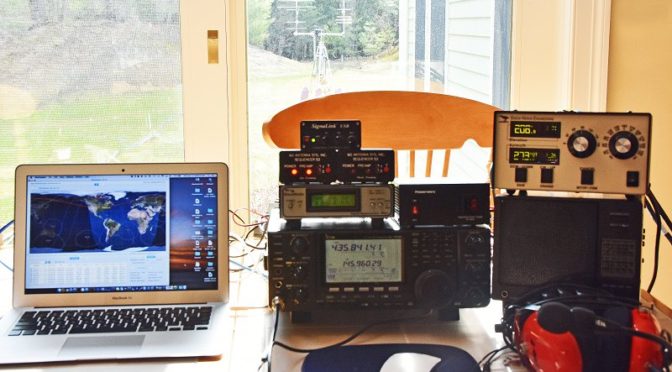
We built an improved portable LEO satellite station a little while back and used it for the first time during a Technician License Class that we taught earlier this spring.

We decided to set up the station in our back yard about a week ago. The idea was to spend some more time learning to operate the station and to improve our satellite operating skills.

The past week has been a productive one. Here are some stats for our satellite operations during the last 7 days –

  • Contacts Made: 78
  • Modes Used: SSB Phone, FM Phone, CW and Packet (APRS FM)
  • Satellites Worked – 9 Total plus the ISS: AO-7, AO-85, ARISS (International Space Station), FO-29, SO-50, XW-2A, XW-2B, XW-2C, XW-2D, and XW-2F
  • States Worked: 23
  • Grids Worked: 49

The week began with a visit from Curtis, N1CMD who has quite a bit of experience with Digital Packet operation via the digipeater on the ISS. After some experimentation, Curtis helped me to find a setup using a SignaLink Sound Card and a second, windows computer that works well for Packet QSOs. I tested the setup using the terrestrial APRS network to get all of the hardware and software working correctly. The combination was then used to make a first packet contact using the ISS.

Operational LEO Satellites

The LEO satellites which are currently operational support a mix of split band modes. All of the satellites that we’ve worked so far use either 2M/70cm or 70cm/2M up and downlinks. The satellites support a variety of operating modes including via single channel FM, linear transponders, and APRS packet systems. Operating skills such as proper adjustment of up and downlink frequencies, Tx power management and setup of the digital packet system have been at least partially mastered this past week.

There are a great bunch of folks who are regulars on the satellites and we have made some new friends in our short time operating through satellites. The single channel FM satellites are usually too busy to support rag-chewing. The linear transponder satellites (there are many of these) support several conversations at the same time and we have had some nice rag-chew sessions on these birds.

There is also a good bit of DX to be had via satellites. This past week we have worked Patrick, FJ/N2IEN in Saint Barthelemy; Chris, 9Y4D in Trinidad and Tobago; Burt, FG8OJ in Guadeloupe; Fausto, HC9VF in Ecuador; and several stations in Canada.

We are planning to set up our portable satellite station at Field Day this year. Curtis will be the main operator/station master for our satellite station. If you are interested in learning more about satellite operations, please let Curtis or I know and we’ll help you to learn more during Field Day 2017.

Fred, AB1OC
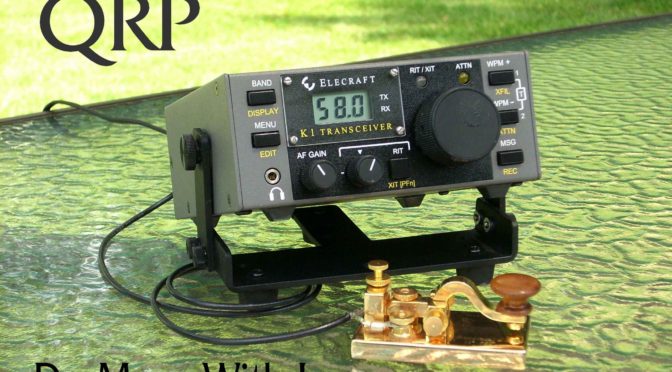
QRP on the AIR… from K-ONE Last Good Question

By Dennis Marandos – K1LGQ

What a difference 90 days can make! It wasn’t that long ago we were looking out our windows and pleading with the snow gods to give us a break, and finally, our cries were heard. The temperatures, the blue skies, the winds have all been recently favorable and we can’t even remember what it was like with four-foot levels of bleached, hard bursts, hoar frosts in our front yards and drifts even higher. Well, we would much prefer to forget last winter than try to remember forging paths to the house garage, the grocery stores, to work or simply just getting our mail in the front yard–but look at it now. The sun is higher in the sky, the temps are thirty to forty degrees warmer than before, and the winds have shifted, a bit, for us to say “We’re in pig (HAM) heaven!”  What does all this lead up to you say? It is nature calling us to get out of the stale-air shack and into our “get-off-our-fanny” modes…including hiking, camping, biking and just plan QRP along the mountain paths. Yes, it’s the call of the CONTINUOUS WAVE!

Dennis K1LGQ, Mr. QRP
Dennis K1LGQ

I have been waiting all winter for the warmer spring months so I could pack my QRP gear into my knapsack, charge up the ole gel-cell and retune my throw-up dipoles to GET ON THE AIR. I have a small 7-amp gel-cell which is pretty much all anyone needs and thin, copper wire to fling onto the nearest tree limb to get the RF into the ionosphere. A quick and grubby antenna tuner will certainly do the job plus its pocket size which means not a lot of space occupied in the QRP bag. Overall, it’s pretty easy and if you’re thinking you have to do a lot to visit Mother Nature’s playground in her best, you’re wrong. Outdoor operating is now easier than it has ever been, and I am going to tell you why.

First off, operating QRP means you take the least favorable weight, carry less with you, and enjoy what you have. Five watts, or less, is pretty slim-pickings and to throw an antenna into a tree is the least of your hardships, but getting outside into the woods, the parks, the BACK YARD is going to be your toughest struggle. Where can I go? Who can I go with? How much gear do I need? Do I need to bring food, coffee, or snacks where I am headed? OH COME ON! We’re talking simply getting outside and into the sun and on the air!

I have built over two dozen QRP transceivers and perhaps as many antennas as well for the trickiest trees around. What you need is simply a low power rig that can be easily driven by six or eight double-AA batteries, or even a Lithium alone will get you on the air and you’re in attendance. Have you checked the pages of CQ magazine or QST to see who is selling QRP transceivers? Or better and easier, ‘Goggle’ QRP kits on your computer and you’ll find a utopia in front of you. Come on, the longer, brighter, sunshine days are here and you need to get moving before that cool breeze from the north comes visiting again. Not to worry, it’ll be a while, so warm up the soldering iron and burn some rosin. Just target the “al fresco” rig and get moving. By the way, bring your key, paper, and chronographic meter as well.

What does it take to get you moving? Okay, let’s suppose someone offered you fifty dollars to join him on a hike. Now, you’re outdoors and you’re loving it. Well, tell yourself that simply taking your gear to the woods is worth more than fifty dollars and look how much you saved. Think of mind relaxing thoughts, soothing, refreshing sunshine and the thrill of working QSOs anywhere someone can hear you. Now—doesn’t this bring a little excitement to your hard pressed schedule? YES, IT DOES! Now get moving…!

CQ WW WPX Contest

This past weekend Abby, AB1BY and I participated in the CQ WPX contest working mobile!  My mobile set up consists of the Icom IC-7100 and various hamsticks We took part only to have fun and to increase our totals towards our DXCC and we did both! We totaled right around 50 contacts for the weekend which we thought was really good seeing that we only worked when we had to go somewhere in the car and I was at work all day on Sunday.

This was a great contest for us as many of the big stations were out and not only do they put out a great signal, for the most part, they hear very good as well! We were actually able to work 20 meters the whole time and we were on late on Friday night and still making good contacts. I would encourage anyone that is new or has a young ham that is showing some interest in the hobby to get involved in one of these contests as a leisurely participant. It’s fairly easy to make contacts and it’s great for DX.

Some of the places we worked:

Ireland, Northern Ireland, Bonaire, Puerto Rico, Cape Verde, Manitoba, France, Germany, Italy, Lithuania, Latvia, Estonia, Netherlands, Venezuela, Spain, Slovak Republic, Russia, Aruba, California and Pepperell, Massachusetts!

Jamey, KC1ENX

Radio Amateurs Developing Skills Worldwide