Category Archives: Newsletter

Nashua Area Radio Society Newsletter Articles. You can find an archive of our Newsletters on our website.

Doing My Hobby At Work: The Saga Continues…

In some recent posts, I wrote about the opportunity I was given to help organize and lead MIT Lincoln Laboratory’s first amateur radio course alongside Jon Schoenberg, AA1FH. The amateur radio course was born out of a desire to try something different that was perhaps more tangential to people’s day jobs than the typical class. The result was way more successful than I could have originally planned for. In essence, the troops were thirsty for more.

At about the time the course was beginning to wrap up, our Technology Office was launching a new initiative called for a Build-Your-Own-X course in which the participants define the X. To give you a bit of background, the Lab has a Build-Your-Own-Radar course that I believe has been going on for close to a decade now. It used to be taught at MIT campus in Cambridge, but has since grown some legs and also moved to the Lab in Lexington as well as in our Beaverworks program to provide a STEM opportunity for high schoolers. The course has steadily evolved from acquiring lumped circuit parts piecemeal from distributors to supposedly having it’s own SKU from Digikey. (Looking around, however, I can’t find it, so when I do, I’ll update this post.)

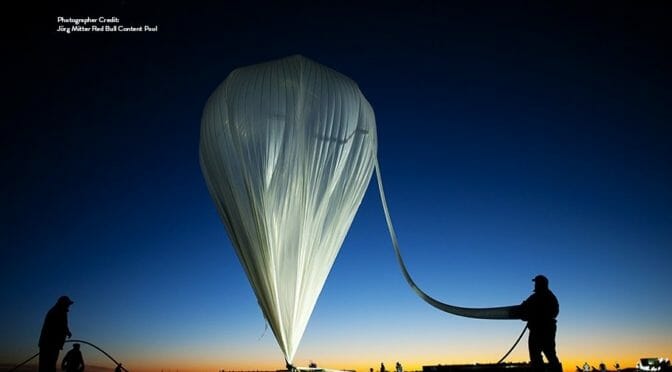
Our Technology Office wanted to reproduce the radar course’s success with another class, so I pitched an idea about a High-Altitude Balloon Carrying Amateur Radio (HABCAR). The wrinkle for this project is that it would attempt to build a global circumnavigating balloon (like many hams have already done — you can read about it from QRPLabs) which would carry diverse sensor payloads. For instance, ionospheric sounding data is notoriously difficult to collect over the ocean. These little gems would definitely do the trick. And, having a WSPR transmitter available (also from QRPLabs), would allow us to radio down our telemetry and other associated sensor data. One could even imagine sending down SSTV images which are captured by small lightweight cameras compatible with Raspberry Pis. There are of course many fun technical challenges, but I work with a small army of smart folks, so we can figure it out!

I ended up again enlisting Jon Schoenberg’s (AA1FH) help as well as Dave Cipolle (W1SZ). Some of you may know Dave from the VHF contests twice a year on Mt. Greylock. He’s the no-fear fellow who’s climbing the towers.

After two pitches, we found out today that our project has received $50K of funding to develop a working prototype and preliminary class materials to be delivered by the end of August 2019! To say I am thrilled would be an understatement! I hope once many of the details are ironed out, this is something I can help out with the club’s already successful HAB program.

If you’ve been following my posts about this, I am really looking forward to updating you all with the progress. Besides, blogging about it is a good way to document the entire process. And, as I have said a few times on the site, it’s pretty damn hard to play radio at home when you have a baby. So, I feel fortunate to be in the position I am at work.

Thanks for reading, and stay tuned for some updates!

73,

Brian, AB1ZO
February 2019 Contest Notes

We’re about a month into winter and there’s no better time than now to get on the low bands. February brings a few QSO parties that are worth noting, and you’ll be glad those low bands are available.

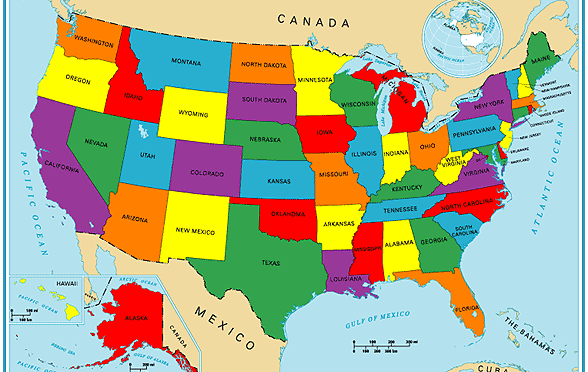
The Vermont QSO party [0000Z, Feb 2 to 2400Z, Feb 3] gives us a chance to put those close-in neighbors in the log. If you’re working on your Worked All States award this is a great time to ensure you have VT in the log. Exchange: RS(T) + County (for VT), and RS(T) + state for others.

Minnesota has their QSO party [1400Z-2400Z, Feb 2]. It only lasts ten hours so this is a good contest for people new to the game to see if they can do the whole shebang! Exchange: Name + county (MN), name + state for others.

ARRL School Club Roundup [1300Z, Feb 11 to 2359Z, Feb 15] gives you a chance to works some youngsters. You don’t have to Elmer kids to make a difference. Just work them in a contest to encourage them! Exchange: RS(T) + class (I/C/S) + state.

The North Carolina QSO party [1500Z, Feb 24 to 0059Z, Feb 25] should provide a target-rich environment. Again, this is a short contest (just ten hours) so pay attention. Exchange: County (NC), state (others).

February is also a great month to do digital modes. Here are some contests for those enthusiasts:

Go to the Contest Calendar to see the full list of contests this month.

Remember to always read the rules before entering the contest. Know the time boundaries, power limits, and exchange before transmitting.

Contest (not-so) secret of the month: success in contesting is based on BIC (butt-in-chair) time. Challenge yourself to operate for some minimum time and see how well you do. Remember that many contests have multipliers, so your score changes more rapidly as the contest progresses. It can be lots of fun watching your score soar!

Good luck to all and drop me a note at  [email protected] with your 3830 entry. The best scores might get a mention in the March Contesting Notes. 73!

Scott, NE1RD

Satellite Station 4.0 Part 3 – Antenna Integration and Testing

Sometimes we learn from problems and mistakes. We all go through this from time to time. It is part of the learning aspect of Amateur Radio.

Satellite Station Integration

My most recent experience came while integrating our new Satellite Antennas into our station…

Source: Satellite Station 4.0 Part 3 – Antenna Integration and Testing

Our 4.0 Satellite Antenna Array and new our 6 m Yagi are up on the tower and working with our Portable Satellite Station 3.0.

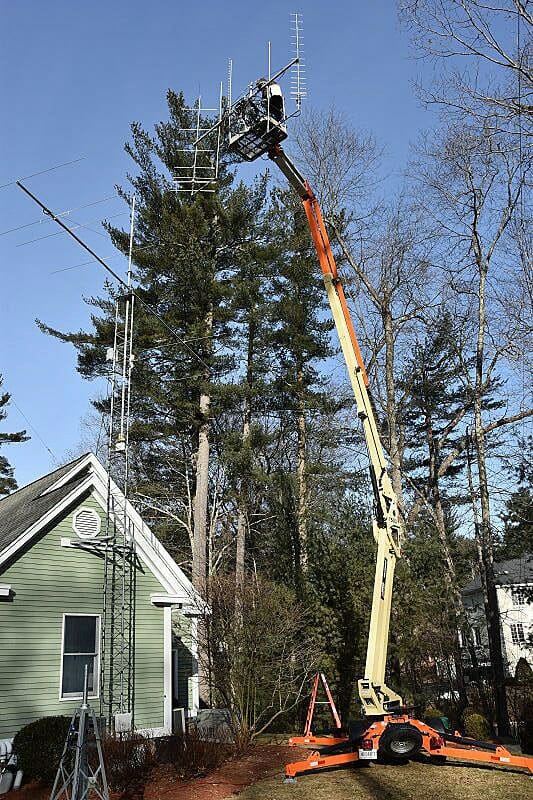
We had some early life problems to work through to get to this stage in our project.  Initial testing revealed a defect in some of the equipment and a wiring error at one of the antennas. We rented a 50 ft Boom Lift to take the antennas back down to correct the problems.

The antennas are back up and all of the controls systems and feed lines are complete and connected to the station. The new station is performing quite well. You can read about the project and the initial performance testing via the link above.

Fred, AB1OC

Radio Amateurs Developing Skills Worldwide