Category Archives: Homebrewing

Articles and other information related to Homebrewing, station building, kit building, and other custom Ham Radio projects.

QRP Antenna Connectors: BNC or RCA?

Which is best for QRP Antenna Connectors: BNC or RCA? I’ve seen both on the web, so I’m trying to decide which connector to use for a QRP antenna.  Maybe you can help me out: Which is the “best” (most common, most useful, works best) for a QRP Antenna Connector: BNC (which stands for “Bayonet Neill-Concelman” according to Wikipedia) or RCA “phono” connectors (they were used for connecting a turntable to an audio amplifier for something like a half a century)?

QRP Antenna Connectors - 50 Ω Female BNC Connectors (Photo by W1AKI)
50 Ω Female BNC Connectors (Photo by W1AKI)

BNC connectors cost more but won’t come loose.  RF cables with BNC connectors seem to be more available.  What I didn’t realize until recently is that they come in both 75 Ω and 50 Ω types.  My picture above seems to be of the 50 Ω type.  Wikipedia has a side-by-side picture comparing the two types.  The commercial version of the Buddipole uses them.

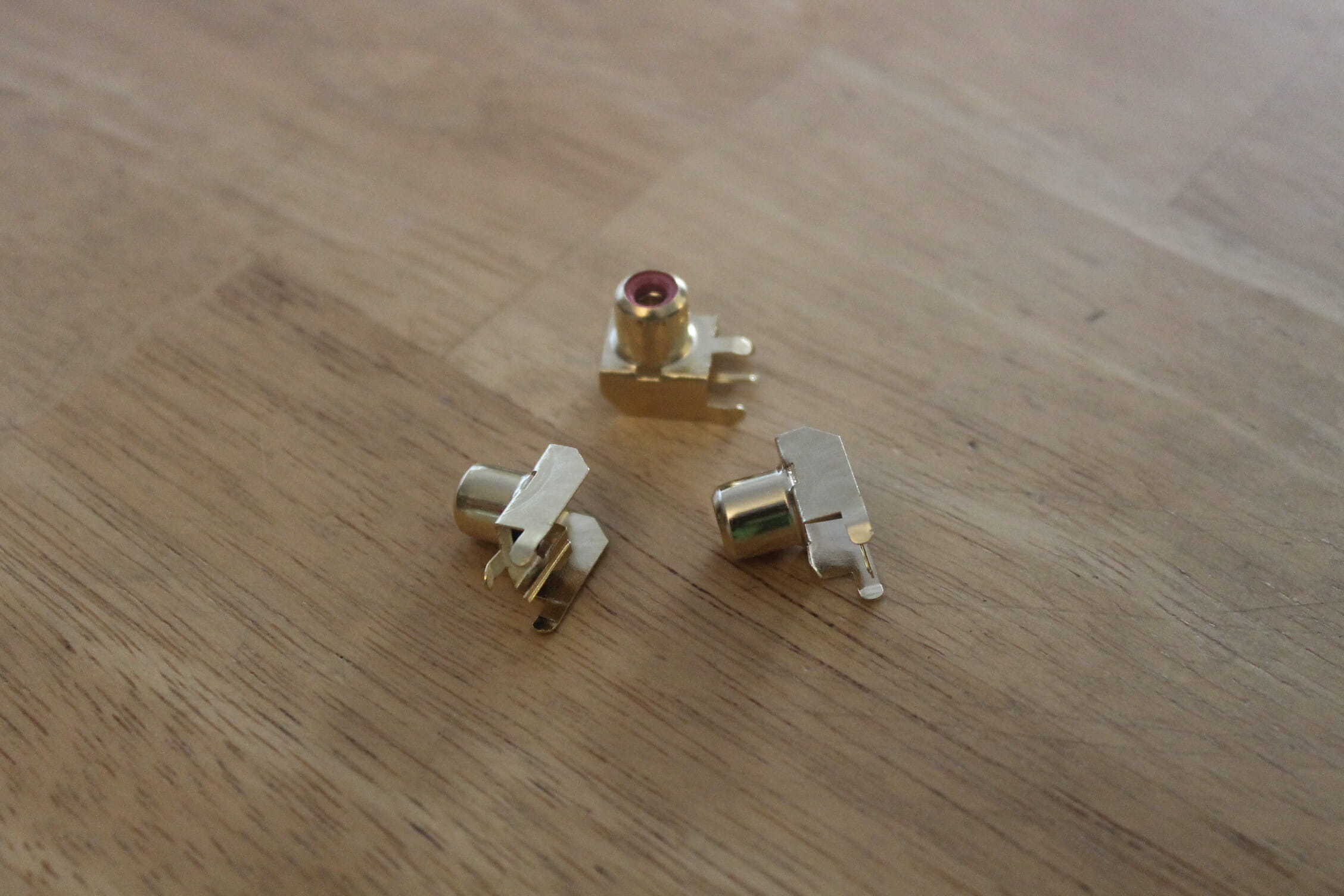
QRP Antenna Connectors - Female RCA Connectors (Photo by W1AKI)
Female RCA Connectors (Photo by W1AKI)

RCA connectors are inexpensive but can become unplugged.  This can be an annoyance if you lose your connection when someone trips over the cable, or it can be a feature in that the antenna won’t get pulled over when someone trips over the cable

(Of course, any cables that are up over the ground, or any guy lines, should be marked with flagging tape — available from any hardware store — to prevent someone from tripping.)

Comments?  Votes?

Thank you.

Aron, W1AKI

Bigshot Slingshot Throwline Launcher for Raising Wire Antennas

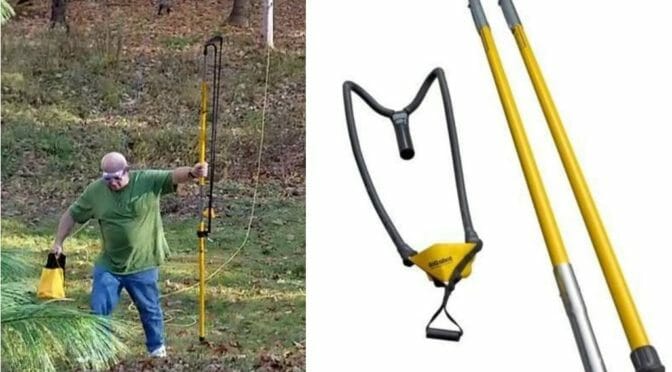
Bigshot Slingshot to launch a line for an antenna

There are several tall trees at my NH QTH and I decided to put an antenna up as high as possible in one of them. I needed a way to accurately put a wire high up into the tree. I read about spud cannons used to launch a line up for an antenna and considered buying or borrowing one for the project. Around this time, I saw a device called a Bigshot Slingshot Throwline Launcher on a TV show about building treehouses and it intrigued me. It is heavy duty and can throw a 10 oz. or 12 oz. weight with a 3/8 inch line attached up 100 feet or more.

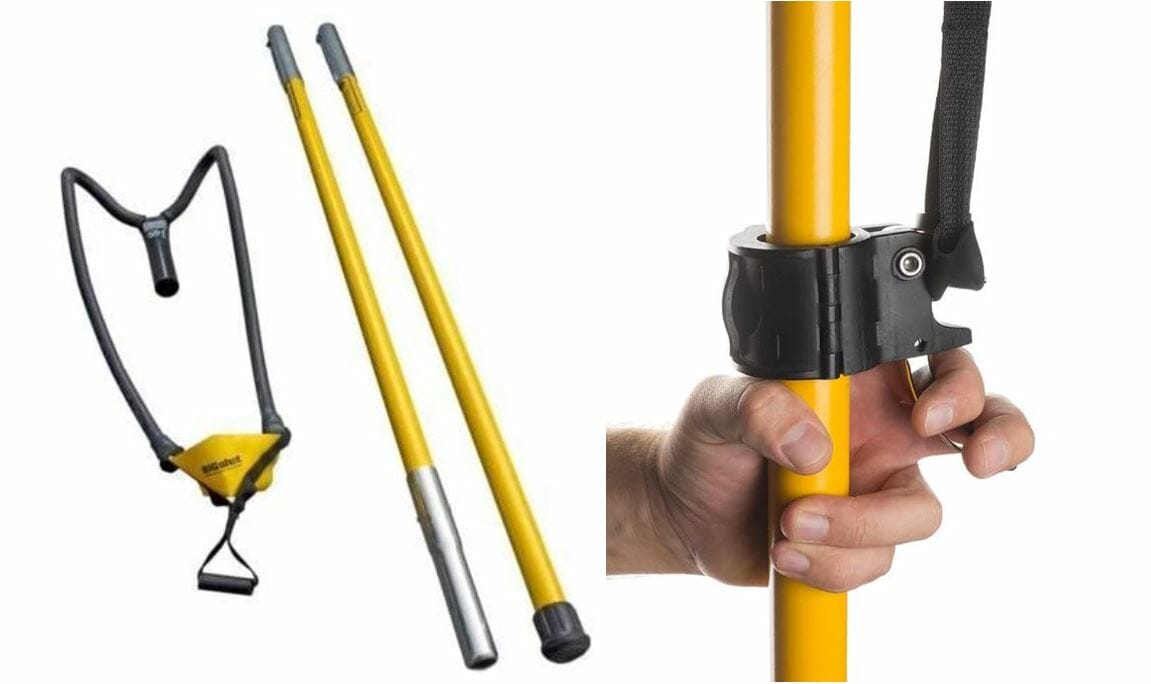
Bigshot Slingshot
Bigshot Line Launcher

I found a deluxe kit on Amazon which contained the slingshot and trigger assembly along with spare elastic bands, throw weights, line, line bag, and carrying case. It is built robustly, to commercial standards and I was eager to try it out. I did a few dry runs and learned that it could easily launch the weight 75 feet up. For more height, set the trigger assembly lower on the pole to stretch the elastics more and launch even higher.

Caution!

An Important Word of Caution Here!! This device is powerful and can cause injury if not used carefully. Read all the instructions, wear eye protection, and like a gun, point it away from anything you do not want to break. I am 6’2” and 275 lbs. when cocking the elastics and straining against their pull this device lifted me from the ground and pulled me off balance with ease. I have a lot of respect for the power it has and you should too.

End Fed Half Wave Antenna at 50 Feet

I previously used this line launcher to install a MyAntennas.com 8010 EFHW antenna in my NH QTH backyard with the endpoint up in a tree 50 feet high. I was happy with the performance there for 6 months until I tried working in the CQ SSB DX WW contest. Before the contest, I logged QSOs on 20 and 40 meters all over the US, South America, Africa, and Europe, along with some 80 meter QSOs out to around 1500 miles. However, during the contest, I had difficulty breaking pileups, so I decided to try and raise the tree end of the antenna.

Preparing to launch the line

Bigshot Slingshot
Old rope in the tree

The line hanging from the tree is what held the antenna at 50 feet. I will tie the line to the throw line when I shoot it up to the higher branch.

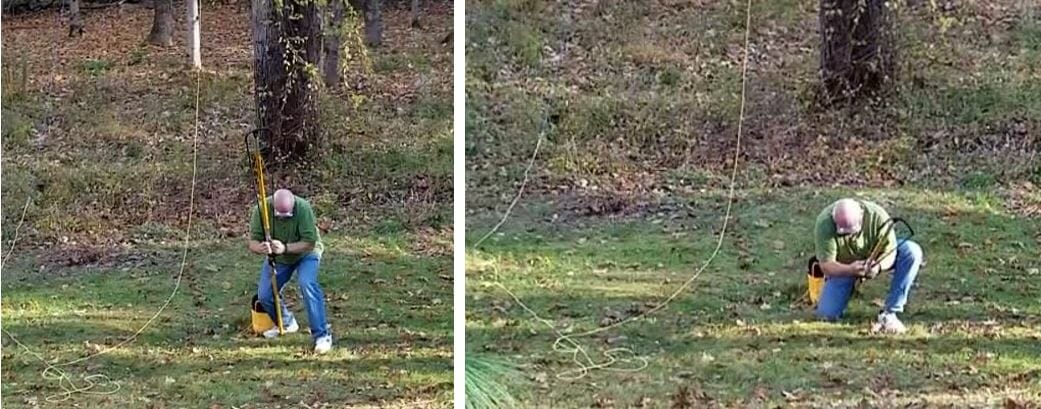
Cocking the catapult

I was trying for maximum height on this launch, so I moved the trigger assembly down on the shaft of the launcher a bit more than usual. It took serious effort to cock the launcher. Note, I am wearing eye protection and pointing the device away from my body.

Launching the line

Bigshot Slingshot
Move to launch position

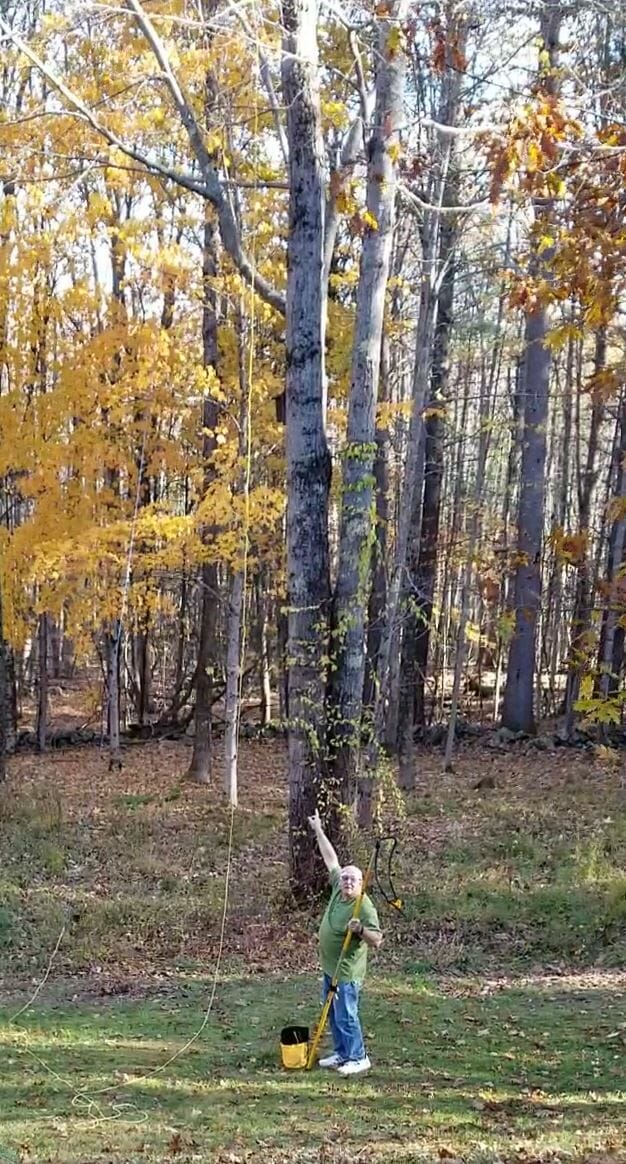
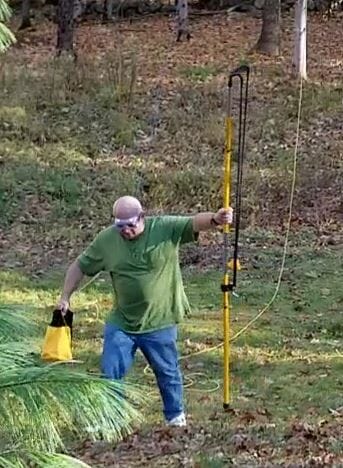
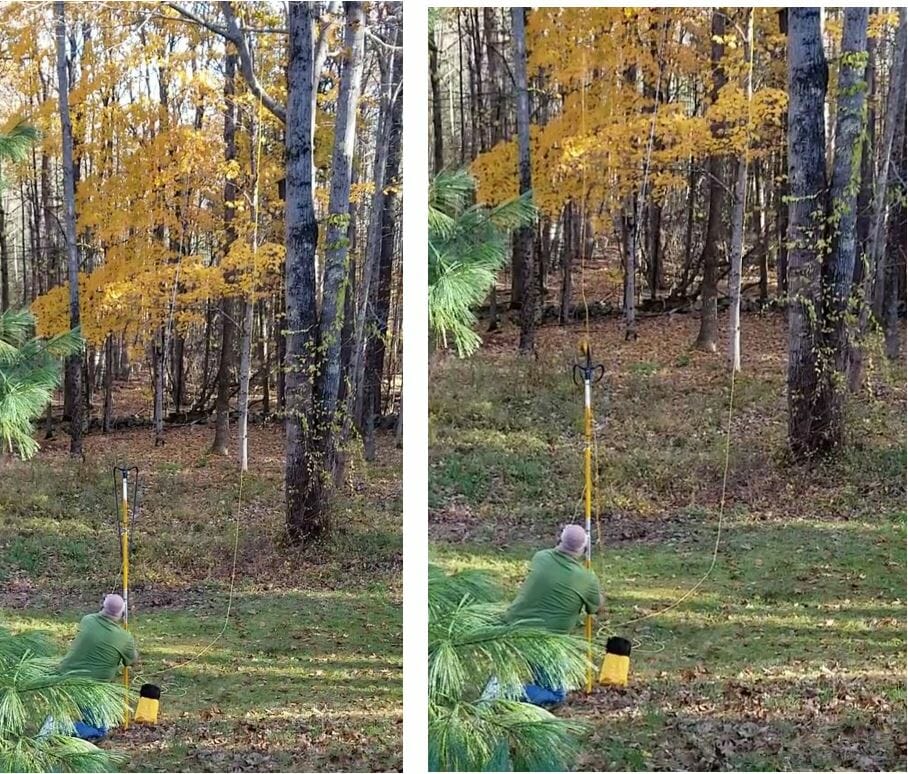
First, you must untangle the throw line before launch. Carefully coil it into the throw bag so it will come out smoothly. The launch should be almost vertical to be able to get the maximum height out of it. Launching at 45 degrees or 60 degrees gets a long distance, but disappointing height. As a result, I think I was launching at 75 or 80 degrees here.

Launching the line
Launching the line

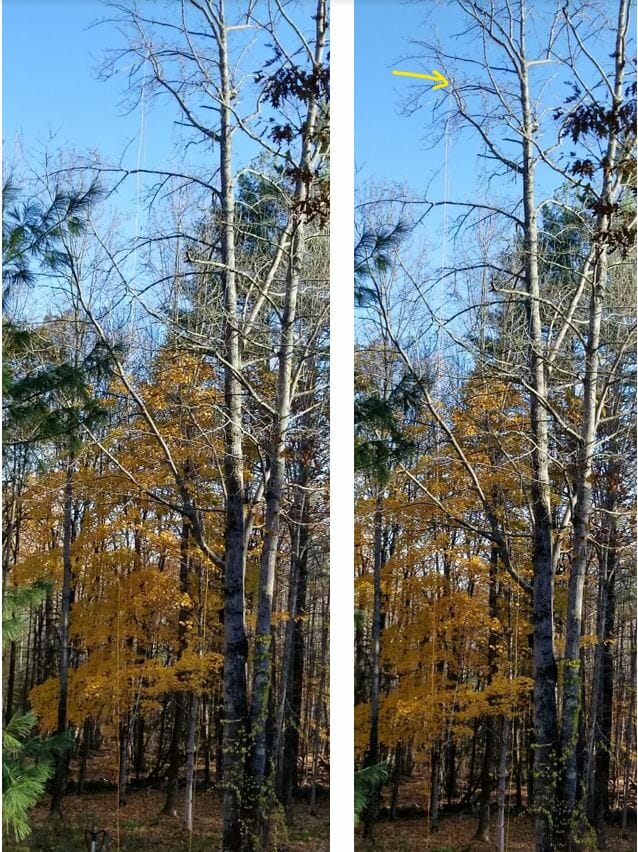
Success, the line is up around 70 feet in the tree

These two pictures fully show the tree to give some scale to how high the end of the antenna is.

Success 70 feet high

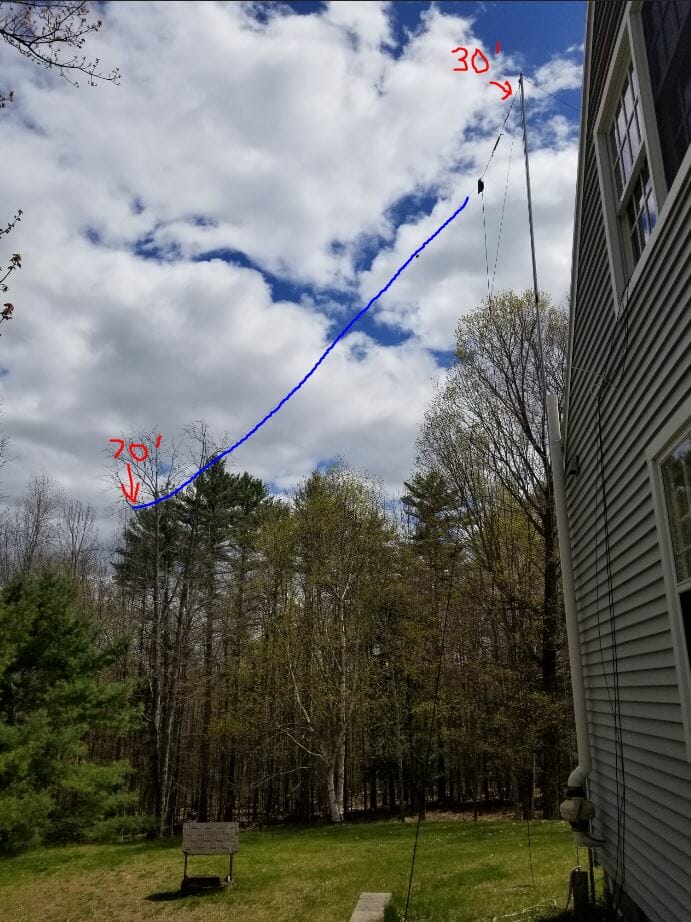
This picture, looking South, shows the antenna feed point around 30 feet high at the house. There are three 10-foot chain link fence top rail sections attached to the corner of the house with a line holding the antenna. From there the ground slopes downhill around twenty feet. The end of the 135-foot wire antenna is hung at seventy feet in the tree. It is running North and South with a little bias to the West.

NH QTH EFHW at 70 feet

Did it work?

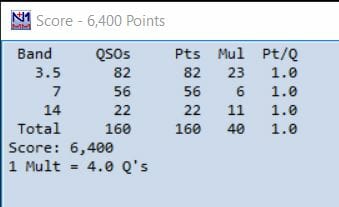
I was eager to find out if it was going to make a noticeable difference in the contest. It did! On the 20 and 40 meter bands I can get through pileups, often on the first or second try. My first QSO on 80 meters was to Ukraine, around 4500 miles away. In the beginning of May, during the NE QSO Party, for instance, I had replies to my CQ on 80 meters with only 100 watts from Italy and Uruguay.  80 meters was my most productive band in the contest.

NEQP 2020 Score Box
NEQP 2020 Score Box

Good for Christmas lights, too!

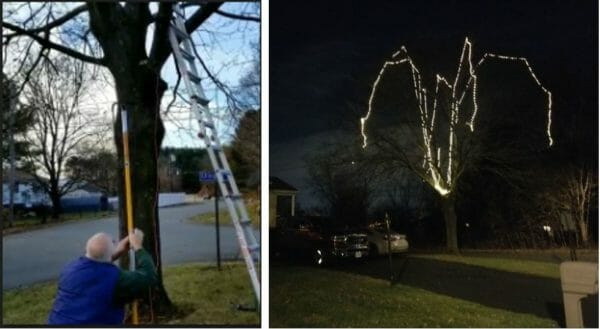
Here is a quick look at the throwline launcher in action. I am sending a line up in a tree to pull up some Christmas lights. Click on the picture to view the video. Each string of lights in the picture on the right represents the arc of the throw-weight and line. The max height in the tree is around 35 feet.

Christmas Lights
Christmas Lights

NARS Winter Field Day 2020

During setup for the Nashua Area Radio Society’s 2020 Winter Field Day the spud launcher, we were using broke after setting up a 40-meter delta loop antenna. We still had to set up the 160 Meter Transmit Antenna. It was a dipole, fed at around 50 feet with each end to be installed around 40 feet high. I made a quick trip home to fetch the throwline launcher. Upon my return it was easy to secure the ends of the dipole up in the trees.

Jon, AC1EV

The Amazing 20m Coil-Shortened “Shower Rod Dipole”.

If you’ve got a few old shower curtain rods hanging around – you can build a low-cost 20m shower rod dipole antenna. Additionally, if you add a tripod, and a matching transformer, and you’ll have a robust field deploy-able antenna. It can also be manually steered for better performance and searching for nulls.

This is the dipole that I used for the ARRL 2019 Field Day and was very happy with its performance. My preference this year was digital modes so I tuned the coils for the magical FT8 14.074 MHz. The original plan diagram is shown in Figure 1 and the coil calculator was used to design the inductors. Anything close to 19-20uH would work for this frequency (14.074 MHz.).

The Plan
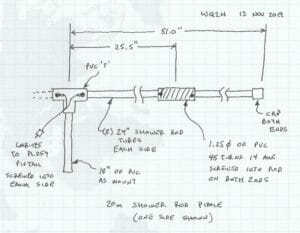
Figure 1 – Mechanical plan

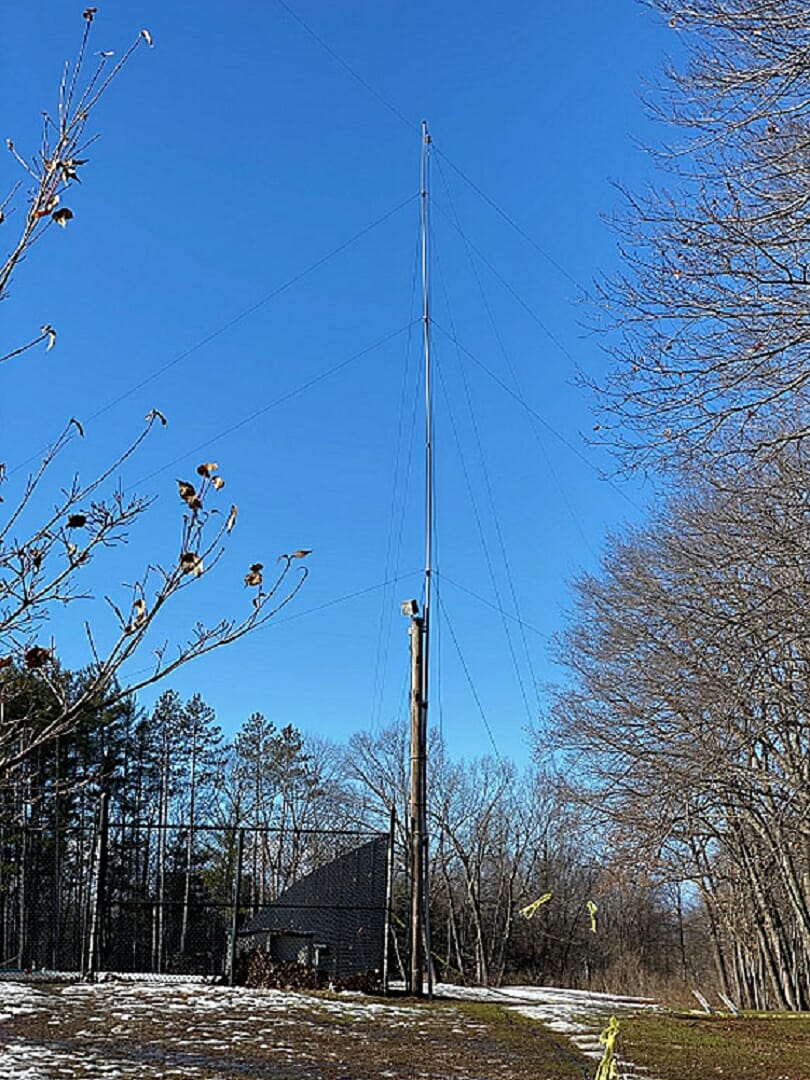
Using a PVC T, about 3 feet of 1.25″OD  PVC pipe, four 24″ aluminum or plated steel shower rod sections, some 14 AWG stranded wire, and a handful of sheet metal screws you really can construct a pretty good dipole for 20m. I tested it mounted on a tripod as shown in Figure 2 and raised to 15-18′. The MFJ-907 transformer, or a torroid assembly similar to the 630m match, will make for an easy match transformer that could be mounted  directly on the “T” section.
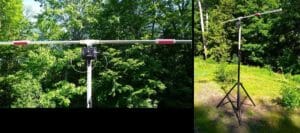
Shower Rod Dipole

Figure 2 – Deployed Dipole on Tripod

On one end of the dipole I attached a short piece of kernmantle (nylon) rope which hung to the ground when the antenna was fully extended. This, and slipping the vertical PVC section over a mast tube, allows for turning the dipole for experimenting with nulls and increased Rx performance.

The Big Day

For the ARRL 2019 Field Day, I operated 1BNH using 5W maximum from near the top of Beech Hill in Dublin, NH. (Grid Square FN32xv) Radio was an FT-991 on battery using the built in ATU. Although the road to the summit was washed out this year from spring flooding, I was able to set up on a pretty good high point along Rt 137 just east of the Zig Zag trailhead.

QSO Results !

With only several hours of operating time out of the back of my Jeep I was able to FT8 QSOs with 13 stations in 6 unique call sign zones. Two of the most distant stations were the Halifax ARC (VE1FO) and the Northeastern Missouri ARC (W0CBL).  Noteworthy is that while limited to only 5 Watts for transmitting, I could clearly hear many more stations (as many as 50) then I could actually QSO with.

Station List:
  1. 2019-06-23         09:48     W0RRC 20m        EN34iv

2. 2019-06-23         09:20     K1HTV   20m       FM18ap

3. 2019-06-23         07:59     W3MIE 20m       EN91vp

4. 2019-06-23         07:48     W4XD   20m        FM08jg

5. 2019-06-23         01:13     VE1FO   20m       FN84ep

6. 2019-06-23         01:11     W0CBL 20m       EN30tl

7. 2019-06-23         01:08     W1QV   20m        FN31xi

8. 2019-06-22         19:43     W4HFH 20m      FM18kt

9. 2019-06-22         19:31     K1BX     20m        FN43ec

10. 2019-06-22         19:25     VA3BIC 20m     FN02jv

11. 2019-06-22         18:39     K3NQT 20m      FN00ra

12. 2019-06-22         18:38     VE3XF   20m     EN94xj

13. 2019-06-22         18:33     VA3OBO 20m   FN03bf

The project turned out a great portable antenna for 20m and the performance will definitely surprise you. A subsequent test at home using 100W on FT8, JT9-1, JT9-2, and WSPR, showed no signs of overpowering the antenna. Finally, if any readers have an interest and/or any other questions about this project feel free to contact me directly: [email protected].

73 – Jim, WQ2H / WK2XAH

References:

ARRL, (2015). The ARRL Antenna Book for Radio Communications, 23th Edition. The American Radio Relay League, Inc. Newington, CT

Electronics Notes (1997). Build an HF Ham Radio Dipole Antenna. Retrieved November 12, 2019 from: https://www.electronics-notes.com/articles/antennas-propagation/dipole-antenna/hf-ham-band-dipole-construction-80-40-20-15-10-meters.php

Andersen, S (2019 July 28). When a Dipole Doesn’t Hang in a Tree. NARS Article. Retrieved on November 12, 2019 from: https://www.n1fd.org/2019/07/28/unusual-dipoles/

Radio Amateurs Developing Skills Worldwide