Category Archives: General

Articles about Amateur Radio and the Nashua Area Radio Society. This is a general category which includes most articles on our website.

NARS Winter Field Day Plans

Brian, W1XMM, has opened up his station for NARS members to operate Winter Field Day  (WFD) on Saturday and Sunday January 27th and 28th so that members can operate WFD with the club callsign, N1FD.  Brian’s station is in a great location, in Antrim, NH and should provide for some great operating.

What is Winter Field Day?

Winter Field Day is an annual event, sponsored by the Winter Field Day Association on the last full weekend in January to encourage development of emergency operating skills.  It is open to frequencies on the HF, VHF and UHF bands.  Here is a summary of the rules. The full rules can be found here.

  • All stations are limited to a maximum of 100 Watts PEP
  • QRP CW limit of 5 watts multiplier of 2
  • QRP Phone limit of 10 watts multiplier of 2
  • Each mode worked on each band counts as 1 multiplier
SteppIR DB18
SteppIR DB18 at W1XMM

W1XMM Station

The following stations and associated bands will be available at W1XMM:

  • SteppIR DB18 40/20/15/10/6m with an Elecraft K3S
  • SteppIR Vertical 80/40/20/15/10/6m with a Yaesu FT991a
  • Log Periodic 50MHz -1.2GHz
  • Inverted V: 80M and 160M (one cable out to both)
Log Periodic Antenna at W1XMM

Great Opportunity for New and Experienced Hams!

This is a great opportunity for newly licensed or inactive amateurs to get some operating experience and a top-notch station.  Brian and other members will be available to coach those who are new to HF and VHF operating.

W1XMM Operating Equipment

Emergency Communications

NARS member Jack Ciaccia, WM0G, who is also the ARRL New England Division Assistant Director for Emergency Communications and Public Service, is encouraging amateurs throughout New England to operate Winter Field Day to developer emergency operating skills.   

We have been challenged by the ARES group to also set up an NVIS antenna and communicate with other ARES operators at set times.  This would be both VHF/UHF and HF.  The ARES is going to use this opportunity to test their communication skills here in New England.

SteppIR Vertical Antenna at W1XMM

Join Us

Interested in joining us for Winter Field Day?  Please sign up by Thursday January 25th at 7:00 pm.  Here’s what you can do:

  • Sign up for operating times – See this Forum Post for the link to the sign-up sheet.
  • Join us on Thursday, January 25th  at 7:00 pm for our final Winter Field Day meeting.  See this Forum Post for the Zoom link.  Or contact Brian at [email protected] to get the details if you cannot make the meeting.
  • Show up at Brian’s QTH in Antrim before your operating slot.


Some Pictures from Winter Field Days Past

Winter Field Days past has been great for NARS over the years. We’ve taken many different approaches to doing it.

Winter Field Days Past
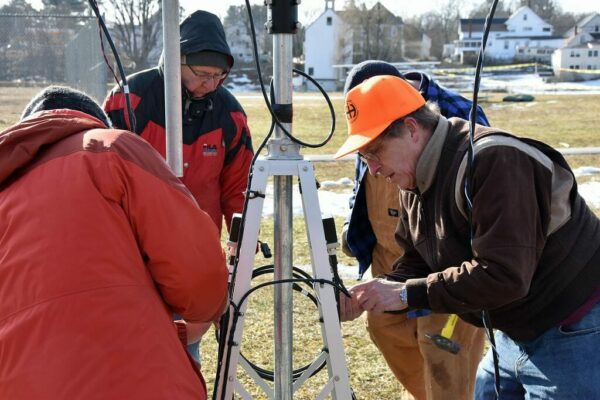
About To Stand Up Out Tower

We’ve used our towers and yagi antennas at many Field Days in the past. Sometimes, it’s been pretty cold and raw when we’ve been putting all of our antenna gear up.

Portable Satellite Ground Station

I really enjoy making contacts using satellites in space and we’ve used some of the satellite ground station equipment that I have as part of several Winter Field Day operations.

Want to learn more about Field Day? Check out our Field Day page. Brian, W1XMM is putting together a Winter Field Day operation for NARS members. You can learn how to join in the fun with Brian and the gang here.

Fred, AB1OC

Truss added to DIY 6m Moxon Antenna

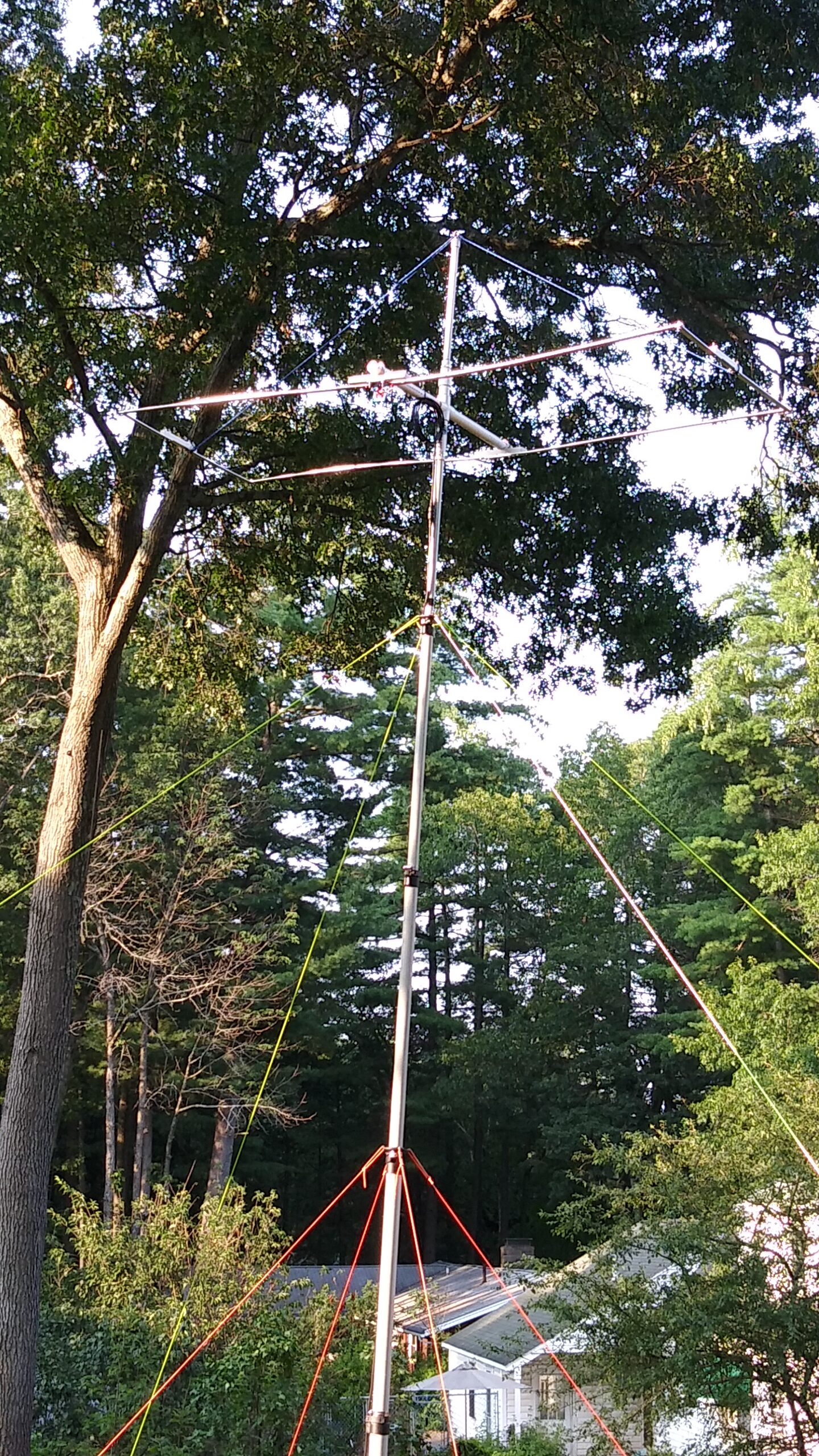
6m Moxon with vertical extension and a rope to each end
6m Moxon with truss and safety-color guy lines

Back on July 17, 2022, I made a post here about building a DIY Moxon antenna for 6m based on plans in the ARRL book Magic Band Antennas for Ham Radio by Bruce Walker N3JO.  It was made of flat aluminum bars instead of round tubing.  The problem with it was that the ends drooped significantly, which reduced the directionality.

I expected this, so I used a cross instead of a ‘T’ in the middle of the boom.  That let me add a vertical extension of PVC pipe in the middle of the boom.   I drilled a hole in the top of a PVC cap, mounted a (stainless steel) eye-bolt in the hole, and put it on top of the extension.  (With the mast lying on the ground, of course.)  Then I was able to tie paracord from the eye-bolt to each end of the antenna as shown in this picture.  I am more concerned about accidents with the lawn mover than stealth in my back yard, so you can see that I used bright safety orange and safety yellow-green paracord for the guy lines.  (In fact, my neighbor, also an engineer, commented that this was a good idea, to prevent tripping.)

I used the “Orange Screw” product mentioned here by others to anchor the guy lines to the ground.  I also used hose clamps, in addition to the mast’s own clamps, to keep the mast from telescoping inward.

It’s important to remember that the only two knots to use with antennas are:

  1. the taut-line hitch and
  2. the bowline knot.

(To help with pronouncing the later, try to remember that it was named for the front end of a boat, where sailors use it.)  These knots were covered in the Tech Night presentations about Field Day.

Aron, W1AKI

Radio Amateurs Developing Skills Worldwide