The FT8 digital mode that Joe, K1JT, and company rolled out a little over a year ago has become a game changer in ham radio. The mode is a modification of the JT9 & JT65 weak-signal modes that have been around for nearly ten years, an eternity in the digital world. These modes, while great for modest stations (read: apartment and condo dwellers; CC&R prisoners; and those with an iron-willed spouse who does not like antennas), suffered from a SLLOOOW exchange cycle. A rapid QSO with a signal report, acknowledgment and 73 might make it in four minutes. FT8 cuts the time to less than half that. The migration to FT8 has left the JT9 & JT65 band segments virtually deserted today.
The burgeoning success of FT8 has led to the development of a DXpedition mode that uses a “fox and the hound” model with the DX being the “fox” and the rest of the world being the “hounds”. The mode enables the DX station to transmit simultaneously in up to five slots at the low end of the FT8 band segment and work hounds operating in the rest of the segment, racking up several hundred QSOs/hour. Still another version is in beta testing that will be used for the RTTY Roundup contest in a couple months. Support for Field Day 2019 is just around the corner.
I’ve found FT8 a great way to keep chasing DX that I just cannot hear on CW let alone SSB. I’ve amassed 1300 QSOs to date and over 140 countries which says a lot with the disappearance of sunspots. All this time watching calls scroll by has given me a chance to observe operating habits good and bad. Good operating is being able to call a DX station off-frequency to increase the probability of being decoded. Bad operating practice is cranking up the power to spill over into another slot and even desense the station you are trying to decode.
Recently, I noticed a strange phenomenon from stations presumably running high power. Signals in FT8 usually have a received level from -2 to -22 dB that is adequate for decoding. Strong signals such as local stations or stations in the first skip zone with levels of 0 to +5 dB obviously are not hard to decode. However, I’ve seen some stations with a received signal level of +4 to +15 dB or more have a second decoded slot with a signal level of -13 dB or lower. Furthermore, this second decoded slot is always 120 Hz below the primary decoded slot.
I first noticed this behavior with a local station. I sent him an email wondering if his sound card went south and he was experiencing some kind of digital splattering. He was surprised that his ICOM 7610 would create a messy signal and insisted that everything checked out OK. A few days later, he sent me an email with a screen capture of another station in The Villages showing the same behavior. This led to the three of us batting around possible causes. Excessive power due to proximity was one possibility in spite of our lack of an aluminum forest. Another suggestion was to try another computer, the thought being that a dated machine would be a bit over-worked at decoding and “bit-draggled” in the presence of strong signals. One fellow switched to a laptop and saw the same thing so nix the computer. The 120 Hz separation made me wonder if power regulation went haywire but then everything in town would have gone south.
One night on 30 meters I logged ten stations that showed these “ghost” decodes. The station locations ranged from IL, IN, KY, PA/NJ and VA based on their grid squares. All of the stations showed a received signal level greater than +4 dB. Another odd thing was the tendency for the ghost decode to occur only during a CQ. When the station was in a QSO, I did not see the ghost. In addition, received levels often fluctuated as much as 12 dB while in a QSO. Like a real ghost, the secondary decode does not consistently appear for any strong station I happen to find.
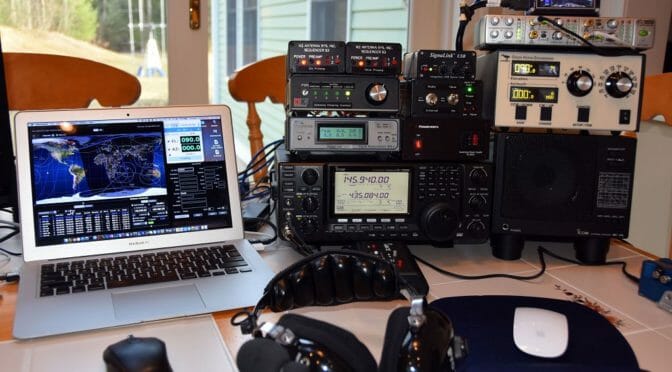
For the record, I have an Elecraft K3 with the K3S synthesizer upgrade. My antenna is a multiband Hygain 6BTV vertical that has a gain of 3 dB over a wet noodle. I set my RF gain around 25% to avoid clipping received signals. Not a hyper-sensitive setup; just your average CC&R station.
Since FT8 is driven by a computer, I decided to subscribe to the WSJT-X reflector to post what I observed and inquire if anyone else had seen the phenomenon. I figured most FT8 users would be far more bit-savvy than I am and might have an idea what is happening. I have not had any bites after several weeks as to what it might be.
As I pondered over this oddity, I came back to the Fox/Hound version of FT8. Each slot that the fox uses is adjacent to the next one. The FT8 software juggles a response to a hound such that the hound is automatically switched to the fox’s transmit slot to complete the QSO. I view it kind of like the carnival kid’s game of fishing for a specific duck in a tub full of rubber ducks circling around. He hooks the duck and pulls it out to try for another one. In a sense, this is similar to the multiple receiver windows that a software-defined radio can implement.
So, where does this leave me? Simple answer: stumped. Therefore, I am inviting those in the NARS community who have experience with FT8 or any of the WSJT-X modes to open up the FT8 program and see if the ghosts appear and look for some common cause.
Disclaimer: Any correlation between occurrences of this phenomenon and October 31 is purely coincidental.
Ed, K2TE