Category Archives: Featured

This category is for featured articles that we want to include in the sidebars and other areas on our website.

Moxons in the Attic (Part 1)

A few months ago, I wrote an article on building a stealth antenna farm. Since I live in the land of CC&Rs, antennas must be “dual use” such as a vertical hidden inside a PVC flagpole, or low dipoles and inverted Vees hidden in trees. I spent many years as an avid contester and DX-chaser to appreciate the logic of stacked beams on towers to enhance the thrill of the hunt. Thanks to Layne, AE1N, I checked out the website of Jeff, AC0C (www.acoc.com) for some ideas of how to build a multi-band station in one’s attic without the condo association vigilantes running him out of town. Jeff spent countless hours crawling around his attic to construct multi-element antennas for 160 through 6 meters. Spurred on by Jeff’s success, I decided to explore the attic of my garage to see what I could do. As I described in the MAY Nashua ARC bulletin, I settled on building Moxon antennas for 15 and 17 meters.

An old adage about antenna building states that an antenna must be built-in lousy weather in order to work right. Thirty years in New Hampshire lent credence to this axiom as I spent many a cold, windy day on a tower doing antenna work. In Florida, a similar law applies: build an antenna in the summer months while sweating profusely rather than during the comfortable winter weather. Again this makes sense: DX and contesting fill up the winter months to have time to mess with antennas. It is also important to remember that, during such endeavors, you will become enamored with you antenna as you take breaks to warm your body (in NH) or drink a gallon of water (in FL), all the while cursing this law of antenna building.

But I’m getting ahead of myself. My garage attic is roughly 20 x 20 feet with an apex of about five feet that runs north-south. I had selected the Moxon design because a conventional 2-element beam would not fit in the space available. I elected to build a Moxon for 15 and 17 meters that would fit in the space available without having to encounter obstacles like the ventilation duct work. I was also fortunate in that my home is one of the older models that do not have foil-backed insulation inside the roof that creates a radiation-proof box. The joists junctions are reinforced with metal plates as part of hurricane building codes. My plan was to attach the wires to the roof trusses and stay away from these plates as much as possible to avoid interaction.

The 17-meter Moxon is a little over seven feet between elements while the 15-meter Moxon is about six feet between elements. I used a piece of half-inch PVC pipe as a template to mark the joists for the 17-meter antenna. The antenna is about 2.5 feet above the attic floor for a total height of eleven feet above the ground. I had modeled it at 13 feet so I figured it would be close enough. The 15-meter Moxon is about 15 inches above the 17-meter one. When viewed from the top, the antennas look like concentric rectangular loops.

Over the course of several weeks, I grunted, groaned and sweated my way back and forth measuring and installing the wires. I worked during the morning hours before I was soaked before 10:00 AM. I found myself wishing I could have my five-year-old grandson help me. He can stand upright and is plenty flexible to maneuver around the joists. While I did not have to worry about the obvious safety issue of working on a tower, I did at times feel I was a candidate for the NFL concussion protocol from bumping my head. I tried using my cycling helmet but it interfered with my headlamp. Another similarity to tower work is that I had to make N trips back and forth in the attic for stuff I forgot. This is, however, much more bearable that climbing up and down a tower to get what I forgot.

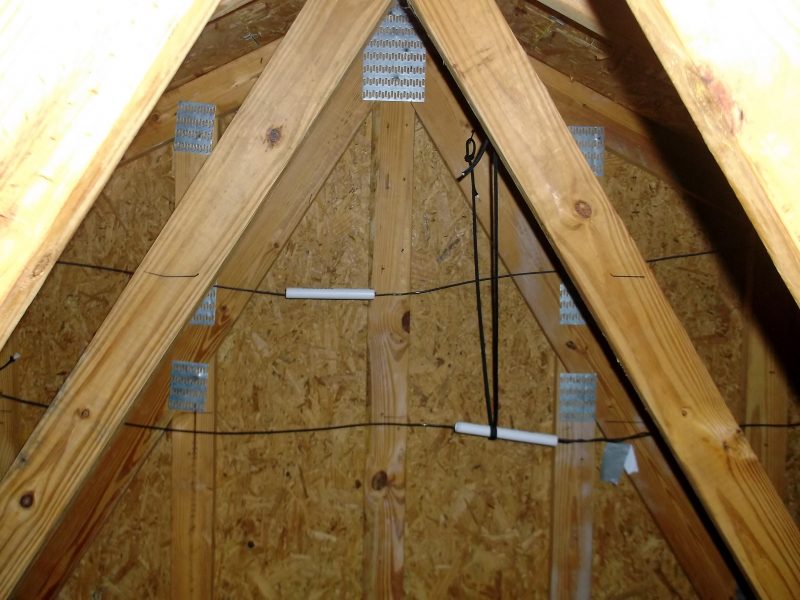
Figure 1 shows a view toward the south end of the attic. The two pieces of PVC form the element separators for the 15-meter Moxon (top wire) and the 17-meter Moxon (bottom wire).

Figure 1 – Moxon Element Separators, 15m (top) & 17m (bottom)

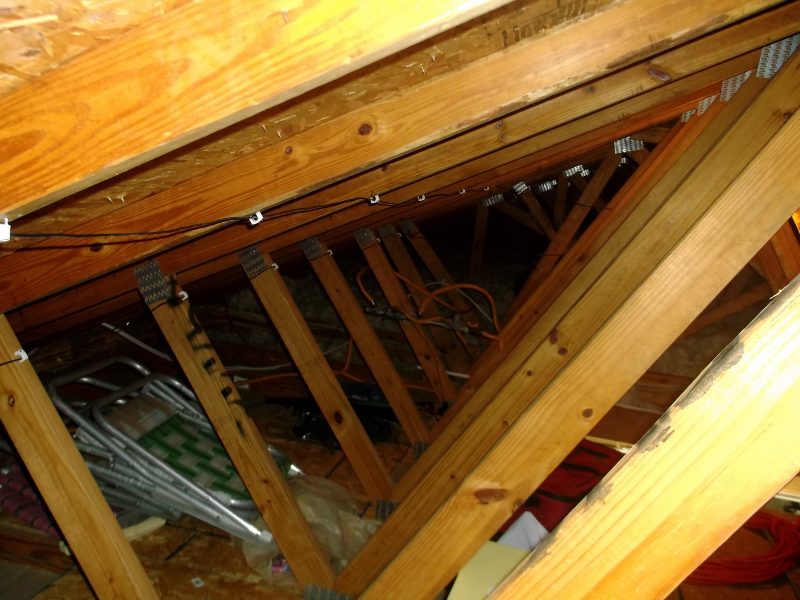
Figure 2 shows the reflector elements for each antenna as secured to the joists, looking north through the attic. The white standoff fasteners are coax cable tie-downs that I found at the hardware store. Standard house wiring fasteners would have worked but they leave little room for pulling wires if I needed to make adjustments. (My first attempt was to use duct tape to hold the elements up. However, the heat soon made them droop.)

Figure 2 – Moxon Reflector Elements, 15 m (top) & 17m (bottom)

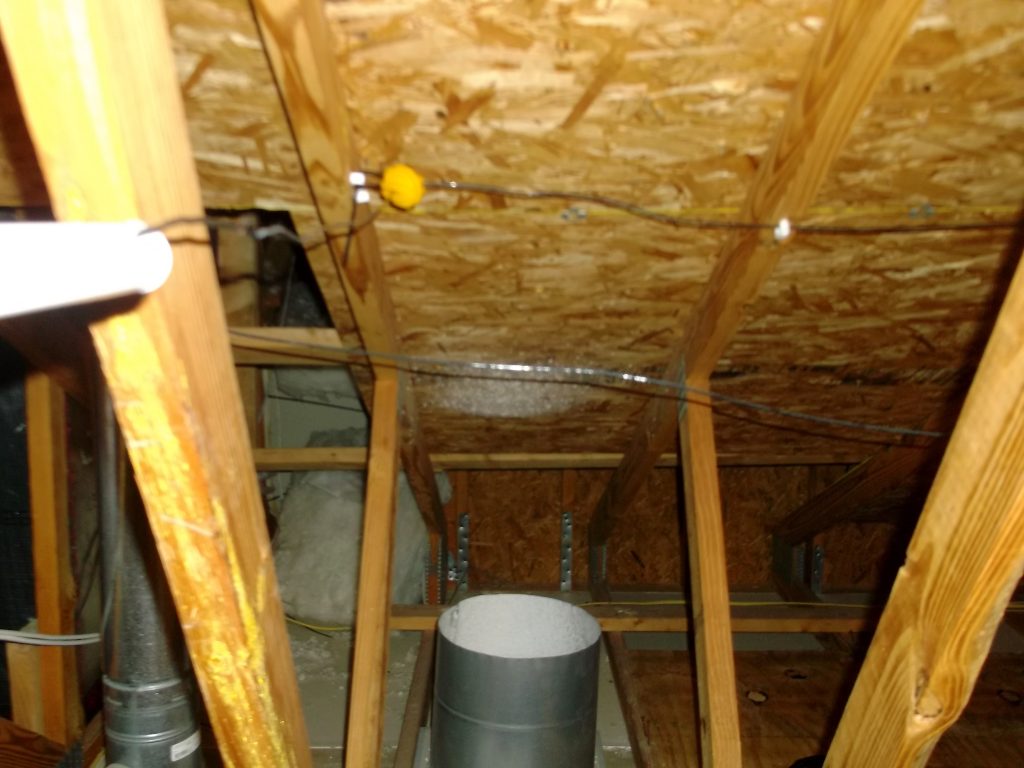
Figure 3 shows one corner of the director of each antenna looking east. The duct work to the left is part of the ventilation system while the open duct vents directly from the garage below. The yellow fence standoff on the upper antenna is the bend point for one end of the 15-meter director. Not visible to the left is a similar bend point for the 17-meter director.

Stealth Antenna - Looking East-from the Reflectors
Figure 3 – Looking East-from the Reflectors

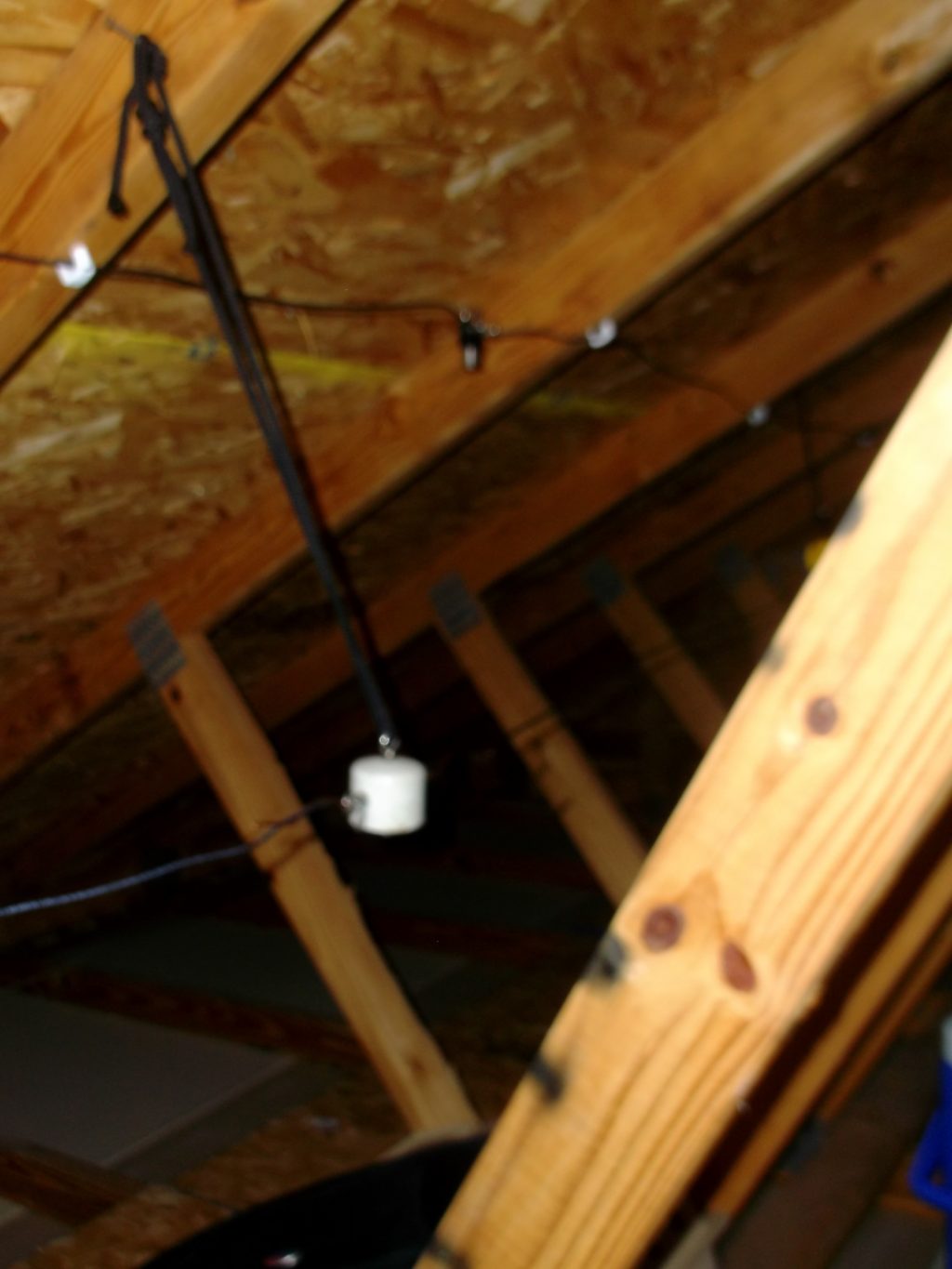
Figure 4 shows the temporary feed points for each antenna.

Stealth Antenna – Feedpoint for 15m (top) & 17m (bottom)
Figure 4 – Feedpoint for 15m (top) & 17m (bottom)

The figures above show the project to date. I installed the 17-meter antenna first and measured its SWR performance with my analyzer. I found that it resonated beautifully at 16.7 MHz with a 1.1:1 SWR while bulging to 3.9:1 at 18.1 MHz. I shortened each element by a foot and ran measurements again, this time the resonant point moved up to 17.3 MHz (1.3:1 SWR) and the SWR at 18.1 MHz dropped to 2.7:1. I folded the elements back another four inches on each end and measured the response. I observed the SWR bottoming out at 1.5:1 at 18.1 MHz where I wanted to be. As a point of interest, I modeled a Moxon designed for 16.7 MHz and noticed the elements were about two feet longer than a Moxon designed for 18.1 MHz, close to the twenty inches I had to shorten the elements. Apparently, there is some interaction with the wiring that runs along the attic floor near the edges.

Armed with the satisfaction I was on the right track, I installed the 15-meter Moxon above the 17-meter antenna. I hooked up the analyzer and fired it up only to find to that its “resonant” point was a dismal 3.0:1 SWR at 22.9 MHz, rising to 3.9:1 at 21.1 MHz. This meant my antenna was too short. I went back to EZNEC, opened the standard dipole model and plugged in 22.9 MHz and found that its length was very close to the overall driven element for a Moxon designed for 21.1 MHz. I lengthened each element by five inches as a starting point to see what would happen. The result was no change in SWR at 22.9 MHz while dropping slightly to 3.6:1at 21.1 MHz. Hmm, looks like I need to get a little smarter about this.

Stay tuned for Part 2 to find out. (Don’t you hate that?)

Ed, K2TE

Boxboro Youth Outreach Summary

I had the pleasure this past Saturday to attend the Boxboro Hamfest with many members of Nashua ARC. Amidst all the talks, activities, vendor booths, and flea markets, one component I was interested in was attending the Youth Forum. As some of you know, Jamey (KC1ENX) and I (AB1ZO), are spearheading Nashua ARC’s involvement with recruiting and extending our membership to include young people; specifically targeting young folks 18 and under. We already have one such star in the club, Jamey’s daughter Abby (KC1FFX), who serves as Youth Advocate on the board. This forum was important for Jamey and me to attend in order to extract lessons learned from other clubs who have successfully built an infrastructure based around attracting and retaining young people. Also in attendance (from what I could see) was Skip (K1NKR) whom many of you know has been active with the Girl Scouts and Thinking Day on the Air. The remainder of this article, therefore, will be to summarize lessons I learned and hopefully engender a discussion among interested parties of what we can do in the coming months. As a relevant aside, I truly believe this all can only work, if we have large buy-in from you as the members, so your input is certainly requested and valued. Lastly, get a good cup of hot-joe, you’re in for a long read…at least I’m honest 🙂

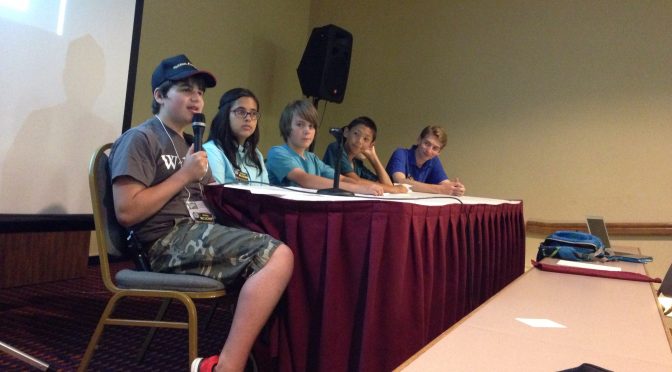
When the Forum began, the audience was faced with a large panel of kids all under 18. Easily 10-12 kids, with a majority of them possessing their General license. Many (if not all) were active members of the Clay Center Amateur Radio Club (and even held positions in the club) which has a whopping 260 members. They boast interesting facts:

  • 12 former astronauts have visited the club
  • The meeting area for the club also has an astro observatory so kids can star-gaze as well
  • Roughly 93 out of 260 members are under 18. (One interesting side note is that if a young person was under 16, then their parents also joined as well due to club guidelines.)
  • Many of these kids are also students at a local high school in Brookline, MA: namely Dexter Southfield High School.

One of the club’s mentors is Bob (K5TEC), who has been involved with amateur radio and working with kids for over 20 years; his day job (when he is not a weekend warrior on the radio) is a teacher at the aforementioned high school.

Essentially,  after a brief introduction by the students regarding their age, license level, and background, the Q&A ensued. The audience began zinging questions to the youth panel and I’ll share some of the results.

Skip (K1NKR) had begun by asking since many of you are bright, young students, why did you choose to do amateur radio verses, really, anything else? Here were their answers:

  • My mom/dad was interested and excited about it, so I became excited too. Additionally, my friends were doing it, and so I wanted to check it out.
  • Since my school offered this as a program, I wanted to check it out due to its proximity and my interest in science
  • I wanted to meet new people (both other kids in the club and on the air) and learn about astronomy, radios, and cultures other people in the world have
  • I have a tech interest and like building computers and working with Linux
  • I like playing sports — Fox hunting is fun because I can run around with my friends doing something techy and sporty
  • I really enjoy “engineering stations” — having a big project and being “in the thick of it” was fun for me
  • I enjoy science (electronics, robotics, rocketry, physics, astronomy, computing) so this seemed natural to get into.
  • I liked the idea of contacting folks all over the world and was interested in contesting when I learned about it

So looking over this list, I can see a few trends here:

  • A young person became interested because someone else they look up to or respect was already involved in the hobby and remained exceedingly positive and excited about it
  • Amateur radio had a natural overlap with many other scientific and engineering disciplines. One facet which I didn’t consider was that for the sportier types — they seemed to gravitate towards the fox hunting
  • Giving a kid a “station building science project” that’s all their own to work on, gave them autonomy. For those kids involved in the DIY electronics maker movement, this became another natural extension.
  • And probably the most important reason, a bunch of other kids were doing it! — critical mass was achieved — and they did activities together!

After speaking with Bob (K5TEC) he mentioned that most kids went to the club meetings every month — but the club meeting structure would sometimes deviate from having a speaker each week. (Didn’t get an answer about how yet, but getting a reply is in the works) There did exist a core group of kids (4 or more) which kept the ball moving for the rest and were responsible for more of the organization of events etc. In fact, the club also had a weekly youth network run totally by kids. Bob stressed that repeaters are essential to keep kids talking to each other. Bob additionally stressed that is we would need to make sure the club is very social — something to be cognizant of as we move forward.

One question I was particularly interested in, given the hectic schedules of high school students, is when they studied for their exams. The answers were:

  • Flashcards / HAM test apps on phone
  • At a summer camp sponsored by the club
  • Studied after school but primarily most studied during the summer

I think the trend is evident. As a club, we will need to concentrate heavily on licensing kids during the summertime. Moreover, putting into place a summer camp of sorts which focuses not just on the test questions but experimentation etc. will be crucial.

Bob (K5TEC) followed-up with a few more comments.

  • He found it VERY important to get kids on the air immediately after they pass their exam. As a result, he would buy a few HT’s, pre-program them, and then sell them to the kids (their parents) at cost, right after the exam.
  • He found it took around 9 hours (at a bare minimum) to train the students during the summer
  • Summertime is the optimal time to be engaging in licensing kids
  • Have an environment where the VE sessions occur that does not scare the kids off and they feel comfortable. (This did not occur to me)
  • Numbers and involvement are absolutely essential

So, that about sums up my findings from the forum. I could go on and on, but your coffee is getting cold if you haven’t drunk it all yet, and I need to get back to work. I think one thing is pretty clear, however, and that is to get and retain more young people, we are going to see our club dynamically shift in really exciting and fun ways in the near future. I don’t know about you, but I’m really looking forward to the day (and I hope it’s in the very near future) when I can hear a bunch of young voices in our meeting place giving presentations, talking about their contacts, and maybe even asking old man Smigielski for some help with their radio.

Best and 73,

Brian, AB1ZO

A Very Memorable Club Meeting

We had a very memorable club meeting last evening. Tom Gallagher NY2RF, CEO of the ARRL and Dave Patton NN1N were our speakers. Tom and Dave talked with us about their plans for the future of the ARRL and our hobby. Their plans include:

  • Initiatives to bring young people and new folks into our hobby
  • Plans for electronics oriented education and training
  • Social Media enhanced information sharing within the Amateur Radio community

These goals align well with the work that our club has been doing over the past 18 months.

13 Colonies Top Club Award Presentation

We also used this opportunity to recognize the members of our club who operated as K2K New Hampshire in the Thirteen Colonies Special Event this year. Their efforts made our club the Top Club in the event this year, making over 9,700 contacts.

Abby Finchum Presenting our Youth Outreach Plans

Abby Finchum KC1FFX, her Dad Jamey KC1ENX, and Brian Smigielski AB1ZO have been working on a project to interest young people in Amateur Radio. Abby did a nice presentation of their plans and asked for folks to volunteer to help us.

Members and Guests at our Meeting

We invited several other clubs in New Hampshire and Massachusetts to join us for our meeting. Our club had a good turnout for the meeting.

Our Thanks to Tom Gallagher and Dave Patton

We ended our meeting by thanking Tom and Dave for taking the time to come to talk about where the ARRL and Amateur Radio are headed. Their plans and work to keep our hobby strong and to evolve the ARRL into the future are very much appreciated by the Amateur Radio community and by our club.

Fred, AB1OC

Radio Amateurs Developing Skills Worldwide