Education and Training information is for folks looking for help to earn or upgrade their license, learn about Amateur Radio, and get help with Ham Radio questions.
WSJT-X developer Joe Taylor, K1JT, weighed in to express his appreciation to all who shared their ideas and experiences using JT9 and JT65 modes during recent multi-hop E-skip openings on 6 meters.
“We are very much aware that a mode with most of the excellent characteristics of JT65, but with faster turnaround time, would be a big winner in such situations,” Taylor commented on behalf of the WSJT-X development team. “We are experimenting with several such possibilities. Tentative goals include 15-second T/R sequences, sensitivity around S/N = –20 dB, occupied bandwidth less than that of JT65, and capability to decode as many as 10 or 20 signals in a 2-kHz bandwidth.”…
This is something to follow if you are interested in the JT modes for HF and VHF communications. Our experience is that a new JT variant that would trade S/N margin for a faster QSO segment speed would be just the ticket on many of the HF bands as well as 6m.
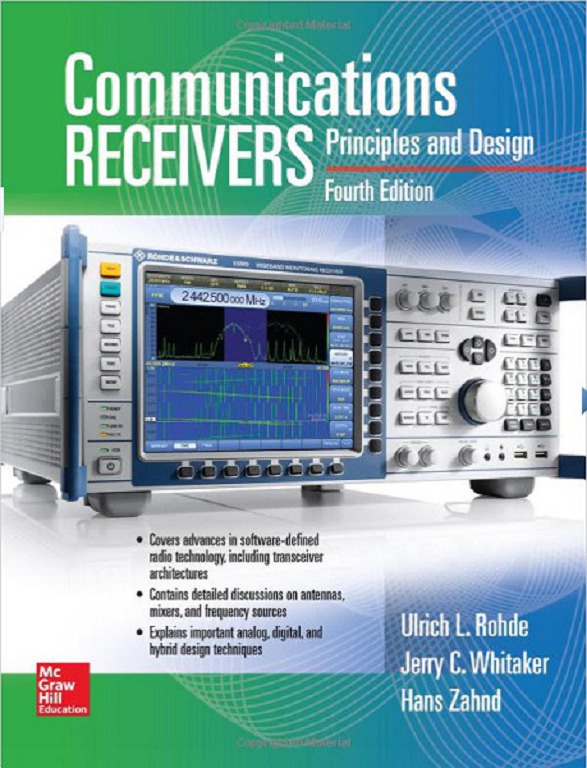
New member here, hoping to add some value! I am returning to amateur radio after a very long period of inactivity, and have been looking for some reading material to jump-start coming up to speed on more recent technology topics. I have discovered a new book which may be of interest to Nashua ARC members. This is actually a revised 4th edition (published 2017) of a book that has been around for some time. Title: Communications Receivers: Principles and Design. This is an engineering textbook, so it is quite technical but strikes a balance between theory and practice. A bit pricey, but it is a virtual goldmine of information, and includes hundreds of references and suggestions for further reading. At 600+ pages, it is not something most will read and understand in a few evenings. Greatly expanded coverage of SDR technology alone is worth the price, IMHO. I highly recommend this book for those who wish to gain an in-depth understanding of the topics covered. This book might be suitable as the basis for a series of Tech Night sessions.
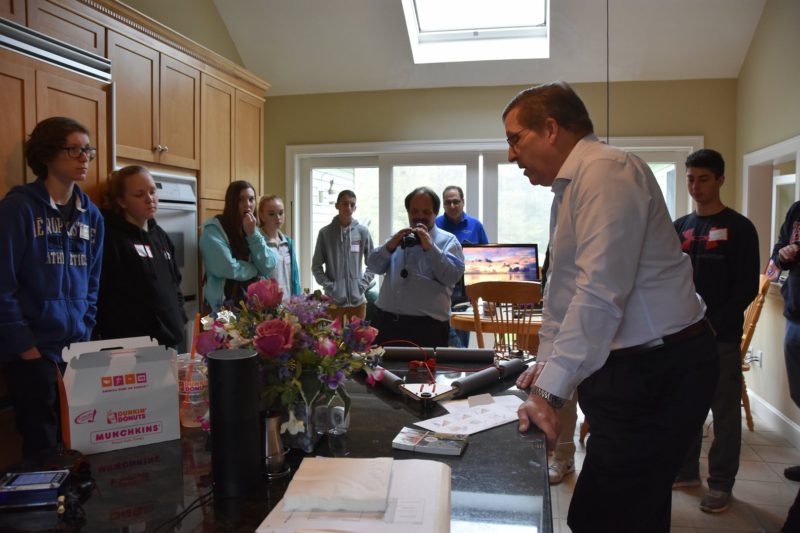
On May 6, members and friends of the HAB (High-Altitude Balloon) Project gathered at Anita (AB1QB) and Fred’s (AB1OC) QTH for an open house to introduce the students participating in our project to amateur radio and the HAB itself. The weather wasn’t exactly cooperating with us, as rain was in the forecast. In fact, this was supposed to be the week before our actual launch so we could do some prep work with the kids. Fate had other ideas for the launch, however, as it was postponed due to more rain and has been since rescheduled to June 3.
Among the students there, we had representation from Merrimack High School, Bishop Guertin High School, and our independent group of which Abby (KC1FFX) and Connor (KC1GGX) made up 2/3 of the students.
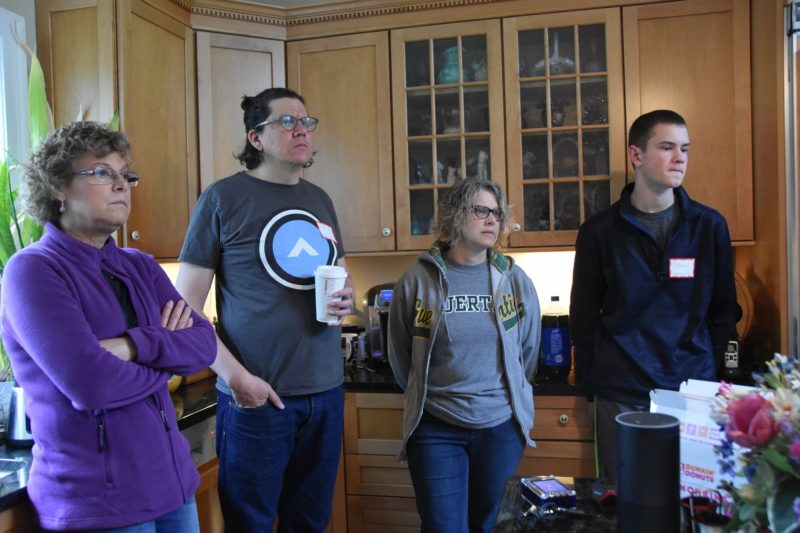
Teachers (and a student) from Merrimack and Bishop Guertin
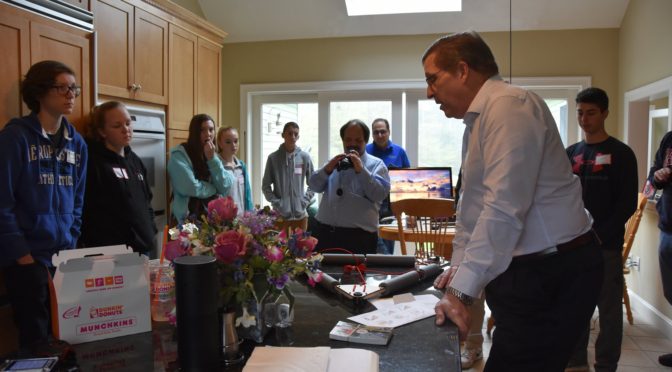
Beginning around 9 am, we crowded into the kitchen to have Fred introduce the agenda for the day.
Gathering around the table
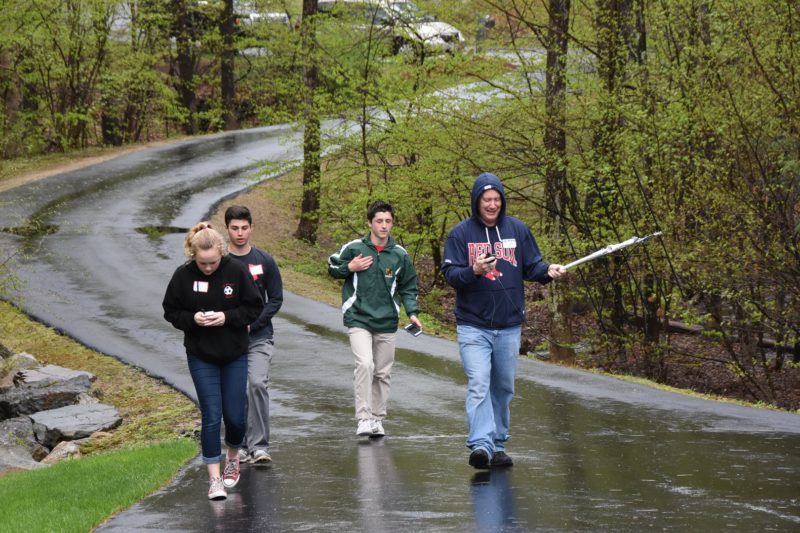
After showing off the HAB, the components, and explaining what everything did and how it was interconnected, we broke off into three teams. The first would tour the illustrious shack, the second would get a primer on antennas and towers in the backyard, and the third would brave the elements and go on a foxhunt.
A crew going on a Fox Hunt
After each group was able to accomplish all three activities, we then invited the kids to make some QSOs in the shack and/or make some QSOs with Fred and Anita’s amateur satellite station v2.0. (I, myself, had made my first two satellite QSOs earlier that morning. A VERY cool station, indeed). A few were definitely nervous and mic shy, but most stepped up and seemed truly amazed (bewildered) that they could talk to some random person in some random corner of the globe.
By about 2 pm, there seemed to be expressions of fatigue on the young faces, and it seemed a natural time to conclude the day. All in all, it seemed the kids truly were excited about amateur radio and the HAB. We look forward to working with them in future phases of our HAB project and hope this is something that many of these freshmen can turn into a serious senior science project when they’re looking ahead towards graduation in a few years. (And perhaps, we’ll get some of them licensed too!)