Category Archives: Activities

Nashua Area Radio Society activities. Included is Field Day, our Annual Picnic, Tech Nights, On The Air Activations and much more.

NEQP 2019 Contest With A Surprise!

I have been a ham for a little over two years now. In that short time, I have had a chance to try out many of the different things one can do. One exciting thing to do is to participate in a contest. Many of us have seen pictures and read articles of serious contesting stations and may even drool a bit for all the high-end hardware and giant antenna farms. I plead guilty myself.

As a new ham, my station has, for the most part, been a basic one. I have an excellent radio in the IC-7300, which priced to be available as a high-end entry-level radio. At this stage in my ham radio adventure, I am not sure I can appreciate the advanced features found in the higher end radios, yet. In the beginning, using my IC-7300 and a Buckmaster 7 Band Off-Center Fed Dipole and running 100 watts many of the stations I was able to contact were contesting stations. Their great antennas and sensitive receivers could pull out my signal with ease. Time passed and my station is improved, now with 500 watts and a hex beam or wire antenna up over 45 feet high and I can compete for attention in a pile-up in a contest.

Unless things are quiet or slow due to the hour, I haven’t had great results running on a frequency in a contest, but search and pounce, where the operator finds a station and replies to their CQ, works well and I am often heard first try. Just that bit is loads of fun and satisfying. I enjoy seeing how my radio performs and contacting people in different places, so entering a contest is fun, even though I know I am not going to be competitive. It is obvious, but I will say it anyway, there are lots of people on the air during a contest. That means it is a great time to make QSOs, even though you are not going to rag chew or be a contender.

Operating From AB1OC-AB1QB

I had a chance to operate from a contest grade station last year for around 4 hours during a CQ WW SSB contest. Thanks to AB1OC Fred and AB1QB Anita for their generosity.
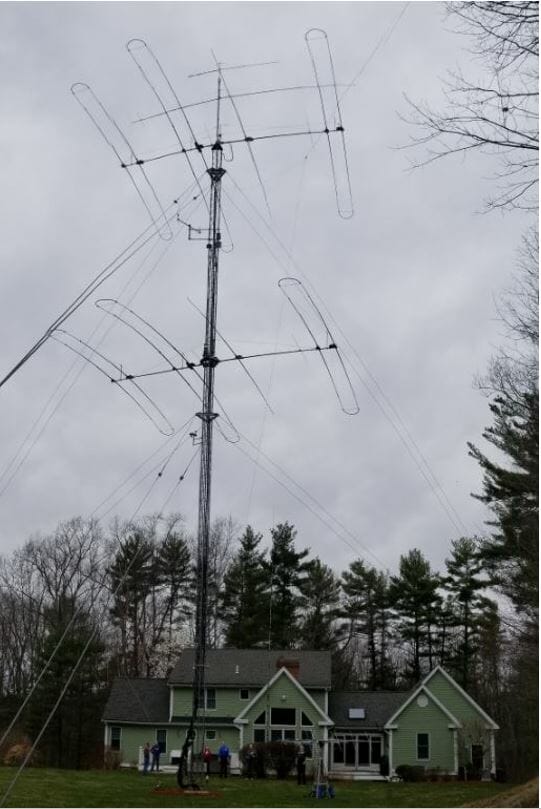
Stacked Steppirs
Stacked SteppIRs

Their station had stacked Steppir antennas and 1500 watts of power so when I talked, people heard me!
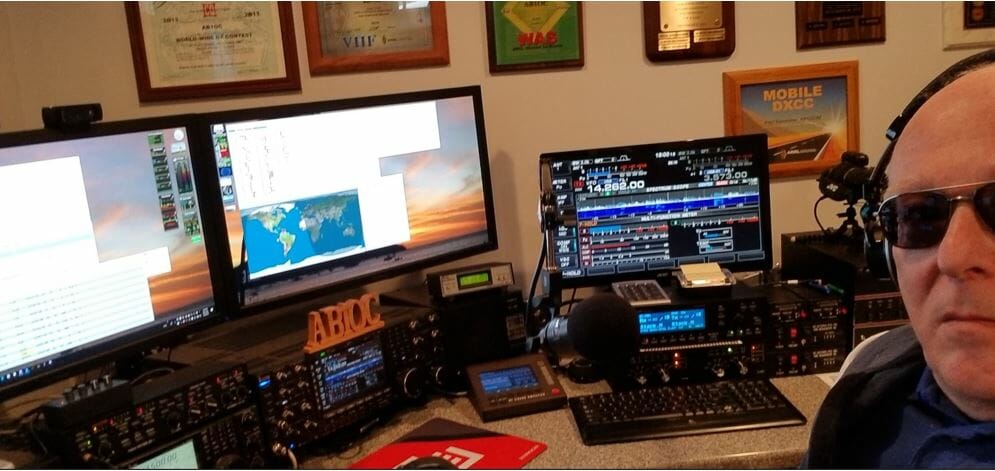
Operating from AB1OC Station

Operating From My QTH

In those 4 hours, I made 99 QSOs on SSB and got 78 different countries! 6 new ones for me, too! It was exciting, so when the North America QSO Party contest came around, I decided I would see how I could do on my own station in the same amount of time. It turned out that I was able to make 100 QSOs and 76 multipliers in 4 hours for that contest, which I thought was respectable given the difference between our stations.
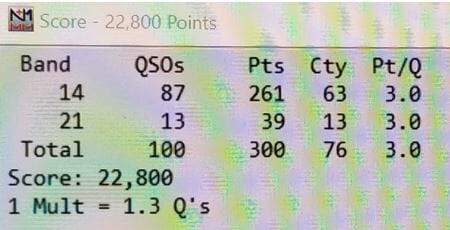
North America QSO Party

As I described above, I only dabbled a bit with contests, yet I had lots of fun. I strongly suggest that you try it out for yourself. I also strongly suggest that you participate fully and submit an official log to the contest when it is over. The first reason is that it makes your QSOs count for the people you contact and the other is that you might be surprised and get a certificate! For new hams, you might be able to submit as a rookie and then you are competing against other rookies and not the big guns. Some contests have other “side” contests in their scoring, so you might pick up something there. Last year I spent around 9 hours in the New England QSO Party contest from my second house, which is in Carroll County, New Hampshire. There are only 147 licensed hams in Carroll county and only 4 entered the contest.

2019 NEQP Competition
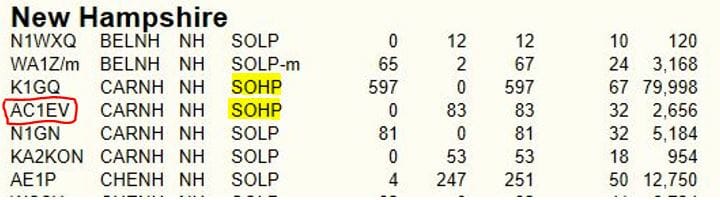
NEQP NH Counties
NEQP NH Counties

You can see in the tables below the populations of licensed hams by county. Middlesex County, Massachusetts has the largest amount of licensed hams in New England! I admit I did not know that, but after thinking about it, it is not surprising. The next largest county is Hartford, CT and it is only half of Middlesex. If you are trying to win a ham radio contest from one of these counties, you will need a serious station and be willing to spend lots of time in the chair.
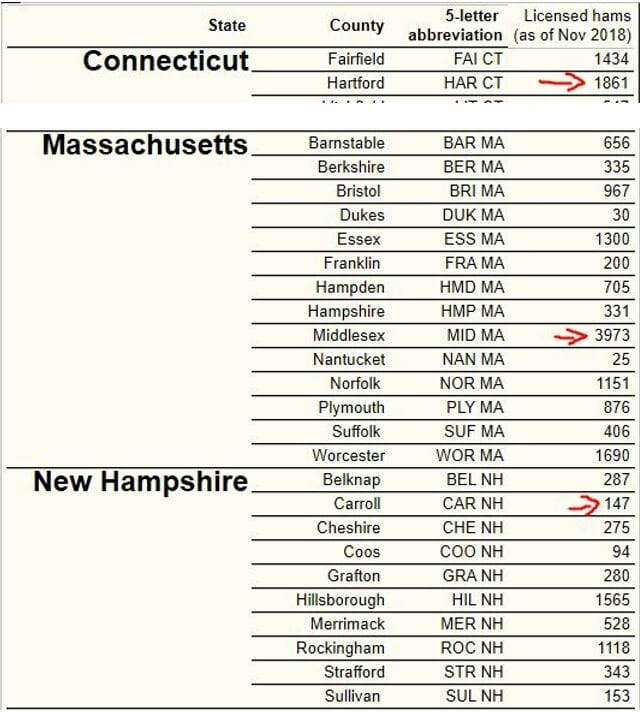
CT MA NH Counties
CT MA NH Counties

Remote Contest Logging

When you operate in a contest you enter your station information in the logger and that is how your location is determined. My home QTH for my license is in Tewksbury, MA but the contest logger needs to have the location of the station you are operating for the contest. When I participated in the NE QSO Party in May 2019 I setup N1MM+ logger like this:
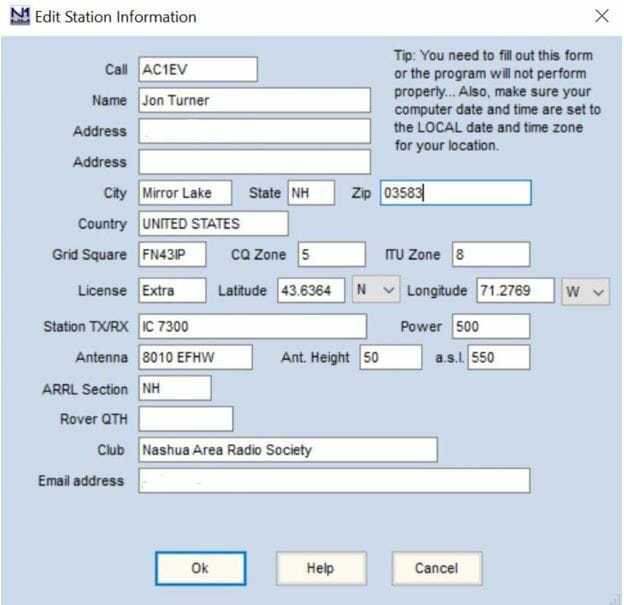
N1MM Station Info NH QTH

I was not trying to win the contest. I thought it would be a good opportunity to make lots of contacts and when you encounter someone you contacted in the contest in a future QSO, you have a good start on beginning a rag chew.

Overall NEQP 2019 Results

Here are the results of the 2019 NEQP. It may be worth looking at previous years’ results for contests you want to compete in to see how the top finishers scored. If you can choose the location you will operate from, this can help as well.
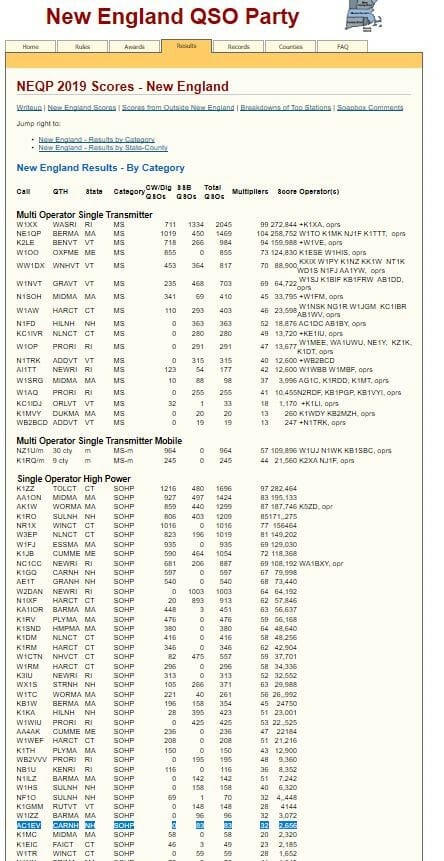
NEQP 2019 Scores
NEQP 2019 Scores

Here is the surprise I received from the 2019 NE QSOP, which prompted this article.   The 2020 NEQP is May 2 – 3, give it a try.
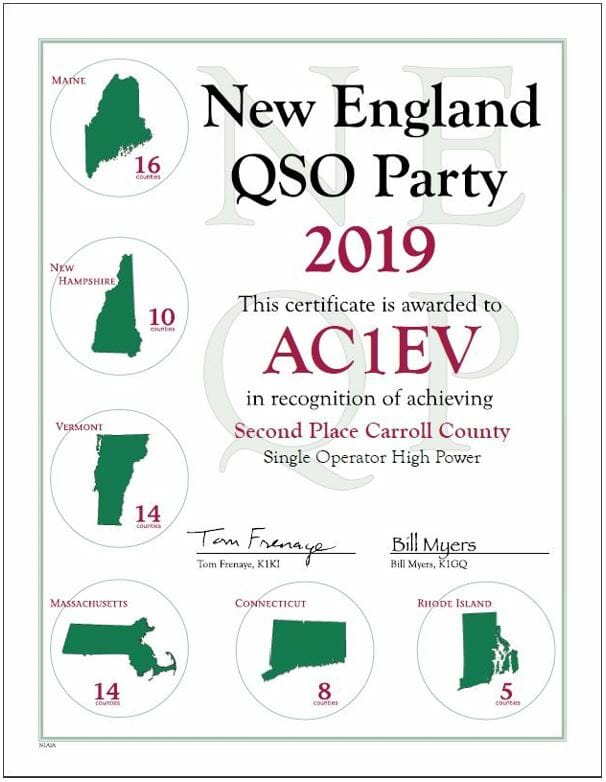
New England QSO Party Certificate

Jon, AC1EV

Winter Field Day 2020 Results

The results from 2020 Winter Field Day are in. The Nashua Area Radio Society was #2 overall as well as in the outdoor category.

Winter Field Day 2020 Results
2020 Winter Field Day Results

As was the case last year, the scores are all about multipliers which is derived from the number of active bands and modes that a station has.

WFD 2020 Operations On Saturday Afternoon

You can read more about our WFD 2020 operation here.

Fred, AB1OC

Tower Horror Story

Greetings fellow NARS members! I hope everyone is well and safely ensconced in the shack chair and on the air. I’m sorry that I missed K1IR’s presentation on tower safety. I’ve known Jim for many years from the Yankee Clipper Contest Club (YCCC) and the Billerica Amateur Radio Society (BARS). Jim has built a competitive station and he introduced me to the “star” method of guying a tower that is more robust than the usual turnbuckle 3-point approach many of us use. While making sure a tower is stable and well-engineered, there is much more to tower safety, as I’m sure Jim pointed out. My story is how things can go terribly wrong.

I had an incident ten years ago while doing tower work that was very serious. Long-time members of NARS may remember what happened but, given the huge growth of new members in the club, I thought it would be worthwhile to retell my tower story. In mid-May 2011, Jerry, K0TV (SK) asked me to help with an ambitious project to install several beams on one of his towers. Jerry was an avid contester who believed that hams should use ALL the bands available to them. This means 432 MHz, 928 MHz, 1296 MHz, and other nose bleed bands. To that end, Jerry wanted to install a 432 MHz quad yagi, a 1296 corkscrew quad yagi, a pair of 928 yagis and a good old 144 MHz yagi. The plan was to install them in a tree fashion on the mast above his 15-meter monobander. As if this wasn’t enough, there was a junction box near the top of the tower with a Medusan tangle of coax jumpers for routing signals to the beams.

I was well-known in the club for readily climbing towers and working on beams in all kinds of weather. I often wonder if I qualified for the 1,000,000 climbing feet award. Just ask anyone who worked with me during years of Field Day installations. Along the way, I picked up a lot of necessary safety habits for working on towers. Contrary to what one might think, I am NOT comfortable at heights. I may be wiry and fit but my heightened awareness of where I am has made me conscious of being careful and deliberate. (This is an axiom everyone should follow in tower work.) So I climb with two belts, always have three points of contact with the tower, and make sure I’m secure before freeing both hands. Sounds simple but complacency can be fatal.

So back to the story. I had been at the top of the tower for over an hour having worked on the junction box cabling and re-positioning the box so I could work on the beams. The weather was a sunny and warm NH day and I was getting hot. I was also getting hot emotionally after having wrestled one of the new antennas in place above the 15-meter beam. It was now time to raise the mast and lower the 15-meter beam to install the next antenna. In order to raise the mast, we installed a lifting plate below the loosened 15-meter beam so that the Ginpole could raise everything once the thrust bearings were loosened. By now I was sweating from the warmth and getting more irritated with the close quarters. I secured the Ginpole hook to what I thought was the lifting plate. It was the 15-meter boom instead. I called down for tension on the Ginpole rope as I loosened the thrust bearing bolts. Down like a guillotine came the mast. The lifting plate slammed on my right index finger, crushing it against the top of the tower platform.

My screams made everyone jump, including the neighborhood. I frantically yelled for more tension on the rope, not realizing it would accomplish nothing. I had to somehow raise the mast to free my hand so I yelled for a crowbar. I managed to lower the Ginpole rope and have the bar sent up. I was able to leverage the lifting plate enough to get my hand out. Now I had to use my damaged hand to unbelt and re-belt myself and get down from 90 feet. It was a slow and agonizing descent but I made it. An ambulance crew was waiting for me and cut off my work glove before taking me to the hospital in Nashua.

The attending physician said there was little he could do and may have to amputate my finger. THAT did not sit well with me. He made some calls and miraculously found surgeons at Mass General willing to come in on a Saturday to see what could be done. It was off to Boston in the ambulance that bobbed and weaved with Siren going in the wonderful maze that is downtown Boston. (I remember the driver saying he was only flipped off twice.)

I went through the usual endless questioning and note-taking that an emergency room requires. I met with the two surgeons still in their weekend attire who examined my finger while ordering an operating room preparation. What struck me was that both looked like they were younger than 30. I had heard of Mass General’s reputation as a top-notch hospital so I wasn’t worried. These two had to be really good at microsurgery.

After seven hours or so in surgery, I came to and saw my right arm covered from the elbow to my hand. The doctors said everything went well (don’t they always say that?) and the covering was to allow warm air from a heater to aid blood flow to my finger while I recovered. I spent the next three days in a hot room to keep the blood flowing. It so happens that an early heat wave rolled through Boston as Memorial Day approached so I don’t why they could not just open the windows. Finally, I was moved to a semi-private room with normal temperatures. Another doctor (also young) came by to unveil the bandages and examine my finger. Seeing it for the first time since my accident, it looked like an ugly pickle. He whipped out his cell phone and took a picture of “how nice it looked”. I could pass up the chance – I asked him if he was going to use it for a pick-up line when off-duty.

Jerry came by to see me while I was in the hospital. Jerry, being Jerry, quipped that it was a good thing it was not my middle finger. People would think twice about asking me what happened. I was able to regain the use of my index finger thanks to the skill of the surgeons. I can’t close my right hand in a fist but I’m left-handed anyway. I look at my finger and have an idea of what my digits will look like in another 20 years.

While I was convalescing I learned that my accident was one of the worse things to happen during tower work, falling being the absolute worst. What can I say about it all? It is this (1) climb with a buddy if possible; (2) take your HT or phone up with you and stay in communication with the ground to avoid yelling and a miscommunication; and (3) keep a lid on your emotions and QUIT if getting irritated or tired.

73 de Ed, K2TE

Radio Amateurs Developing Skills Worldwide