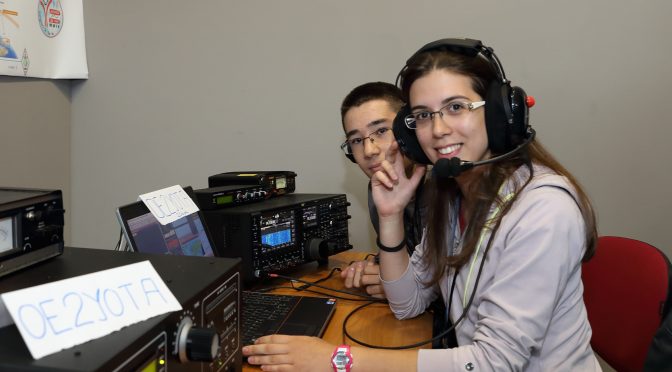
Nashua ARC will be hosting its first Youth Outreach event on Saturday, October 1 from 8am-2pm at Mine Falls Park in Nashua, NH. Mine Falls Park is located on Whipple St.
Mine Falls Park hosts many youth soccer games every Saturday throughout the Fall. We are hoping to take full advantage of that fact in order to provide kids a bit of insight into what comprises amateur radio.
Some of the activities that we will likely host are:
Get-On-The-Air (GOTA) Station
Fox hunts
Use some HT’s and get on the Nashua repeaters
This we hope is to generate enough interest so that we can plan a follow-on activity a bit later.
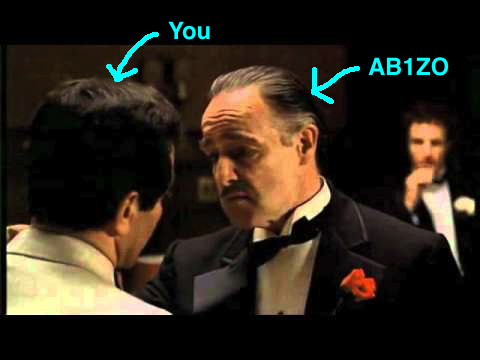
Now comes the part where AB1ZO looks at you warmly, scratches his cheek, and asks you for a favor. It might go down something like this:
A friendly, casual conversation between me and you
And that favor is that we really do need your help to come out to the Park:
Help us set up beginning around 8 am
(Setup is pretty important to have able bodies around for. We’ll shoot to get on the air as quickly as possible after. Perhaps by 9 am)
Work the booth
(Most importantly) Interact with the kids.
Help breakdown around 2 pm
The more the merrier and the longer you’re able to give a bit of time, the better as well. Additionally, you are completely encouraged to bring family and friends, especially if they are < 18 years old. But in all honesty, I think it would be fantastic if we had a significant contingent of the club at the Park, to welcome our guests. But don’t do it for me, do it for the kids:
Do it for the kids…
If you think you can give some time, please contact myself ([email protected]) or Jamey (KC1ENX) to let us know what you would like to help with. Again, we really could use the volunteers in all the aforementioned areas. We’re hoping this is a facet of the club you will all embrace as it evolves.
At our most recent Tech Night meeting on Sept 12, at the end of the meeting, Fred (AB1OC) asked Brian (AB1ZO) to list a few of the upcoming tech night events.
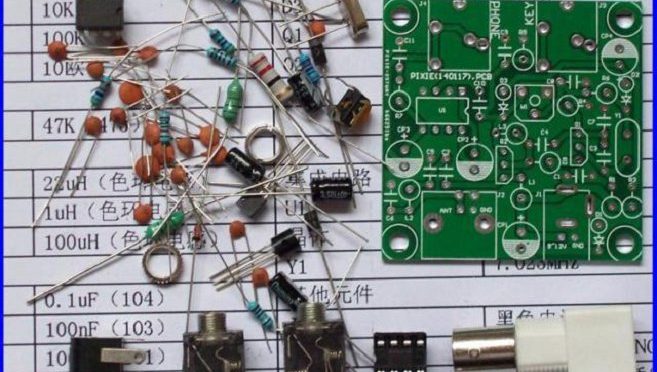
One such event would be to host a kit-building tech night. Plans are in the works to secure Pixie QRP kits (which run in cost from $3-$13) or some variant of this and assemble the kits during the allocated time. It’s expected that more experienced HAMs can mentor newbies in endeavors such as these.
Secondly, an informal poll was asked of members in attendance regarding the types of topics that would be of general interest. These included:
Low-band antenna discussion: Due to the decreasing sunspot activity, “40m is becoming the new 20m”. What options to HAMs have to get on the lower bands, particularly if you are real-estate limited?
Receiver vs Transmit antenna discussion — options for both
High-frequency terrain analysis (HFTA) in order to better understand propagation effects of one’s signal
Making sense of the influence of sunspot activity on amateur radio in general. Some energy, for example, could be dedicated to interpreting the sunspot GUI that appears on the website after login and understanding the science of the ionosphere.
Working more with test-equipment kits and how to use them. This may include oscilloscopes, spectrum and network analyzers, frequency counters, signal generators, building CW paddles/keyers, and soldering kits.
Using RTL-SDR dongles (or again some variant) and using them in small DIY projects that we could potentially complete in the allotted time.
I do want to say a few other things:
Since our club is growing, and many new people are joining, I do want to stress that it is important that sometimes we “recycle” old Tech night topics in an effort to better educate our newer members. In this capacity, I would again hope that veteran members could help train younger ones. For example, I cannot solder to save my life. I would love some training during a surface-mounting tech night (since I couldn’t make the last one) and have someone experience show me the ropes.
Many of you are working on interesting projects at home. No matter how small or large you think it is, I am 100% certain there are a group of people within the club who would like to hear what you have to say. So if you would like to present at Tech Night something you have been working on, please do not hesitate to email me at [email protected].
I also want to solicit your feedback on this blog as well as my email for any other topics. The more suggestions we have the merrier! It’s important we adequately represent the interests of as many members of the group as we can.
In the coming weeks, I will start to construct a more concrete list of potential Tech Night topics, but help me — help you 🙂 Thanks for reading and see you on-the-air.
I suppose the title could also be: (or how I learned to stop procrastinating and finally put up my HF antenna).
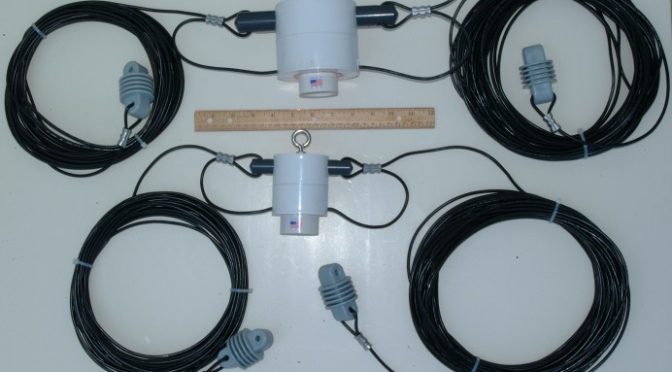
Well, I did it. I finally got my HF antenna up after months of admiring it through the plastic wrap and having the world’s most expensive paperweight (IC-7300) sitting in my metashack (how could I really ascribe any reality to it when it was still merely a concept). What I would like to accomplish in this article is not only a description of the construction etc. but also of some mental gymnastics, I had to do in order to get to the finish line.
Way back in February, I was able to get my General license. I was pretty stoked (to use the common tongue) and looking forward to getting it up and going. This required, essentially, two things: a radio and an antenna. Easy-peasy, right? The first really was easy. I wanted a 7300. Who didn’t? The proverbial ICOM bandwagon drove by my house daily. Several times a day while banging on a few drums. So, I did my homework as best as I could, talked to a few folks, and with not much arm twisting, bought a rig. Now I needed the antenna. And some drums…
For this portion of the ordeal, I ended up doing my homework a little more. I spoke to Fred and Anita at length about their choices: read their blog, saw their own setup in person, read posts in the Elmering session of Nashua ARC’s website, read comments on eHam.net about various antenna types. Some factors to consider are — in no particular order:
Budget
How much help you will have to put this up
Aesthetics
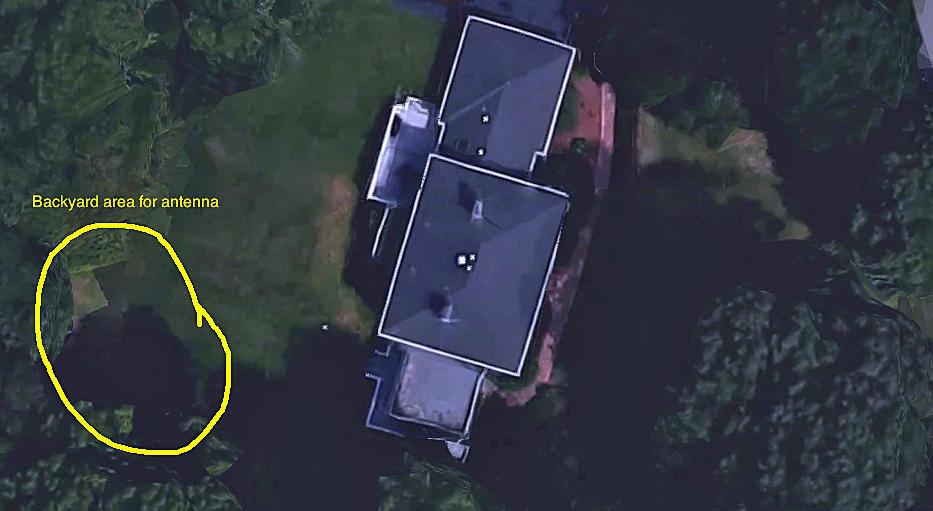
Available real estate
How many bands do you want to work
At my QTH in MA, I have 0.5 acres in the front and back.
I think the price point was a bit north of 300 bucks. Having made up my mind, I didn’t do anything about it. Upon reflection, I think I really didn’t act because work consumed me until mid-May. I literally had no free weekends for months, so there was no rush. In the interim, Fred and Anita had opened up their station for use, and I took joy in hearing about others’ QSOs for a while.
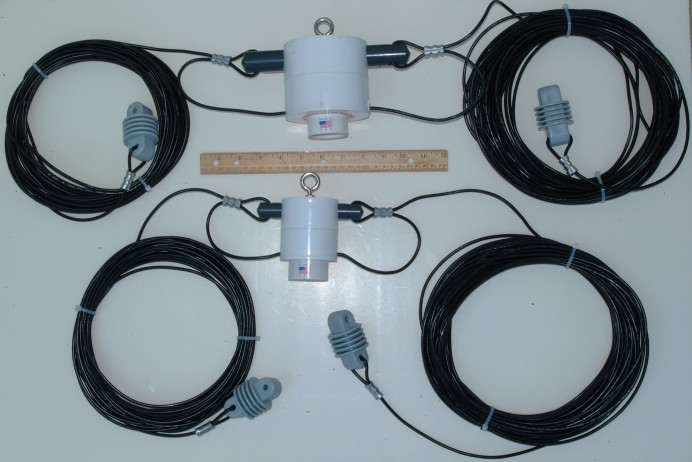
In order to still feel like a HAM, however, I decided to take my Extra exam in May. Once I that got out of the way I bought the Buckmaster in June on one fateful Thursday afternoon, and again, there it sat in the meta shack until September. Excuse #2: Honestly, with a project this big (at least for me) I think I was a bit gun-shy to get it up. I felt unqualified to do it; maybe even afraid to fail amidst all these competent people in the club.
Up until now, this may have read as Dear Diary, so let’s get to some actual station construction! Labor Day weekend was the ticket.
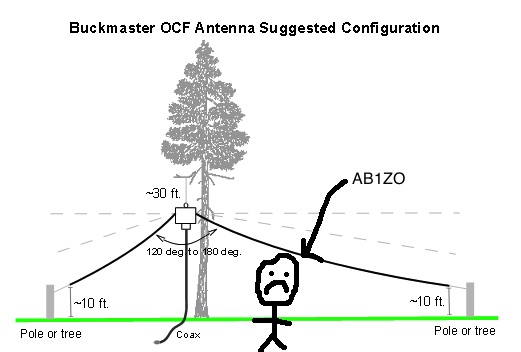
Good grief was this tough! Probably 85-90% of the total time was spent trying to figure this out. Mainly because, looking at the graphic, I had to get this about 35 ft. in the air. I got frustrated pretty quickly…
Buckmaster OCF dipole installation picture. Right from their website
Now maybe that doesn’t seem like it’s that high, but I assure you, it becomes pretty darn high when you keep failing. So thinking about the problem and researching on the internet led me to some methods to try to get a rope up in the tree:
Use a potato gun
Call folks from the club to come lend a hand
Rent a scissor lift from Home Depot
Use a bow and arrow
Use rope tied to a rock or stick and try to launch over the branch I want.
Here was what the jury decided on each of these options:
Built one! Fires really well, but had issues initially with sparking it in the combustion chamber. Turns out the reason was due to insufficient amounts of butane getting into the chamber. In any case, I abandoned this as a choice. But who’s to say I can’t be mischievous at a later date.
I felt bad bothering folks despite one ethos of amateur radio is to Elmer each other, so I didn’t ask for help. Bad news bears to those of you in the same predicament.
Too expensive for the little time I needed it. I think Home Depot (spelling error intentional) wanted something in the neighborhood of 200 bucks or more.
Don’t have one and nearest friend with one lived in Carlisle. Would have to work around his schedule and at this point, I was thru being patient.
Rock idea worked reasonably well, but honestly, the best option was to get a stick and tie nylon fishing line around it. I have a pretty good arm it turns out, so I tied fishing line around the stick and started throwing.
In full disclosure, the elimination of these options takes us from Friday to Monday. Wisps of steam could be seen emanating from my ears.
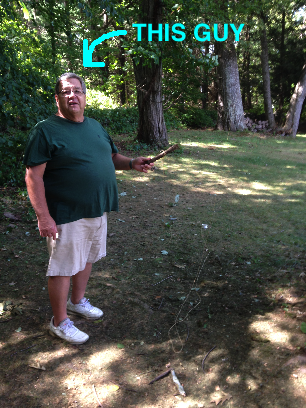
The stick was attaining the requisite height and hitting where I needed it to. The huge snag (no pun intended), though, was the fishing line was getting caught in the branches on the way down. Yet another problem. Cue engineer father-in-law. He’s the guy labeled “this guy” in the picture.
Helper Dude
He recommended winding a large amount of fishing line around the stick (but not all of it so that there would still be some left over on my side of the branch) so that when it came down the other side of the branch, it would unravel and not be as likely to get caught. This worked like a charm!
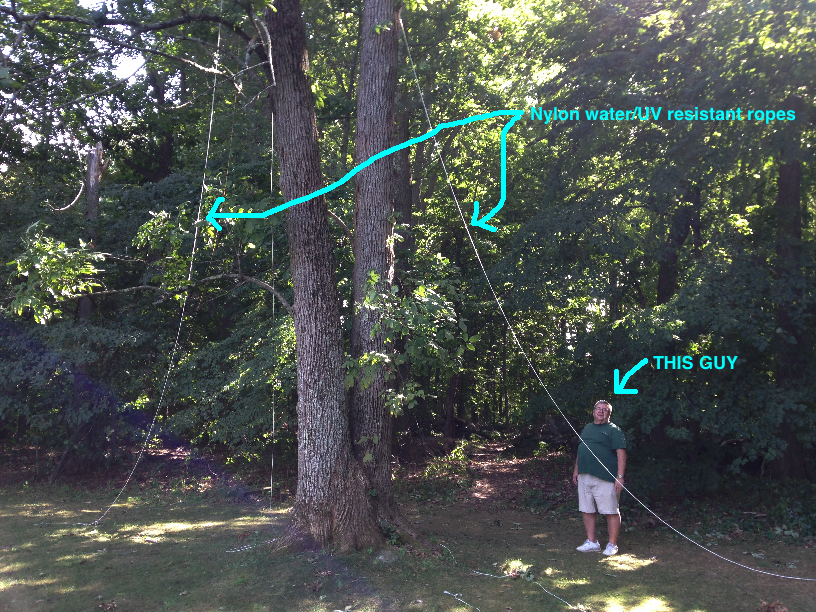
With the fishing line on either side of the branch, we tied the actual nylon, water / UV resistant rope (which I picked up at Home Depot) somewhere 25% up my side of the fishing line and then got on the far side of the branch and began hoisting it up. This also worked out very well.
Same father-in-law and hanging ropes which will support the Buckmaster
Finally, with the rope I actually want to use over the tree, I tied the Buckmaster to one end of the rope on my side of the branch and then raised it up. I lowered and raised it a few times to make sure it wouldn’t get caught in the tree at any place. I tied off the free end through an eye screw that I screwed into the tree.
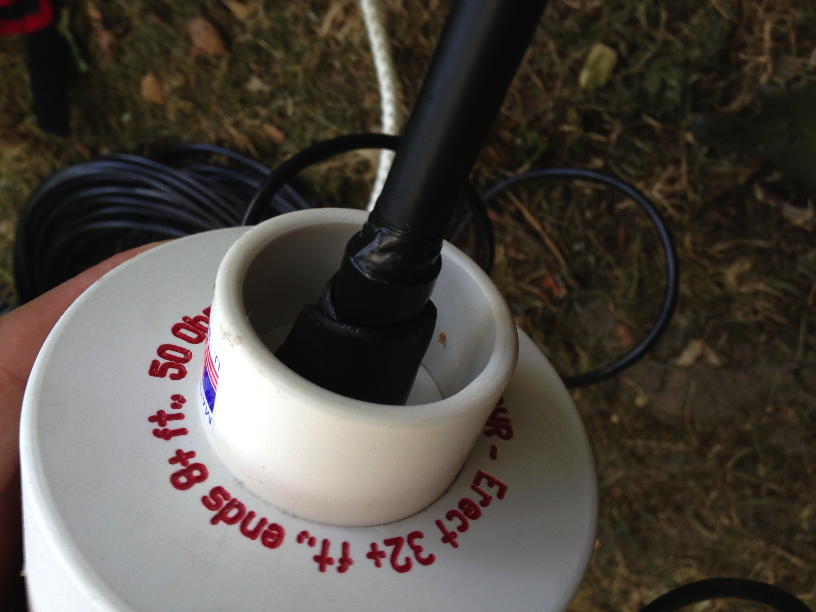
The coax I used was LMR-400. Again, doing my homework, I decided to splurge and buy 200 ft of coax but without the PL-259 connectors. I did this because I wanted to be able to cut the coax where I wished and would subsequently learn how to attach the connectors myself. This too turned out to be a relatively easy job. I picked up some connectors at the Boxboro Hamvention and borrows Dave’s (N1RF) crimper set (with dies) to attach the connectors. Taking my time, I was able to do both ends of the 200 ft coax in about 30 minutes tops. I also purchased some Super 88 electrical tape from Home Depot as well as used Scotch’s 2228 Moisture Sealing Electrical Tape (some other folks use CoaxWrap) for weatherproofing. I applied this following Fred’s suggestion on his blog.
Layers of super 88 and weatherproofing electrical tape fastened to antenna connection point
With the feed-point setup, I then purchased two more nylon, water/UV resistant ropes to connect to the Buckmaster’s insulators. I found that the 3/16” diameter by 100 ft. rope worked well (3/16″ fit nicely through the insulators’ 1/2″ holes), again purchased at Home Depot. Shirley, the cashier, shot me a smile after ringing me up for the umpteenth time. To temporarily tie these off, I terminated the rope through some more eye screws I screwed into trees in my yard. But for the final installation, I will again follow Fred’s advice from his blog post.
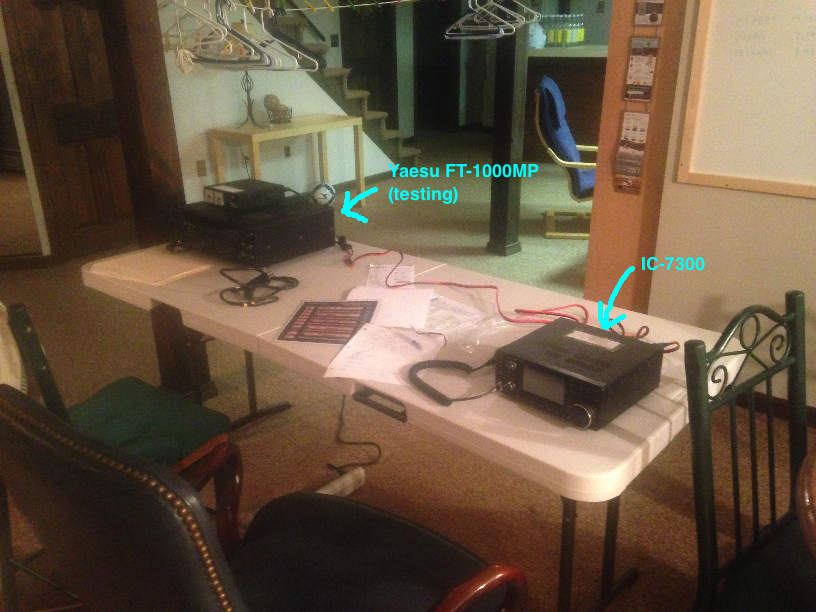
Then, I ran inside, ran the coax through the window thereby performing the transformation of the meta shack into a proto shack! (Proto because it’s in the process of getting changed and upgraded) Ta da! Prestidigitation! That night I worked Brazil and the Czech Republic on 20 and 40 m respectively, and Australia around 0615 the next morning on 20m.
Protoshack. Coax not shown.
My follow up projects:
I never mentioned grounding. I do have an 8 ft copper ground rod that I will install. I bought lightening arresters from DX Engineering: I have the kind that allows the passage of DC voltage which is needed for utilizing an antenna switch down the road. Since I plan on buying an antenna switch later, this seemed like a good option. This entire installation will take some time, so I need to find a free weekend. For now, I am only operating when the skies look perfect!
Install my 15 m dipole that I bought from the HRO and covers the band not covered but the Buckmaster. This will likely happen in the Spring. For reals.
Track down RF interference sources in my home and install the necessary chokes and beads. I’m kind of looking forward to this step.
Find a final resting height for the radiating wires of my Buckmaster. I have a cousin with tree climbing equipment. Once he comes over to trim some branches etc., I am going to try and make a 180-degree angle with the wires as best as I can. Additionally, my wife wants me to switch out the white, nylon, water/UV resistant rope with dark colored rope since it’s a bit too visible.
Once I got going, I really had a blast. If I can be of any help to anyone about this, please feel free to send me a reply or contact me on the club website. Thanks a lot for following me through the whirlwinds that are my thoughts, and see you on the air!
We use cookies to ensure that we give you the best experience on our website. If you continue to use this site we will assume that you are happy with it.