All posts by Nashua Area Radio Society

Webmaster for the Nashua Area Radio Society

Member Spotlight, Craig N1SFT

Hi, my name is Craig T. Bailey.   Member Spotlight Craig N1SFT

I’ve been a licensed amateur radio operator since 1994.  Like many hams, during our sophomore year in high school, while we all were getting drivers licenses, of course, we installed citizen band radios!  It didn’t take long before we realized the CB wasn’t really what we were looking for – so we were introduced to Amateur radio, and by Junior year we were licensed Techs.   In ’94 we were still being called “No Code Techs” because the transition into the current technician structure was still fairly new.

I joined the Central NH Radio club, and the club meetings were pretty good, and there were a couple club organized hikes, so the idea of “Summits on the air” has been with me for a long time… albeit not as the formal structured activity that it is today.  Once my buddies and I started leaving for college, we all brought our HTs, and we all intended to stay active, but best-laid plans – you know how it goes.   I still have my trusty Alinco DJ-F1T 2m handheld… it was state of the art with its DTMF pad, and its huge 40 memory slots: it still works, but the battery packs are totally gone…  (I prefer my modern day stable including a Yaesu VX-8DR, FT-2980R, FT-817ND, FT-891, and even an old Yaesu FT-90R.)

In college, I studied classical civil engineering at the University of New Hampshire where I earned a B.Sci in Civil engineering, and then a Professional Masters Degree from the University of Maine in Surveying and Business Management. While at UNH things were just so busy that ham radio had to take a back seat.

My wife and I moved to Nashua in 2000, and and we started our careers and family.  I am a licensed professional engineer (PE – Civil,) and my wife Marcie is also a PE, although she’s a Mechanical Engineer.  I am also a Licensed Land Surveyor, a certified septic designer, and I work for the family surveying and engineering company based in Gilford, NH.  One job is never enough, so for my second job I’m a part-time professor of Civil Engineering Technology at NHTI, Concord’s Community college in Concord NH.  Night classes are the reason you’ll likely not see me at many Club meetings.  I teach structural engineering topics in Steel, Timber, Reinforced concrete, and of course Statics and Strength of Materials.  I also teach AutoCAD Civil 3D, AutoCAD 3D, and elementary plane surveying.

I’ve finally joined the Nashua Area Radio Society, and I’m sure glad to be here!  When I’m not on the radio, you’ll probably find me, my wife, and our two daughters (7 and 5) camping somewhere in the RV.  We love camping, and since my upgrade to General, I’ve been bringing the 100-watt radio along for night time operating from the campsite.

When I’m not volunteering for NARS, my first love is with the Boy Scouts of America.  I’ve been a member of the Daniel Webster Council BSA since I was 6 in 1984.  I’m still a member and am currently serving as an Assistant Council Commissioner, assisting the Scoutmasters, Cubmasters, and Venture Crew Leaders put on a great program for New Hampshire’s young boys and girls.

We stay pretty busy, that’s for sure!

Craig, N1SFT

Member Spotlight Craig N1SFT

The Four Days of Field Day, 2018

Field day has come and gone… but the memories burn brightly! (just like my sunburn.)  This was my first FD experience, which is crazy since I’ve been licensed since 1994.  At some point during the FD planning in our club, when the question was asked for someone to step forward to lead the transportation team, the smart ones took a step back except me… so I won that prize, so to say.  I thoroughly enjoyed the planning, and the lead-up to actually executing the plan.  Being relatively new to the club, trying to wrangle how to mobilize the club equipment forced me to reach out and meet a bunch of members – because this job would require teamwork. To the members who stepped up to lend a hand, their trucks, their truckin’ skills, and most importantly their time… THANK YOU.  The Nashua Area Radio Society had an impressive operation, none of which could have happened without the equipment on site, organized, and delivered in an efficient manner.

Starting on Thursday afternoon, the transport team began hooking trailers, loading them and making the delivery to the site – but not until after 8 PM local, which was nice, because we got to stop for dinner on the way to the site.  The next morning, the transport team met again at  8 AM local at various locations to finish the move of equipment, so the site teams could finish the setup.  Finally, all the gear was on site, and a small tent city was starting to emerge from the football field at Hudson Memorial School, complete with towers and antennas.

Friday night, before FD started, John, KB1EEU and I were on site keeping the site secure, and that Tribander on top of that 60-foot tower was calling our names!  I had never heard such little noise on 20 meters until that night.  Crystal clear skies, down to about 58 degrees, we donned our sweatshirts and hooked my Yaesu FT-891 up to that Tribander… and we were into Honolulu on 20 meters.  Not bad, right?  It got better.  We then tuned in an op who had an accent that was clearly not from New England… we were into Sydney Australia, and both of us worked some DX.  My first DX, my first Field Day.

Fast forward to Saturday night, the site was humming with activity, the day shift had been hitting the bands hard.  I really enjoyed operating in a team environment, and once I figured out what was going on, I jumped onto a logger and while Jerry K1OKD was running, I was trying to keep up with him, getting those QSOs into the log!  The night shift was my favorite time to operate.

The operators of N1FD did a fantastic job, and my hat is off to the experienced hams – you guys and gals make it look easy!  Staying up as late as I did put sort of a damper on how many hours I could operate while keeping my eyes open, so next year I’ll be sneaking away to grab a nap when I can.

Lessons were learned that will make FD 2019 even better, including where we can improve logistics, operations, and resource management.  But isn’t that the point?  Sure, there is a radio sport flair to it, but aren’t we pulling all this gear out of storage, setting it up, activating, and then reversing the process to improve our ability to provide good communications? I’m glad I was involved in FD, and I hope others will come out next year and try it if they’ve never done it before.   Let’s just hope FD 2019 we don’t have to pack it up and haul it back Sunday night in the pouring rain!

Many thanks to the Transport team:
Charlie Pentedemos, AB1ZN
Charlie Dunn, W1CBD
Trish, N1LOI
Jeff Lalmond, KB1EXO

Craig T. Bailey,
N1SFT

Why Does The Antenna Formula 234/f Work?

antenna formula

The formula 234/f is a handy way to estimate the size of a ¼ wave antenna element based on the desired frequency for the antenna. Here is how to derive that number using only other constants and conversion ratios.

How big is a ¼ wave for a given frequency? We can use the band name as a hint (14 MHz is called 20m) but we need a more exact size.

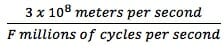
The speed of light in a vacuum (c) is 3 x 10⁸meters per second. The wavelength (λ) for a given frequency (usually referred by ν, but we’ll call f) is defined to be c/λ. Wavelength is the speed of light divided by the frequency. So, the wavelength in meters is:

We only want to know the size of a single cycle for this frequency so we can divide both the numerator and denominator by a million. That makes the numbers much smaller! Wavelength in meters is now:

That is, wavelengths in meters uses this simple formula:

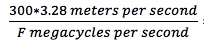
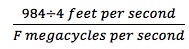
But, we want this in feet (because we’re Americans) so we need to convert meters to feet. One meter is about 3.28 feet. So, convert wavelengths to feet:

which is

But we don’t want a whole wavelength; we want just a quarter of that for our dipole arm. Divide the whole thing by four.

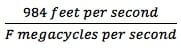
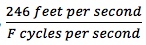
which gives us

Why is this 246 and not 234? This is because we are using the speed of light as the speed of the current in the wire. But, nothing goes as fast as light but light! We need to put in the velocity factor for the wire (which is relative to the speed of light) to know how big a quarter wave is in the wire.

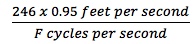
Choose 0.95 as the velocity factor as a guess for most antenna wire. That is, the charge propagates down the wire at about 95% of the speed of light.

which gives us the formula

The formula 234/f isn’t “magic”; it is just a distillation of the simple formula speed-of-light/frequency with all the unit conversions and velocity factor assumptions baked-in.

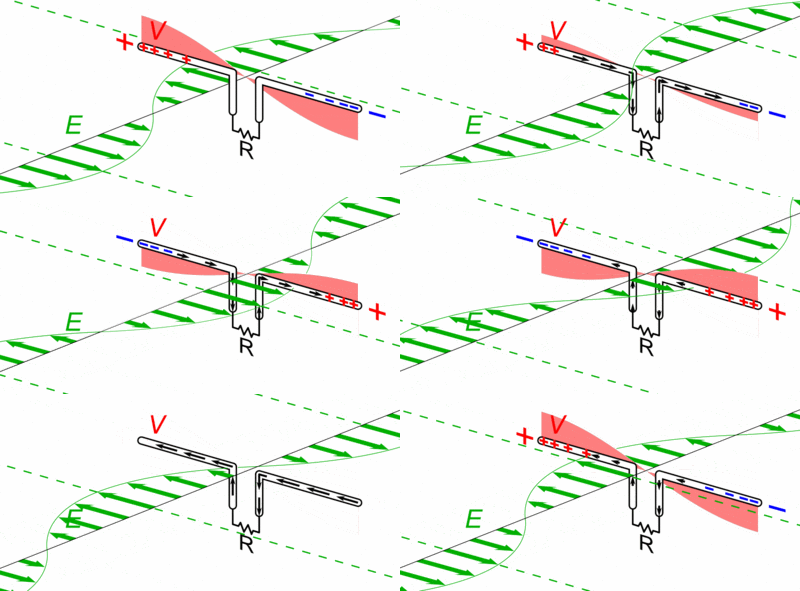
** Dipole animation from wikipedia.org

Posted by Scott, NE1RD

Radio Amateurs Developing Skills Worldwide