All posts by Nashua Area Radio Society

Webmaster for the Nashua Area Radio Society

2018 Club Meeting Retrospective

Regular Club Meetings

The Nashua Area Radio Society (NARS) meets every first Tuesday except in August when there is no meeting. (Note that months where the first Tuesday falls on a holiday the two monthly meetings may be pushed out a week.) The monthly regular meetings typically feature a speaker from outside the club that brings something interesting from the ham radio community, the world of science and technology, or local interest. There is also a January Show-and-Tell meeting, and the Field Day planning and retrospective meetings held in June and July.
Here is a quick run-down of the presentations made to NARS over the last year.

February

Global Ionosphere Radio Observatory
Dr. Ivan Galkin, University of Massachusetts Lowell
We use the ionosphere for HF communications, but did you know that changes to the ionosphere can also affect GPS systems? Dr. Galkin described his groups work creating a system of Ionosonde stations to measure the ionosphere. And all this is done just up the road at the University of Massachusetts, Lowell.

March

Theory and Repair of Astron Power Supplies
George Allison, K1IG
Linear power supplies will eventually fail, but they can be repaired easily if you have a little know-how. George Allison walked through the design and theory of these devices and showed how easy it can be to get a dead unit back on the air.

April

The Current State of the D-Star Evolution
Terry Stader, KA8SCP
The proliferation of digital radio hotspots using Raspberry Pi and Arduino computers has been astounding. Terry Stader walked through some of the advancements of the D-Star ecosystem and other digital radio platforms.

May

MIT Haystack Observatory
Phil Erickson, W1PJE
One of the nation’s premier observatories is located just miles from Nashua. Phil Erickson gave us a virtual tour of the facilities.

September

BITX and µBitX Transceivers
Andy Stewart, KB1OIQ
Ashhar Farhan, VU2ESE, created a very low-cost transceiver that could be constructed by anybody in his native India with commonly sourced parts. The designs became an instant sensation in the QRP radio community. (Farhan was recently inducted into the QRP Hall of Fame.) Andy Stewart gave us a good overview of the BITX and µBITX technologies and even showed us some extensions for the radio to support visually-impaired operators.

October

Working the ISS and Satellites
Fred Kemmerer, AB1OC
Here at the bottom of the solar cycle it is good to broaden your experiences. Fred Kemmerer gave an excellent overview of the basics of satellite communication, including working the International Space Station.

November

Nashua Emergency Coordinator
Justin Kates, KB3JUV
Communications is an important part of any emergency situation planning. Justin Kates briefed club members on the planning and preparation Nashua makes for any emergencies.

December

Plane Tracking with ADS-B
Thomas Kavanaugh, KC1ELF
Most aircraft are now fitted with a system called ADS-B, part of the new system of anticollision technologies. Data is broadcast by each aircraft on 1090 MHz and that data can be received and decoded by a simple ground station you can build on a computer as simple as a Raspberry Pi. Thomas Kavanaugh gave the club an overview of this technology.

Tech Nights

NARS holds a second meeting of the month a week after the club’s regular meeting. “Tech Night” is a chance for club members to exchange ideas and share their knowledge and experiences. Many of these meetings are captured in video and archived on the NARS website https://www.n1fd.org You can access the video collection here https://www.n1fd.org/video-collection/ Remember that you must be logged into the website to have access to these web pages and materials.

January

Building a Mobile HF Station
Fred Kemmerer, AB1OC
Video available

February

Kit building night
Paddlestick touch keyer by K1EL

March

Antenna Modeling I
B. Scott Andersen, NE1RD
Video available

April

Basic Kit Building Techniques
Steven Elliott, K1EL
Video available

May

Portable Operating and Gear
Video available

June

All About Field Day
Video available

July

Raspberry Pi and Ham Radio
Anita Kemmerer, AB1QB and Jamey Finchum, AC1DC
Video available

August

WSJT-X
Fred Kemmerer, AB1OC
Video available

September

DMR Radios and Programming
Bill Barber, NE1B
Video available

October

Frequency Measurement Challenge
George Allison, K1IG
Video available

November

Remote Operation
Fred Kemmerer, AB1OC

December

RTL-SDR workshop
B. Scott Andersen, NE1RD
Club members were encouraged to bring their SDR solutions to the meeting and either seek help from other club members or provide help to those seeking to get their systems running. There were many newly working SDR systems at the end of the evening.

NARS 2018 Meeting Topics

DateMeetingTopicPresenter
JanuaryRegularShow-and-TellClub members
JanuaryTech NightBuilding a Mobile HF StationFred Kemmerer, AB1OC
FebruaryRegularGlobal Ionosphere Radio ObservatoryDr. Ivan Galkin, UMass Lowell
FebruaryTech NightKit Build: Paddlestick Touch KeyerClub members
MarchRegularTheory and Repair of Astron Linear Power SuppliesGeorge Allison, K1IG
MarchTech NightAntenna ModelingB. Scott Andersen, NE1RD
AprilRegularD-Star + Bishop Guertin Robotics teamTerry Stader, KA1SCP, and students from Bishop Guertin High School
AprilTech NightKitsSteven Elliott, K1EL
MayRegularMIT Haystack ObservatoryPhil Erickson, W1PJE
MayTech NightShow and TellClub members
JuneRegularField Day Planning MeetingClub members
JuneTech NightField Day Skill BuilderClub members
JulyRegularField Day RetrospectiveClub members
JulyTech NightRaspberry Pi and Ham RadioAnita Kemmerer, AB1QB, and Jamey Finchum, AC1DC
AugustRegular** No meeting this month **
August Tech NightWSJT-X and FT-8Fred Kemmerer, AB1OC
September RegularBitX40Andy Stewart, KB1OIQ
September Tech NightDMR Radios and ProgrammingBill Barber, NE1B
OctoberRegularISS and SatellitesFred Kemmerer, AB1OC
OctoberTechFrequency Measurement Challenge: Ideas and StrategiesGeorge Allison, K1IG
NovemberRegularNashua Emergency CoordinatorJustin Kates, KB3JUV
NovemberTech NightRemote OperationFred Kemmerer, AB1OC
DecemberRegularPlane Tracking with ADS-BThomas Kavanaugh, KC1ELF
DecemberTech NightRTL-SDR WorkshopClub members

The MFJ-1836H Cobweb antenna for your attic

MFJ-1836 Cobweb Antenna

MFJ-1836 and MFJ-1836H

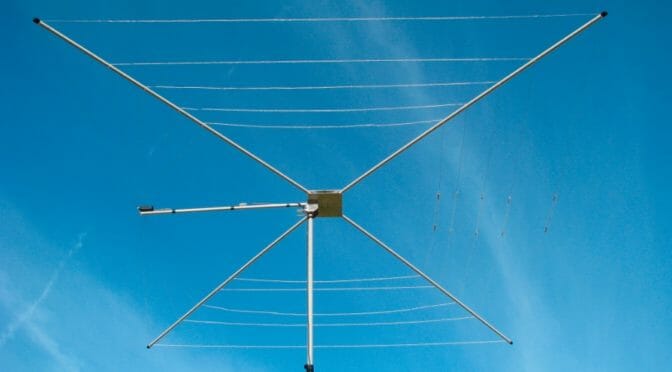
MFJ has created a set of 1/2-wave dipole antennas folded into a square (sort of a cobweb antenna). There are two units that cover 10m-20m. They are the MFJ-1836 ($229.95) that handles power up to 300 W, and the MFJ-1836H ($259.95) that handles up to 1.5 kW. These antennas are roughly 12-feet as measured diagonally across the square they make. (That is, about 9-foot by 9-foot.)

I purchased the high-power version and raised it up 25 feet in my backyard last year. I found its performance to be comparable to the vertical dipole antennas I have erected permanently.

My Original Intent

I originally purchased the antenna to see if it could be adapted to travel. I’d like to go on another lightweight DXpedition someday and I’m always looking for low-cost/low-weight solutions. This antenna weighs under 9 pounds (with the low-power model weighing slightly less than its big brother). Just for reference, the Buddipole Tripod and Mast weigh almost seven pounds and that’s before we add an antenna!

Assembly

Assembly of the antenna is straight-forward. I mounted it on a pipe and stuck it into a deck table’s umbrella hole. That allowed me to put the work at eye level and spin the antenna while I assembled it. That made assembly easy. I’m guessing I spent an hour reading the instructions and routing the wires.

The Wires

This is the only disappointment with the unit: the wires. MFJ used a lightweight stranded wire that is quite fragile with frayed ends. I’ve snapped the outer-most wire (for 20m) twice. If I were to attempt to adapt this antenna for travel it would have to be rewired with something more robust. My first choice would be Wireman model 534 “Invisible Touchcoat ‘Silky’ 26 AWG, 19-strand 40% copper-clad steel” wire. This stuff is tough with a break strength of 25 pounds. If I were to rewire this unit, or more likely purchase another antenna, I would discard the MFJ wires and use this stuff.

Tuning the Antenna

Tuning was straightforward when I used the antenna outside mounted up 25-feet. I just followed the MJF instructions and got a good match on all bands.

Tuning the antenna indoors mounted in my attic was another story.

MFJ-1836H mounted in NE1RD's attic
MFJ-1836H mounted in NE1RD’s attic

This antenna, like nearly all antennas, works best when in the clear. That is, they work best when there is nothing in their near-field (say within 1/2 a wavelength). MFJ recommends the antenna be mounted at least 20-feet off the ground. Mounting this thing in my attic meant my furnace and roof are all within the antenna’s near field.

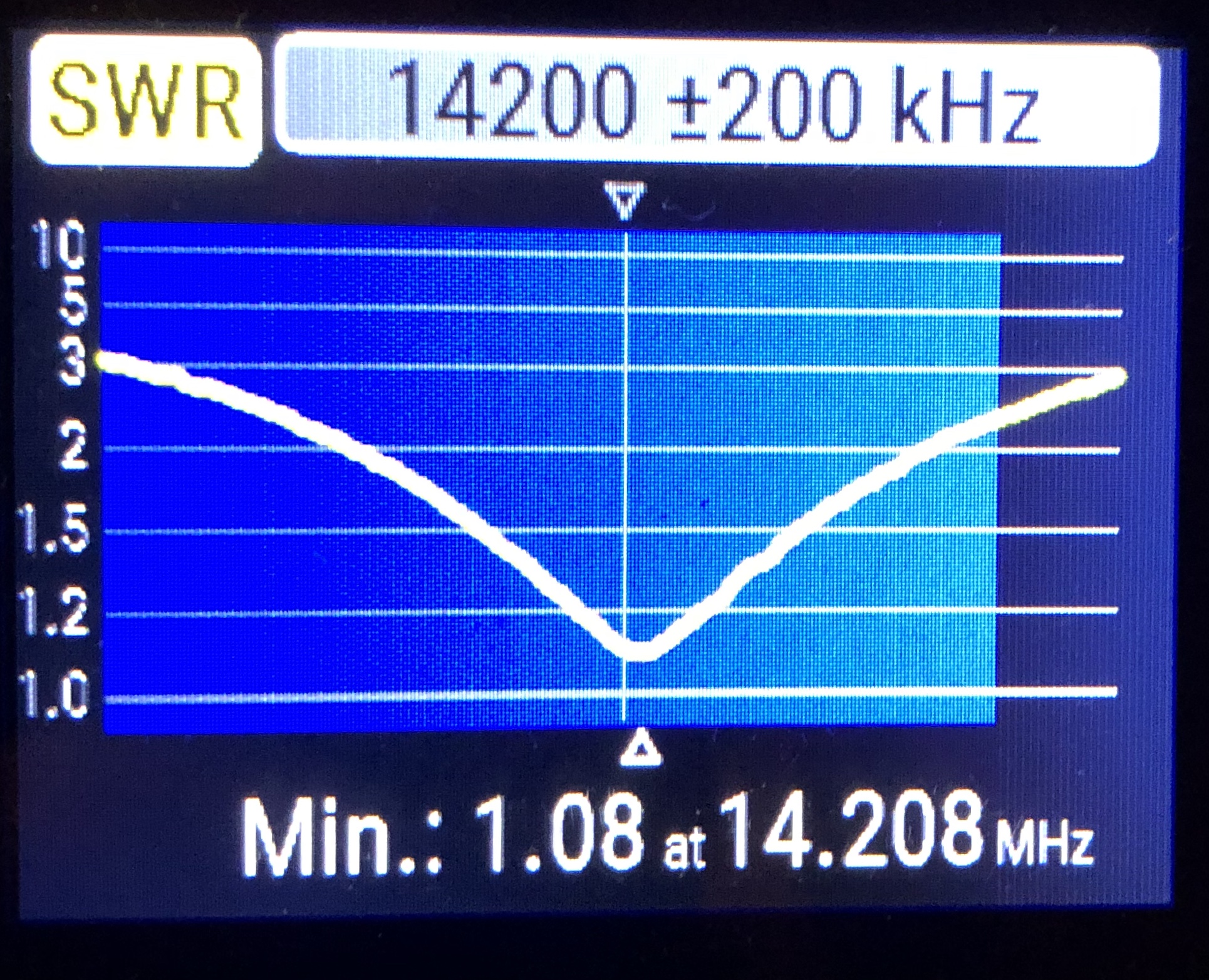
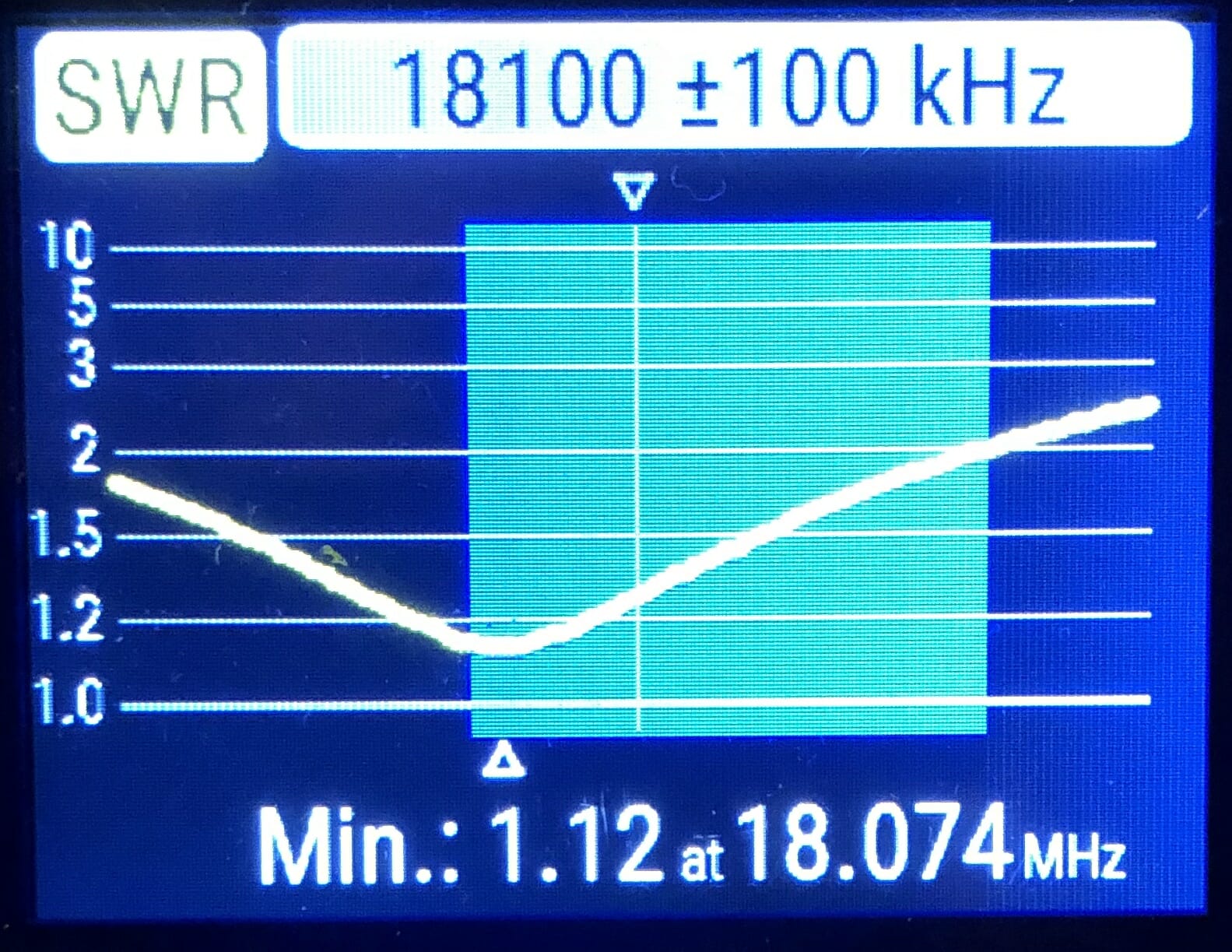
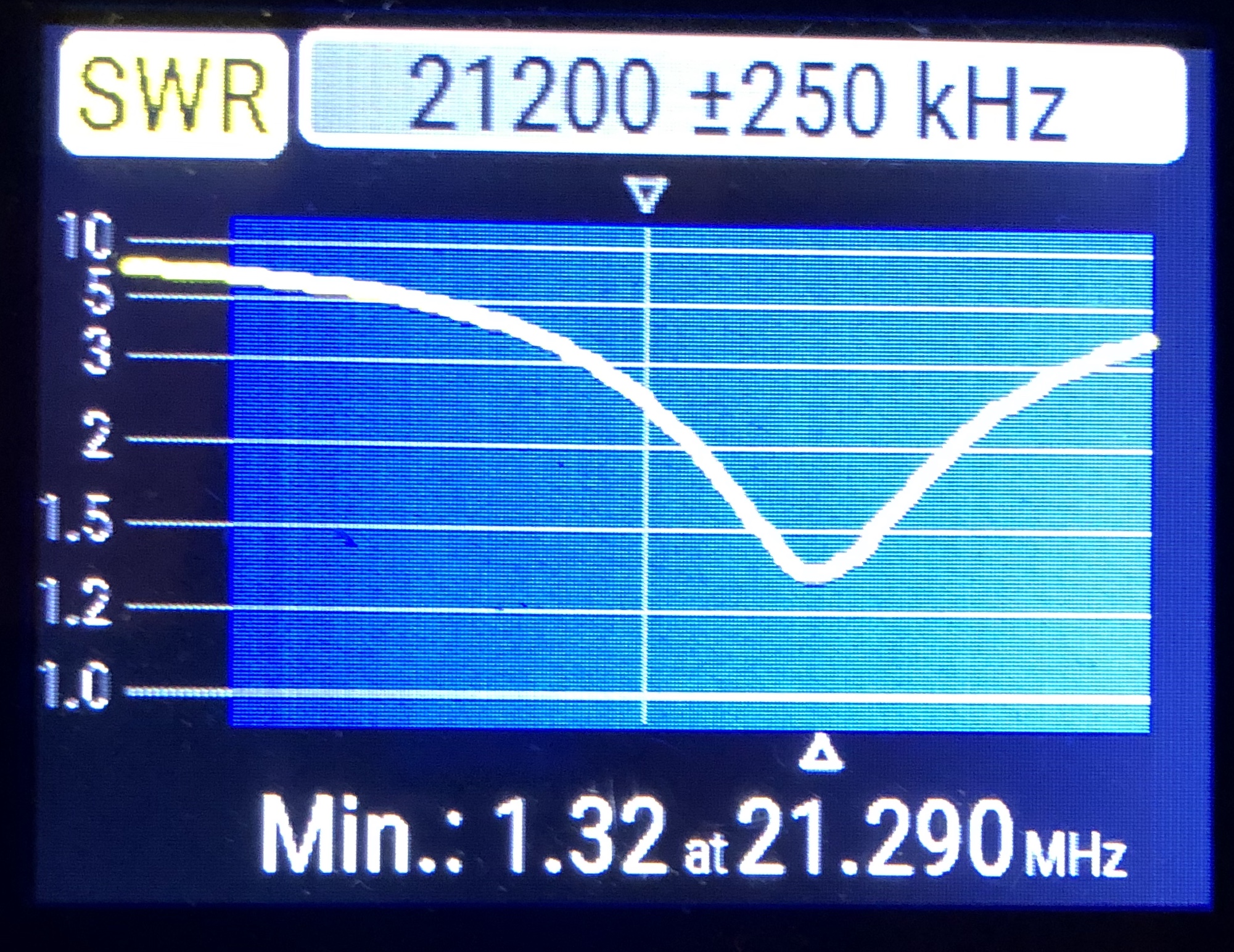
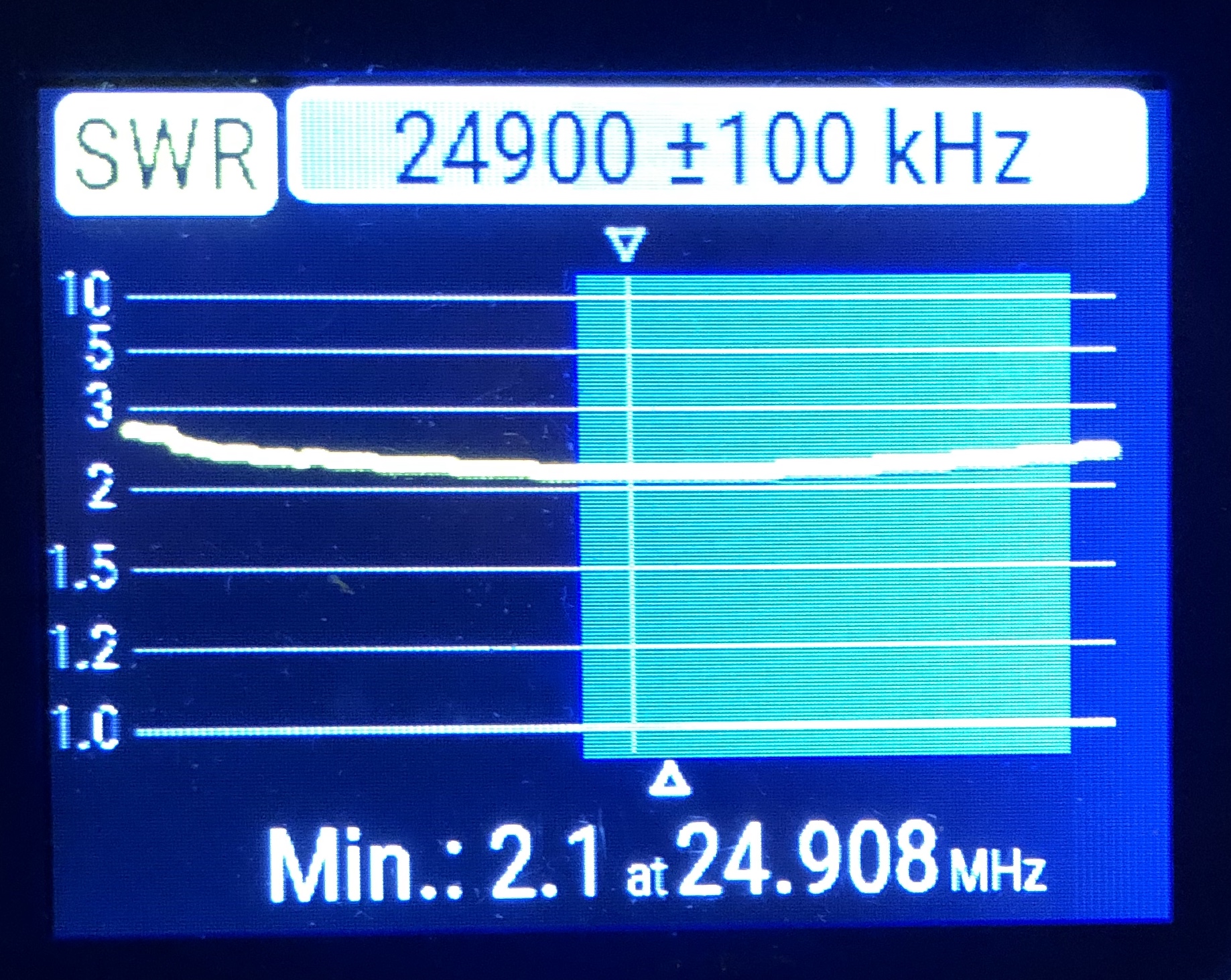
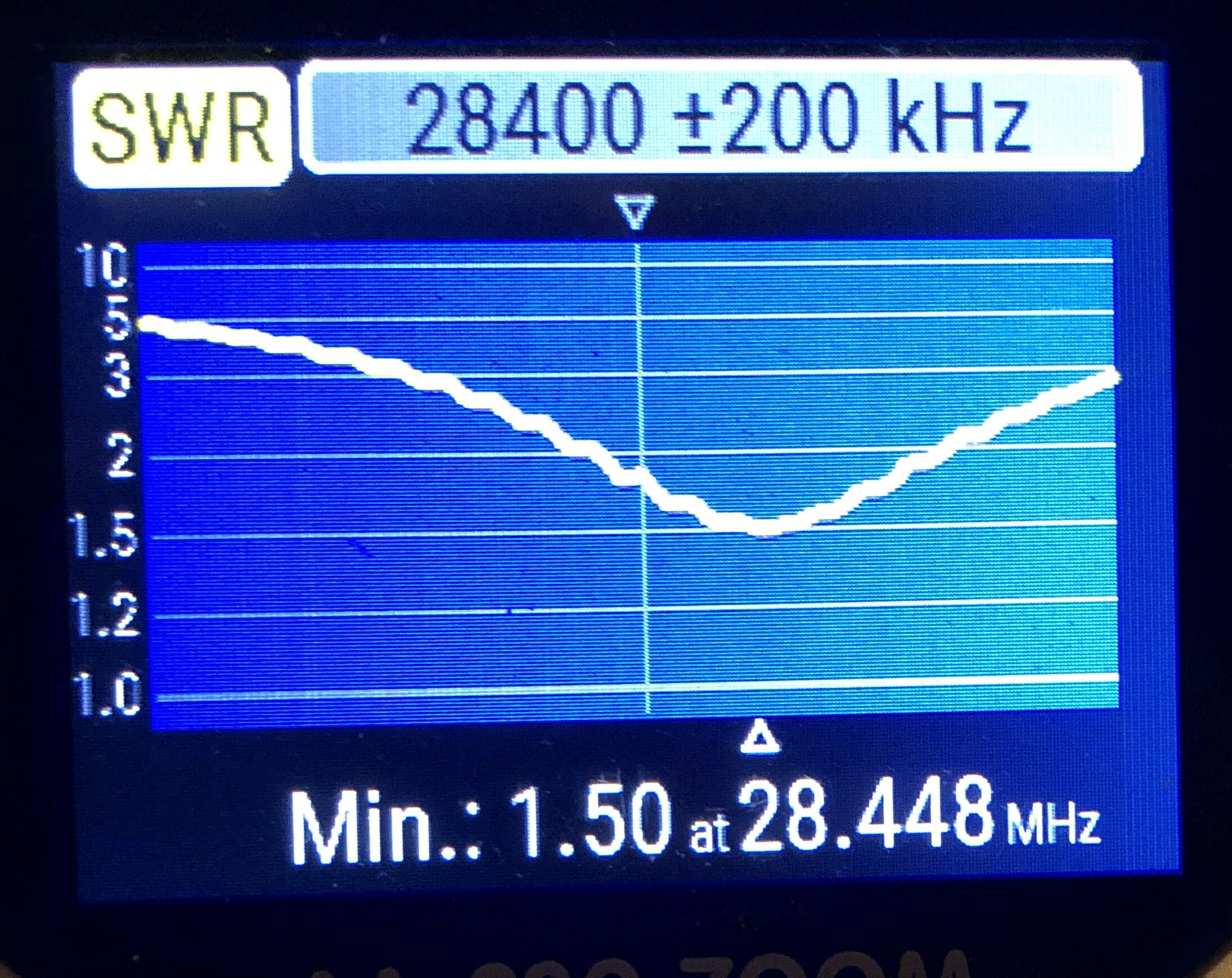
The upshot of this is I had to spend a little extra time adjusting lengths of the antenna wires to make it provide a good match on these five bands. My trusty RigExpert analyzer made the work go quickly. Here are the plots for the installed antenna.

20m SWR
17m SWR
15m SWR
12m SWR
10m SWR

I confess that I could probably do better on all bands except 20m if I were to spend more time adjusting the wires. But this is good enough for now.

HOA and Other Limitations

I spent my first few years in a restrictive environment where it was difficult for me to use outdoor antennas. If you have a large attic and find yourself in a similar situation then this antenna is worth a look. Temper your expectations, though. Remember that in general antennas are better outside than inside, and mounted higher rather than lower (although antennas can be hung too high!). Your antenna’s performance will be some combination of how well you have tuned it, and what kinds of objects are in the antenna’s near-field. Still, any antenna is better than no antenna!

The Big Brother: MFJ-1838

MFJ has a larger offering that covers the 30m and 40m bands. This antenna measures about 20-feet diagonally so you’d need a large attic to hold it. The MFJ-1838 is $399.95.

Wrapping Up

My home office is directly below the MFJ-1836H antenna and I have a small station there usually running an Elecraft KX3 (though some other QRP rigs are often called to duty there). With this antenna, I can now operate on any of five bands without needing to touch an antenna switch (all of which are two floors below my office in the basement!). It should make casual operating in the winter much more enjoyable.

Scott, NE1RD

Doing My Hobby At Work: Conclusion

Past Steps and Summary

In a previous post, I mentioned that myself and Jon Schoenberg AA1FH were teaching MIT Lincoln Laboratory’s first amateur radio course. The Lab strongly encourages professional education. Traditionally, these courses are centered around topics like Stochastic Estimation, Introduction to Electromagnetics, or Radar Principles. These courses tend to be very apropos to people’s day jobs and can sometimes be even more esoteric.

For this course, however, I embarked on something that was a bit more tangential — though relevant — to people’s day jobs. Spoiler alert: The class was a huge success! And I was pretty nervous overall to plan, manage, organize, and teach some of the classes. I remain shocked, stunned, and awed by the outpouring of interest people have for this hobby.

So what happy by-products resulted from this endeavor:

  • 6 people (that I know of so far) obtained their amateur license with 5 doing it through our club.
  • Our own Burns Fisher was a guest lecturer for the amateur satellite portion of the class! (Thanks, Burns!) Looking around the room, his talk noticeably engaged the students.
  • Our Weekly Bulletin featured the Amateur Radio course on the front page! This is excellent for coverage and exposure for when we offer this again in Fall 2019. One of our newly minted hams, KO5TI, had a truly wonderful quote: ““The Amateur Radio course is unique in that it uses learning a popular hobby as a vehicle for presenting relevant technical material. We’ve heard from world class experts on antennas, propagation, digital communications, and electronic design.”
  • We took interested folks from the class on the KC1XX (Matt Strelow) superstation tour to demonstrate what state-of-the-art looks like! This helped to maintain interest and get people excited about their own smaller-scale homebrew projects.
  • We generated enough interest for a part-two spin-off. It looks like it’s going to be a HAB project, ladies and gentlemen. This will be a fun hands-on project to get newly interested people involved in hardware and amateur radio. (But with the added benefit of data collection and analysis). We should have a good degree of success from the vast experience of folks at the Lab.

Next Steps

At work, the Technology Office is sponsoring a Build-Your-Own-X class, where X = (something fun). As an example, a Build-Your-Own-Radar currently exists. In this course, employees learn some radar theory, and then build their own radar, perform calibration, and do some testing on moving objects.

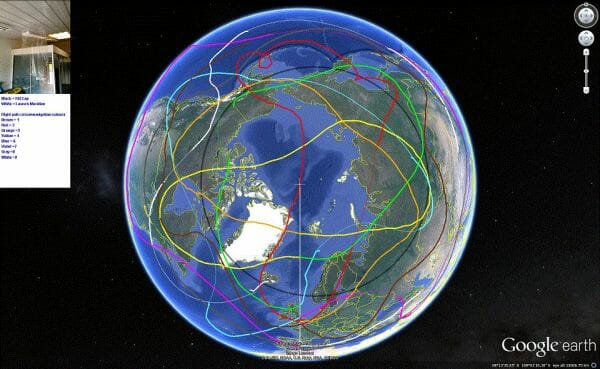
I took a shot and submitted a HABCAR (High-Altitude Balloon Carrying Amateur Radio) proposal. The wrinkle in this (which NARS has not done before) is for the flights to be global circumnavigations using WSPR. You can read a fair amount about this from the QRPLabs website and elsewhere on the web. In particular, M0XER has been quite busy; racking up a maximum number of 8 circumnavigations!

Luckily, many people at work have logged many hours flying and engineering the types of balloons needed for these flights. For instance, one has to use mylar balloons instead of latex since latex breaks down from long-term UV exposure. Additionally, one typically needs to worry about carrying ballast with these balloons. At night, as the air cools, the balloon has to release ballast in order to maintain a constant altitude.

After making a 4 minute elevator pitch, with some Q&A, I recently learned the HABCAR idea made it to the final round on January 18th. So, I need to think through more rigorously what a class built around this would look like in my presentation. I will have to present a Bill of Materials, list the support/help required, and outline the goals for each week of the class. It’s a lot of work. But it’ll be fun. Maybe after this project gets off the ground (pun intended), I can bring the lessons learned to NARS’ continuing STEM program.

Happy flying!

–Brian AB1ZO

Radio Amateurs Developing Skills Worldwide