All posts by Nashua Area Radio Society

Webmaster for the Nashua Area Radio Society

Skywarn Training Report

Late spring brings with it the start of a new severe weather season. As we saw this week in the Dayton area, severe thunderstorms and tornadoes can cause damage and threaten life. The Hara Arena, the former site of Hamvention was destroyed by a tornado.

National Weather Service forecasters track storms carefully using radar and automated weather observations, but their forecasts can be aided by Skywarn reports from trained observers. These eye-witness observations can validate radar data and help forecasters make decisions on whether to issue additional warnings.

I recently attended a Skywarn training session conducted by the Norton, MA National Weather Service office. The class was held at the Milford, MA Fire Department and lasted about two and a half hours.

Rob Macedo (KD1CY), the Norton office’s Skywarn amateur radio coordinator, taught the class with the assistance of an NWS forecaster. Rob started the training with an overview of how often southern New England has severe thunderstorms and tornadoes. He discussed a few of the tornadoes that have occurred in New England, and the role that Skywarn spotters played by informing NWS forecasters of conditions on the ground.

Rob taught that moisture, instability, and lift are the ingredients needed to form a thunderstorm. He also told us about the stages of a thunderstorm, thunderstorm types, and cloud identification.

The instructors spent quite a bit of time on thunderstorm types and cloud identification. Properly identifying clouds is key to spotters providing accurate reports to the forecasters.

The NWS forecaster concluded the training with a discussion on challenges of weather spotting in New England and the criteria for reporting weather phenomena.

This was the fifth time I’ve taken the course over the last 20 years. I was impressed by how the training materials use videos and photographs from New England to help prospective spotters better understand what they’ll see here. My first training I took in the late 1990s was done with a slide projector showing photographs of perfect examples of thunderstorms in the mid-west, things we’d never see here.

Skywarn training is a wonderful opportunity for any weather-lover, and a great way to fulfill our obligation to use amateur radio to benefit the public. Learn more about local Skywarn programs at the NWS Norton office, and at the WX1BOX website.

Brian, W1BP

The RockMite Part 3: The Oscillator

In the first RockMite article, I described the receiver of the radio. I identified the place in the receiver that accepted the output of the oscillator (marked B going into pin 6 of the mixer) but skipped describing the actual oscillator. In this article, we’ll examine the oscillator and how it drives both the receiver and the transmitter.

The RockMite Overall

As a reminder, here is the whole schematic for the RockMite.

Schematic for the RockMite transceiver (from QRPMe.com)

Figure 1. The Schematic for the RockMite Transceiver

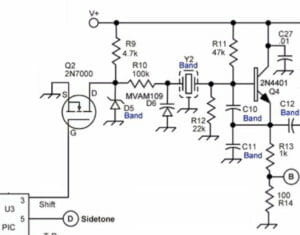
The part of the schematic we need to analyze for this article is near the word “Transmitter” in the big schematic. I’ve cut it down in the next figure (and removed some of the distracting elements).

Figure 2. The RockMite Oscillator

Colpitts Oscillator

The RockMite has within it a Colpitts oscillator. The transistor Q4 is the amplifier and the two capacitors C10 and C11 form the voltage divider. This design employs a crystal (Y2) that is band-dependent, of course, as are C10, C11, and C12. The output of C12 leads to another layer of transistor amplification that enlarges the voltage swing.

Note point B between R13 and R14. This signal leads to the input of the mixer U1 and serves as the beat frequency oscillator (BFO) that detects the received signal.

Silicon Tuning Diodes

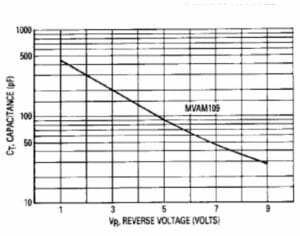
Before I can describe the rest of the circuit I need to introduce a part that I thought was almost magical when I learned about it. The part number for these devices is MVAM109 (in the center of Figure 2). The symbol looks like a cross between a diode and a capacitor. Indeed this is exactly what this part is: a diode and a capacitor combined in a very special way. The varactor (tuning) diode acts like a capacitor, but the capacitance depends on the reverse voltage across the diode. I’ve included a plot from the Motorola data sheet below.

Figure 3. Capacitance versus reverse voltage

You can see that as the reverse voltage goes up the capacitance exhibited by the part goes down. Change the voltage and you change the capacitance. We use this in the part of the circuit described in the next section.

Tuning One of Two Frequencies

The oscillator uses Y2 (a crystal) to help determine the frequency. But, the frequency can be altered by adding or subtracting capacitance. MVAM109 (D6) will be the device that changes the capacitance.

Examine the circuit beginning with Q2 (2N7000). When the transistor is turned on there is a completed circuit between the source and drain (S and D in the diagram). In this case, the source is connected to ground. So, when the transistor is turned on the point in the circuit after D is brought down to zero volts.

Check out R9, a 4.7K Ohm resistor that connects to the drain of Q2, and to a Zener diode D5 (which is also band dependent, as it turns out). The Zener is used as a voltage regulator. Say the Zener is a 3.9-volt model. Since we are connected (through R9) to V+, the voltage at the point where D5 connects to R9 will be limited to 3.9 volts (or whatever the Zener is rated) and R9 is the current limiting resistor. This is assuming the transistor switch Q2 is open (not conducting).

In this situation we have D6 being reverse-biased to the voltage determined by the Zener diode. That much reverse bias will cause the varactor to exhibit some amount of capacitance.

If the switch Q2 is closed (and it conducts) then that point in the circuit is brought down to zero volts and the varactor is no longer reverse biased (or to a voltage below what the D5 part would supply) and we get a completely different capacitance.

The gate of Q2 is controlled by the UI PIC from a line called “Shift”, and it is used to switch between these two frequencies (by turning Q2 on or off). This is how the RockMite offers two different crystal-controlled frequencies with the push of a button.

Next Time

We have already gone through three-quarters of the schematic of the RockMite. Next time, in the last installment, I will walk through the transmitter and the filtering used by the radio.

Links

The RockMite Part 1: The Receiver

The RockMite Part 2: The UI

Scott, NE1RD

June 2019 Contest Notes

The beginning of June marks the unofficial start of Summer. There are still the various state QSO parties you can work (see Contest Calendar dot com), but the weather is finally nice! Wouldn’t you rather get out of your shack and operate in the great outdoors? June is a great month to operate VHF/UHF from a mountaintop, QRP portable from a picnic table, or with your friends on Field Day.

June Contests

ARRL June VHF Contest [1800Z June 8 to 0259Z June 10]

Exchange: Maidenhead grid square (RST is optional)

Go to the top of a mountain with your all-band, all-mode radio. I’ve done VHF contests QRP with an FT-817 (now being sold as the FT-818). These radios are not very economical with your batteries, but since I was driving to the top of the mountains when I did this I could bring all the power I wanted. No problem! Other radios such as the FT-857D offer the same all-band and all-mode features but have 100 watts.

I’ve always been partial to Icom radios (if I can’t use an Elecraft), so the IC-7000 was a go-to radio for me. Same deal with being something of a power-pig. But, if you’re operating from your car then you have no problem.

Finally, if you do have a hankering for Elecraft, the KX-3 can take an internal 2-meter module that allows you to run on both 6m and 2m. If you can’t bring a whole power plant worth of power with you then this is an excellent option.

ARRL Field Day [1800 June 22 to 2100Z June 23]

Exchange: 11A NH (“11 Alpha New Hampshire” on phone)

The NARS club is going all-out (again) this year planning an 11A. There is so much going on for this event that I won’t even try to give you a synopsis here. To catch up go to the Field Day page and see the fine article written by Fred.

I can’t emphasize enough how wonderful Field Day can be to someone a little tentative on the air. Field Day is a very relaxed event, and there will be a whole host of Elmers present that WANT you to get into the game. We will sit with you, explain everything, let you make some contacts, give suggestions and encouragement, and generally have fun because YOU are having fun!

Please come to the June main membership meeting, and the June Tech Night to receive the full orientation. If you can’t make those meetings, no worries. The point of the meetings is to help the members feel comfortable and informed (and safe) during the event. There will be additional instruction before on-air activities begin.

Until next time

This concludes the June contest notes. I hope all of you with a portable radio will try to get outside and make a few contacts. SOTA, POTA, and IOTA all have programs that reward the adventurous. Get out there and get a little sunshine!

Scott, NE1RD

Radio Amateurs Developing Skills Worldwide