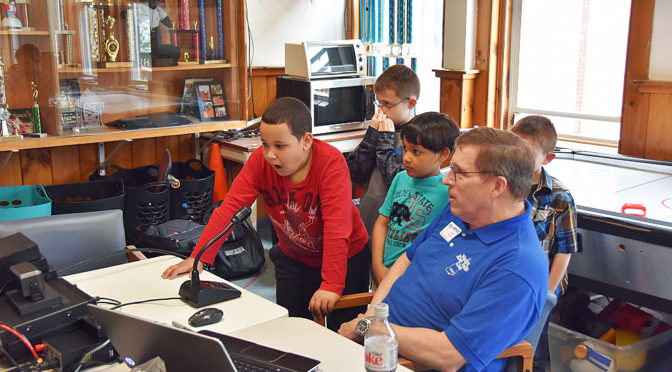
We recently received a request from the Police Athletic League (PAL) in Nashua, NH to put on a Get On The Air (GOTA) demonstration of Amateur Radio for the kids there. The folks at PAL are trying to create activities that promote STEM and Amateur Radio interest among kids.
GOTA Station
Jamey, KC1ENX and I went to PAL a little while back and set up our portable station using the screwdriver antenna on my truck.
Kids on the Air at Nashua PAL
We had some of the worst propagation conditions that we have seen in a while on the day we were at PAL, Fortunately, Mike, K1WVO got on to try to give the kids a few contacts.
QSL Cards
We also brought some QSL cards and Jamey spent some time with the kids explaining QSLs and some of the places that were contacted.
HAB and Foxes
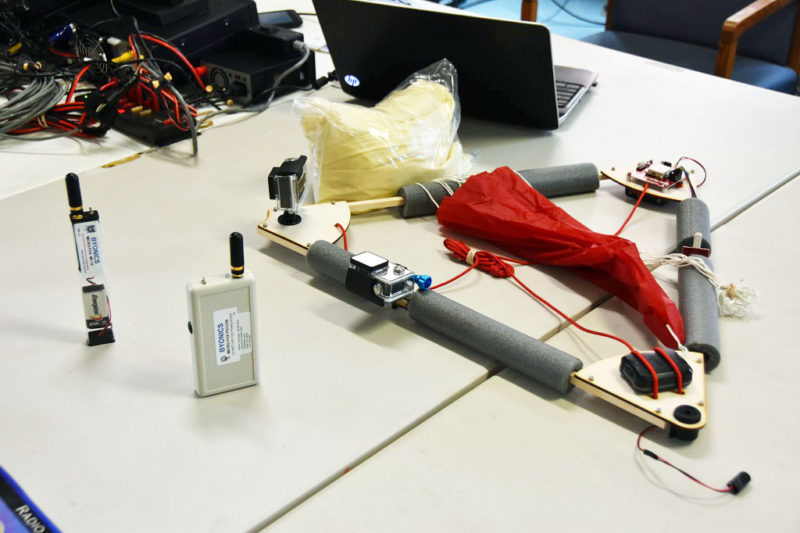
We also brought our High Altitude Balloon (HAB) and our 2m Fox Hunt transmitters for the kids to see. There was lots of interest in the HAB platform and what it would be like to see the video that it will record.
Due to the poor propagation conditions, the kids did not get to make many contacts. The folks at PAL invited us to come back another time when the conditions are better and we plan to do that later this summer. We also invited the PAL folks to visit us during our Field Day operation coming up and try out the GOTA station there.
Special thanks to Jamey, Matt, and Mike for helping us with our GOTA event at PAL.
We have been working with teachers from several local schools to create a STEM learning curriculum to help the students involved in our HAB project learn about the science associated with our High Altitude Balloon (HAB) Project.
Merrimack High School HAB Project Students and their Teacher
Our club’s HAB team has prepared materials for and delivered a series of five classroom sessions to each group of students. These sessions have included material on the Atmosphere, the Physics of HAB Flight, and the Radio Technologies (APRS and GPS) used on the HAB.
Bishop-Guertin High School HAB Project Students and their Teachers
We have also shared this material with a group of students who are not part of the two high schools that we are working with on the HAB project.
Additional HAB Project Students, Parents, and Club HAB Team Members
Altogether, we have 13 students involved in our HAB project. The students and their teachers have given us high marks for the STEM learning aspect of the project to date. Here is a sample of the feedback that we have received from the faculty members at the schools who are involved in the project:
I think you did a great job today. I was very impressed with your presentation, the clarity of the material you presented to the students and how well organized your power point was: Simple and to the point. Thank you so much for taking the time to come. … I am excited to see and hear more next week. It is evident that you have a true passion for it and that is conveyed to the students.
Once again, Thank you for the thought-provoking presentation. The students left excited to see your radio station at open house and eager to launch the HAB!
We got together to assemble and test the HAB platform a few weeks back. We did this to ensure that all of the components worked as intended and to determine the actual weight of the platform so we could estimate the HAB’s performance and flight path.
HAB Flight Platform
The platform includes GPS receivers, a flight computer to record location, speed and atmospheric temperature and pressure data, a 2M APRS transmitter to send telemetry data to the ground during the HAB’s flight, and two GoPro video cameras to record video during the flight. All of these systems are working well and the HAB platform is ready for flight. We have also secured the required Helium for our launch.
Balloon Performance Calculator
We have introduced the students to online calculators which they have used to predict the performance of our HAB. The calculator shown above was used to estimate the HAB’s maximum altitude (31,290 m or about 102,600 ft) and how much Helium we will need for the flight.
Jetstream Forecast
The students also learned about the various layers in the atmosphere and how the conditions there will affect the flight path of our HAB.
HAB Flight Path Prediction
We have helped the students use another online calculator which is used to predict our HAB’s flight path. These predictions are only valid about 5 days in advance of the flight and the flight path varies considerably based upon the daily changes in Jetstream conditions. As you can see from the prediction above, we will need to select a launch location in western Vermont or Massachusetts to avoid the risk of our HAB landing in the ocean.
We will be gathering all of the students together for an HAB and Amateur Radio Open House before our launch. The open house activities will include some hands-on work with the flight computer and radio equipment on our HAB, a chance to Get On The Air, learn about Amateur Radio Satellites, and participate in a Fox Hunt.
We are planning to launch our HAB in May from a location near Bennington, Vt. It will be possible to track the HAB while it is in flight via this link to APRS.fi.
We’d like to thank all of our donors for providing us with the funding for our HAB project. Also, a special thanks to all of our club members who have worked on the project and the preparation and delivery of the STEM classroom materials:
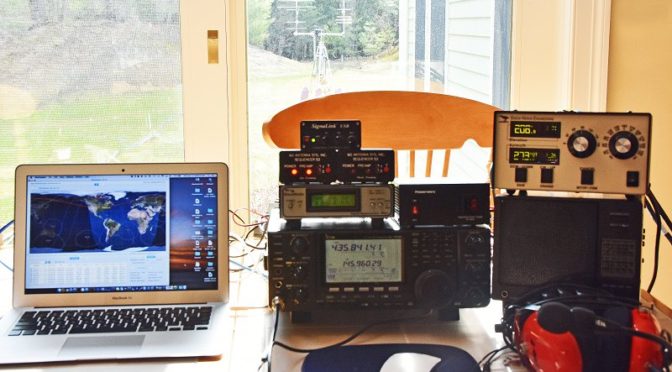
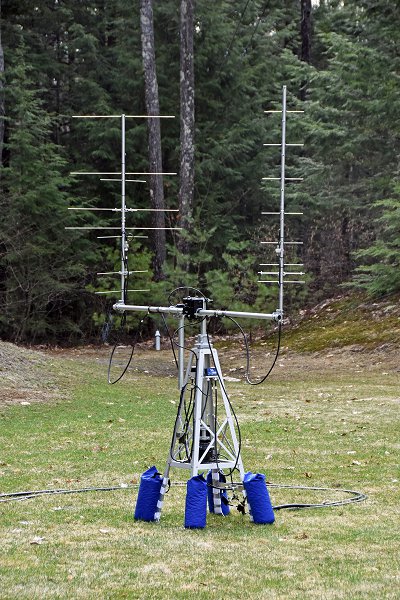
We decided to set up the station in our back yard about a week ago. The idea was to spend some more time learning to operate the station and to improve our satellite operating skills.
The past week has been a productive one. Here are some stats for our satellite operations during the last 7 days –
Contacts Made: 78
Modes Used: SSB Phone, FM Phone, CW and Packet (APRS FM)
Satellites Worked – 9 Total plus the ISS: AO-7, AO-85, ARISS (International Space Station), FO-29, SO-50, XW-2A, XW-2B, XW-2C, XW-2D, and XW-2F
States Worked: 23
Grids Worked: 49
The week began with a visit from Curtis, N1CMD who has quite a bit of experience with Digital Packet operation via the digipeater on the ISS. After some experimentation, Curtis helped me to find a setup using a SignaLink Sound Card and a second, windows computer that works well for Packet QSOs. I tested the setup using the terrestrial APRS network to get all of the hardware and software working correctly. The combination was then used to make a first packet contact using the ISS.
Operational LEO Satellites
The LEO satellites which are currently operational support a mix of split band modes. All of the satellites that we’ve worked so far use either 2M/70cm or 70cm/2M up and downlinks. The satellites support a variety of operating modes including via single channel FM, linear transponders, and APRS packet systems. Operating skills such as proper adjustment of up and downlink frequencies, Tx power management and setup of the digital packet system have been at least partially mastered this past week.
There are a great bunch of folks who are regulars on the satellites and we have made some new friends in our short time operating through satellites. The single channel FM satellites are usually too busy to support rag-chewing. The linear transponder satellites (there are many of these) support several conversations at the same time and we have had some nice rag-chew sessions on these birds.
There is also a good bit of DX to be had via satellites. This past week we have worked Patrick, FJ/N2IEN in Saint Barthelemy; Chris, 9Y4D in Trinidad and Tobago; Burt, FG8OJ in Guadeloupe; Fausto, HC9VF in Ecuador; and several stations in Canada.
We are planning to set up our portable satellite station at Field Day this year. Curtis will be the main operator/station master for our satellite station. If you are interested in learning more about satellite operations, please let Curtis or I know and we’ll help you to learn more during Field Day 2017.
We use cookies to ensure that we give you the best experience on our website. If you continue to use this site we will assume that you are happy with it.