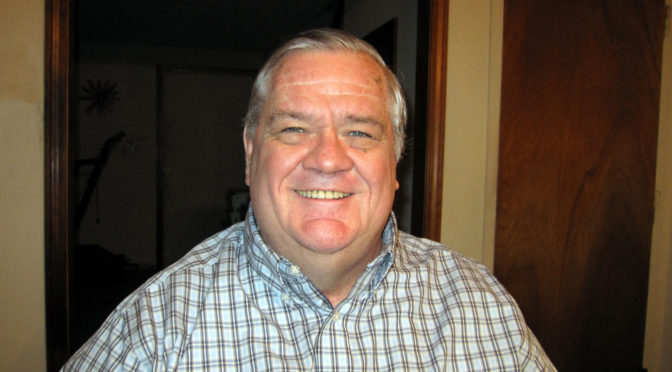
Name: Francis A. Swiech
Elected Club Offices: Former Vice President and Former Secretary of the Nashua Area Radio Club
Appointed Club Office: Currently a member of the Nashua Area Radio Club Audit Committee
Call Sign: N1DGQ (licensed 32 years, since November 1984)
License Class: Extra
Current Age: 72 (April, 2017 – first licensed at age 40)
How I Became Licensed:
I was always interested in ham radio. When I was in the seventh grade, I visited the Novice station of a ham radio operator about my age. He had a Heathkit DX 40 transmitter and a Hallicrafters receiver. He operated crystal controlled on 40 meters CW. Since I did not know the International Morse code, his demonstration CW QSO did not mean too much to me. I did, however, get to see some of the interesting QSL cards he had collected. A few years later, when I was in high school, my parents bought me a Hallicrafters SX-99 receiver. This gave me the opportunity to explore short-wave radio listening, log distant broadcast band AM radio stations, and listen to many ham radio QSOs. At that time the sunspot cycle was at its peak, 10 meters was open, and many hams were still using AM. The Hallicrafters SX-99 was not a single side band (SSB) receiver, but I could copy SSB signals by switching the radio to the CW mode and adjusting the beat frequency oscillator (BFO).
Many years went by, and I continued to enjoy listening to short-wave broadcasts, ham QSOs on the high frequency (HF) bands, distant AM broadcast band stations, and 2 meter repeaters on a scanner. However, I did not pursue getting a ham radio license because of the code requirement that existed at the time. Sometime in 1983 or 1984, I attended a ham radio picnic, sponsored by John Fryer (WA1THH – Silent Key) and the Nightly Nut Net at Greeley Park in Nashua. At that picnic I met two older women who were grandmothers and also ham radio operators. Listening to them talk, it became evident to me that I was smarter than these grandmothers. If they could learn the code and get a ham radio license, so could I.
In June of 1984, on a local repeater, I heard that the Nashua Area Radio Club (NARC) Field Day was being held at Sanders Corporation on Spit Brook Road, so I went to visit and inquire about becoming a ham. I met the NARC President, Bill Burden (WB1BRE), who advised me to buy an ARRL Tune in the World book with a 5 WPM code practice cassette tape, and to learn the code over the summer. NARC, specifically Maurice Cote (K1HDO – Silent Key), would be giving a ham radio and code class in the fall. It so happened, that Maurice knew me. He was one of the Project Engineers who worked on a microwave switch Research and Development contract that I managed when I was in the Air Force, assigned to the Air Force Avionics Laboratory at Wright Patterson AFB, Ohio. Anyway, by the time the code class had begun, I had already learned to copy the code at a very basic level from the Tune in the World code practice tape. Maurice invited me to his house to see his ham station and to give me some additional code practice. He also put me in contact with the hams, who were giving one of the first Volunteer Exams at the ARRL New England Convention in Boxborough, MA that fall. I made an appointment, and took the exam. At that time walk-in candidates for the exam were not permitted. After I had passed the 5 WPM code test, I was given the Novice written exam. I explained that I did not want a Novice license, I wanted a Technician license and I needed the General written exam. At that time there was no separate Technician written exam. I was told that I had to first pass the Novice written exam before I could take the General written exam. I had not understood this, and I had only glanced at the Novice test questions. Fortunately, however, I passed both the Novice and the General written exams. In November 1984 I received my N1DGQ call sign and Technician license in the mail. With further code practice, mostly listening to a 13 WPM code tape and listening to the ARRL CW bulletins, I upgraded to Advanced and then to Extra in about three years.
Other Hams in Family: None
My Elmer: Dave Shaw (K1BXZ – Silent Key) was my CW Elmer. He encouraged me to practice using the code and to upgrade my code speed. He and I would have local CW practice QSOs on 15 meters, and sometimes on two meters FM using code oscillators.
How Often Do I Operate: Most every day
Bands I Operate: 2 meters, 220 MHz and 440 MHz FM, mostly repeaters. I live in a condominium and I have antenna restrictions, which limit my ability to operate on the HF bands.
Types of Operation: Ragchew
My Station: Sparse
Do I Build Equipment: Very little, mostly J-pole, 2 meter antennas made from 300 ohm TV twin lead wire.
Other Ham Radio Activities:
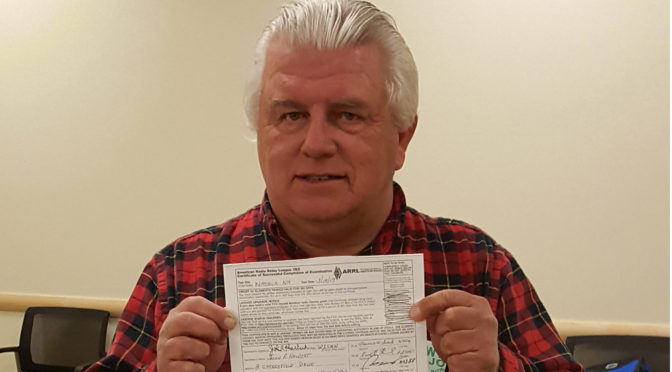
Volunteer Examiner: I am a Volunteer Examiner with the ARRL and also W5YI. I regularly assist in administering the Amateur Radio Exams in Nashua, NH and elsewhere as needed.
Former Database Manager and Member of the Staff of the New England Repeater Directory: I gather information about New England amateur radio repeaters. With inputs from others, I used to maintain and update the database for the New England Repeater Directory, until when a new daily automated update system was implemented. Richard (W1RJC) maintains this Directory on his website, http://www.nerepeaters.com/ . This activity originally got started after I got a 220 MHz radio and jotted down a list of local 220 MHz repeaters on a single sheet of paper. From there this list grew to a larger list of repeaters on various bands, maintained with a word processor using a Commodore 64 computer. It has now become a web site of its own.
Has Ham Radio Influenced My Profession?: No. I am retired from the Air Force and did not get licensed until near the end of my Air Force career.
Other Hobbies: I enjoy hiking local trails and small hills. I walk very slowly, steadily and carefully, especially downhill. I do not sleep outdoors overnight; I want to come home and sleep in my own bed. I sometimes take a handheld radio and a spare battery with me when I go hiking, especially if I plan to climb a hill. When I reach the top of the hill, I check the repeaters on the 2 meter, 220 MHz and 440 MHz bands to see which ones are actually on the air. I use the information I gather to update the New England Repeater Directory. But the most important thing I get from hiking is the exercise.
Frank, N1DGQ